




CBSE Class 10 exam gap preparation strategy 2027 means using the days between papers for subject-wise revision, not for fresh chapters. The CBSE Class 10 date sheet 2027 starts on February 16, 2027.
- Gaps of 4 to 5 dates separate most major papers. Revise one subject at a time, solve one timed paper per subject, and keep the last 24 hours for light revision and rest.
- Mathematics to Science has 4 free days, Science to English has 3, English to Hindi has 4, and Hindi to Social Science has 4 free days.
- Start each gap by reviewing your mistake notebook and prioritising chapters where you previously lost marks.
- Use the initial days for unit-wise revision, the second-last day for a timed sample paper, and the final day for correcting errors and revising short notes.
- Avoid New Topics in the Last 24 Hours. Revise formula sheets, diagrams, keywords and mistake notes. Pack your exam kit and get 7–8 hours of sleep.
Related Links:
- CBSE Class 10 Sample Papers with Solutions 2027: Download PDF, Check Difficulty Level and PYQs
- CBSE Class 10 Exam Pattern 2027: Subject-wise Marks, Question Types & Marking Scheme
- CBSE Class 10 Question Paper 2026(Available): Download PDF & Check CBSE PYQs with Solution
Key Summary
- The CBSE Class 10 date sheet 2027 places Mathematics on February 17, Science on February 22, English on February 26, Hindi on March 3 and Social Science on March 8.
- Mathematics comes one day after the first paper (Painting, February 16), so Maths revision and mocks must finish before the board exams begin.
- A gap of 5 dates leaves 4 free days, and a gap of 4 dates leaves 3 free days. Plan by free days, not by the difference in dates.
- Spend each gap on weak chapters from the mistake notebook, one timed sample paper and short formula or keyword sheets.
- In the last 24 hours, revise only notes, pack the exam kit and sleep on time.
CBSE Class 10 Date Sheet 2027
The CBSE Class 10 board exam date sheet 2027 spreads the five major academic subjects across February and March. Check your subject code before planning, as the date depends on it.
- Mathematics: Both Standard (041) and Basic (241) are on February 17, one day after the first paper.
- Science: February 22, which leaves 4 free days after Mathematics.
- English: February 26 for both English papers, with 3 free days after Science.
- Hindi: March 3 for Course A and Course B, with 4 free days after English.
- Social Science: March 8, with 4 free days after Hindi.
- Gap rule: The gap is the difference between exam dates, not the number of full preparation days.
| Date and Day | Subject Code | Subject |
|---|---|---|
| February 16, 2027 (Tuesday) | 049 | Painting |
| February 17, 2027 (Wednesday) | 041 / 241 | Mathematics (Standard and Basic) |
| February 19, 2027 (Friday) | 064 | Home Science |
| February 22, 2027 (Monday) | 086 | Science |
| February 24, 2027 (Wednesday) | 165 / 402 / 417 | Computer Applications / IT / Artificial Intelligence |
| February 26, 2027 (Friday) | 101 / 184 | English (Communicative / Language and Literature) |
| March 1, 2027 (Monday) | 122 | Sanskrit |
| March 3, 2027 (Wednesday) | 002 / 085 | Hindi (Course A and Course B) |
| March 8, 2027 (Monday) | 087 | Social Science |
| Gap Between Major Papers | Difference in Dates | Free Days |
|---|---|---|
| Mathematics to Science | 5 | 4 (Feb 18-21) |
| Science to English | 4 | 3 (Feb 23-25) |
| English to Hindi | 5 | 4 (Feb 27-Mar 2) |
| Hindi to Social Science | 5 | 4 (Mar 4-7) |
Ques. What is the CBSE Class 10 date sheet 2027?
Ans. Major papers are Mathematics on February 17, Science on February 22, English on February 26, Hindi on March 3 and Social Science on March 8, all from 10:30 AM to 1:30 PM.
Ques. When is the CBSE 2027 board exam date for Class 10 Mathematics?
Ans. February 17, 2027, for both Standard (041) and Basic (241).
Also Check:
- CBSE Class 10 Sample Papers with Solutions 2027: Download PDF, Check Difficulty Level and PYQs
- CBSE Class 10 Previous Year Question Paper: Sample Papers with Solutions, Download PDF & Check CBSE Previous Year Question Papers with Solution
CBSE Class 10 Exam Gap Preparation Strategy 2027: How to Use the Gap
The CBSE Class 10 exam strategy for the gap is to use it for revision and timed practice, not for new chapters. Fix your plan around the free days from the table above.
- Day 1: Revise the weakest chapters from your mistake notebook.
- Middle days: Cover the remaining units and solve previous-year questions.
- Second last day: Solve one timed paper from the CBSE sample paper 2026-27 for Class 10 and grade it with the marking scheme.
- Last day: Fix the errors found in that paper and revise short notes.
| Free Days | Suggested Use |
|---|---|
| 3 days |
|
| 4 days |
|
Ques. How to use the gap between CBSE Class 10 exams?
Ans. Revise weak chapters first, solve one timed sample paper, grade it with the marking scheme and spend the last day on error fixes.
Ques. Should I study new chapters during the exam gap?
Ans. No. Revise what is already covered. New topics at this stage reduce confidence and take time from revision.
- How to Use CBSE Class 10 Sample Papers in Your Preparation?
- CBSE Class 10 Syllabus 2027: Subject-wise Topics, Deleted Chapters and PDF Download
How to Revise Each Subject in 1-2 Days?
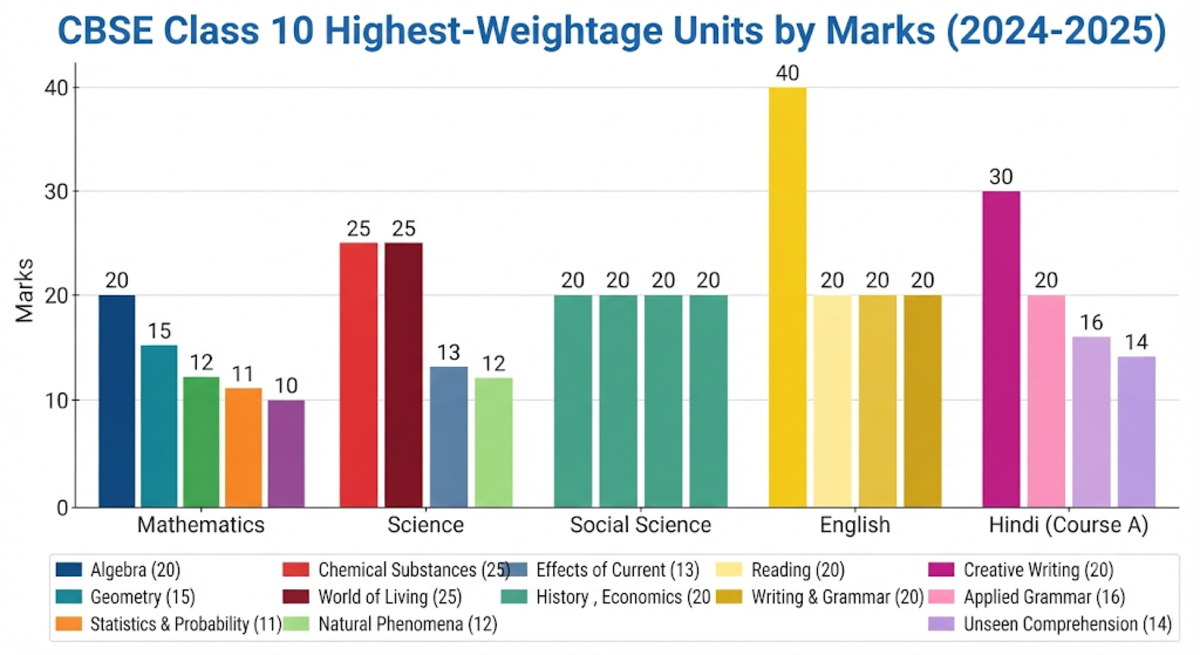
If only 1-2 days are available for a subject, revise by marks weightage and by your own errors. Skip low-weightage topics you already know.
- Start with the mistake notebook: Revise the chapters where marks were lost in earlier papers.
- Use one resource per subject: NCERT and your own notes only.
- Prioritise high-weightage units: Use the unit-wise marks of the sample paper 2026-27.
- Write, do not read: Rewrite formulas, equations and keywords on one sheet per subject.
- End with one timed paper or section: In a 1-day gap, solve one section instead of a full paper.
| Subject | Highest-Weightage Units (Marks) |
|---|---|
| Mathematics |
|
| Science |
|
| Social Science |
|
| English |
|
| Hindi (Course A) |
|
Ques. How to revise each subject in 1-2 days?
Ans. Start with weak chapters, cover the highest-weightage units, make a one-page formula or keyword sheet and solve one timed paper or section.
Ques. How many chapters can be revised in one day?
Ans. Plan by unit, not by chapter. For example, one Science unit or one Social Science subject per day.
- CBSE Class 10 Exam Date 2027: Exam Starts Feb 16, Practical exams start 1st January, Exam Schedule, Registration and Admit Card Dates
- CBSE Class 10 Science Question Paper Available- Download Previous Year Papers with Solutions (2025-2020)
CBSE Class 10 Exam Gap Preparation Strategy for Maths
Mathematics is the first major paper, on February 17, so the real gap is the time before February 16. Complete the syllabus and mock tests before the boards begin. The 4 free days after it go to Science.
- Before Feb 16: Finish the syllabus, NCERT exercises and at least 8-10 papers, as Maths needs the most practice.
- Revise by marks: Algebra and Geometry carry 35 of 80 marks.
- Formula sheet: List formulas for Trigonometry, Mensuration and Statistics on one page.
- Case-study questions: Practise reading the data first, then picking the formula.
- Time plan: Cap Section A (MCQs) at 25 minutes.
| Day Before Maths | Task |
|---|---|
| Day 1 | Algebra and Number Systems |
| Day 2 | Geometry, Coordinate Geometry and Trigonometry |
| Day 3 | Mensuration, Statistics and Probability |
| Day 4 | One timed paper, then error fixes |
Ques. How to prepare for CBSE Class 10 Maths in the last few days?
Ans. Revise Algebra and Geometry first, practise formulas and case-study questions, and solve one timed sample paper.
Ques. Is Maths Standard or Basic revision different?
Ans. Solve the sample paper of the course you opted for, and use the same date (February 17) for planning.
This YouTube video by the channel “Shobhit Nirwan” analyzes the recently released CBSE 2026-27 mathematics sample paper. The discussion evaluates the difficulty level of the provided questions and offers guidance on how students should structure their preparation for the actual board paper format.
CBSE Class 10 Exam Gap Preparation Strategy for Science
Science is on February 22, with 4 free days after Mathematics. Divide the gap by discipline and keep one day for a timed paper.
- Chemistry: Balanced equations with physical states, reaction types and acid-base-salt properties.
- Biology: Underline NCERT keywords and practise neat, labelled pencil diagrams.
- Physics: Write the formula, substitute with SI units, and revise ray and circuit diagrams.
- Numericals: Solve a few from Electricity and Light each day.
- Experiment-based questions: Practise setups, observations and conclusions, since Science questions are experiment- and diagram-heavy.
- Order of attempt (to practise): Biology, Chemistry, then Physics numericals, or follow the paper sequence.
| Day | Task |
|---|---|
| Day 1 | Chemical Substances: equations, reactions, acids, bases, salts |
| Day 2 | World of Living: Biology diagrams and keywords |
| Day 3 | Natural Phenomena and Effects of Current: numericals and ray and circuit diagrams |
| Day 4 | One timed paper, then error fixes |
Ques. How to prepare for CBSE Class 10 Science in 4 days?
Ans. Take one discipline per day, practise diagrams and numericals, and solve one timed sample paper on the last full day.
Ques. Which Science units carry the most marks?
Ans. Chemical Substances and World of Living, with 25 marks each.
CBSE Class 10 Sample Papers 2027
Check out the CBSE Class 10 Sample Papers with Solutions 2026-27 below:
| Subject | Sample Paper |
|---|---|
| English (Language & Literature) | Download PDF |
| English (Communicative) | Download PDF |
| Hindi A | Download PDF |
| Hindi B | Download PDF |
| Mathematics (Basic) | Download PDF |
| Mathematics (Standard) | Download PDF |
| Science | Download PDF |
| Social Science | Download PDF |
CBSE Class 10 Exam Gap Preparation Strategy for Social Science
Social Science is the last major paper, on March 8, with 4 free days after Hindi. The four units carry 20 marks each, so divide time equally.
- One unit per day: History, Geography, Political Science, and Economics.
- Point-wise answers: Write 3 points for 3-mark answers and 5 points for 5-mark answers. Underline NCERT terms in every answer.
- Map work: Practise locating and labelling every day for 20 minutes. Write the question number and location name.
| Day | Task |
|---|---|
| Day 1 | History: events, dates, movements |
| Day 2 | Geography: resources, agriculture, industries, map work |
| Day 3 | Political Science and Economics: concepts, definitions, data questions |
| Day 4 | One timed paper, map practice and error fixes |
Ques. How to prepare for CBSE Class 10 Social Science in the exam gap?
Ans. Revise one unit per day, write point-wise answers with NCERT keywords, and practise map work daily.
Ques. Is map work important in the Social Science paper?
Ans. Yes. Map work is a separate section, so practise it every day and mention the question number and location name.
CBSE Class 10 Exam Gap Preparation Strategy for English and Hindi
English is on February 26 and Hindi on March 3. Both are language papers, so the gap should go to writing formats, unseen passages and literature answers.
- English Reading (20 marks): Solve one discursive and one case-based passage in the time limit.
- English Writing and Grammar (20 marks): Revise the formal letter (100-120 words), the analytical paragraph and grammar (tenses, modals, determiners, subject-verb concord, reported speech).
- English Literature (40 marks): Revise chapter and poem names, authors and key references from First Flight and Footprints Without Feet.
- Hindi grammar and unseen: Practise Apathit Bodh and Vyakaran first.
- Hindi writing: Revise Sandesh Lekhan, Vigyaapan and Suchna formats. Avoid matra and spelling errors.
| Paper | Gap Plan |
|---|---|
| English (3 free days after Science) |
|
| Hindi (4 free days after English) |
|
Ques. How to prepare for CBSE Class 10 English in the gap?
Ans. Practise passages, formal letter and analytical paragraph formats, and revise literature references with chapter and author names.
Ques. How to prepare for CBSE Class 10 Hindi in the gap?
Ans. Start with unseen passages and grammar, then revise textbook answers and the prescribed writing formats.
Official CBSE Class 10 Subject-wise Syllabus PDF Download
| Subject | Official PDF Download |
|---|---|
| Mathematics: Standard (Code 041) / Basic (Code 241) | Download CBSE Class 10 Maths Syllabus PDF |
| Social Science (Code 087) | Download CBSE Class 10 Social Science Syllabus PDF |
| Science (Code 086) | Download CBSE Class 10 Science Syllabus PDF |
| English Language and Literature (Code 184) | Download CBSE Class 10 English Syllabus PDF |
| Hindi A (Code 002) / Hindi B (Code 085) | Download CBSE Class 10 Hindi Syllabus PDF |
How to Manage Time During the Last 24 Hours Before an Exam?
The last 24 hours are for light revision, preparation and sleep. Do not start new topics or a full mock paper.
- Revise only short notes: Formula sheets, keyword lists, diagrams and the mistake notebook.
- Pack the exam kit: Admit card, pens, pencils, ruler, geometry box and water bottle.
- Check the details: Subject, subject code, reporting time and centre. The exam runs 10:30 AM to 1:30 PM for most papers, and some subjects have a 2-hour slot.
- Finish by evening and avoid late-night revision. Sleep for 7-8 hours.
- Morning of the exam: Skim one page of notes, eat light and leave early.
| Time Block | Task |
|---|---|
| Morning | Revise the weakest unit from notes |
| Afternoon | Solve a short section of previous-year questions |
| Evening | Skim formula or keyword sheets and pack the kit |
| Night | Sleep on time |
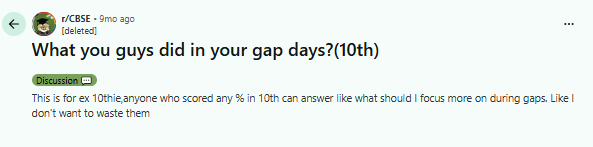
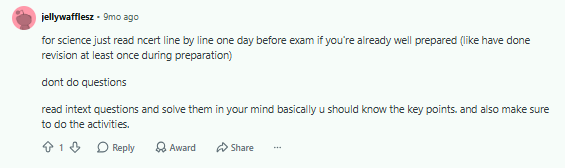
Students on Reddit discuss how they prepared in their CBSE Class 10 exam gaps:
- Go through the entire NCERT textbook line by line the day before the exam rather than using other study material.
- Avoid spending time solving extra question banks or practice papers at this stage.
- Read through the NCERT intext questions and recall the key answer points in your mind instead of writing them out.
Source: Reddit
Ques. What to do in the last 24 hours before a CBSE Class 10 exam?
Ans. Revise short notes, pack the exam kit, check the paper details and sleep for 7-8 hours.
Ques. Should I solve a full sample paper the day before the exam?
Ans. No. Solve only a short section if needed. Full papers belong in the earlier part of the gap.
CBSE Class 10 Study Timetable for the Exam Gap
A Class 10 study timetable for the gap should have fixed blocks for revision, practice and rest. This is a sample for a 4-day gap.
- Morning (3 hours): Concept revision of one unit.
- Afternoon (2 hours): Previous-year questions and numericals or writing practice.
- Evening (2 hours): Error fixes, short notes, and diagrams.
- Breaks: 10 minutes after every 50 minutes of study.
- Revision loop: Spend 15 minutes before bed on that day's notes.
| Time | Task |
|---|---|
| 8:00-11:00 AM | Unit revision |
| 11:00 AM-1:00 PM | Break and meal |
| 2:00-4:00 PM | PYQs, numericals or writing practice |
| 5:00-7:00 PM | Error fixes and short notes |
| 9:30-10:00 PM | Revise the day's notes and sleep |
Ques. What is the best study timetable for CBSE Class 10 in the exam gap?
Ans. Revision in the morning, practice in the afternoon, error fixes in the evening and 7-8 hours of sleep.
FAQs on CBSE Class 10 Exam Gap Preparation Strategy 2027
Ques. How to prepare for CBSE Class 10 board exams during the gap?
Ans. Divide the free days by unit, revise weak chapters first, solve one timed paper and fix errors on the last day.
Ques. When does the CBSE 2027 date sheet for Class 10 start?
Ans. February 16, 2027, with Painting. Mathematics follows on February 17.
Ques. How many days are there between CBSE Class 10 major papers?
Ans. The gaps between dates are 4 to 5 days, which leaves 3 to 4 free days.
Ques. Which CBSE Class 10 paper needs the earliest preparation?
Ans. Mathematics, as it is on February 17, one day after the first paper.
Ques. Which sample papers should I use for revision?
Ans. Official CBSE sample papers for 2026-27 and their marking schemes.
Ques. How to manage time in the Class 10 board exam?
Ans. Use the 15-minute reading time to plan, cap MCQs at 25-30 minutes and keep time for long answers.



Comments