



Education Content Expert
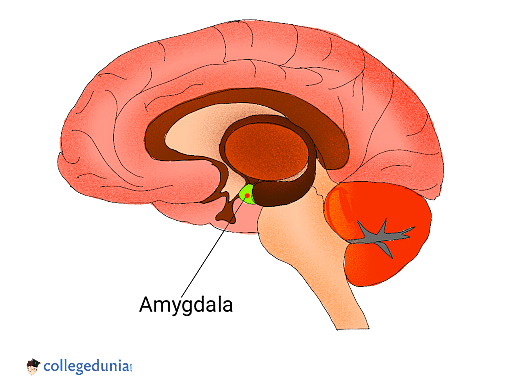
Amygdala is an almond-shaped section of nervous tissue in the brain's temporal lobe. They are a component of the limbic system, which controls emotions, survival instincts, and memory.
- There are two amygdalae in the human body, one on each side of the brain.
- Amygdala is in charge of emotion perception, such as anger, fear, sadness, and aggression control.
- It helps in the storage of memories of events and emotions so that a person can recognize similar events in the future.
Amygdala evaluates the emotional importance of sensory perception and prompts an appropriate response. It, thus, plays an important role in how animals assess and respond to environmental threats and challenges.
Read More: NCERT Solutions For Class 11 Biology Neural Control and Coordination
| Table of Content |
Key Terms: Amygdala, Brain, Limbic System, Flight and Fight, Emotions, Memory, Hippocampus, Hypothalamus
What is Amygdala?
[Click Here for Sample Questions]

Amygdala is a part of the limbic system that controls flight and fight responses of the human body.
- It is also referred to as the emotional center of the brain.
- It is a small structure in the brain's temporal lobe that works to regulate emotions and motivations.
- Every human has two amygdala, one in each hemisphere of the brain.
- It helps to preserve memories and attach those memories to specific emotions such as happiness, sadness, and joyous.
Amygdala
Read More:
Amygdala Function
[Click Here for Previous Year Questions]
The various functions performed by Amygdala are as follows:
- Learning: The amygdala facilitates learning about negative and positive reinforcement paradigms.
- Amygdala and Hippocampus: Since amygdala is adjacent to the hippocampus, which stores episodic memory, it can cause changes or modifications to the memory through emotions. It can also elicit emotions by recalling random objects.
- Evaluating Emotional Event Value: Amygdala determines whether an event was happy, sad, frustrating, and so on. It can detect impending danger and work to prepare the body to meet the demands of the situation.
The emotional aspects of the amygdala facilitate the attachment of emotions to the hippocampus's episodic memory. This is a classic example of the cooperation of the amygdala and hippocampus.
Read More: Neural Control and Coordination
Amygdala Location
[Click Here for Sample Questions]
Amygdala is found in the medial temporal lobe, immediately anterior to (in front of) the hippocampus. Amygdala is paired network of neurons in each one of these hemispheres of the mind.
Read More: Neural Control and Coordination MCQs
Amygdala Pathway
[Click Here for Previous Year Questions]
Each amygdala receives input and sends it to a variety of regions in the brain. Pathways are inputs and outputs that can be afferent or efferent depending on whether they are received or sent.
Efferent Projections
The primary function of the amygdala is to modulate the activity of the hypothalamus. This is done via two major pathways namely the stria terminalis and the ventral amygdaloidal pathway.
Stria Terminalis
- Stria Terminalis is a pathway that connects the centromedian nucleus of the amygdala to the ventromedial nucleus of the hypothalamus.
- The pathway also transports fibres to the septal nuclei and thalamic regions of the brain.
- Stria terminalis transports fibres from these three areas back to the amygdala in addition to efferent fibres.
- It plays an important role in many different types of organisms' stress responses.
Amygdalofugal Pathway
- It is the primary efferent pathway of the amygdala.
- It emerges from the amygdaloid complex's centromedial and basolateral nuclei.
- It transports fibres to various locations throughout the nervous system.
- The basolateral group's axons travel medially through the innominate substance and terminate at the hypothalamus and septal nuclei.
- It is an innominate substance that sends cholinergic neurons to the cortex of the brain, which is crucial for social behavior modulation.
Read More: Neural Control and Coordination Important Questions
Afferent Projections
The basolateral group of nuclei receive impulses from the dorsal and medial thalamus, as well as many cortical areas. It also receives many neural fibers from the brainstem.
- In any case, all of these fibers send a wide variety of somatosensory, visual, and optical information to the amygdala.
- The basolateral group receives all impulses, which are projected to the centromedian group.
- There, they are supposed to be arranged and sent to various motor centers to stimulate a response to the received information.
- As a result, the amygdaloid zone of motor divergence is another name for the central group.
These are the structures that specifically send fibers to the Amygdala:
- Olfactory Bulb
- Orbitofrontal Cortex
- Cingulate Gyrus
- Basal Forebrain
- Medial Thalamus
- Hypothalamus
- Brainstem
Amygdala Damage
[Click Here for Sample Questions]
Amygdala helps to sense dangers and threats. It is also associated with memory and emotions. Therefore, any damage to this part of the brain can profoundly affect our lives. Some effects of the damage to the amygdala are
- The intensity of emotions increases in a drastic manner.
- Unable to recognize emotions and feel them.
- State of depression, stress, or anxiety.
- Eating Disorders
- Loss of Perception
- Loss of Memory
- Extra need for external stimuli
Check More:
Things to Remember
- Amygdala is a cluster of almond-shaped cells located near the base of the brain.
- There are two amygdalae in a human, one on each side of the brain.
- It is considered to be a part of the limbic system of the brain.
- Amygdala helps to define and regulate emotions.
- It activates the fight-or-flight response.
- Amygdala Pathway is divided into two parts namely Afferent Projections and Efferent Projections.
- Any damage to the amygdala affects the lives of humans profoundly with severe emotional and mental damage.
Previous Years’ Questions
- Outermost covering of the brain is called as… (JIPMER 2000)
- In the brain lateral ventricle is connected to diocoel by… (OJEE 2010)
- Sympathetic neural system induces… (NEET 1999)
- Nerve impulse is generated when nerve cell undergoes… (CUCET 2006)
- In human beings, olfactory lobes are…
- Tongue is under the control of…
- Hypothalamus does not control… (KEAM)
- Structurally, what are olfactory nerve cells… (GUJCET 2008)
- Injury localized to the hypothalamus would most likely disrupt… (NEET 2014)
- GnRH secreted from the hypothalamus mainly stimulates… (AMUEEE 2013)
Sample Questions
Ques. What is Amygdala? (3 Marks)
Ans. Amygdala is a part of the limbic system, which is concerned with memory and emotions. It is one of three parts that work together to facilitate our life experiences and various cognitive aspects such as learning and decision-making. The amygdala is a grey matter that is oval in shape and resembles an almond. It is commonly referred to as the amygdaloid body due to its complex composition of 13 nuclei.
Ques. Explain how Amygdala is the in charge of emotions. (3 Marks)
Ans. Amygdala is in charge of the brain's emotions. It gives emotional weight to all events as they happen. It aids memory retention by associating intense emotions with them and turning them into emotional triggers, both positive and negative. Simply put, it associates emotions with the environment. It is effective at regulating fear and anger because its primary function is to deal with the body's fight or flight responses.
Ques. Is Amygdala the fear centre of the Brain? (3 Marks)
Ans. According to research, the amygdala modulates the fear response in humans. In several brain imaging studies, fearful stimuli such as fearful faces, fear-inducing images, and fear-conditioned cues were found to activate the amygdala. These findings suggest that the amygdala plays a significant role in regulating the fear response in both humans and animals.
Ques. How is Amygdala linked to addiction? (3 Marks)
Ans. Addiction is considered a brain disease rather than a lack of willpower or a character flaw. According to a study published in Brain Research, a typical addiction cycle consists of three stages:
- Preoccupation/Anticipation
- Binge/Intoxication
- Withdrawal/Negative Effect.
In the early stages, impulsivity often takes precedence, while compulsivity takes precedence at the end. When a person is in the final stages of withdrawal, the amygdala is activated and sends stress signals to the body, causing them to crave more of that substance.
Ques. What is Amygdala Hijack? (3 Marks)
Ans. Amygdala responds to stress as if it were a physical threat. It is capable of seizing control of the brain and activating the startle circuit.
- The symptoms of an amygdala hijack are caused by the effects of the two stress hormones cortisol and adrenaline.
- Slowing down, breathing slowly and deeply, and attempting to focus the mind are all techniques for preventing or stopping an amygdala hijack.
- Individuals who regularly practise these techniques can better prepare for stressful situations.
Ques. How does Amygdala work? (3 Marks)
Ans. Amygdala works in a variety of fascinating ways, including
- It attempts to determine the level of threat in a situation.
- If it determines that the situation is unfavourable, it begins to prepare for a fight or flight response.
- It sends a signal to the hypothalamus in order to start the responses.
- In order to meet the demands, the hypothalamus begins to change the heartbeat, blood pressure, blood sugar levels, sweat glands, and so on.
Ques. What are Afferent Projections? (1 Mark)
Ans. Afferent nerve fibres are the axons (nerve fibres) carried by a sensory nerve and responsible for relaying sensory information from sensory receptors to brain regions. Afferent projections travel to a specific brain region.
Ques. What are the functions of Amygdala? (3 Marks)
Ans. Amygdala plays a unique role in mediating many aspects of emotional learning and behaviour.
- Amygdala is particularly responsible for the emotion of Fear.
- It influences cognitive processes such as memory formation, decision-making, attention, and social behaviour.
- Amygdala sends information to the prefrontal and sensory cortices, as well as the hippocampus. As a result, the amygdala can assign emotions to these cognitive processes.
Ques. Where is Amygdala located? (3 Marks)
Ans. Amygdalae are a component of the limbic system, which is located deep within the brain. Amygdalae are located in the temporal lobe, just in front of the hippocampus. They are connectors and communicators in the limbic system, which is located in both the temporal and bottom of the frontal lobes. They send messages directly to the hippocampus, which relays information to other brain areas such as the hypothalamus, thalamus, and cerebral cortex.
Ques. Which structures send fibres to Amygdala? (3 Marks)
Ans. The structures that send fibres to Amygdala are:
- Olfactory Bulb
- Orbitofrontal Cortex
- Cingulate Gyrus
- Basal Forebrain
- Medial Thalamus
- Hypothalamus
- Brainstem
Check-Out:



Comments