



Education Content Expert
Aromatic Compounds are a class of hydrocarbons that contain one or more aromatic rings. Aromatic Compounds are organic compounds that have conjugated planar ring systems with delocalized pi-electron clouds instead of individual alternating single and double bonds. The use of the word ‘aromatic’ as a chemical term was introduced for the first time in 1855 by August Wilhelm Hofmann.
- Aromatic compounds are also known as arenes or aromatics.
- They are unsaturated compounds that are stable in nature.
- Aromatics are required to satisfy Huckel’s Rule.
- Benzene and Toluene are the most common examples of aromatic compounds.
Plants and microorganisms have an exclusive route to benzene-ring compounds, thus, the majority of aromatic compounds are produced by plants and microorganisms in nature. Computer parts, DVDs, and drugs such as Aspirin and paracetamol are all made up of aromatic compounds. Thus, aromatic compounds have made a huge contribution to the development of mankind.
Read More: NCERT Solutions For Class 11 Chemistry Organic Chemistry Some Basic Principles and Techniques
Key Terms: Aromatic Compounds, Aromatic Hydrocarbons, Benzene, Aromaticity, Huckel’s Rule, Aromatics, Aliphatic Hydrocarbons
What are Aromatic Compounds?
[Click Here for Sample Questions]
Aromatic compounds are a large class of unsaturated chemical compounds characterized by one or more planar rings of atoms joined by covalent bonds of two different kinds.
- Aromatic compounds are also known as "mono- and polycyclic aromatic hydrocarbons".
- The unique stability of aromatic compounds is called Aromaticity.
- Aromatic compounds have a pleasant odor.
- Aromatics need to satisfy Huckel’s Rule of Aromaticity.
- Benzene is the best-known aromatic compound and the parent to which numerous other aromatic compounds are related.
- Aromatic compounds are commonly used in industries for the synthesis of drugs, polymers, pesticides, etc.
Read More:
Examples of Aromatic Compounds
[Click Here for Previous Years' Questions]
Aromatic hydrocarbons are hydrocarbons that contain sigma bonds and delocalized pi electrons between carbon atoms in a ring. They are known for their pleasant smell and that is why they are called aromatic. Some examples of aromatic compounds are:
- Toluene
- Aniline
- Phenol
- Benzaldehyde
- Ortho-Xylene
- Acetophenone
- Benzyl Alcohol
- Paracetamol
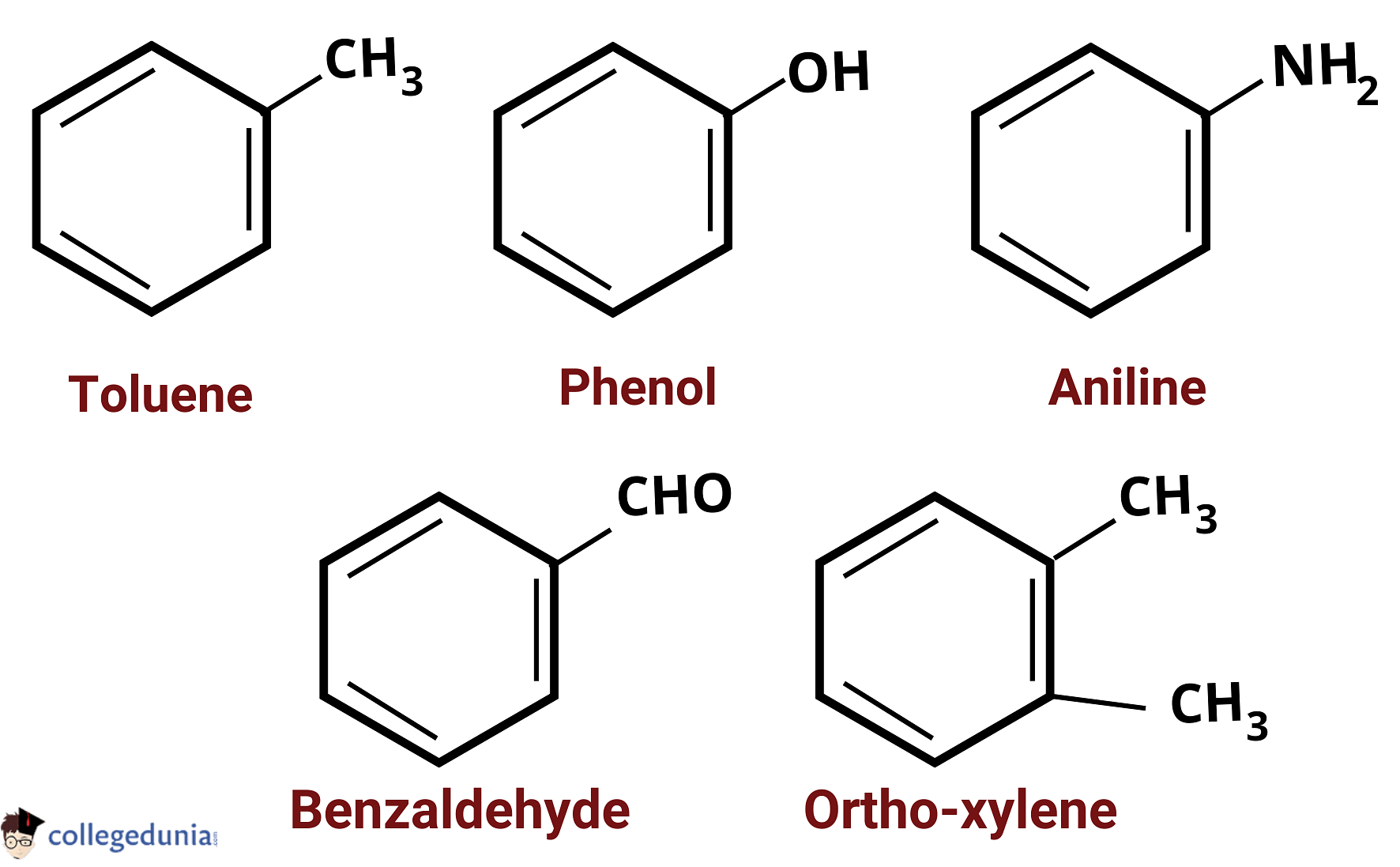
Examples of Aromatic Compounds
Aromatic compounds are divided into two broad categories:
- Benzenoid Aromatic Compounds: Containing a Benzene Ring.
- Non Benzenoid Aromatic Compounds: Not Containing a Benzene Ring.
A hydrocarbon is said to be an aromatic compound if they follow Huckel Rule. All aromatic compounds follow the Huckel Rule. According to the Huckel rule, in order for a ring to be aromatic, it should have the following properties:
- Planarity
- Presence of (4n +2)π electrons, where n is an integer (n = 0, 1, 2, . . .)
- Complete Delocalization of π electron in the ring.
Benzene: Parent Member of Aromatic CompoundsBenzene (C6H6) is the best example of representing aromatic compounds. It is also a parent member of aromatic compounds. The cyclohexatriene structure for benzene was first proposed by August Kekule in 1865.  Structure of Benzene
|
Huckel’s Rule of Aromaticity
[Click Here for Sample Questions]
Aromatic compounds have to be planar, fully conjugated having a cyclic cloud of π electrons below and above the plane of the molecule. They contain sp2 hybridized carbon atoms and must obey the Huckel rule. Huckel’s Rule states that:
| “Aromatic Stability is possessed by only planar, fully conjugated monocyclic polyenes having 4n + 2π electrons, where n is an integer, that is, n = 0, 1, 2, 3, 4, etc.” |
- According to Huckel’s Rule, the ring system must have (4n+2) π electrons, where n is any whole number (0, 1, 2, 3, etc).
- According to this basis, the ring systems which have 2(n=0), 6(n=1), 10(n=2), 14(n=3) etc pi electrons are aromatic.
- Common examples of aromatic compounds are benzene, naphthalene, and anthracene.
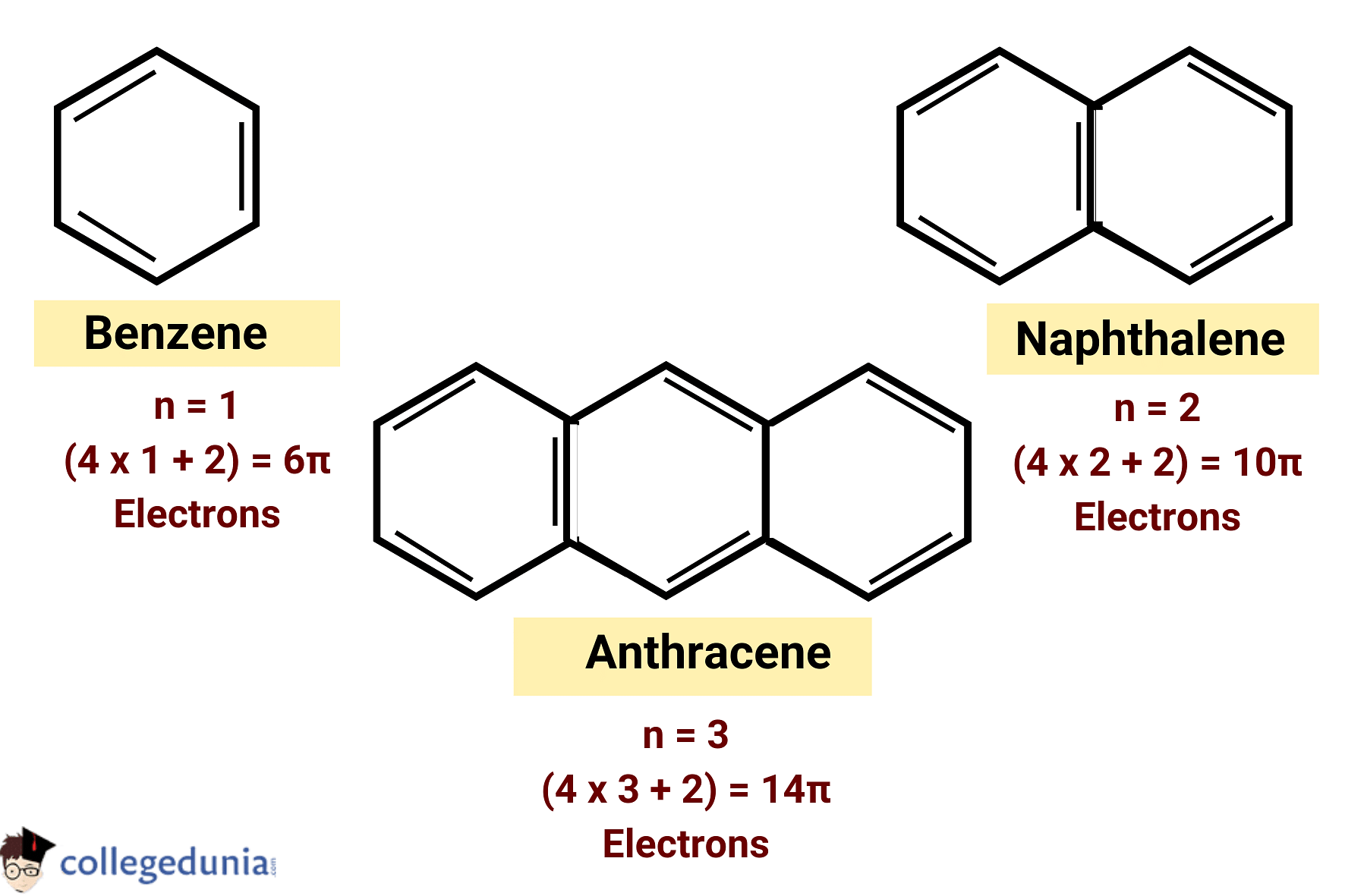
Huckel’s Rule of Aromaticity
Read More: Hydrocarbons Important Questions
Properties of Aromatic Compounds
[Click Here for Previous Years' Questions]
The properties of Aromatic Compounds are:
- Aromatic Compounds have delocalized pi-electrons.
- They show a coplanar structure.
- These compounds are used as a solvent for non-polar compounds.
- They are usually non-polar and immiscible in water.
- Aromatic Compounds have extremely high resonance energy.
- They are stable unsaturated compounds.
- They undergo reactions rather than addition reactions.
- Aromatic Compounds show electrophilic aromatic substitution and nucleophilic aromatic substitution reactions.
Classification of Aromatic Compounds
[Click Here for Sample Questions]
Aromatic compounds are classified on the basis of the position of the functional group. Aromatic compounds are divided into two groups:
- Nuclear Substituted Compounds: If any substituent or functional group, is directly linked to the benzene ring in an aromatic compound, it is known as a nuclear-substituted compound.
- Side Chain Substituted Compounds: If the functional group is available in the side chain of the ring in an aromatic compound, then it is known as a side chain substituted compound. Such compounds are called the phenyl derivatives of the relative aliphatic compounds.
Read More:
IUPAC Nomenclature of Aromatic Compounds
[Click Here for Previous Years' Questions]
In earlier times, most of the compounds with the same structural formula were known by different names given to them on the basis of the regions where they were synthesized. However, such a naming system caused a lot of confusion. Thus, a common naming system with standard rules was set up by International Union for Pure and Applied Chemistry (IUPAC) for the naming of compounds. This method of naming the compounds is known as IUPAC nomenclature.
IUPAC nomenclature of Aromatic Hydrocarbons is as follows:
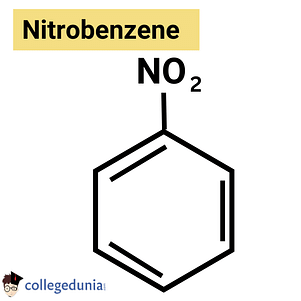
- According to the IUPAC Nomenclature, the substituent or functional group name is placed as a prefix to the name of the aromatic compound. For instance, a nitro-group attached to a benzene ring is called nitrobenzene.
- In case there is more than one similar functional group attached to the ring, they are numbered as per the Greek numerical prefixes like- di, tri, and tetra as prefixes denoting the number of the similar functional groups attached to the ring. For example, if two Bromo-groups are attached to the benzene ring, they are named ad 1, 2-bromobenzene.

- When different functional groups are attached to the ring, the base functional group of the compound is given the number 1 and then in the chosen direction, the next number is allotted to the next functional group. The functional groups are named in alphabetical order. For example, if nitro and chloro groups are attached to the benzene ring, then according to the IUPAC nomenclature, the name will be given as 2-chloro-1-methyl-4-nitrobenzene.

- When multiple functional groups are attached to the benzene ring then, some terms like ortho (o), meta (m), and para (p) are also used as prefixes to indicate the relative positions 1,2-; 1,3- and 1,4- respectively. For example, the compound 1,2-Di-bromo-benzene can be named as o-di-bromo-benzene.
- If an aromatic compound is attached to an alkane group, then the aromatic compound will not be considered a parent, but rather will be considered a functional group. For Example- when an alkane group is attached to benzene, then it is called phenyl, denoted by Ph-.
Read More: Organic Chemistry: Basic Principles and Techniques
Difference between Aromatic and Aliphatic Hydrocarbons
[Click Here for Sample Questions]
Aromatic hydrocarbons and aliphatic hydrocarbons are two types of organic compounds composed of hydrogen and carbon. The major differences between aromatic hydrocarbons and aliphatic hydrocarbons are as follows:
| Aromatic Hydrocarbons | Aliphatic Hydrocarbons |
|---|---|
| Aromatic hydrocarbons contain carbon and hydrogen attached in a ring system with delocalized pi-electrons. | Aliphatic hydrocarbons contain carbon and hydrogen attached in straight chains, branched chains, or non-aromatic ring forms. |
| These compounds show aromaticity. | These compounds do not show aromaticity. |
| These are unsaturated compounds. | They can be saturated or unsaturated compounds. |
| Aromatic Compounds have delocalized pi-electrons. | Aliphatic hydrocarbons do not have delocalized pi-electrons. |
| They are conjugated compounds. | Majority of aliphatic compounds are not conjugated. |
| Aromatic compounds follow Huckel's Rule. | It isn’t necessary that all aliphatic hydrocarbons will follow Huckel's Rule. |
| Most of the aromatic compounds have a pleasant odor. | These compounds do not have a pleasant odor. |
| The carbon-to-hydrogen ratio is low in aromatic hydrocarbons. | The carbon-to-hydrogen ratio is high in aliphatic hydrocarbons. |
| They generally burn with sooty yellow flame. | They burn with a non-sooty flame. |
| Common examples of aromatic hydrocarbons are Benzene, toluene, naphthalene, etc. | Common examples of aliphatic hydrocarbons are methane, ethane, propane, etc. |
Read More: NCERT Solutions for Class 11 Chemistry Hydrocarbons
Hydrocarbons Handwritten Notes
[Click Here for Previous Years' Questions]
Given below are the handwritten notes on hydrocarbons and aromatic compounds:


Handwritten Notes on Hydrocarbons
Things to Remember
- Aromatic Compounds are hydrocarbons that contain sigma bonds and delocalized pi electrons between carbon atoms in a ring.
- Aromatic Compounds are also known as arenes, aromatics, or mono- and polycyclic aromatic hydrocarbons.
- All aromatic compounds follow Huckel's Rule and have a pleasant odor.
- Aromatic Compounds are unsaturated compounds that have unique stability.
- Benzene is the most prominent example of an aromatic compound and is also a parent to other compounds of this class.
- Other examples of aromatic compounds include Toluene, Aniline, Phenol, Benzaldehyde, Ortho-Xylene, Acetophenone, etc.
- Aromatic Compounds have played an indispensable role in the development of mankind.
Previous Years’ Questions
- Among P, Q, R, and S, the aromatic compounds(s) is/are... [JEE Advanced 2013]
- Which of the following compounds are aromatic…
- Which of the following is an aromatic compound… [AFMC 2009]
- According to Huckel's rule an aromatic compound must possess… [JKCET 2007]
- Two aromatic compounds having formula C7H8O which are easily… [WBJEE 2011]
- An aromatic compound 'A′ having molecular formula C7H6O2 on treating… [JEE Main 2019]
- The effective electrophile in aromatic sulphonation is... [MU OET 2010]
- In the sodium fusion test of organic compounds, the nitrogen of the organic compound is… [NEET 1991]
- The most suitable method of separation of 1:1 mixture of ortho and para-nitrophenols is… [NEET 1993]
- The best method for the separation of naphthalene and benzoic acid from their mixture is… [NEET 2005]
- 2-butene shows geometrical isomerism due to… [NEET 2000]
- Which of the following techniques is most suitable for purification of cyclohexanone… [NEET 1997]
- Which of the following undergoes nucleophilic substitution exclusively by… [NEET 1980]
- How many chain isomers could be obtained from the alkane… [NEET 1988]
- The Cl-C-Cl angle in 1,1,2,2-tetrachloroethene and tetrachloromethane will be about… [NEET 1988]
- Which one of the following can exhibit cis-trans-isomerism? [NEET 1988]
- The most suitable method of the separation of a mixture of ortho and… [NEET 1999]
- Nitrogen detection in an organic compound is carried out by Lassaigne's test… [NEET 2013]
- Which of the following molecules represents the order of hybridisation… [NEET 2018]
- An aromatic compound A (C7H9N)on reacting with... [KCET 2014]
Sample Questions
Ques. What are aromatic compounds? (3 Marks)
Ans. Aromatic Compounds are defined as chemical compounds that contain conjugated planar ring systems with delocalized pi-electron clouds instead of discrete alternating single and double bonds.
- Aromatic Compounds generally refer to a compound having [4n+2]π electrons with cyclic conjugated structures that are particularly stable (Hückel's rule).
- These compounds have a pleasant odor and burn with a yellow sooty flame.
- Common examples of aromatic compounds are Benzene, toluene, naphthalene, etc.
Ques. Mention a few differences between Aromatic hydrocarbons and Aliphatic hydrocarbons. (3 Marks)
Ans. Aromatic hydrocarbons and aliphatic hydrocarbons are two organic compounds composed of hydrogen and carbon. The differences between them are as follows:
- Aromatic hydrocarbons are unsaturated compounds, whereas, aliphatic hydrocarbons can be both saturated and unsaturated compounds.
- Aromatic hydrocarbons show aromaticity and have a pleasant odor while aliphatic hydrocarbons do not show aromaticity and don't possess a pleasant odor.
- Aromatic hydrocarbons always follow Huckel’s Rule while it is not necessary that all Aliphatic hydrocarbons follow Huckel’s rule.
- Benzene is an example of an Aromatic hydrocarbon while Methane is an example of an aliphatic hydrocarbon.
Ques. Give some examples of Aromatic compounds. (3 Marks)
Ans. Almost all aromatic compounds are generally hydrocarbons. Some of those compounds are also used in our daily life. Some examples of aromatic compounds are:
- Benzyl Alcohol
- Paracetamol
- Aspirin
- Benzene
- Aniline
Ques. What are the properties of Aromatic compounds? Write any three properties. (3 Marks)
Ans. The properties of aromatic compounds are:
- These compounds show a co-planar structure.
- They have excessively high resonance energy.
- They have a high ratio of carbon to hydrogen which produces a sooty yellow flame.
Ques. Define Huckel’s rule of aromaticity. (3 Marks)
Ans. Huckel’s rule of aromaticity states ‘in order to classify a ring to be aromatic, it should be planar and have fully conjugated (4n + 2) pi electrons, where n is an integer.’
- This rule is used to estimate the aromatic qualities of any planar ring-shaped molecule in the field of organic chemistry.
- The supporting quantum mechanics that were required for the formulation of this rule was solved first by the German physical chemist and physicist Erich Armand Arthur Joseph Huckel in1931.
Ques. What do you mean by an aromatic organic compound? (2 Marks)
Ans. Compounds that contain delocalized pi-electron clouds with a conjugated planar ring in place of alternating single and double bonds are known as aromatic compounds. These chemical compounds show aromaticity which is used for describing a cyclic property, having planar molecules with resonance bond rings which shows more stability.
Ques. What is the significance of aromatic hydrocarbons? (2 Marks)
Ans. Aromatic hydrocarbons are used as a non-polar solvent for other molecules. Aromatic hydrocarbons can be used as additives in paints, lacquers, gasoline, and other products. The low reactivity of Aromatic hydrocarbons also helps them to be used as a solvent.
Ques. State some conditions for compounds for aromatic compounds. (2 Marks)
Ans. An aromatic compound will have:
- Cyclic molecules.
- A distinct kind of odor.
- Planar and flat molecules.
Ques. What is aromaticity? (2 Marks)
Ans. Aromaticity is the property of the conjugated cycloalkenes that enhances the stability of a molecule owing to the delocalization of electrons present in the π-π orbitals. Aromatic molecules or compounds are said to be very stable, and they do not break so easily. They also react with other types of substances.
Ques. How can we know if a compound is aromatic? (1 Mark)
Ans. A compound is aromatic if it is cyclic, planar, and is a completely conjugated compound with 4n + 2 π electrons. Any deviation from these criteria makes a compound non-aromatic.
Ques. What are heterocyclic aromatic compounds? (2 Marks)
Ans. Aromatic compounds may consist of a hetero atom in the ring like alicyclic compounds. These compounds are known as heterocyclic aromatic compounds. Examples include Pyrimidine, Carbazole, Purine, Pyrrole, etc.
Ques. Are alkenes more reactive than aromatic compounds? (2 Marks)
Ans. Aromatic compounds are more stable hence, they do not react easily. Yes, alkenes are more reactive than aromatic compounds. Due to their stability, aromatic compounds are used as an industrial solvent (in the case of non-polar compounds).
Ques. What kind of ring current is there in benzene? (1 Mark)
Ans. The compound benzene has a diamagnetic ring current. In the case of compounds that are antiaromatic, the ring current present is paramagnetic.
Ques. Which is the most essential aromatic compound? (2 Marks)
Ans. The most essential aromatic compound which is the parent to numerous other aromatic compounds is Benzene (C6H6). The six carbons are joined in a ring and have the planar geometry of a regular hexagon in which all of the C—C bond distances are equal.
Check-Out:



Comments