



Education Journalist | Study Abroad Lead
Ellipsoid joint is a type of synovial joint that is capable of both flexion and extension. It is the most common type of synovial joint found in the human body, making up approximately 80% to 90% of all joints. An ellipsoid joint has an elliptical shape, like an eye socket or pear, generally with one convex (bulging) and one concave (depressed) surface.
Read about: Saddle Joints
| Table of Content |
Key Terms: Saddle Joints, Condyloid Joints, Synovial Joint, Anatomy of Ellipsoid Joints, Vertebrae, Metacarpophalangeal Joints, Metatarsophalangeal Joints
Types of Joints
[Click Here for Sample Questions]
In human body, joint is a junction that connects bones and cartilage together. Joints help in movement of the body like running, walking, and shaking hands. Force generated by muscle is used for carrying out movements through various joints. Joints are classified into different types on the basis of motion, structure, and function.
Types of joints in human body are:
- Hinge Joints
- Gliding Joints
- Saddle Joints
- Fibrous Joints
- Pivotal Joints
- Synovial Joints
- Cartilaginous Joints
- Condyloid Joints
- Ball and Socket Joints
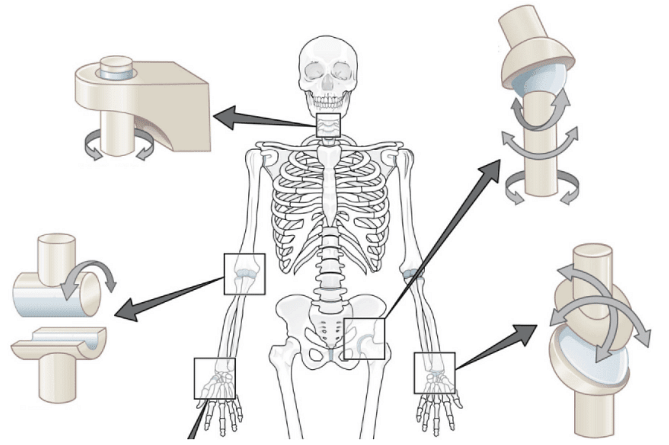
Types of Joints
Read more about: Types of Joints
What is Ellipsoid Joints?
[Click Here for Sample Questions]
Ellipsoid joint is a biaxial joint that enables movements in angular motions. Movement of these joints are in two plains: back and front, and side to side. An ellipsoid joint is located between knuckle joints, wrist joints, metacarpophalangeal and metatarsophalangeal joints in fingers.
Phenomenon of Ellipsoid Joints is also used in automobiles where a ball and socket joint are found in the steering column. They allow the driver to rotate their direction of travel without rotating the wheels.
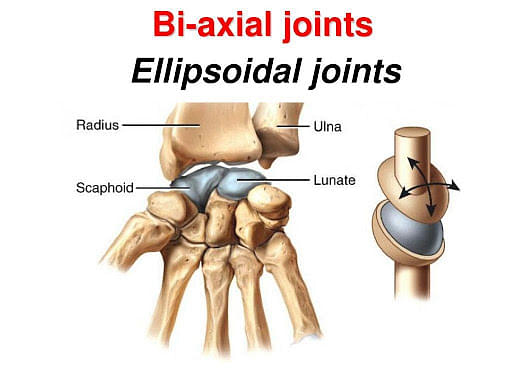
Ellipsoid Joint Functions
Anatomy of Ellipsoid Joints
[Click Here for Sample Questions]
An ellipsoid joint is a type of ball-and-socket joint. The base of ellipsoid joint is shaped like an egg, rather than being completely round. This structure can be used for joints that are subjected to large forces, such as in the neck, the hip, and the shoulder.
Surfaces of ellipsoid joints are ovoid and vary in length as well as curvature as they are traced from front to back or from side to side. This is similar to the diameter and curvature of an ellipse that vary in directions at right angles to each other. For example: Joint between the second metacarpal and first phalanx of the second finger that allows the finger to flex and extend. It also enabled swinging towards or away from the neighbouring finger.

Ellipsoid Joint in Finger
Read about: Locomotion and Movement
Ellipsoid Joints Movement
[Click Here for Sample Questions]
Ellipsoid joints have a small degree of rotational freedom, allowing for limited articulation. In contrast to ball and socket joints, ellipsoid joints do not have as much range of motion. Condyloid joints or Ellipsoid Joints allow angular movement along two axes, as shown in the diagram below.
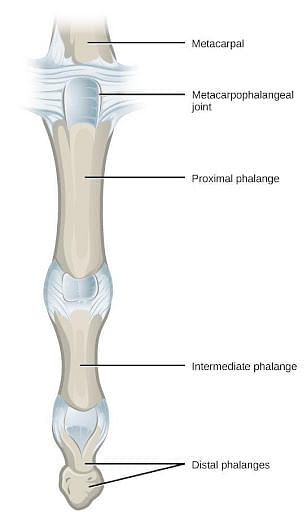
Metacarpophalangeal Joints in Finger
Ellipsoid Joints Location
[Click Here for Sample Questions]
Ellipsoid joints are most commonly found in the neck, back, and spine. They are located between two vertebrae or in the upper part of the sacrum. The symphysis of the pubic bones (the joint between the two pubic bones in the pelvis that meets at the top of the pelvic joint) is another common location for ellipsoid joints.
Things to Remember
- Ellipsoid joint is a type of synovial joint that helps with flexion and extension in human body.
- Ellipsoid joint has an elliptical shape. It looks like an eye socket with one convex (bulging) and one concave (depressed) surface.
- Ellipsoid joint movements are back and front and side to side, in angular motions.
- Surfaces of ellipsoid joints are similar to diameter and curvature of ellipse that vary in directions at right angles to each other.
- These joints are located between wrist joints, knuckle joints, metacarpophalangeal joints, and metatarsophalangeal joints of fingers.
- Ellipsoid joints are a type of hinge, which is commonly used phenomenon in automotive industry. It connects components without welding two pieces together.
Also Read:
Sample Questions
Ques. What is Condyloid joint, and what’s the difference between this and Ellipsoid Joint? (2 Marks)
Ans. Elliptoid joints are a type of condyloid joint. They work by pressing against one another and rotating in order to allow movement in all directions. They do not offer as much strength as the other type, so they are less often used.
Ques. Give an example of ellipsoid joint. (2 Marks)
Ans. Ellipsoid joints are oval-shaped condyle of a bone that fits into the elliptical cavity of the other bone. An example of Ellipsoid joint is the wrist that moves similarly to the ball and socket joint except it is unable to rotate 360 degrees. This prohibits axial rotation.
Ques. Where are ellipsoid joints located in the body?(2 Marks)
Ans. Ellipsoid joints, also known as a ‘condyloid joint’, allow back and forth and side to side movement. They are found in between metacarpals and phalanges of human body. See below diagram to understand further.
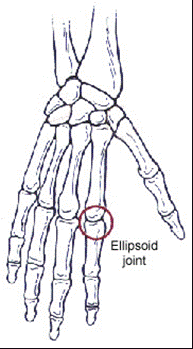
Ellipsoid Joint Location
Ques. Are ellipsoid joints multiaxial? (2 Marks)
Ans. Spheroidal (ball and socket) joints are universal joints that permit multiaxial movements. Examples include the hip and shoulder. Ellipsoid joints (oval and socket) are shallower articulations that allow movements in at least two planes.
Ques. What is the difference between saddle and ellipsoid joint?(2 Marks)
Ans. Saddle joint is a modified ellipsoidal joint. It has a pair of bones in a rider and saddle shape. First metacarpal of the thumb and trapezium (one of the carpals) form this kind of joint. Saddle joint has a wider range of flexibility, including biaxal movement.
Ques. How a bone is formed? What kind of food should we take for proper growth and upkeep of bones? (2 Marks)
Ans. Skeleton forms soft and elastic cartilages before birth. Some of these cartilages are changed to bones. With deposition of substance containing calcium, bones become hard and strong. When a baby is born, the skeleton is soft. At an older age, bones become hard and brittle. For proper growth and maintenace of bones, food rich in calcium, phosphorus, vitamins and proteins is necessary. Milk, curd, fruits, vegetables and eggs contain the required nutrition.
Ques. Explain articulations in a human skeleton. (3 Marks)
Ans. There are various articulations or joints present in human skeleton. Three main types of articulations are:
Immovable joints (Synarthroses): No joint cavity and no movement is possible in this articulation. These joints include Sutures, Gomphoses, and Syndesmosis.
Imperfect joints (Amphiarthrosis): These are slightly movable joints in which syanovial cavity is not present. These are cartilaginous joints. Examples include between bodies of the vertebrae, between manubrium and body of sternum.
Perfect joints (Diarthroses): These joints are freely movable are typically have articulate surface and synovial capsule. Synovial fluid acts as a greaser in the joint. Fore example, joints of elbow, wrist, ankle, hip, knee.
Ques. How useful is the study of the nature of body cavity and coelom in the classification of animals? (3 Marks)
Ans. Presence or absence of cavity between body wall and gut wall is very important. Body cavity lined by mesoderm is called coelom.
(i) Animals containing coelom are called coelomata, e.g. annelids, hemichordates, arthropods, molluscs, echinoderms, and chordates.
(ii) In some animals, body cavity is not mesoderm. Mesoderm is rather present as scattered pouches between ectoderm and endoderm. Such a cavity is called pseudocoelom and animals with these cavities are called pseudocoelomates.
(iii) Animals in which body cavity is absent are known as acoelomates.
Ques. Explain different kinds of Synovial Joints. (4 Marks)
Ans. Synovial joint is a fluid-filled joint cavity that is found within a fibrous capsule. They are freely movable and are most common types of joint found in body. Synovial joints are sub-classified based on the shape of their articular surfaces and movements permitted:
Hinge: Allows movement in one plane, usually flexion and extension. E.g. ankle joint, elbow joint, knee joint.
Saddle: Has resemblance to saddle on a horse’s back and is characterised by opposing articular surfaces with a reciprocal concave-convex shape. E.g. carpometacarpal joints.
Plane: Articular surfaces are relatively flat, allowing bones to glide over one another. E.g. acromioclavicular joint, subtalar joint.
Pivot: Allows for rotation only and it is formed by central bony pivot surrounded by bony-ligamentous ring. E.g. proximal, distal radioulnar joints, atlantoaxial joints.
Condyloid: Contains a convex surface that articulates with concave elliptical cavity. They are also called ellipsoid joints. E.g. metacarpophalangeal joint, metatarsophalangeal joint, wrist joint.
Ball and Socket: Where ball-shaped surface of one rounded bone fits into cup-like depression of other bone. Allows free movement in numerous axes. E.g. hip joint, shoulder joint.
Ques. What are the different types of joints in human body? Explain their functions. (5 Marks)
Ans. The different types of joints found in human body are:
| Types of Joints | Function | Located at |
|---|---|---|
| Ball and Socket Joint | A rounded, ball-like end of one bone fits into cup-like socket of another bone in ball-and-socket joint. Since all movement types are possible in all directions, this structure allows for largest range of motion. | Shoulder and hip joint |
| Hinge Joint | These are similar to door hinges and can only move back and forth. | Elbow, lower jaw, and knee joint |
| Fixed Joint | Where bones are not flexible, fixed joints or immovable joints are found. Bones are fused together in a way that they are anchored to the component, typically to construct a fixed structure. | Skull and upper jaw |
| Pivot Joint | Pivot joint is made up of one bone that can swivel in a ring formed by another bone. One bone can be tapped into the other in a way that full rotation is not possible in this type of joint. It helps in side-to-side and back-to-front movement. | Neck |
| Gliding Joint | This joint allows two or more round or flat bones to freely move or slide together without rubbing or crushing. | Wrist, ankle, palm, sole |
| Saddle Joint | Although saddle joint does not allow for rotation, it allows for back and forth movement as well as side to side movement. | Thumb |
For Latest Updates on Upcoming Board Exams, Click Here: https://t.me/class_10_12_board_updates
Check-Out:



Comments