



Education Journalist | Study Abroad Lead
Barr Body is referred to as the deactivated X-chromosome present in a normal female’s somatic cell. It mostly gets to be seen in the body of mammalian species. Though the Barr Body of a cell is usually inactive while forming a gamete, Barr Body reacts that might form dysfunctional organs or odd kinds of diseases in offspring later.
Read Also: Mendel’s experiment
| Table of Content |
Key Takeaways: Barr body, Somatic Cells, Lyon Hypothesis, DNA, Chromosome, Inactivation, Genes, Genetic disorders, X-chromosome, Chromatin, Gamete, Germ cells, Stem cells
What is a Barr Body?
[Click Here for Sample Questions]
Barr Body is a cell structure of a mammalian female’s somatic cell, which is formed when an X-chromosome is inactive. The Barr Body is also called sex chromatin. The Barr body in a somatic cell looks small with a structure that is dark-stained. Discovered by a Canadian micro-anatomist, Murray Barr, this somatic cell structure is named Barr Body after her name. The somatic cells of females consist of 2 X-chromosomes.
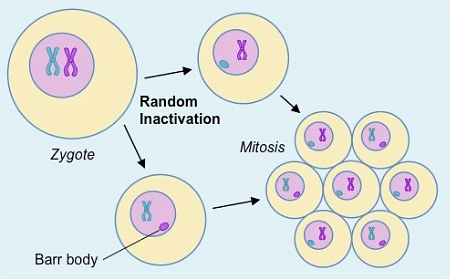
Barr Body
Also Read:
| Related Articles | ||
|---|---|---|
| Law of Heredity | Difference between Darwinism and Lamarckism | Genetic Disorder |
| Receptors | Prokaryotic cells | Cell wall and cell membrane |
Somatic Cell
[Click Here for Sample Questions]
Except for sex cells such as gamete, germ cells or stem cells, every other body cell that forms multiple organs of a human body is called a Somatic cell. ‘Soma’ of Somatic is a Greek word, which means ‘body’.

Somatic Cell
The Barr Body or the inactive X-chromosome is a part of somatic cells. Somatic cells are divided either through the process of binary fission or mitotic division. These cells are diploids that contain paired chromosomes and DNA in them. After division, somatic cells make up skin tissues, bones, multiple internal organs etc.
Read Also: Interphase
Lyon’s Hypothesis
[Click Here for Sample Questions]
Lyon’s hypothesis is proposed by Geneticist Mary Lyon regarding the reason why Barr Body gets formed? It is elucidated that in the mammalian female embryos (or early development period), one of the X-chromosomes gets deactivated. This deactivation happens in order to avoid the passage of any kind of dysfunctional disease to the next offspring’s body cell.

Lyon’s Hypothesis
Some of the key features of Lyon’s Hypothesis are as follows.
- X-chromosome gets deactivated.
- The X-chromosome inactivation starts in the 32 cells that consist of female embryos after 2 days of fertilization.
- One of the X-chromosomes of 32 cells gets inactive randomly.
- The mitotic phase is stable when X- inactivation occurs.
Read Also: Cell organelles
Formation of Barr Body
[Click Here for Sample Questions]
The formation of Barr Body is random because, in non-random deactivation, the process seems to be fixed with no such evidence. The process of lyonization starts when the centromere works as the starting point of lyonization to deactivate the X-chromosome. The centromere also ensures the presence of two or more chromosomes before making a Barr Body. So, the area of the centromere is called the Xic or X inactive centre. The centromere has 12 genes from which two genes Xist and Tist participate in the process of inactivation.
The level of Tist gene decreases in the process and the increased amount of Xist begins to expand all over that particular chromosome. The Xist factor slowly coats the whole chromosome. This is how the Barr Body is formed.
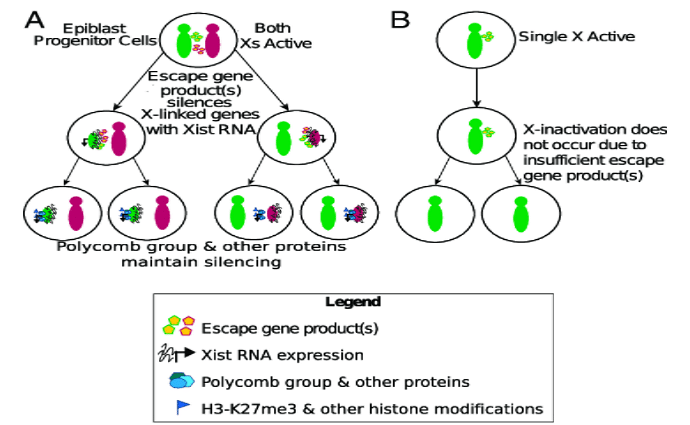
Formation of Barr Body
Read Also: Parenchyma Cells
Identification of Barr Body
[Click Here for Sample Questions]
Female mammalians have 44 XX chromosomes while males have 44 XY. Hence, only female mammalians have one Barr Body and male bodies have none. In females, the Barr body or the deactivated X-chromosome is mostly present in the heterochromatin part of the chromosome where it stays coiled in a small portion. Due to being coiled, the Barr body is spread less.
Significance of Barr Body
[Click Here for Sample Questions]
The daughter cell of an offspring is made up of one chromosome from its mother cell and one from its father. Therefore, the normal daughter can have either XX or XY. But if the Barr Body of a female reacts while fertilization, they either have XXY or XXXY, which exceeds 46 chromosomes. Some of the significant features of Barr Body are:
- To stop the effect of potentially toxic double doses of X-linked genes.
- To make sure the daughter cell doesn’t get affected with dysfunctional symptoms.
- To have proper cell division in the offspring for avoiding future diseases.
Read Also: Single Cell Protein
Examples
[Click Here for Sample Questions]
Some of the disorders that arise due to the Barr body are as follows.
Klinefelter Syndrome
Klinefelter syndrome is a condition created in male bodies only due to the reactivity of the Barr Body. They have the unusual chromosome number 47, XXY.
Males suffering from Klinefelter have less testicular growth and they produce little sperm, which affects their sexual reproduction. They also have issues like fewer muscles, body hair etc.

Klinefelter Syndrome symptoms
Now, What is the function of the Barr Body in Klinefelter affected males?
Due to the criss-cross effect, the mother’s chromosome is prominent in male offspring. So, the reactivity of the Barr Body produces another X-chromosome in embryos besides the normal process of forming a gamete. This prominent X-chromosome, later, makes XXY formation causing the Klinefelter syndrome.
Calico Cat
The majority of the calico cats are female. These Calico cats have a tortoise-like pattern in their body. This pattern is due to some cells having inactivated black alleles where orange colour is prominent and vice versa.

Calico Cat
Things to Remember
- Barr Body is the inactive X-chromosome in a female body.
- The Barr Body is only to be seen in mammalians.
- X-inactivation starts from the centromere region of the random chromosome.
- The two gene factors that are connected with the lyonization process are Xist and Tist.
- The tortoise-like pattern of the calico cat is an effect of Barr Body.
Also Read:
Sample Questions
Ques: What is Barr Body? Name a syndrome caused by the presence of Barr Body? [2 marks]
Ans: Barr Body is the inactive X-chromosome present in a female body’s somatic cell. The Barr body can only be found in a female mammalian’s body. Klinefelter syndrome( only in males) is caused by the presence of the Barr Body.
Ques: Write down Lyon’s hypothesis. [3 marks]
Ans: Geneticist Mary Lyon proposed Lyon’s hypothesis. Those are-
- X-chromosome is genetically inactivated.
- The X-chromosome inactivation starts after 2 days of fertilization in the female embryos that consists of 32 cells.
- One of the X-chromosomes of 32 cells gets inactive randomly.
- The mitotic phase is stable when X- inactivation occurs.
Ques: What is a somatic cell? Write down the significance of Barr Body. [2 marks]
Ans: The Greek word ‘Soma’ means body. Hence, every kind of cell of a human body that is not connected to the formation of sex organs is called a somatic cell. Somatic cells get divided to form organs such as skin tissues, bones etc. The Barr body gets formed to not carry any dysfunctional diseases into the daughter cell or in offspring.
Ques: What is a gene? Write down the full form of DNA and RNA [3 marks]
Ans:- Gene is the fundamental unit of DNA, that is composed of a nitrogen base, sugar molecules and phosphate groups. It basically carries the heredity to the next generation.
The full form of DNA is Deoxyribonucleic acid
And the full form of RNA is ribonucleic acid.
Ques: Describe the double-helical structure of DNA. Who discovered this structure? [3 marks]
Ans: Watson and Crick discovered the double-helical structure of DNA. In the double-helical structure of DNA,
- It has two polynucleotide strands.
- Both the polynucleotides have 10 nucleotides. The length of each helical turn is 3.4 m.
- Backboned with phosphate and sugar, the sugar is attached with a nitrogen base.
- The form of double-helical structure is bonded with H-bond between cytosine, thymine, adenine and guanine.
- Adenine and thymine have 2 H-bonds and Cytosine and Guanine have 3 H-bonds.
Ques: Who proposed the chromosomal theory of inheritance? Mention two autosomal genetic syndromes with their symptoms. [3 marks]
Ans: Chromosomal theory of inheritance is proposed by Scientists Walter Sutton and Theodore Boveri.
Two autosomal genetic syndrome and their symptoms are:
Down syndrome whose symptoms are mentally ill and broad palm
Sickle cell anaemia whose symptoms are fewer red blood cells, swelling hands and feet.
Ques: Describe different types of chromosomes. [3 marks]
Ans: The four types of chromosomes on the basis of the presence of centromere are-
- Metacentric- When the centromere is situated in the middle of the chromosome with 2 equal chromatin, it is called a metacentric chromosome.
- Sub-metacentric- When a chromosome has a centromere slightly far from the centre, it is called Sub-metacentric.

Types of chromosomes
- Acrocentric- When the centromere is at the near of one end of the chromosome, it is called Acrocentric. Acrocentric chromosomes have one long and one short chromatin.
- Telocentric- When the centromere is at the last tip or at the tip of the tail of the chromosome, this chromosome is called Telocentric.
Ques. Explain the Law of Dominance using a monohybrid cross. [3 marks]
Ans: When two different factors (genes) or a pair of contrasting forms of a character are present in an organism, only one expresses itself in the F generation and is termed as dominant while the other remains unexpressed and called recessive factors (gene).
A tall (TT) true-breeding plant is crossed with a dwarf (tt) plant. The character of height is represented by ‘T’ for tall ‘t’ for a dwarf is the alternate form as the character of height. The Fj hybrid ‘Tt’ is Tall, showing that tall is dominant over dwarf white dwarf remains unexpressed in F, offspring due to the phenomenon of dominance by tall factor or gene. In this Tt heterozygous has a tall phenotype showing T is dominant over the t allele.

Law of Dominance using a monohybrid cross
Ques. How is sex determined in human beings? [2 marks]
Ans: Sex determination refers to the mechanisms employed by organisms to produce offsprings that are of two different sexes. The sex of an individual is determined by the genetic information present in the individual’s sex chromosomes. Sex determination in humans is done by XY type chromosomes. In humans, females have two XX chromosomes and males have two different chromosomes (XY).
Ques. Mention the advantages of selecting pea plants for experiment by Mendel. [3 marks]
Ans: Mendel selected garden pea (Pisum Sativum) for the following reasons.
- It is an annual plant with a short life span and gives results within 3 months.
- The plant is grown easily and does not require care except at the time of pollination.
- F1 hybrids are fertile.
- Seven pairs of contrasting characters are easily detectable.
- True breeding self-pollination.
For Latest Updates on Upcoming Board Exams, Click Here: https://t.me/class_10_12_board_updates
Check-Out:



Comments