



Education Journalist | Study Abroad Lead
The simplest of carboxylic acids, formic acid (HCOOH), also known as methanoic acid, is used in the preparation of textiles and leather. Formic acid was first extracted from ants and was given the Latin term Formica, which means "ant." Carbon monoxide and sodium hydroxide in the presence of water react to form sodium formate, which then reacts with sulphuric acid to form formic acid.

Formic acid (HCOOH)
Carbon monoxide is treated with an alcohol such as methanol (methyl alcohol) in the presence of a catalyst to produce formic acid in the form of its esters.
Formic acid is not a normal carboxylic acid; it is characterized by its acid strength, lack of anhydride formation, and reactivity as a reducing agent—a feature owing to the CHO group, which confers certain aldehyde-like properties. Formic acid's methyl and ethyl esters are commercially available. Sulphuric acid in concentrated form dehydrates formic acid to carbon monoxide.
Pure formic acid is a colorless, flammable liquid with a pungent odour that irritates mucous membranes and creates blisters on the skin. It freezes at 8.4°C (47.1°F) and boils at 100.8°C (213.4°F).
| Table of Content |
Keyterms: Carboxylic Acids, Aldehyde, HCOOH, Ester, NaHCO3, Carbon, Hydrogen, Sulphuric acid, Atom, Covalent Bond
Also Read: Structure of Amines
Structure of Formic Acid
[Click Here for Sample Questions]
Formic Acid has a simple structure because it is the first carboxylic acid in the series and includes only one carbon atom, giving it the moniker methanoic acid. A carbon atom has a single bond with hydrogen, a double bond with oxygen, and another single bond with oxygen that is connected with a hydrogen atom in the structure. The same can be seen in the picture below, which displays the HCOOH structure of formic acid.
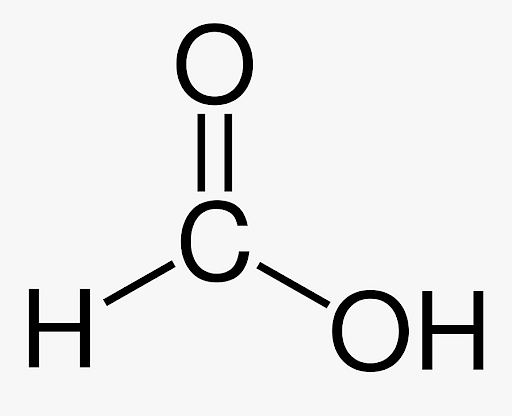
Structure of Formic Acid
Formic Acid Physical Properties
[Click Here for Sample Questions]
- As we've seen, the IUPAC designation for Formic acid is Methanoic acid. It is the first of the carboxylic acids in the homologous series. So far, we've learned about Formic acid's structure and IUPAC name.
- Formic acid seems to be a thick translucent liquid with no discernible color, making it difficult to identify.
- Formic acid has a somewhat higher boiling point than water. Formic acid has a boiling point of 100.8°C.
- Formic acid has a rather low melting point. The melting point of formic acid is only 8.4°C.
- Formic acid has a low density of 1.22g/cm3 and is not a particularly dense liquid.
- The odor of formic acid is distinctively harsh and unpleasant.
- It is water-soluble and miscible.
- Because formic acid is the first in the homologous series, its molecular weight isn't particularly high. Methanoic acid has a molecular weight of 46.03 g/mol.
Also Read:
| Related Articles | ||
|---|---|---|
| Acids and Bases | Calculate Ph of Weak Acid | Acids Bases Salts |
| Base Meaning | Oxalic Acid | Tannic Acid |
Formic Acid Chemical Properties
[Click Here for Sample Questions]
- Formic acid, as its name implies, is acidic and can convert blue litmus to red litmus.
- Formic acid is a donor of hydrogen bonds.
- In most cases, formic acid comprises carbon and carbon types of covalent connections. Carbon forms all covalent bonds in formic acid as well. Only covalent bonds exist in formic acid.
- When formic acid combines with formyl chloride, three chlorides are formed namely - phosphoric pentachloride, hydrogen chloride, and phosphoryl chloride. The solution to the equation is given below:
HCOOH + PCl5 → HCOCl + POCl3 + HCL
- Mercuric chloride can be reduced to mercurous chloride by formic acid, resulting in a white precipitate. The reaction's equation is shown below:
HCOOH + 2HgCl2 →Hg2Cl2+ 2HCl+ CO2
Formic Acid Tests
[Click Here for Sample Questions]
All carboxylic acids must pass the following general tests:
- Carboxylic acids change the color of litmus paper from blue to red.
- When a saturated solution of NaHCO3 is added to carboxylic acids, carbon dioxide is produced as effervescence.
- Heating ammonium silver nitrate in formic acid produces a silver mirror.
- A crimson cuprous oxide precipitate is generated when formic acid is heated with Fehling's solution. When formic acid is heated with mercuric chloride solution, mercurous chloride is produced, resulting in a white precipitate.
- It is neutralized by ammonium hydroxide, then a few drops of ferric chloride solution are added to give it a red color.
- Carbon monoxide gas is released when concentrated sulfuric acid is heated, and it burns with flame.
Also Read: Dilution Formula
Formic Acid Manufacturing Processes
[Click Here for Sample Questions]
Formamide is formed by reacting methyl formate with formamide.
Methyl formate is generated when methanol and carbon monoxide combine in the presence of a strong base. Below is the chemical reaction to the above-mentioned procedure
CH3OH + CO → HCO2CH3
In industries too this procedure is employed, and the reaction is carried out under particular conditions. The following are typical circumstances for the reaction's progress to be possible:
- The temperature of 80 °C
- a pressure of 40 atm
- phase of liquid
Sodium methoxide is the most common base utilized in this method.
The major result of hydrolysis of the obtained methyl formate is our target chemical. We also obtain various byproducts as a result of this. The following is the hydrolysis reaction:

However, the approach described above has a drawback. The ammonium sulphate that is produced as a by-product of the reaction must be disposed of. Because the chemical is dangerous and can cause significant environmental harm, disposing of it is a time-consuming operation. Numerous governments have restricted the disposal of chemicals into the environment to safeguard it. This has created challenges for several manufacturers of Formic Acid.
Formic Acid Functions
[Click Here for Sample Questions]
- Because formic acid alone is unable to eliminate iron oxide deposits, it is used in combination with citric acid.
- Industrial chemicals in saturated monocarboxylic acids are one of the main areas where formic acid is beneficial.
- Formic acid is an excellent reducing agent for potassium dichromate and sodium reduction.
- It is used in the tanning and dyeing sectors, but other assets are cheaper, thus formic acid is only used in a few circumstances where it has a distinct benefit.
- As a result of its antibacterial qualities, formic acid is widely used in the agriculture industry.
- It is widely used as a pesticide and is effective in preventing pest assaults on crops.
Also Read: List of Strong Acids
Things to Remember
- Pure formic acid is a colorless, flammable liquid with a pungent odour that irritates mucous membranes and creates blisters on the skin.
- Carbon monoxide and sodium hydroxide in the presence of water react to form sodium formate, which then reacts with sulphuric acid to form formic acid.
- IUPAC designation for Formic acid is Methanoic acid. It is the first of the carboxylic acids in the homologous series.
- The odor of formic acid is distinctively harsh and unpleasant. It is water-soluble and miscible.
- A crimson cuprous oxide precipitate is generated when formic acid is heated with Fehling's solution. When formic acid is heated with mercuric chloride solution, mercurous chloride is produced, resulting in a white precipitate.
- Industrial chemicals in saturated monocarboxylic acids are one of the main areas where formic acid is beneficial.
Also Read:
Sample Questions
Ques: What is formic acid's chemical formula? What exactly is the function of formic acid? (2 marks)
Answer: Formic acid has the chemical formula HCOOH. It has a carboxyl group as well as an aldehyde group.
In cattle feed, formic acid is utilized as an antimicrobial and preservative. It's a key component in domestic limescale removers.
Ques: Is it true that formic acid is a powerful acid? (2 marks)
Answer: A strong acid is one that completely dissociates in an aqueous solution. In an aqueous solution, a weak acid dissociates somewhat. Formic acid (methanoic acid, HCOOH) is a weak acid that is found in bee and ant stings. Ant distillation was once used to make the acid.
Ques: Is it true that formic acid is detrimental to humans? (2 marks)
Answer: Formic acid is an unpleasant chemical found in some ant species' sprayed venom and some stinging nettle secretions. At large doses, this is hazardous, but at low concentrations, it is quite effective. Humans utilize formic acid as a food preservative because it is antibacterial.
Ques: Where does formic acid come from? (2 marks)
Answer: With only one carbon atom, this is the most basic carboxylic acid. It can be found in nature in numerous forms, such as bee and ant sting venom, and is a useful organic synthesis reagent. It is mostly employed as a preservative and antibacterial ingredient in livestock feed.
Ques: What is more acidic - Formic or acetic acid? (2 marks)
Answer: Because it lacks a contributing group of electrons, formic acid is more powerful than acetic acid. One of the reasons that acetic acid is less acidic than formic acid is because the methyl group is an electron-donating group that destabilizes the conjugate base's negative charge.
Ques: What is the best way to neutralize formic acid? (2 marks)
Answer: Baking soda (NaHCO3) can also be used to neutralize acids, such as formic acid. If you spilled formic acid solution on your skin, use a thick paste of sodium bicarbonate water to neutralize it (NaHCO3).
For Latest Updates on Upcoming Board Exams, Click Here: https://t.me/class_10_12_board_updates
Check-Out:



Comments