



Education Content Expert
Coincident Lines are those lines that coincide or lie on top of each other. The pair of two lines that overlap each other are called coincident lines. The equations of the two coincident lines are the same when reduced to the simplest form. For instance, x + y = 8 and 2x + 2y = 16 are the equations of two coincident lines. The equation of both these lines is x + y = 8 in their simplest form, thus, these two lines are coincident lines.
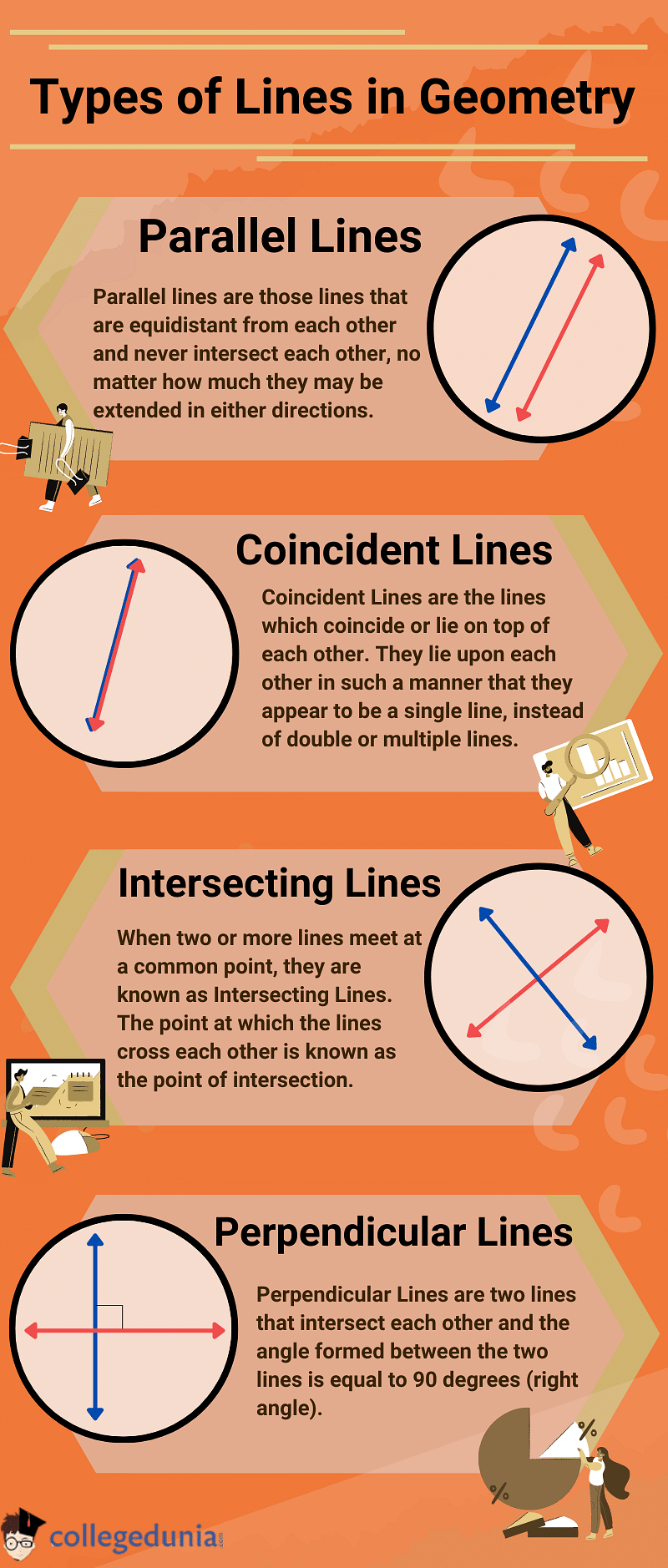
There are three major types of lines in Geometry namely parallel lines, perpendicular lines, and coincident lines. Parallel lines have a defined distance between them and do not intersect each other. Perpendicular lines are the lines that intersect each other at 90 degrees.
| Table of Content |
Key Terms: Coincident Lines, Parallel Lines, Perpendicular Lines, Coincident Lines Equation, Variables, Linear Equations in Two Variables
What are Coincident Lines?
[Click Here for Sample Questions]
Coincident lines are the lines that lie on top of each other. Coincident lines are the lines in which one line completely covers the other line in such a manner that they appear as a single line instead of double or multiple lines.
Consider the figure given below, both lines l and m appear to be a single line, but actually, there are two lines here. Thus line l and line m are coincident lines.

Coincident Lines
Read More:
| Relevant Concepts | ||
|---|---|---|
| Perpendicular Line Formula | Line Segment | Horizontal and Vertical Lines |
| Angle between Two Lines | Different Forms of the Equation of Line | Properties of Parallel Lines |
Coincident Lines Equation
[Click Here for Sample Questions]
The equation of a line is represented in the standard form as
y = mx + b
Where
- m is the slope.
- b is the y-intercept of the line.
Equation of Coincident Lines
The equation for coincident lines is given as
ax + by = c
When two lines coincide with each other, then there could be no other interruption between them.
For example, 3x +3y = 9 and 9x + 9y = 27 are two coinciding lines.
First Line: 3y = 9 - 3x
⇒ y =3 - x
x = 3 - y
Second Line: 9y = 27 - 9x
y = (27 - 9x) / 9 = 3 - x
x = (27 - 9y) / 9
x = 3 - y
We can see that the "x" and "y" values are the same. Thus, the given lines are coincident lines.
Read More: Equation of Straight Line Formula
Coincident Lines Graph
[Click Here for Sample Questions]
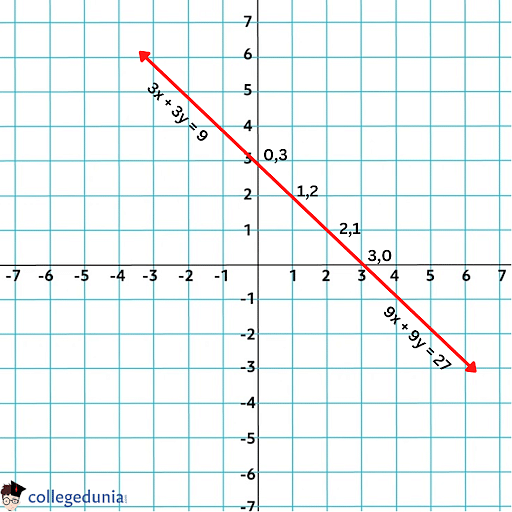
Coincident Lines appear like there is one line in graphical representation, but there will be two or more lines on top of each other. Taking the example of the above-mentioned coincident lines, the graphical representation of both coincident lines is given below.
- First Line: 3x +3y = 9
- Second Line: 9x + 9y = 27
On solving both equations, we will plot the points on the graph in the given manner:
Coincident Lines Graph
Coincident Lines Solution
[Click Here for Sample Questions]
Coincident lines are those lines that lie on top of each other and they have infinite solutions. We can find the solution for the equations of the above-mentioned coincident lines as follows:
First Line: 3x +3y = 9
⇒ y =3 - x
⇒ x = 3 - y
Second Line: 9x + 9y = 27
⇒ y = 3 - x
⇒ x = 3 - y
When x = 0, y = 3 ; x = 1, y = 2 and it continues. When y = 0, x = 3; y = 1, x = 2 and so on. We can see that the value of x and y are the same in both lines. There are infinite solutions possible on the lines because every point on the lines on the graph is common to both the coincident lines.
Thus, the values of x and y in both equations will be the same, and there are infinite common points and solutions possible for coincident lines.
Types of Lines
Coincident lines Formula
[Click Here for Sample Questions]
Coincident Lines Formula helps us to check whether a given set of linear equations represent a pair of coincident lines or not.
Consider that the pair of linear equations in two variables is given as:
a1x + b1y + c1 = 0 and a2x + b2y + c2 = 0
Then, the lines representing these equations are said to be coincident if
This is the coincident lines’ formula, and the lines that satisfy this formula are called consistent and they can have infinitely many solutions.
Read More: Pair of Linear Equations in Two Variables Formula
Solved ExampleExample: Find out whether the lines representing the pair of equations18x – 4y + 32 = 0 and 9x – 2y + 16 = 0 and are coincident or not. Solution: It is given that,
On comparing the given equations with a1x + b1y + c1 = 0 and a2x + b2y + c2 = 0,
Putting the values in the coincident lines formula, we get
Thus, a1/a2 = b1/b2 = c1/c2 Hence, the lines representing the given equations are coincident. |
Difference between Parallel and Coincident Lines
Parallel Lines and Coincident Lines are two of the main types of lines in Geometry.
- Parallel lines have constant space between them and the lines never intersect each other.
- Coincident lines are on top of each other or one line completely covers the other line. Parallel lines do not have common points whereas coincident lines have infinite common points.
Read More:
| Related Topics | ||
|---|---|---|
| Parallel Line Formula | Lines and Angles | Transversal and Angles |
| Concurrent Lines | Distance Between Two Lines | Intersecting Lines and Non-intersecting Lines |
Things to Remember
- Coincident lines are defined as those lines that lie on top of each other.
- Coincident lines lie upon each other in such a manner that they appear to be a single line.
- The lines representing a pair of linear equations in two variables are said to be coincident if: a1/a2 = b1/b2 = c1/c2.
- Coincident lines are consistent and have infinite solutions.
- Coincident lines are neither parallel lines nor perpendicular lines however are completely similar to each other.
- The difference between parallel lines and coincident lines is that parallel lines have constant space between them and never intersect each other, whereas coincident lines lie on top of each other.
Sample Questions
Ques. Check whether the following pair of equations are coincident lines or not. 3x – 1y + 8 = 0; 6x – 2y + 16 = 0. (3 Marks)
Ans. Here, we will use the formula of the coincident lines to determine whether the given pair of lines are coincident lines or not.
- Equation 1: 3x – 1y + 8 = 0
- Equation 2: 6x – 2y + 16 = 0
From equation 1, 3x – 1y + 8 = 0, a1 = 3, b1 = -1, c1 = 8
From equation 2, 6x – 2y + 16 = 0, we can interpret that, a2 = 6, b2 = -2, c2 = 16
Using the coincident lines formula,
a1/a2 = b1/b2 = c1/c2
- a1/a2 = 3/6 = 1/2
- b1/b2 = -1/-2 = 1/2
- c1/c2 = 8/16 = 1/2
Thus, we can see that, a1/a2 = b1/b2 = c1/c2
1/2 = 1/2 = 1/2
Therefore, the given pair of lines are coincident lines.
Ques. Find out whether the given pair of lines are coincident lines or not. 4x + 4y + 1 = 0; 8x + 12y + 4 = 0. (3 Marks)
Ans. We can check whether the given pair of lines are coincident lines or not through the coincident lines formula.
- From Equation 1: 4x + 4y + 1 = 0, a1 = 4, b1 = 4, c1 = 1
- From Equation 2: 8x + 12y + 4, a2 = 8, b2 = 12, c2= 4
Using the coincident lines formula,
a1/a2 = b1/b2 = c1/c2
- a1/a2 = 4/8 = 1/2
- b1/b2 = 4/12 = 1/3
- c1/c2 = 1/4
Here, a1/a2 ≠ b1/b2 ≠ c1/c2
1/2 ≠ 1/3 ≠ 1/4
Thus, the given pair of lines are not coincident lines.
Ques. What are Coincident Lines? (3 Marks)
Ans. Coincident lines are two or more lines that cover each other completely or in simpler terms lie on top of one another. Coincident lines appear as a single line on the graph, however, in reality, there are two or more lines on top of each other with infinite common points. They also have infinite solutions.
Ques. How to check if two lines are Coincident Lines? (3 Marks)
Ans. We can check whether two lines are coincident or not, by using the formula given below:
a1/a2 = b1/b2 = c1/c2.
For instance, 7x + 14y + 1 = 0 and 14x + 28y + 2 = 0 are the equation of two lines. Here, in equation 1, a1 = 7, b1 = 14, c1 = 1 and in equation 2, a2 = 14, b2 = 28, c2 = 2.
Using the formula, a1/a2 = b1/b2 = c1/c2 ⇒ 1/2 = 1/2 = ½. It means that the given lines are coincident lines.
Ques. What is the main difference between Intersecting Lines and Coincident Lines? (3 Marks)
Ans. Intersecting Lines and Coincident Lines are two types of lines in Geometry. When two lines meet at a point or intersect each other, then they are called intersecting lines, whereas, the lines that exactly overlap or cover each other are known as coincident lines. Intersecting lines have only one common point while coincident lines have many common points as every point that is on one line is also a point on the second line.
Ques. What is the equation for Coincident Lines? (3 Marks)
Ans. The equation of a line is given in the form ax + by = c. When two lines are coincident, then, there is no intercept difference between the lines. Thus, both the equations of the two lines are actually the same in the case of coincident lines. For example, the first line is 4x + 4y = 8 and the second line is 8x + 8y = 16. They are coincident lines as both equations are actually the same on simplification.
Ques. What is the Coincident Lines Formula? (3 Marks)
Ans. According to the Coincident Lines Formula, if the given two lines are in the form: a1x + b1y + c1 = 0 and a2x + b2y + c2 = 0, then the lines representing the given equations can be considered as coincident lines only if they satisfy the condition: a1/a2 = b1/b2 = c1/c2. Thus, the formula to check whether lines are coincident or not is: a1/a2 = b1/b2 = c1/c2.
Ques. Are Coincident Lines perpendicular to each other? (2 Marks)
Ans. Perpendicular lines are defined as lines that intersect at a 90-degree angle or right angle. Thus, coincident lines are not perpendicular lines as the perpendicular lines have a common intersection point making a 90-degree angle whereas coincident lines have many common points.
Ques. State the difference between Coincident Lines and Parallel Lines. (2 Marks)
Ans. Parallel lines do not have common points as the lines are parallel to each other maintaining a constant distance whereas coincident lines have infinite common points and thus, they do not have constant space because lines are on top of each other.
Ques. How many solutions do coincident lines have? (1 Mark)
Ans. Coincident lines have an infinite number of solutions as they overlap each other and have infinite common points.
Check-Out:



Comments