



Education Journalist | Study Abroad Lead
A continuous function is a function in mathematics that continues and does not have any break in its expected range of values. A continuous function is applied in almost every function to ensure small changes in their values. When a function can be drawn without picking up the pencil it is also called a continuous function. A function that is not continuous and has a break in-between, is known as a discontinuous function.
| Table of Content |
Key Takeaways: Continuous function, Discontinuous function, Continuity and discontinuity, Function, f(x)
Also read: Integration by Partial Fractions
Continuity
[Click Here for Sample Questions]
Function is said to continue in a given space if there is no separation of the activity graph throughout the interval. Assume that the “f” function is actually a set of real numbers and that “c” is a point in the field of f. Then f continues to c if
lim x → c f (x) = f (c)
Or in other words,
A function is said to be continuous at x = c where x belongs to domain of f(x) if
lim x → c- f (x) = lim x → c+ = f (c)
i.e., LHL = RHL = Value of function at x = c
Condition For Continuity
- It must be defined at that point.
- Its limit must exist at the point
- The value of the function at that point must equal the value of the limit at that point.
Continuous Function Properties
- f + g continues to x = c.
- f - g continues to x = c.
- f. g continues to x = c.
- f / g continues to x = c, (provided g (c) ≠ 0).
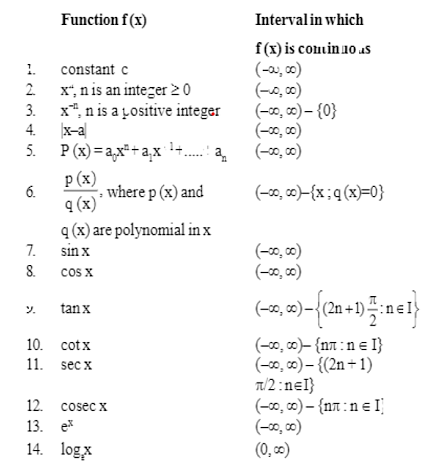
Various Continuous Functions
Also read: Difference between Sequence and Series
Discover about the Chapter video:
Continuity and Differentiability Detailed Video Explanation:
Discontinuity
[Click Here for Sample Questions]
In mathematics a function is said to be a discontinuous function when the continuity of a function breaks. When the function f(x) of the left hand limit is not equal to the right hand limit function it is said to be a discontinuous function of the first order.
Reasons for Discontinuity
If f(x) is not continuous at x= c, we say that f(x) is discontinuous at x = c.
Possibilities for Discontinuities
- lim x → c- f (x) and lim x → c+ exists but they are not equal.
- lim x → c- f (x) and lim x → c+ exist and are equal but not equal to f(a).
- f(c) is not defined.
Types of Discontinuities
There are four different types of Discontinuities are:
- Removable Discontinuity
- Jump Discontinuity
- Infinite Discontinuity
Removable Discontinuity
In deductions, the function with the two-dimensional limits is clearly defined as x = a, but either f (a) is not defined or f (a) does not correspond to its limits. Removable Discontinuity can be granted by:
Lim x → a f (x) ≠ f(a)
This type of discontinuation can be easily eliminated by redefining the function in such a way
f ( a ) = lim x → a f (x)

Jump Discontinuity
Jump Discontinuity is a type of non-continuity, where the left-hand and right-hand limit of the function x = a is present, but they do not match each other. Stopping jumping can be represented as follows:
lim x → a + f(x) ≠ lim x → a − f(x)

Infinite Discontinuity
With continuity, the function varies from x = a to provide a non-continuous environment. It means that the function f (a) is not defined. Since the value of the function x = a does not come close to any value or is inclined to infinity, the limit of activity x → a is also not defined.

Also Read: Integral Formula
Things to Remember
- Function f is said to be continuous in an open interval (a, b) if it is continuous at every point in this interval.
- Function f is said to be continuous in the closed interval [a, b] if f is continuous in (a, b)
lim x → a + f (x) = f (a)
lim x → b - f (x) = f (b)
- For a function to be continuous, it has to satisfy LHL = RHL = Limit At That Point for function f(x).
lim x → c - f (x) = lim x → c + = f (c)
- For graphical functions graph, function or curve must go continuous they must not be any discontinuity in graph
- For function to be discontinuous at x = c :
limx → c − f (x) and lim x → c + f (x) exist but are not equal.
lim x → c − f (x) and lim x → c + f (x) exist and are equal but not equal to f (c).
f (c) is not defined
Also Read:
Sample Questions
Ques. Based on this graph, decide where the function is continuous or discontinuous.  (2 marks)
Ans: It is a discontinuous function as the curve is not continuous.
Points of discontinuities are x = − 4, x = 2 and x = 4.
Ques. Based on this graph given below, decide where the function is continuous or discontinuous.  (2 marks)
Ans: It is a discontinuous function as the curve is not continuous.
Points of discontinuities are x = − 8, x = -2 and x = 6.
Ques. Determine the given function is continuous or not at x = 0 and x = -1. f(x)=(4x+5)/(9−3x) (4 marks)
Ans: For x = 0,
Lim x → 0 f (x) = lim x → 0 (4 x + 5) / (9 – 3x)
= lim x → 0 (4x + 5) / lim x → 0 (9 − 3x) = [4 lim x → 0 x + lim x → 0 5 ]/ lim x → 0 9 – 3 limx → 0 (x)
= {4 (0) + 5} / (9 − 3(0))
= f (0)
As, lim x → 0 f (x) = f (0) so. The function is continuous at x = 0.
For x = 1,
Lim x → -1 f (x) = lim x → -1 (4 x + 5) / (9 – 3x)
= lim x → -1 (4x+5) / lim x → -1 (9−3x)
= [4 lim x → -1 x + lim x → -1 5 ]/ limx → -1 9 – 3 lim x → -1 x
= lim x → -1 {4(−1)+5} / {9−3(−1) }
= f(−1)
As, lim x → -1 f (x) = f (-1) so. The function is continuous at x = -1.
Ques. Prove that function f is defined as f(x)={xsin1/x if x≠0, 0 if x=0 is continuous at x =0. (2 marks)
Ans: LHL at x = 0,
Lim x→0− f(x) = limx→0− x sin1/x = 0 As, -1
Similarly, lim x→0+ f(x) = lim x→0+ x sin1/x = 0 [f(0) =0]
Thus, limx→0− f(x) = lim x→0+ f(x) = f(0)
Hence, the function f(x) is continuous at x =0.
Ques. Determine the function f(x) = -x2 + 4 if x<= 3, 4x - 8 and x > 3 is continuous at x = 3. (3 marks)
Ans: For a function to continuous LHL = RHL = Limit at that point
So,
f(3) = -(3)2 + 4 = -5
Thus f(3) is defined.
Now, lim x→3 f(x).
For this we have to calculate lim x→3- f(x) and lim x→3+ f(x):
lim x→3- f(x) = -(3)2 + 4 = -5
and
lim x→3+ f(x) = 4(3) – 8 = 4.
As LHL ≠ RHL ≠ Limit At That Point
Hence, lim x→3 f(x) does not exist. Thus, f(x) is not continuous at 3.
Ques. Determine the function f(x) = sinx / x if x ≠ 0, if x = 0 is continuous at x = 0. (2 marks)
Ans: As, f(0) = 1
Then,
lim x→0 f(x) = lim x→0 sinx / x = 1
Now comparing with f(0) and lim x→0 f(x),
f(0) = 1 = lim x→0 f(x)
Hence, LHL = RHL = Limit At That Point, so the function is continuous at x = 0.
Ques. For what values of x, f(x) = (x+17) / (x – 5) is continuous? For what values of x, f(x) = 6x5 – 16x2 is continuous? (2 marks)
Ans: Function f(x) = (x+1) / (x – 5) is continuous everywhere except at x = 5
As it is a polynomial function so f(x) is continuous at every real number.
Ques. State the interval(s) over which the function f(x) = √(4 - x2) is continuous. (2 marks)
Ans: As, lim x→a √(4 - x2) = √(4 - a2) for all values of a in (-2 , 2).
LHL = lim x→2 - √(4 - x22) = 0 and RHL = lim x→2+ √(4 - x2) = 0
Therefore, f(x) is continuous over the interval [-2 , 2].
Ques. Find the relation between a and b if the following function is continuous at x = 4. (3 marks)
f(x) = { ax − 3, if x ≤ 4 b x + 8, if x > 4
ax − 3, if x ≤ 4 b x + 8, if x > 4
Ans: As, f(x) is a continuous function at x = 4.
Then,
lim x→4- f(x) = limx→4+ f(x) = f(4)
lim x→4 (ax - 3) = lim x→4 (bx + 8) = a(4) - 3
Hence, b(4) + 8 = a(4) - 3
So, from the first two expressions,
4a - 3 = 4b + 8
4a - 4b = 11
Therefore, the relation between a and b is 4a - 4b = 11.
For Latest Updates on Upcoming Board Exams, Click Here: https://t.me/class_10_12_board_updates
Check-Out:



Comments