



Content Curator
Calculus is the mathematical analysis of continuous change which mainly has two branches, differential calculus, and integral calculus. The Fundamental Theorem of Calculus states the relationship between differentiation and integration of a function. These two concepts apparently seem to have no relation between them, one arises from an area problem and the other from a tangent problem. The fundamental theorem establishes the link between the two. In this article, we will understand the two theorems under the fundamental theorem of calculus and evaluate the definite integral thereby.
Read More: Inverse Trigonometric Formula
| Table of Content |
Key Terms: Area of Function, Calculus, differentiation, derivative function, basic fundamental theorems, definite integral calculation
Area Function
[Click Here for Sample Questions]

Area Function
To find the area enclosed by a curve denoted as y=f(x), which is defined in the interval [a, b], the integral will be ab  f(x)dx. If x is a point within the closed interval [a, b], the area will be denoted by

Here, we are assuming f(x) > 0 and x belongs to (a, b) and is non negative. However, the assertions made above are true for the other functions also. The area of the shaded portion depends on the value of ‘x’. This is denoted by A(x).
This helps in defining the two basic fundamental theorems of calculus.
Integrals Detailed Video Explanation
Also Read:
| Related Articles | ||
|---|---|---|
| Complex Numbers and Quadratic Equations | Geometric Mean (G.M.) | Bayes Theorem Formula |
| Sequence and Series | Arithmetic Progressions Revision Notes | Real Numbers Formula |
First Fundamental Theorem of Calculus
[Click Here for Sample Questions]
Statement: Let f be a continuous function on the closed interval [a, b] and A(x) be the area function. Then A’(x) = f(x), for all x lying in [a, b].
To make it simpler, let f be a continuous function defined on [a, b] and F be the function defined for all x in [a, b] by,

Then, F is uniformly continuous on the [a, b] and differentiable on (a, b) and F’(x)=f(x) for all x belonging to (a, b).
Therefore, F’(x) is a derivative function of F(x).
Read More: Inverse Matrix Formula
Second Fundamental Theorem of Calculus
[Click Here for Sample Questions]
Statement: Let f be a continuous function on the closed interval [a, b] and F is an indefinite integral of a function f on [a,b], then
F(b) - F(a)= f(x) dx
F(b) - F(a) is the definite integral of F in the integral [a, b]
Where f(x) is the integral and,
dx indicates the integrating agent,
a is the upper limit of integral and b is the lower limit of integral.
Remarks
![Integral]() f(x)dx is defined by the difference between antiderivative F at upper limit b and lower limit a.
f(x)dx is defined by the difference between antiderivative F at upper limit b and lower limit a.- Here, f(x) must be well defined and continuous lying in [a,b].
- This theorem allows the estimation of definite integral faster without determining the sum’s limit.
- To estimate a definite integral, the most important step is finding a function whose derivative is equal to the integrand.
 f(x)dx is defined by the difference between antiderivative F at upper limit b and lower limit a.
Read More: Calculus Formula
Method of Definite Integral Calculation
[Click Here for Sample Questions]
To calculate the value of a definite integral, follow these steps given below,
- First, determine the indefinite integral of f(x) as F(x).
 f(x)dx=[F(x)+C]]ab= [F(b)+C] - [F(a)+C] = F(b)-F(a)
Here, C is the arbitrary constant that cancels itself out on calculating the definite integral.
- Calculate F(b)-F(a) applying the values of a and b. This gives the value of the definite integral of f in x lying between [a, b].
Also Read:
| Related Articles | ||
|---|---|---|
| DEFINITE INTEGRAL | FUNDAMENTAL THEOREM OF CALCULUS | Determinant Formula |
| INTEGRATION BY PARTIAL FRACTIONS | INTEGRATION BY PARTS | Onto Function |
Things to Remember
- Calculus is the mathematical analysis of continuous change which mainly has two branches, differential calculus, and integral calculus.
- The Fundamental Theorem of Calculus states the relationship between differentiation and integration of a function.
- These two concepts apparently seem to have no relation between them, one arises from an area problem and the other from a tangent problem.
- The fundamental theorem establishes the link between the two.
Sample Questions
Ques. Evaluate the integral y= \(\frac{12xdx}{(x+1)(x+2)}\) (2 marks)
Solution.

Applying the second fundamental theorem of calculus,we get
y=F(2) -F(1)=[-log 3+2log 4] -[-log 2+2log 3]= -3log 3+log 2+2log 4=log(32/27)
Ques. Evaluate (x3-x2) dx (2 marks)
Solution. Using the second fundamental theorem of calculus,
(x3-x2) dx=(x44-x33)=(16/4-8/3)-0=4/3
Ques. Find the area bounded by the curves y=x and y=x2. (2 marks)
Solution. Given, y=x2 and y=x
x2=x
x2-x =0x(x3/2-1)=0
x1=0, x2=1
So, the curves intersect at the points (0, 0) and (1, 1).
Therefore the area between the curves will be
A=01(x-x2) dx =(x3/23/2-x33)=1/3(2x3-x3) =1/3
Ques. Evaluate:  (2 marks)
Solution:

Ques. Evaluate:  (3 marks)
Solution:

Ques. Evaluate:  (3 marks)
Solution:

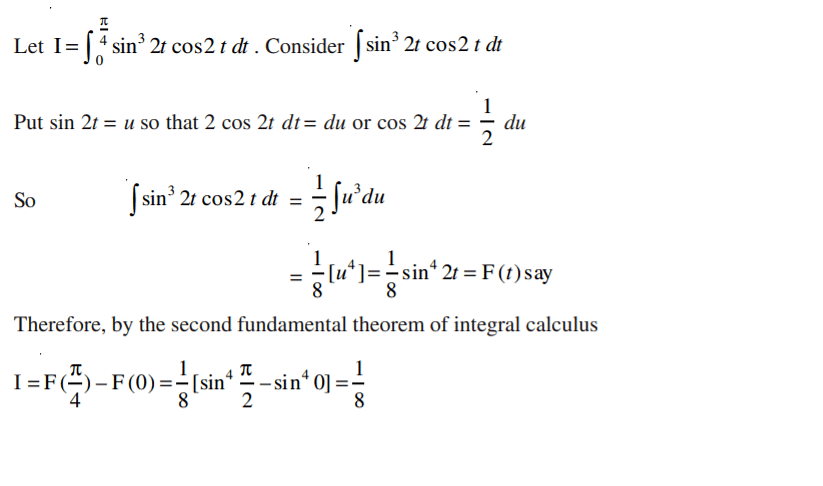
Ques. Evaluate:  (5 Marks)
Solution:
Ques. State the first fundamental theorem of Calculus. (1 mark)
Ans. The first fundamental theorem of calculus explains the derivative of the integral of a function gives the integrand which means the distinction and integration are inverse operations. Additionally, they cancel each other out and the integral function is an antiderivative.
Ques. State the second fundamental theorem of Calculus. (2 marks)
Ans. The fundamental theorem of calculus part 2 states that it holds ∫a continuous function on an open interval I and on any point in I. Moreover, it states that F is defined by the integral i.e, anti-derivative.
Ques. Do you think anti-derivatives and integrals are the same? (2 marks)
Ans. Definite integral gives the integral between a and I along with the same point. While, on the other hand, indefinite integral shows the integral between a and I at some indefinite point which is represented by the variable x. Nevertheless, according to the fundamental theorem of calculus, the anti-derivatives and indefinite integrals are the same.
Ques. Why is the area of anti-derivative under the curve? (2 marks)
Ans. When the integration of a function is f(x), the anti-derivative will be F(x). Additionally, if we assess the anti-derivative over a specific area [a,b], then we will get the area under the curve.
For Latest Updates on Upcoming Board Exams, Click Here: https://t.me/class_10_12_board_updates
Check-Out:



Comments