



Content Curator
Multiple angles, in trigonometry, are commonly found in trigonometric functions. It is not possible to directly determine the values of many angles, but they can be determined by expressing each trigonometric function in its extended form.
- The multiple-angle formulas include the double and triple-angle formulas. The common functions employed in the multiple-angle formula include sine, tangent, and cosine.
- In mathematics, multiple angles are the types of angles that are a multiple of a given angle.
- For example, the sine and cosine of multiple angles can be represented in terms of the sine and cosine of the given angle using trigonometric identities.
- Multiple angle formulas can be used to simplify trigonometric expressions and to find exact solutions to trigonometric equations.
Read Also: NCERT Solutions for Class 11 Mathematics Trigonometric Functions
| Table of Content |
Key Terms: Multiple Angles, Trigonometric Functions, Double Angle, Triple Angle, Sine, Tangent, Trigonometric Equations, Binomial Theorem, Euler’s Formula
What are Multiple Angles?
[Click Here for Sample Questions]
Multiple angles can be seen in Trigonometric Functions. The values of the multiple angles cannot be found directly, yet their values can be evaluated by expressing every trigonometric function in its expanded form.
- The trigonometric function of multiple angles is known as the multiple-angle formula.
- The double and triple angles formula are often applicable under the Multiple-Angle formulas.
- It's important to note that while multiple-angle formulas help simplify trigonometric expressions, they should be used with care as they can sometimes lead to numerical instability or loss of precision.
- It's usually better to use these formulas in conjunction with other techniques, such as factoring or substitution, to simplify trigonometric expressions.
- Sine, Tangent and Cosine are the common functions used for the multiple-angle formula.
Using Euler's formula and the Binomial Theorem, one can calculate multiple angles of the type sin nx, cos nx, and tan nx, which are all represented in terms of sin x. The double and triple-angle formulas are examples of multiple-angle formulas. The multiple-angle formula is another name for the trigonometric function of multiple angles.
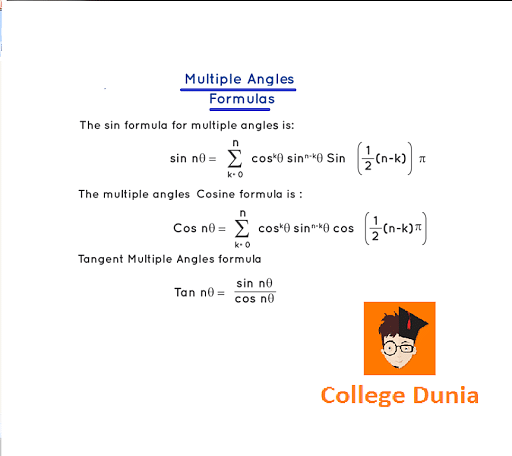
Multiple Angles Formulas
Check Also:
Multiple Angles Formula
[Click Here for Previous Year Questions]
Multiple angle formulas are used in trigonometry in order to express trigonometric functions of angles which are multiples of a given angle in terms of trigonometric functions of the given angle. With the help of these formulas, trigonometric expressions can be simplified and trigonometric equations can be solved.
Sine Formula
For multiple angles, the sin formula is as follows:
| \(sin \text{ n}\theta = \displaystyle\sum_{k=0}^{n} cos^{k} \theta \text{ sin}^{n-k}\theta \text{ sin} [\frac{1}{2}(n-k)\pi]\) |
Where n = 1, 2, 3...
The following are some basic formulas:
- Sin 2θ = 2 × Cosθ.Sinθ
- Sin 3θ = 3 Sinθ – 4 Sin3θ
Cosine Formula
For multiple angle, the cosine formula is:
| \(cos \text{ n}\theta = \displaystyle\sum_{k=0}^{n} cos^{k} \theta \text{ sin}^{n-k}\theta \text{ cos} [\frac{1}{2}(n-k)\pi]\) |
Where n = 1, 2, 3…
The following are basic formulas:
- Cos 2θ = Cos 2θ – Sin 2θ
- Cos 3θ = 4Cos 3θ – 3Cos θ
Tangent Formula
For multiple angle, the tangent formula is:
| \(Tan \text{ n}\theta = \frac{Sin\text{ n}\theta}{Cos\text{ n}\theta}\) |
Where n = 1, 2, 3..
Its basic formula can be represented as:
→ tan nθ = sin nθ/cos nθ
Trigonometric Ratios for Multiple Angles
The following are the important trigonometric ratios for multiple angle equations.
- sin 2A = 2 sin A cos A
- cos 2A = cos2A – sin2A
- sin 2A = 2 tan A/(1 + tan2A)
- cos 2A = 2 cos2A – 1
- cos 2A = 1 – 2 sin2A
- 2 cos2 A = 1 + cos 2A
- 2 sin2 A = 1 – cos 2A
- tan2 A = (1 – cos 2A)/(1 + cos 2A)
- cos 2A = (1 – tan2 A)/(1 + tan2 A)
- tan 2A = 2 tan A/(1 – tan2 A)
- sin 3A = 3 sin A – 4 sin3A
- cos 3A = 4 cos3A – 3 cos A
- tan 3A = (3 tan A – tan3A)/(1 – 3 tan2A)
Trigonometric Functions Detailed Video Explanation
Also Check:
| Relevant Links | ||
|---|---|---|
| Tangent Function | Cosine Function | Sine Function |
Multiple Angle Formula for Inverse Trigonometric Functions
[Click Here for Sample Questions]
The following are multiple angle formulae for various inverse trigonometric functions.
- 2 sin-1x = sin-1(2x√(1-x2))
- 2 cos-1x = cos-1(2x2-1)
- 2 tan-1x = tan-1(2x/(1-x2)) = sin-1(2x/(1+x2) = cos-1(1-x2)/(1+x2)
- 3 sin-1x = sin-1(3x-4x3)
- 3 cos-1x = cos-1(4x3-3x)
- 3 tan-1x = tan-1[(3x-x3)/(1-3x2)]
Things to Remember
[Click Here for Sample Questions]
- Values of multiple angles can be determined by expressing each trigonometric function in its extended form.
- The multiple-angle formulas include the double and triple-angle formulas.
- The common functions used in multiple angles, in trigonometry, include sine, tangent, and cosine.
- The multiple-angle formula is another name for the trigonometric function of multiple angles.
- The sin formula for multiple angles is: \(sin \text{ n}\theta = \displaystyle\sum_{k=0}^{n} cos^{k} \theta \text{ sin}^{n-k}\theta \text{ sin} [\frac{1}{2}(n-k)\pi]\).
- The cos formula For multiple angles is: \(cos \text{ n}\theta = \displaystyle\sum_{k=0}^{n} cos^{k} \theta \text{ sin}^{n-k}\theta \text{ cos} [\frac{1}{2}(n-k)\pi]\).
- The tan formula For multiple angles is: \(Tan \text{ n}\theta = \frac{Sin\text{ n}\theta}{Cos\text{ n}\theta}\).
Read More:
Previous Year Questions
- Considering only the principal values of inverse functions...(JEE Mains 2019)
- The value of sin251∘ + sin239∘ is...(KCET 2020)
- Let f(?) = (1+sin2?)(2−sin2?). Then for all values of ?… (WBJEE 2013)
- If 0≤x<π/2, then the number of values of x for which... (JEE Mains 2019)
- If A, B, C are the angles of...(MHT CET 2018)
- Consider a triangular plot \(\Delta\)ABC with sides...(JEE Mains 2019)
- The perimeter of a certain sector of a circle is equal...(KCET 2008)
- In any triangle \(\triangle\)ABC, the simplified form of...(KCET 2011)
Sample Questions
Ques: Prove that cos 5x = 16 cos5 x – 20 cos3 x + 5 cos x: (4 marks)
Ans: L.H.S. = cos 5x
= cos (2x + 3x)
= cos 2x·cos 3x - sin 2x·sin 3x
= (2 cos2 x - 1) (4 cos3 x - 3 cos x) - 2 sin x cos x (3 sin x - 4 sin3 x)
= 8 cos5 x - 10 cos3 x + 3 cos x - 6 cos x sin2 x + 8 cos x sin4 x
= 8 cos5 x - 10 cos3 x + 3 cos x - 6 cos x (1 - cos2 x) + 8 cos x (1 - cos2 x)2
= 8 cos5 x - 10 cos3 x + 3 cos x - 6 cos x + 6 cos3x + 8 cos x - 16 cos3 x + 8 cos5 x
= 16 cos5 x - 20 cos3 x + 5 cos x
Ques: Prove that \((\frac{sin\,2x + sin\,x}{cos\,2x+1+cos\,x}=tan\,x)\). (3 marks)
Ans: Given: Using the multiple angle formulas,
Sin2θ =2×Cosθ.Sinθ and, Cos2θ = Cos2θ – Sin2θ
\(\frac{sin\,2x + sin\,x}{cos\,2x+1+cos\,x}=tan\,x\)
Putting the values in L.H.S
\(\frac{2\,sin\,x\;cos\,x+sin\,x}{cos\,x+2cos^{2}\,x}\)
\(=\frac{sin\,x(1+2cos\,x)}{cos\,x(2\,cos\,x+1)}\)
R.H.S = tanx
Hence proved, \(\frac{sin\,x+sin\,2x}{1+cos\,x+cos\,2x}=tan\,x\)
Ques: Using the multiple angle formula, show that (3 sin A-4 sin3A)/(4 cos3 A – 3 cos A) = tan 3A. (2 marks)
Ans: We can deduce that sin 3A = 3 sin A-4 sin3A.
cos 3A = 4 cos
3 A – 3 cos A
(3 sin A-4 sin3A)/(4 cos3 A – 3 cos A) = sin 3A/cos 3A
tan 3A. proved.
Ques: If sin = 1/2 and the angle is in the first quadrant, calculate sin 2, cos 2, and tan 2. (4 marks)
Ans: Given: sin α = 1/2
So cos α = √(1 – sin2α)
= √(1 – 1/4)
= √3/2
tan α = sin α/cos α
= 1/√3
sin 2α = 2 sin α cos α
= 2.(1/2).√3/2
= √3/2
cos 2α = cos2α – sin2α
= (¾) – (¼)
= 1/2
tan 2α = sin 2α/cos 2α
= √3
Ques: Prove that \((\frac{3 \sin\theta -4 sin^{3}\theta}{4 cos^{3}\, \theta – 3 cos\, \theta}=tan\;3\theta) \) by using multiple angle formulas. (3 marks)
Ans: Using the multiple-angle formulas,
Sin3θ = 3Sinθ - 4Sin3θ, and Cos3θ =4Cos3θ – 3Cosθ
Putting the values in L.H.S,
\(=\frac{3Sin\theta - 4Sin^3\theta}{4Cos^3\theta – 3Cos\theta}\)
\(=\frac{Sin3\theta}{Cos3\theta}\)
R.H.S = tan3θ
Hence proved, \(\frac{3 \sin\theta -4 sin^{3}\theta}{4 cos^{3}\, \theta – 3 cos\, \theta}=tan\;3\theta\)
Ques: Express tan(3α)tan(3α) in terms of “tanα tanα”. (1 mark)
Ans: tan(3α)=tan(2α+α)
=tan(2α)+tanα1−tan(2α)tanα
=2tanα1−tan2α+tanα1−2tanα1−tan2α⋅tanα
=2tanα+tanα(1−tan2α)1−tan2α−2tanα⋅tanα
=3tanα−tan3α1−3tan2α
Ques: What are the formulas for double angles? (3 marks)
Ans: The trigonometric ratios of double angles (2) are written using double-angle formulas in terms of trigonometric ratios of single angles.
The following are the double-angle formulas for sin, cos, and tan:sin
2A = 2 sin A cos A or,
sin 2A = (2 tan A) / (1 + tan2A)
cos 2A = cos2A - sin2A or,
cos 2A = 2cos2A - 1 or,
cos 2A = 1 - 2sin2A or,
cos 2A = (1 - tan2A) / (1 + tan2A)
tan 2A = (2 tan A)/(1 - tan2A)
Ques: Find sin2θ if sin θ = ?. (3 marks)
Ans: We are aware of this.
sin2θ = 2 sin θ cos θ
We need to figure out what cos θ. is.
Let's utilise the sin cos formula cos2θ + sin2θ = 1.
We get cos2θ = 1 - sin2θ
= 1-(9/25)
cos2θ = 16/25
cos θ = 4/5
sin2θ = 2sinθcos θ
= 2 × (3/5) × (4/5) = 24/25
Ques. Prove the following: i) (sin4θ – cos4θ +1) cosec2θ = 2
ii) (√3 + 1) (3 – cot 30°) = tan360° – 2 sin 60°. (5 marks)
Ans. i) As per the L.H.S. = (sin4θ – cos4θ +1) cosec2θ
Thus,
= [(sin2θ – cos2θ) (sin2θ + cos2θ) + 1] cosec2θ
By applying the identity sin2A + cos2A = 1, we get
= (sin2θ – cos2θ + 1) cosec2θ
= [sin2θ – (1 – sin2θ) + 1] cosec2θ
= 2 sin2θ cosec2θ
= 2 sin2θ (1/sin2θ)
= 2
= RHS
ii) As per the LHS,
LHS = (√3 + 1)(3 – cot 30°)
= (√3 + 1)(3 – √3)
= 3√3 – √3.√3 + 3 – √3
= 2√3 – 3 + 3
= 2√3
Then, we can see that:
RHS = tan360° – 2 sin 60°
= (√3)3 – 2(√3/2)
= 3√3 – √3
= 2√3
Thus, (√3 + 1) (3 – cot 30°) = tan360° – 2 sin 60°.
Hence proved.
Ques. Prove that (sin α + cos α) (tan α + cot α) = sec α + cosec α. (4 marks)
Ans. We can prove the identity (sin α + cos α) (tan α + cot α) = sec α + cosec α by:
L.H.S, (sin α + cos α) (tan α + cot α)
= sin α tan α + sin α cot α + cos α tan α + cos α cot α … (by applying the distributive property)
= (sin α/cos α) + (cos α/sin α) + (sin α/cos α) + (cos α/sin α) … (with the definitions of tangent and cotangent)
= (sin2 α + cos2 α)/(sin α cos α) + (cos2 α + sin2 α)/(sin α cos α) … (using cross-multiplication)
= 2/(sin α cos α) (by using the identity sin2 α + cos2 α = 1)
R.H.S, sec α + cosec α
= 1/cos α + 1/sin α … (with the definitions of secant and cosecant)
Here 1/cos α = sec α and 1/ sin α = cosec α.
= (sin α + cos α)/(sin α cos α) … (using cross-multiplication)
It can be seen that the LHS is equal to 2/(sin α cos α) and the RHS is equal to (sin α + cos α)/(sin α cos α), meaning that they are equal to each other.
Hence proved.
For Latest Updates on Upcoming Board Exams, Click Here: https://t.me/class_10_12_board_updates
Also Check:



Comments