



Content Curator
Difference between Predation and Parasitism is that predation is the act of preying upon an animal by another, while parasitism is when an organism lives as a parasite on the body of another organism. Predation and Parasitism are the two forms of interspecific interactions in an ecosystem.
- Individuals from various species interact with one another in interspecific interactions.
- The predator is the active creature in predation, whereas the victim is the passive organism.
- The parasite is the active organism in parasitism, whereas the host is the passive organism.
- Predation differs from parasitism in that the predator kills the prey right away in predation, whereas parasitism does not kill the host organism.
- The parasite may, however, kill the host organism in rare situations.
Read Also: Two Kingdom Classification
| Table of Content |
Key Terms: Parasite, Host, Reproductive Health, Interspecific interaction, Predator, Prey, Ecosystem, Cannibalism, Enzymes
What is Predation?
[Click Here for Sample Questions]
The act of one animal preying upon another is called predation. During predation, the predator is the most active creature. The predator kills the victim right away. Predation includes lions eating zebras, foxes eating bunnies, and bears eating salmon.
This principle may be used by both people and plants. Plant predation includes bears eating berries, bunnies eating lettuce, and grasshoppers devouring leaves. A lion killing a buffalo is an example of predation.
- Predators are known to play an active role in predation, while victims play a passive role.
- Predation can have several meanings based on the species, trophic level, and mode of action.
- It has many different forms, including parasitism, herbivory, and cannibalism.
Predators can be further classified as:
- Herbivores
- Carnivores
- Omnivores.
This helps to maintain the population of prey. By decreasing the level of competition among the prey species, they maintain species variety in a community.
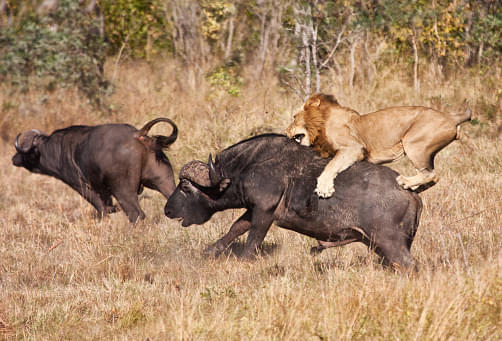
- Predators and prey developed together in the same habitat.
- For sustenance, the predator kills the victim. To kill the prey, the predator must be larger than the prey.
- The predator should likewise be immune to the prey's toxins.
- Animal-eating predators have a monogastric digestive tract.
- The prey also possesses features that aid in the predator's escape.
- It may possess speed, keen perception, poisons, and thorns.
Also Read:
| Concept Related Links | ||
|---|---|---|
| Entomology | Population Interaction | Population |
| Ascariasis | Difference Between Pathogens and Parasites | Parasitism |
What is Parasitism?
[Click Here for Previous Year Questions]
Parasitism is the act of one organism living as a parasite in or on another organism. The connection is damaging to the host organism since the parasite develops, feeds, and is sheltered on it. Although the majority of parasites do not harm their hosts, certain parasites may eventually kill the host.
These parasites are pathogenic, meaning they infect the host and cause sickness. Humans are parasitized by ectoparasites like lice, mosquitoes, and fleas, protozoans like amoeba and Plasmodium, and worms like roundworms, tapeworms, and pinworms. Plant parasites such as aphids and insects feed on the sap. The image below depicts a mosquito biting a person.

Parasites in animals' intestines feed on partially digested food. Parasites are often smaller than the host organism. However, once they have infiltrated the host, they reproduce at a faster pace. Some of the parasitic life cycle's developmental phases take place inside the host.
There are different types of Parasitism, some include:
Endoparasitism
Endoparasites are parasites which live inside the body of its host. The process of this collectively is known as Endoparasitism. The examples of endoparasitism are Nematodes and Hookworms.
Ectoparasitism
When parasites live outside the body of its host, it is referred to as ectoparasitism. Ectoparasitism can be found in organisms like Lice and Ticks.
Mesoparasitism
Mesoparasites partly inhabit the host body. These type of parasites are seen to enter the body via a hole on the host’s external surface.
Brood Parasitism
Brood parasitism takes place when a species parasitizes a host to raise its offspring at the expense of the host. The cuckoo bird is an example of brood parasitism. It incubates eggs in a rival bird’s nest, that further rears the hatchlings.
Obligatory Parasitism
Obligate parasites have to complete all stages of their life cycle upon the host. Obligate parasitism can be seen in a wide variety of organisms, including plants, mammals, fungi, bacteria, and viruses. For instance, head lice are obligate parasites. in order to survive, they must remain on the human scalp.
Facultative Parasitism
Facultative parasites are parasites that can survive without a host, and occasionally engages in parasitic behaviour. These parasites generally do not require the host to complete their life cycle. Strongyloides stercoralis, nematode species, is an example of Facultative Parasitism.
Also Read:
Difference Between Predation and Parasitism
[Click Here for Sample Questions]
Some of the differences between Predation and Parasitism include:
| Predation | Parasitism |
|---|---|
| Predation is the act of one animal preying upon another. | The practice of living as a parasite on or within another organism's body is Parasitism. |
| It occurs when a predator and prey interact. | It occurs when a parasite infects a host organism. |
| Their mode of action includes Hunting, killing, and attacking the prey. | A parasite’s mode of action includes invading the host's cells, surviving, using resources, and damaging the host. |
| Interact with many prey. There is no specific prey-predator relationship there. | They interact with only one host organism. Host-specific parasites. |
| Larger and stronger than the prey. | Smaller than the host organism. |
| Between a predator and prey, there is no metabolic dependency. | There is a close link between metabolic dependency on the host and the parasite. |
| A predator is a very active animal that hunts its prey with much physical effort. | The parasite is generally passive in its progression. |
| Herbivores, Carnivores and Omnivores. | Virus, helminths, and ectoparasites. |
| From the outside, they hunt, kill, and feast on their victim. | Invade living cells, make use of the host's nutrition and other advantages, and damage the host. |
| To get nutrients, they have to kill their prey. | Utilize the nutrients provided by the host organisms. |
| They are known as “surplus killers” because they kill their victims right away. | They do not belong in the category of “surplus killers” since they do not kill the host organism right away. |
| Not dependent on prey to complete their life cycle. | Dependent on host organisms to complete their life cycle. |
Similarities Between Predation and Parasitism
[Click Here for Previous Year Questions]
Some similarities of Predation and Parasitism are:
- The Interspecific interactions between two distinct species in an environment are both predation and parasitism.
- Predation and parasitism are two species that developed in the same habitat.
- Predation and parasitism are both detrimental to one species but advantageous to the other.
Also Read: Genetic Engineering
Things to Remember
- Parasitic castration, directly transmitted parasitism (through touch), trophically transmitted parasites (by being eaten), vector-transmitted parasitism, parasitoids, and micropredation are the six basic parasitic techniques for the exploitation of animal hosts.
- Parasites impair host fitness through a variety of pathologies, ranging from parasite castration to host behavior change.
- Parasitism is typically unmistakable; it is part of a spectrum of interactions between species, ranging from parasitoids to predation, mutualism to mutualism, and saprophytism in some fungi.
- Sharp claws or jaws are used by many predatory creatures, both vertebrates, and invertebrates, to grab, kill, and tear up their prey.
- Micro Predators are little animals that eat only other species, similar to predators.
Also Read: Biotechnology
Previous Years questions
- Choose the correct match showing division of labour with animal ....[KCET 2013]
- Which one of the following groups of three animals is correctly matched with ...[KCET 2013]
- In which of the following animals, haemocyanin pigment is found?...[NEET 2001]
- Transfer of Taenia to secondary host occurs as….[NEET 1989]
- Jelly fish belongs to ...[NEET 1989]
- The diagram of Labeo rohita is given below. Identify the parts ....[KCET 2010]
- Column I contains larval stages and column II contains the group to which ...[KCET 2011]
- In which of the following organisms, self fertilization is seen ?...[KCET 2007]
Sample Questions
Ques. What is the meaning of predator? (1 mark)
Ans. A predator is any organism that survives by killing comparatively smaller organisms in order to survive. An example of the same is when Lions prey upon zebras, it makes them the predator.
Ques. What is the meaning of parasite? (1 mark)
Ans. A Parasite is an organism that lives in, on, or with another organism to acquire nutrients, or multiply in a state that directly or indirectly harms the host.
Ques. How does predation lead to extinction? (1 mark)
Ans. Predators can enhance the likelihood of prey extinction as a result of a catastrophic disturbance by lowering prey population size and altering ecological attributes of prey individuals such as habitat characteristics, making prey species more vulnerable to extinction.
Ques. What are Facultative Parasites? (1 mark)
Ans. Facultative parasites are a type of parasites which can survive without a host. They only occasionally engage in parasitic behaviour. These parasites don’t require the host to complete their life cycle. Strongyloides stercoralis is an example of Facultative Parasitism.
Ques. What is the effect of predation? (2 marks)
Ans. Because predators' impacts originate at the top of the food chain and flow down to lower trophic levels, predation is a top-down force. When predators have an indirect effect on the abundance of species more than two trophic levels below, this is known as a trophic cascade. Predators have far-reaching consequences on their ecosystems. They change the structure of ecosystems by distributing nutrients and seeds obtained via foraging. They also influence lower species in the food chain by affecting the range, quantity, and variety of their prey, a phenomenon known as trophic cascades.
Ques. What is the importance of parasitism? What factors affect predation? (2 marks)
Ans. Parasites can also affect host behavior and fitness, as well as host population levels, which can have significant implications for trophic interactions, food webs, competition, biodiversity, and keystone species. These interactions show that parasites play an important role in determining the organization of communities and ecosystems.
Predation is determined by a variety of factors, including the relative abundance of each food, the potential costs associated with each food, and other factors such as the risk of being eaten by predators, the amount of food available for the prey, the number of different prey species available to a predator, and how quickly the predator and prey species reproduce.
Ques. What are the main characteristics of parasitism? What is a fact about parasitism? (2 marks)
Ans. Parasites have the following characteristics in common: Parasites are generally smaller than their hosts. Invertebrates and vertebrates are both hosts for parasites. Adult parasites can reside on the host (like lice), in the host (like tapeworms), or feed on the host regularly (e.g. mosquitoes).
A parasite can infect an animal's circulatory system, organs, surfaces, and other bodily components, or it can assault the system of a plant. The host receives no benefit and is subjected to infection and other forms of sickness, as well as a reduction in production, lesions, and even death. To live, parasites rely on their hosts.
Ques. What causes parasitism? (3 marks)
Ans. When a person ingests something contaminated by feces from an infected human or animal, such as a dog or cat, the infection is transferred by the fecal-oral route.
Many parasites infiltrate or dwell in people's gastrointestinal tracts. As a result, parasites or their eggs are frequently found in people's feces.They can be obtained through contaminated food or water, an insect bite, or sexual intercourse.
Some parasite infections are simple to cure, while others are not. Parasites range in size from microscopic one-celled creatures known as protozoa to large worms visible to the human eye.
Ques. Why is predation important? How does predation affect the population? (3 marks)
Ans. Predators play a crucial role in maintaining a healthy ecology. Predators prey on weak prey like the elderly, injured, sick, or very young, leaving more food for healthy prey to survive and thrive. Predators also assist to restrict the spread of illness by regulating the number of prey populations.
Predation affects the population as the prey population develops slowly, reproduces infrequently, and their numbers decline.Predator populations grow, putting more pressure on prey populations and acting as top-down control, pushing them toward extinction. As a result, both resource availability and predation pressure determine the size of prey populations.
Ques. What are the characteristics of parasitic diseases? (5 marks)
Ans. The characteristic of the parasitic disease are:
- Itching in the anus or vaginal area
- Abdominal discomfort
- Weight loss
- Increased hunger
- Bowel obstructions
- Diarrhoea and vomiting eventually lead to dehydration
- Sleeping issues
- Worms present in the vomit or faeces
- Anaemia
Also Read:



Comments