



Content Writer
Dinoflagellates are unicellular, eukaryotic organisms that belong to the kingdom Protista and phylum Dinoflagellata. They are microscopic in size and are characterized by the presence of two flagella that facilitate movement.
- The term dinoflagellate was derived from the Ancient Greek words- “dînos”, meaning whirling” and “flagellate”, meaning whip.
- Generally, they are marine organisms, but some species are also found in freshwater habitats.
- They are often photosynthetic organisms; however, some animals may be heterotrophs.
Dinoflagellate can be grouped into six types, namely gymnodinoid, suessoid, gonyaulacoid peridinioid, nannoceratopsioid, dinophysioid, and prorocentroid.
- They are also responsible for phenomena such as red tides and bioluminescence on the ocean surface.
- These species are mainly found in shallow coastal waters where the cysts may seed oceanic populations.
- This category of phylum exhibits two types of life cycles that are gametic meiosis and zygotic meiosis.
Key Terms: Dinoflagellates, Kingdom Protista, Marine Planktons, Red Tides, Flagella, Bioluminescence, Meiosis, Heterotrophs, Eukaryotic Organisms, Cells, Asexual Reproduction, Sexual Reproduction
Protista
[Click Here for Sample Questions]
Kingdom Protista comprises all single-celled eukaryotes (organisms with a well-defined nucleus). Most members of this kingdom are aquatic.
- Protists have either cilia or flagella for their movement.
- The kingdom was first observed in pond water by Antoni van Leeuwenhoek.
- These species are converted into protists when they are part of the group.
Nutrition in protists can be either photosynthetic, holozoic, saprobic (derived from dead and decaying matter), or parasitic, while reproduction can either be asexual or sexual.
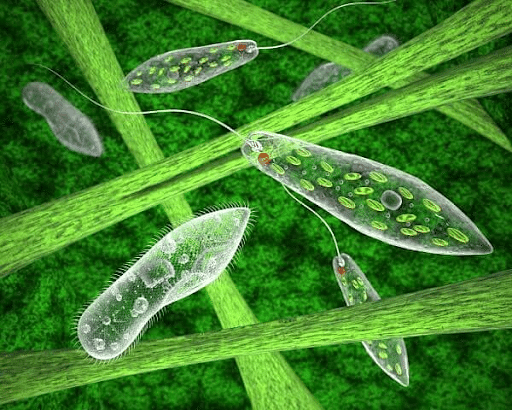
- Diatoms, dinoflagellates, euglenoids, slime moulds, and protozoans are all members of the kingdom Protista.
- They are food-independent and do not have any fixed shape.
- These organisms make their own food through chloroplast.
- Protista is used in the production of vinegar like acetobacter aceti.
Also Read:
| Related Articles | ||
|---|---|---|
| Biotechnology | Genetic Engineering | Endangered Species |
| Organisms and Population | Algal Bloom | Sexual Reproduction in Fungi |
Dinoflagellates Classification
[Click Here for Sample Questions]
Dinoflagellates were classified under the kingdom Protista as well as phylum Dinoflagellata. However, some scientists have kept dinoflagellates under the category of Pyrrophycophyta (meaning- fire plants).
- Dinoflagellates come under the supergroup Chromalveolata, which originated from the secondary symbiosis of red algae.
- The presence of a similar ribosomal DNA sequence characterises the group Alveolata.
- Alveoli, which is flattened vesicles in the plasma membrane.
The cell wall of these species consists of stiff cellulose on the outer surface. Dinoflagellates appear red, yellow, green, blue, and brown depending upon the type of pigment in the cell.
- The population of this category of phylum depends upon the latitude, temperature, salinity, and depth.
- These species are phototrophic or mixotrophic in nature.
- There are around 4500 species in this category.
The information about Dinoflagellates are tabulated below:
| Domain | Eukaryota |
|---|---|
| Kingdom | Protista |
| Supergroup | Chromalveolata |
| Group | Alveolata |
| Phylum | Dinoflagellata |

Dinoflagellates Characteristics
[Click Here for Sample Questions]
The important characteristics of Dinoflagellates are as follows:
- Dinoflagellates are unicellular, eukaryotic and microscopic organisms.
- Most organisms in this category are motile; however, some organisms are non-motile.
- The habitat of most of these species is marine, while few are freshwater species.
- Around ninety per cent of these species are marine plankton.
- The temperature, pH and depth of water governs their distribution.
- Some dinoflagellate species are Noctiluca, Ceratium, Ornithocercus, Gonyaulax, Peridinium, and Gymnodinium.
Dinoflagellates Structure
[Click Here for Sample Questions]
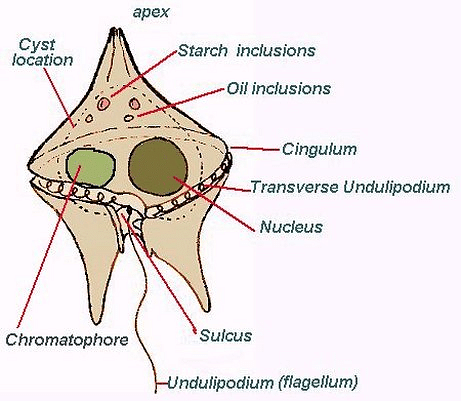
The size of dinoflagellates ranges between 15 to 40 microns. The cell has a complex covering called amphiesma. Armoured dinoflagellates possess theca, a rigid coat present on their body that has two or more plates of cellulose and pectin.
- Naked dinoflagellates lack the presence of theca.
- The plasma membrane is flattened vesicles known as alveoli.
- These alveoli contain cellulose plates, which are permeated with silicates.
Further, the cell comprises all common membrane-bound organelles such as mitochondria, Golgi bodies, rough and smooth endoplasmic reticulum and food vacuoles.
- They have two grooves- sulcus and cingulum.
- The sulcus is longitudinal, and the cingulum is a transverse groove.
- These grooves bear the flagella.
- Dinoflagellates possess two flagella that help them in movement.
One of the flagella wraps around the transverse groove like a belt, while the other is present in the longitudinal groove, which is perpendicular to the transverse groove and projects behind the cell.
- Since both of the flagella are at right angles to each other, they are also called whirling whips.
- Pusule, a non-contractile vacuole present near the flagellar base, further facilitates floatation and osmoregulation.
- The nucleus of the dinoflagellates is known as the dinokaryon.
- It has chromosomes attached to the nuclear membrane.
- The chromosomes remain condensed throughout, have a fibrillar appearance and lack histones.
Dinoflagellates Reproduction
[Click Here for Sample Questions]
Most dinoflagellates reproduce asexually through binary fission. The cells, in this case, are haploid. However, some species reproduce sexually by undergoing fusion to form a zygote.
- The zygote may form a resting stage known as dinocyst or may remain motile.
- The zygote then undergoes meiosis to form haploid cells.
- Under unfavourable conditions, vegetative cells of dinoflagellates fuse to form a Planozygote.
- It consumes excess fat and oil to form a hard shell, and its size increases.
- This stage is known as Hypnozygote (similar to hibernating).
- Under favourable conditions, the shell of the Hypnozygote breaks.
- The dinoflagellates enter a temporary stage, Planomeiocyte, wherein they regain their actual size.

Dinoflagellates Nutrition
[Click Here for Sample Questions]
Most dinoflagellates are usually photosynthetic while some are heterotrophic; a few exhibit both photosynthesis and heterotrophic nutrition, hence called mixotrophic.
- Heterotrophic dinoflagellates ingest other microorganisms and protozoans to get nutrients.
- However, some also exist as endosymbionts (live inside the host) in marine invertebrates like corals, jellyfish, etc.
- The photosynthetic endosymbionts are known as Zooxanthellae.
They provide carbohydrates to their hosts, while those lacking pigments depend on the host for their nutrition and live like parasites.
- Dinoflagellates are important producers in the marine ecosystem.
- They store food in the form of starch, like carbohydrates and oils.
Bioluminescence Dinoflagellates
[Click Here for Sample Questions]
Bioluminescence is an important characteristic of Dinoflagellates. More than 18 genera of these species are bioluminescent.
- They contain the enzyme luciferase, which is present in the cytoplasmic bodies called scintillons.
- Luciferin acts as the substrate of the light-producing biochemical reaction, which is pH-dependent- as the pH drops.
- They bind to luciferase due to a change in the shape of the enzyme.
- Bioluminescence is used as a defence mechanism by the dinoflagellates against their predators.
Example of Bioluminescence DinoflagellatesExample: Examples of ecosystems having bioluminescent dinoflagellate include Montego Bay in Jamaica and the Indian River Lagoon in Central Florida. |

Dinoflagellates Red Tides
[Click Here for Sample Questions]
Red tides are a condition that occurs when the dinoflagellate population rapidly multiplies. The number increases so much that it discolours the water and imparts a red or brown colour to it.
- This “bloom” of dinoflagellates may be attributed to nutrient and hydrographic conditions such as increased phosphates and so on.
- Red tides can have up to 20 million cells per litre of tidewater.
- The species that cause red tides include Karenia Brevis, Alexendrium fundraise, Pfiesteria, and Gonyaulax.
- The red tides can, at times, be harmful to aquatic life.
- Certain species causing these tides produce neurotoxins.
- It may cause fatal or non-fatal illness in some fishes.
- The species may accumulate and impact organisms in the higher trophic levels by being consumed by them.
- Such red tides are also known as Harmful Algal Blooms (HAB).

Things to Remember
- Dinoflagellates are single-celled eukaryotes that are usually considered protists.
- The largest species is Noctiluca, which may be up to 2 mm in diameter.
- The lifecycle of these species is haplontic, i.e., the zygote (2n) formed from karyogamy divides meiotically to produce haploid (n) cells.
- Mitosis in these organisms is closed type, i.e., the nuclear envelope does not break during mitosis, and the mitotic spindle is extranuclear.
- The chloroplast of dinoflagellates is bound by three membranes and contains chlorophyll a, c, along with other pigments.
- It contains pigments such as fucoxanthin, peridinin, etc.
- The Gulf of Maine produces saxitoxin that can be accumulated by shellfish and can be toxic to some fish species.
Also Read:
Sample Questions
Ques. Do dinoflagellates undergo sexual or asexual reproduction? Explain the reproduction process in dinoflagellates. (5 marks)
Ans. Most dinoflagellates reproduce asexually. However, certain species reproduce sexually.
- The asexual reproduction in dinoflagellates is through binary fission.
- Sexually reproduction is through fusion to form a zygote, which may form a resting stage known as dinocyst or may remain motile.
- The zygote then undergoes meiosis to form haploid cells.
- In case of unfavourable conditions, vegetative cells of dinoflagellates fuse to form Planozygote. It consumes excess fat and oil, to form a hard shell and its size increases. This stage is known as Hypnozygote, (similar to hibernating).
- Under favourable conditions, the shell of the Hypnozygote breaks and the dinoflagellates enter a temporary stage, Planomeiocyte, wherein they regain their actual size.
Ques. Explain the structure of dinoflagellates, with a neat and labelled diagram. (5 marks)
Ans. Dinoflagellates are microscopic, eukaryotic protists. Their size ranges between 15 to 40 microns. The basic structure of dinoflagellates is as follows:
- The cell in dinoflagellates has a complex covering called amphiesma.
- Armoured dinoflagellates possess theca or lorica, a rigid coat present on their body that has two or more plates of cellulose and pectin, while naked dinoflagellates do not have a theca.
- Inside the plasma membrane are flattened vesicles known as alveoli. These alveoli contain cellulose plates, which are permeated with silicates.
- They have two grooves- sulcus and cingulum.
- The sulcus is longitudinal and the cingulum is a transverse groove. These grooves bear the flagella.
- Dinoflagellates possess two flagella that help them in movement.
- One of the flagella wraps around the transverse groove like a belt while the other is present in the longitudinal groove, which is perpendicular to the transverse groove, and projects behind the cell.
- Since both of the flagella are at right angles to each other, they are also called whirling whips.
- Floatation and osmoregulation are further facilitated by Pusule, a non-contractile vacuole present near the flagellar base.
Ques. What causes red tides? Name some species that can cause red tides. (3 marks)
Ans. Red tides are a condition that occur when the dinoflagellate population rapidly multiplies and the number increases so much that it discolours the water and imparts a red or brown colour to it.
- Red tides can have up to 20 million cells per liter of tidewater.
- This “bloom” of dinoflagellates may be attributed to nutrient and hydrographic conditions such as increased phosphates and so on.
- The species that cause red tides include Karenia brevis, Alexendrium fundyense, Pfiesteria.
Ques. In the sexual reproduction of dinoflagellates, which type of cell division does the zygote undergo? Why. (2 marks)
Ans. Dinoflagellates undergo sexual reproduction (fusion) to form a zygote that is diploid (2n). the zygote then undergoes meiotic division to produce haploid (n) cells.
Ques. How do the vegetative cells of dinoflagellates survive under unfavourable conditions. (3 marks)
Ans. Under unfavourable conditions, vegetative cells of dinoflagellates fuse to form Planozygote. It consumes excess fat and oil, to form a hard shell and its size increases. This stage is known as Hypnozygote (similar to hibernating).
- Under favourable conditions, the shell of the Hypnozygote breaks and the dinoflagellates enter a temporary stage.
- Planomeiocyte, wherein they regain their actual size.
Ques. Describe the bioluminescence in dinoflagellates. (3 marks)
Ans. More than 18 genera of dinoflagellates are bioluminescent. They contain the enzyme luciferase, which is present in the cytoplasmic bodies called scintillons.
- Luciferin acts as the substrate of the light-producing biochemical reaction, which is pH-dependent- as the pH drops, luciferin binds to luciferase due to a change in the shape of the enzyme.
- Examples of ecosystems having bioluminescent dinoflagellate include Montego Bay in Jamaica and the Indian River Lagoon in Central Florida. Bioluminescence is used as a defence mechanism by the dinoflagellates against their predators.
Ques. Write a short note on the nutrition of dinoflagellates. (5 marks)
Ans. Most dinoflagellates are usually photosynthetic while some are heterotrophic; a few exhibit both photosynthesis and heterotrophic nutrition, hence called mixotrophically.
- Heterotrophic dinoflagellates ingest other microorganisms and protozoans to get nutrients. However, some also exist as endosymbionts (live inside the host) in marine invertebrates like corals, jellyfish, etc.
- The photosynthetic endosymbionts are known as Zooxanthellae; they provide carbohydrates to their hosts, while those who lack pigments depend on the host for their nutrition and live like a parasite. Dinoflagellates are important producers in the marine ecosystem.
- They store food in form of starch like carbohydrates and oils.
Ques. What are the characteristics of dinoflagellates. (3 marks)
Ans. The characteristics of dinoflagellates are as follows:
- Dinoflagellates are unicellular organisms that are mostly found in freshwater.
- They depend on factors like pH level, temperature, salinity, and depth of the aquatic ecosystem.
- The movement of these species is based on flagella that also facilitate a spinning top-like motion.
- They store food in the form of starch.
- There are three modes of nutrition, namely phototrophic, heterotrophic, and mixotrophic.
Ques. What is protista. (3 marks)
Ans. Protista comprises all single-celled eukaryotes (organisms with a well-defined nucleus), Most members of this kingdom are aquatic. Protists have either cilia or flagella for their movement.
- Nutrition in protists can be either photosynthetic, holozoic, saprobic (derived from dead and decaying matter), or parasitic, while reproduction can either be asexual or sexual.
- Diatoms, dinoflagellates, euglenoids, slime moulds, and protozoans are all members of kingdom Protista.
Ques. What is Harmful algal bloom. (2 marks)
Ans. Harmful algal bloom also known as excessive algae growth which produce natural algae produced toxin thus causing negative impacts to other organisms. It lower the level of oxygen in fresh water. It can last for few days to many month. They are referred to as red tides in marine environment. There effect also increase with increase in temperature and low circulation.
Ques. What is Bioluminescence. (3 marks)
Ans. Dinoflagellates possess an important trait called bioluminescence. These species belong to more than 18 genera and are bioluminescent. They have the luciferase enzyme, which is found in the so-called scintillons, cytoplasmic bodies.
- As the pH falls, luciferin serves as the substrate of the light-producing metabolic reaction.
- They attach to luciferase because of the enzyme's altered structure.
- Dinoflagellates use bioluminescence as a defense strategy against their predators.
For Latest Updates on Upcoming Board Exams, Click Here: https://t.me/class_10_12_board_updates
Check-Out:



Comments