



Education Journalist | Study Abroad Lead
Embryology is an important topic of Biology that deals with the development of embryos. It takes into account the baby’s prenatal development. This includes dealing with the principles from the stage of the fertilization of the ovum to the development of the foetus. In this article, we will explore the concept of embryology, types, the process of embryogenesis, and the stages of pregnancy.
| Table of Content |
Keyterms: Embryology, embryos, embryogenesis, fertilization, pregnancy, foetus, infant, cell embryo, ovum-fertilization, mutation, evolution
What is Embryology?
[Click Here for Sample Questions]
Embryology refers to an understanding and study of the development of an embryo into a foetus. It could also be called the science of studying the prenatal development of a foetus. Embryology, a vital branch of Biology, was discovered by Karl Ernst Von Baer.
- Embryology is all about the development process of a single–cell embryo into an infant. This entire process usually takes 9 months but in a few cases, the process gets completed pre-maturely as well.
- The study aims at tracing and understanding the development of an embryo to foetus from the very stage of ovum-fertilization to the birth of an infant.
- Stem cell research is another important aspect of the study of embryology. This helps in tracking the impacts of the mutation and the progression of the genetic disorders if any.
- Therefore, embryology in itself is a wholesome study that provides in-depth analysis and understanding of the stages of evolution.
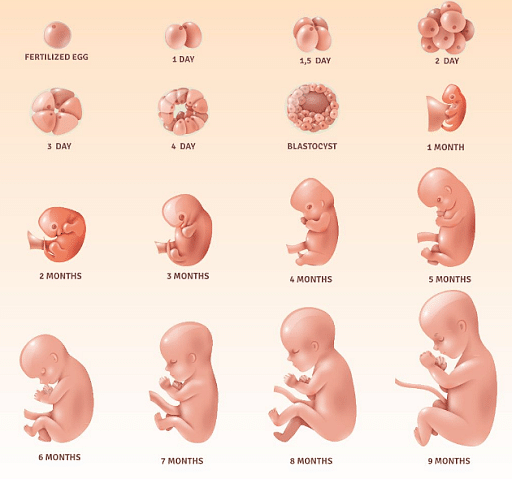
Stages of Human Development
What is Embryogenesis?
[Click Here for Sample Questions]
- Embryogenesis refers to the process of embryology. The entire process of the reproduction cycle, from the fertilization of the ovum through sperm and the formation of the zygote to an embryo, is known as Embryogenesis.
- When the ovum and the sperm meet, fertilization occurs which leads to the formation of a zygote.
- The next step involves the mitotic division in the zygote. This takes place multiple times and that too without any cellular differentiation and significant growth.
- Finally, the mitotic division leads to the formation of an embryo, which later develops into a fetus and this defines the concept of embryogenesis which is understood through embryology using various techniques and methods.
Read about: Internal Formation of Zygote
Human Development
[Click Here for Sample Questions]
Human Development is referred to as a highly precise but complex process. In this process, a single cell happens to differentiate (cellular differentiation) and develop into a multicellular human being. This is a continuous process that begins when an ovum is fertilized by a sperm which leads to the formation of a zygote and this differentiates into a definitive system of organs and hence into their early functional stage.
The multiple mechanisms involving the transformation in the process of human development and embryogenesis include the following.
- Cell division
- Cell migration
- Growth
- Cell differentiation
- Apoptosis
- Cell rearrangement.
A better understanding of embryology and its procedures helps the doctors and other professionals in the field for preparing the healthcare strategies and the planning:
- Therapeutic procedures for infertility
- Prenatal diagnosis and surgical treatments
- Mechanisms to prevent birth defects
Also Read: Placenta Definition
Duration and the Stages of Pregnancy
[Click Here for Sample Questions]
The human gestation period/pregnancy lasts for over nine months/266 days. Sometimes, childbirth also takes place prematurely or even after nine months. The entire process of pregnancy is divided into trimesters of three intervals:
- First Trimester: This consists of the period mainly from week one to twelve. This is the pre-embryonic or embryonic development stage.
- Second Trimester: This consists of the period from week thirteen to twenty-fourth. This is the stage of foetal development and generally, most of the body parts develop in this stage.
- Third Trimester: This consists of the period from week twenty-fifth to that of the birth of an infant. This stage witnesses some of the major developments in the child such as the formation of the blood cells, bones turn hard, sense organs are developed and the fingernails are also visible by this stage.

Stages of Pregnancy
Also Read:
| Related Articles | ||
|---|---|---|
| Lactation | Oogenesis | Implantation |
| Blastocyst | Pollination | Gemmule formation |
Types of Embryology
[Click Here for Sample Questions]
- Descriptive Embryology: This is defined as the study concerned with the direct observation and description of embryological development.
- Comparative Embryology: It involves the embryological development of different species. And it paves the way for understanding the evolution and phylogenetic significance in a much more relevant manner.
- Experimental Embryology: This is also called Casual embryology or Analytical Embryology. In this type of embryology, the embryos are experimented with, for the purpose of studying the various developmental stages. And this also helps in understanding the fundamental mechanisms of the organisms. Dissection and removal of various parts of the embryos take place. They are then transplanted and observed, even the environmental conditions are altered.
- Chemical Embryology: It is also known as Physiological or Biochemical Embryology. Chemical Embryology deals with biophysical, biochemical, and biological techniques.
Things to Remember
- Embryology is an important topic of Biology that deals with the development of embryos and prenatal development.
- Types: Descriptive, Comparative, Chemical, and Experimental Embryology.
- Embryogenesis refers to the entire process of the reproduction cycle, from the fertilization of the ovum through sperm and the formation of the zygote to an embryo.
- Human Development refers to the continuous complex process whereby a single cell develops into a multicellular human being.
- The human gestation period/pregnancy lasts for over nine months and is divided into three trimesters.
Read More About Parturition
Sample Questions
Ques. What is embryology? Who developed it? (2 marks)
Ans. Embryology refers to the science of studying the prenatal development of a foetus. Embryology, a vital branch of Biology, was developed by Karl Ernst Von Baer.
Ques. What is the human gestation period? (1 mark)
Ans. The human gestation period/pregnancy lasts for over nine months / 266 days. Sometimes, childbirth also takes place prematurely or even after nine months.
Ques. What are the various types of embryology? (2 marks)
Ans. Embryology is of various types such as:
- Descriptive Embryology
- Comparative Embryology
- Chemical Embryology
- Experimental Embryology
Ques. What is the evidence of the evolution provided by embryology? (2 marks)
Ans. As proven by Charles Darwin, evolution is inevitable. Embryology involves the transformation of a zygote into an embryo which is then transformed into a foetus, thus giving the evidence for evolution.
Ques. How does embryogenesis work? (2 marks)
Ans. Embryogenesis refers to the process of fertilization of an ovum and the formation of a zygote. The development of a zygote into an embryo through the process of cellular differentiation is known as embryogenesis.
Ques. Describe the stages of pregnancy. (2 marks)
Ans. Pregnancy can be divided into three trimesters such as:
- First Trimester: Week one to twelve. This is the pre-embryonic or embryonic development stage.
- Second Trimester: Week thirteen to twenty-fourth. This is the stage of foetal development. The body parts also develop in this stage.
Third Trimester: Week twenty-fifth to that of the birth of an infant.
For Latest Updates on Upcoming Board Exams, Click Here: https://t.me/class_10_12_board_updates
Check-Out:



Comments