


Examples of newton's first law of motion.

Jasmine Grover logo

Jasmine Grover

Education Journalist | Study Abroad Lead

Newton's first law of motion, also known as the law of inertia, states that an object at rest will remain at rest and an object in motion will remain in motion with a constant velocity unless acted upon by an external force. In simpler terms, it means that objects will continue to do what they're already doing unless something else forces them to change. Inertia was explained by Sir Isaac Newton in his first law of motion.
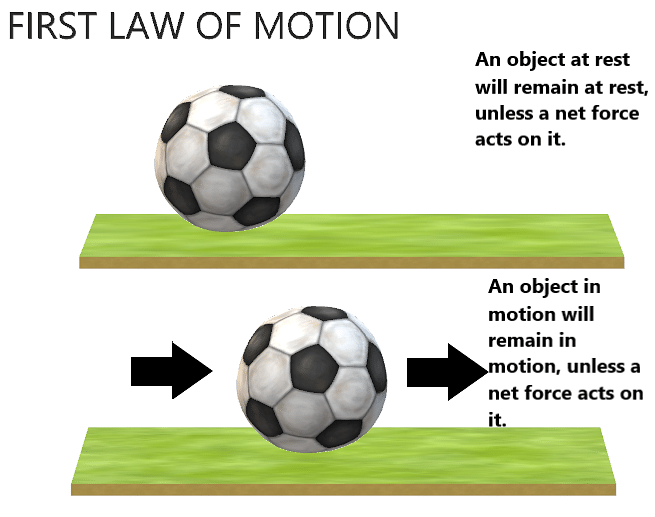
Newtons First Law of Motion

Here are some examples that illustrate the first law of motion:

  1. A book sitting on a table: If a book is placed on a table and left undisturbed, it will remain there until someone or something moves it. The book is at rest, and according to Newton's first law, it will remain at rest until a force acts upon it.
  2. A car driving on a straight road: When a car is moving on a straight road with a constant speed, it will continue to do so until an external force acts on it, such as hitting the brakes or turning the steering wheel.
  3. A hockey puck sliding on ice: When a hockey puck is pushed on the ice, it will continue to slide until it hits something, such as the boards, another player's stick, or the goalpost. In this case, friction and air resistance will slow down the puck, but it will continue to move in a straight line until acted upon by an external force.
  4. A person jumping off a diving board: When a person jumps off a diving board, they move in a parabolic arc before hitting the water. According to Newton's first law, the person will continue to move in a straight line with a constant velocity until the force of gravity pulls them down towards the water.

Overall, Newton's first law of motion is all about inertia, the tendency of objects to resist changes in their state of motion. It helps explain why objects behave the way they do and is a fundamental principle of physics.

Read More:

CBSE CLASS XII Related Questions

  • 1.
    Four independent waves are expressed as \[ (i)\; y_1=A_1\sin\omega t, \] \[ (ii)\; y_2=A_2\sin 2\omega t, \] \[ (iii)\; y_3=A_3\cos\omega t, \] \[ (iv)\; y_4=A_4\sin\left(\omega t+\frac{\pi}{3}\right) \] The interference between two of these waves is possible in

      • (i) and (iii) only
      • (iii) and (iv) only
      • (i), (iii) and (iv) only
      • All of them

    • 2.
      Two heaters rated as \((P_1,V)\) and \((P_2,V)\) are connected in series across a dc source of \(V/2\) volt. The power consumed by the combination will be –

        • \((P_1+P_2)\)
        • \(\dfrac{P_1+P_2}{2}\)
        • \(\dfrac{P_1P_2}{2(P_1+P_2)}\)
        • \(\dfrac{P_1P_2}{4(P_1+P_2)}\)

      • 3.
        If Bohr’s quantization postulate (angular momentum \( = \frac{nh}{2\pi} \)) is a basic law of nature, it should be equally valid for the case of planetary motion also. Why, then, do we never speak of quantization of orbits of planets around the Sun? Explain.


          • 4.
            The figure shows three point charges kept at the vertices of triangle ABC. The net electric field, due to this system of charges, at the midpoint M of base BC will be:

              • \( \frac{q}{4 \pi \epsilon_0 l^2} \) pointing along MA
              • \( \frac{q}{\pi \epsilon_0 l^2} \) pointing along AM
              • \( \frac{q}{2 \pi \epsilon_0 l^2} \) pointing along AM
              • Zero

            • 5.
              Assertion (A) : All atoms have a net magnetic moment. Reason (R) : A current loop does not always behave as a magnetic dipole.

                • Both Assertion (A) and Reason (R) are true and Reason (R) is the correct explanation of the Assertion (A).
                • Both Assertion (A) and Reason (R) are true, but Reason (R) is not the correct explanation of the Assertion (A).
                • Assertion (A) is true, but Reason (R) is false.
                • Both Assertion (A) and Reason (R) are false.

              • 6.
                If both the number of protons and the neutrons are conserved in each nuclear reaction, in what way is mass converted into energy (or vice versa) in a nuclear reaction? Explain.

                  CBSE CLASS XII Previous Year Papers

                  Comments


                  No Comments To Show
