



Education Journalist | Study Abroad Lead
Galvanic corrosion (or bimetallic corrosion) is an electrochemical process in which one metal corrodes more quickly than another upon contact with an electrolyte. Galvanic corrosion happens when two different metals are electrically linked and submerged in a conductive solution. One metal is protected (the cathode), while the other (the anode) corrodes. In comparison to when the metal is uncoupled, the rate of assault on the anode is accelerated.
| Table of Content |
Key Terms: Galvanic Steel, Galvanic Corrosion Examples, Electrochemistry, Galvanic Cell Corrosion, Electrolysis Corrosion, Galvanic Testing
What is Galvanic Corrosion?
[Click Here for Sample Questions]
Galvanic corrosion (dissimilar-metal corrosion) is an electrochemical process in which one metal corrodes preferentially. This occurs when it comes in electrical contact with a different type of metal, and both metals are immersed in an electrolyte like water. When a galvanic pair forms, one of the metals becomes the anode and corrodes quicker than it would if treated alone, while the other becomes the cathode and corrodes slower.
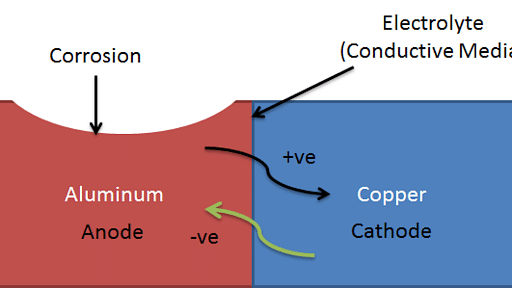
Galvanic Corrosion
Corrosion can occur in either or both of the metals in the pair. This only occurs when an electrolyte is present which acts as a channel through which the ions migrate and there is an electric conducting path that connects both the metals. A potential difference between the two materials is the driving factor for corrosion.
| History of Galvanic Corrosion
|
Also Read:
| Related Articles | ||
|---|---|---|
| Standard Hydrogen Electrode | Standard Electrode Potential | Cell Potential |
| Difference Between Cell and Battery | Concentration Cell | Nonelectrolyte |
Examples of Galvanic Corrosion
[Click Here for Previous Year Questions]
Examples of Galvanic Corrosion are listed below:
- Galvanic corrosion affected the Statue of Liberty in New York, USA. Corrosion took place between the wrought iron support framework and the statue's copper exterior. The iron support structure rusted as a result.
- The fighting cruiser 'USS Independence' was another victim of galvanic corrosion. A steel water jet propulsion system was fitted to the ship's aluminium hull. In this corrosion, the aluminium hull worked as an anode against the steel.
- The circuit is completed when zinc and copper metals are immersed in an electrolyte, which can be water or an aqueous solution containing any salt, such as copper sulphate.
- Zinc now begins to oxidize as a result of its higher oxidation potential than the cathode. As a result, zinc begins to corrode and generate zinc ions.
- Copper ions, on the other hand, begin to acquire electrons and become reduced, protecting the metal.
- The operation is repeated until the zinc electrode is completely dissolved. The hydrogen ions in the electrolyte are also converted to hydrogen gas, which is visible at the cathode as bubbles.
- At the anode, there is a reaction: Zn → Zn+2 + 2e-
- Reaction at cathode: 2H++2e- → H2↑

Example of Galvanic Corrosion
Mechanism of Galvanic Corrosion
[Click Here for Sample Questions]
The mechanism of Galvanic Corrosion is explained below:
- When two metals come in contact with each other in an electrolyte, the more reactive metal serves as an anode in the presence of an electrolyte, whereas the less reactive metal works as a cathode. The electrolyte provides a route for particles to flow through, resulting in fast eroding of the anodic metal.
- Galvanic corrosion can be advantageous in preventing corrosion of a cathodic metal. The use of zinc in batteries to induce zinc corrosion in order to produce a potential difference is an excellent illustration of this.

Mechanism of Galvanic Corrosion
Causes of Galvanic Corrosion
[Click Here for Previous Year Questions]
Every galvanic cell works due to the potential difference between its two metals. The flow of electrons within the cell is caused by this potential difference. The oxidation potential of a metal electrode refers to its capacity to lose electrons and become oxidized. The higher the oxidation potential, the easier it is for the metal to give up its electrons.
The reduction potential is the polar opposite of the oxidation potential. It's a metal ion's capacity to take up electrons and get reduced in solution. An electrochemical series is constructed based on the oxidation potential of metals.

As the elements at the top of the series are more quickly oxidized, there is a greater risk of electron loss. The corrosion process begins when two metal electrodes are put in an electrolyte and the circuit is completed by connecting the metal electrodes with a wire. Metals having a greater oxidation potential will begin to operate as anodes and lose electrons, whereas metals with a lower oxidation potential will begin to act as cathodes and gain electrons.
The electrochemical series governs the activity of metals. As a result, current flows from a more active metal (anode) to a less active metal (cathode).

Galvanic Cell
Galvanic Corrosion Prevention
[Click Here for Sample Questions]
Galvanic corrosion can be avoided by doing the following:
- If materials with similar corrosion potentials are chosen.
- By isolating the two metals from each other as the electrical connection is broken.
- Through the process of electroplating, a thin inert metal layer is formed which reduces galvanic corrosion.
- Applying impermeable coatings like paint to both materials. The cathode coating is the most vital and must be in good shape, or else galvanic corrosion will worsen.
- Placing electric insulation between the two metals to separate them and stop the electron flow.
- Using a sacrificial anode that is anodic to both metals.
- Adding Corrosion inhibitors to the environment.

Please Note: If these steps are not feasible, the rate of attack can be reduced by maintaining a large anode to cathode area, i.e. more than 10. Alternatively, a sufficient corrosion allowance might be included in the anode design. In some conditions, galvanic activity can cause welds to corrode more quickly. In seawater, for example, carbon steel welded metal might be severely corroded while the neighboring parent material remains unaffected.
Things to Remember
- Galvanic corrosion is an electrochemical reaction that occurs when dissimilar metals come into contact.
- When placed in an electrically conducting environment, one metal corrodes faster (the anode), while the other corrodes slower (the cathode).
- Noble metals, such as stainless steel, can, for example, generate galvanic corrosion in less noble metals.
- Every galvanic cell works due to the potential difference between its two metals.
- Through the process of electroplating, a thin inert metal layer is formed which reduces galvanic corrosion.
- Galvanic Corrosion only occurs when an electrolyte is present which acts as a channel through which the ions migrate and when there is an electric conducting path that connects both the metals.
- The higher the oxidation potential, the easier it is for the metal to give up its electrons.
Also Read:
Sample Questions
Ques. Is it possible for galvanic corrosion to occur in the presence of air? (2 marks)
Ans. Galvanic corrosion (also known as bimetallic corrosion) is an electrochemical process in which one metal preferentially corrodes when it is in electrical contact with another in the presence of an electrolyte. Galvanic cells may occur in any electrolyte, including wet air or soil, and under any chemical circumstances.
Ques. What does galvanic corrosion necessitate? (2 marks)
Ans. For galvanic corrosion to occur, three criteria must be met: electrochemically different metals must be present, they must be in touch with these metals electrically, and An electrolyte must be used to expose the metals.
Ques. Give examples of real-life situations where galvanic corrosion was discovered to be an issue. (3 marks)
Ans. Galvanic corrosion can be harmful as:
- In America that drinking water was being tainted with lead as a result of galvanic corrosion between copper and lead in the pipes. Authorities agreed to employ various insulating materials that can prevent galvanic corrosion to avoid this.
- Another example is the corrosion of ship weld metals caused by steel coupling with the weld metal. Even though ships are coated, collisions with icebergs cause the paint to peel off, resulting in galvanic corrosion.
Ques. What happens when galvanic corrosion takes place? (2 marks)
Ans. Galvanic corrosion happens when two distinct metals come in touch and dissolve in a conductive fluid and are electrically linked. One metal (the cathode) is completely coated, while the other (the anode) is corroded. The attack rate on the anode is accelerated when compared to the conditions when the metal is uncoupled.
Ques. How do you keep metal from corroding due to galvanic corrosion? (3 marks)
Ans. Galvanic corrosion may be readily avoided on aluminum by applying a single layer of chrome phosphate pretreatment followed by primer and a high-performance coating. Instead, a single coat of heavy-bodied bituminous paint can be applied in the field. Anodic coatings alone are usually inefficient for galvanic isolation.
Ques. How may galvanic corrosion be avoided by using a bigger anode and a smaller cathode? (3 marks)
Ans. The rate of galvanic corrosion is determined by the surface area ratio of the anode and cathode. The rate of metal corrosion is slowed when a big anode is used with a smaller cathode because the anode has a high surface area. When we use the inverse-large cathode and tiny anode, on the other hand, corrosion is hastened and the anode dissolves fast. To prevent galvanic corrosion, it is recommended to avoid using big cathodes and smaller anodes.
Ques. What is galvanic corrosion's driving force? (2 marks)
Ans. Galvanic corrosion happens when two different metals come together. The difference in electrode potentials between the two metals is what drives the corrosion response. The differential in oxygen concentration inside the crevice and outside the fissure is the driving force for corrosion.
Ques. Is oxygen required for galvanic corrosion? (3 marks)
Ans. Galvanic corrosion does not occur when there are no dissolved oxygen or hydrogen ions to keep the cathode process going. Different metals, such as copper and steel, can be combined in closed hot-water systems with negligible corrosion. When aluminum is added to brass, for example, it becomes more corrosion resistant.
Ques. Is an electrolyte required for galvanic corrosion? (2 marks)
Ans. Galvanic corrosion requires the existence of an electrolyte and an electrical conducting channel between the metals. The electrolyte allows for ion migration, which allows ions to migrate in order to avoid charge build-up, which would otherwise block the process.
Previous Year Questions
- Which of the following is incorrect in a galvanic cell… [KCET 2016]
- What is the electrode potential (in V) of the following electrode at… [JIPMER 2009]
- The standard reduction potentials at 298 K for the following… [AP EAPCET 1998]
- Given, for Sn4+/Sn2, the standard reduction potential is… [MHT CET 2010]
- In a galvanic cell, the electrons flow from… [KCET 2004]
For Latest Updates on Upcoming Board Exams, Click Here: https://t.me/class_10_12_board_updates
Check-Out:



Comments