



Education Journalist | Study Abroad Lead
Mathematics is a domain in which trigonometry is one of the most important branches. According to Hipparchus, this concept originated in Greece. The purpose of this topic is to explore the topic of trigonometric ratios and the formula of the half-angle value with examples. So, let's get started!
| Table of Content |
Keyterms: Trigonometry, Trigonometric ratios, Half-angle value, Angles, Triangles, Right-angled triangles, Radians, Trigonometry angles, Adjacent sides
Read More: Trigonometry Table
The concept of trigonometry
[Click Here for Sample Questions]
The study of trigonometry involves angles and sides of triangles as well as the angles themselves. In particular, it involves right-angled triangles. The trigonometric ratios are used to find the angles and sides of a triangle. The trigonometric ratios are one of the elements of mathematics. Different formulas are available for calculating the triangle as well as the half-angle.
Depending on the angle, right-angled triangles are measured either in radians or degrees. There are five common trigonometry angles: 0°, 30°, 45°, 60°, and 90°. These angles can be easily used with various formulas to display sides. In addition, there are formulas for half-angle values, which are also widely used.
Plane trigonometry and spherical geometry are two sub-branches of this branch of mathematics. In trigonometric functions, triangles are represented as trigonometric ratios. The sine, cosine, and tangent functions are integral to trigonometry. Let's consider a right-angled triangle whose hypotenuse is its longest side. The adjacent and opposite sides of the hypotenuse are referred to as opposing and adjacent sides.
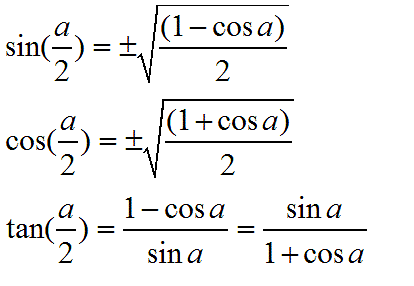
Listed below are some important half-angle formulas:
Also Read:
Identities at a half-angle
[Click Here for Sample Questions]
The most commonly used half-angle identities in solving trigonometry problems are as follows:
- The formula for half angles of sin is: sin A/2 = ±√[(1 - cos A) / 2]
- In half angles, cos A/2 = ±√[(1 + cos A) / 2]
- The half-angle formula for tan is: tan A/2 = ±√[1 - cos A] / [1 + cos A] (or) sin A / (1 + cos A) (or) (1 - cos A) / sin A
The half-angle formulas are derived from the double angle formulas
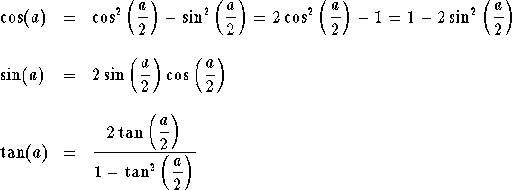
Here are the formulas for calculating half angles, which we can use to derive the above formulas. There are a wide variety of double angle formulas in the form of 2θ, 2A, 2x, etc. It is well known that the double angle formulas for sin, cos, and tan are
- Sin 2x = 2 sin x cos x
- Cos 2x = cos2 x - sin2 x (or)
= 1 - 2 sin2x (or)
= 2 cos2x - 1
- Tan 2x = 2 tan x / (1 - tan2x)
Every equation of a double angle formula may be solved by substituting A/2 for x on both sides (since 2x = 2A/2) = A).
- Sin A = 2 sin(A/2) cos(A/2)
- Cos A = cos2 (A/2) - sin2 (A/2) (or)
= 1 - 2 sin2 (A/2) (or)
= 2 cos2(A/2) - 1
- Tan A = 2 tan (A/2) / (1 - tan2(A/2))
You can also obtain one half-angle formula by using another half-angle formula. For example, we can deduce three important half-angle identities from the formula of cos A in the first section. See below for the proof of half-angle formulas.
Read More: Isosceles Triangle Theorems
The Half Angle Formula for Proof of Sin
The next step will be to prove the half-angle formula for the sine function. Let's use one of the formulas of cos A.
Cos A = 1 - 2 sin2 (A/2)
As a result,
2 Sin2 (A/2) = 1 - cos A
Sin2 (A/2) = (1 - cos A) / 2
Sin (A/2) = ±√[(1 - cos A) / 2]
A Half Angle Formula for Cos Derivation
Our next step is to prove the half-angle formula for the cosine function. Let us choose one of the above formulas for cos A.
Cos A = 2 cos2(A/2) - 1
As a result,
2 Cos2(A/2) = 1 + cos A
Cos2 (A/2) = (1 + cos A) / 2
Cos (A/2) = ±√[(1 + cos A) / 2]
Formula for the Tan Derivation at Half Angles
The formula for tan
(A/2) is [sin (A/2)] / [cos (A/2)]
Using the half angle formulas of sin and cos,
tan (A/2)
= [±√(1 - cos A)/2] / [±√(1 + cos A)/2]
= ±√[(1 - cos A) / (1 + cos A)]
It is one of the formulas for tan (A/2). Here, let us rationalize the denominator and derive the other two formulas.
tan (A/2)
= ±√[(1 - cos A) / (1 + cos A)] × √[(1 - cos A) / (1 - cos A)]
= √[(1 - cos A)2 / (1 - cos2A)]
= √[(1 - cos A)2/ sin2A]
= (1 - cos A) / sin A
The second formula of tan (A/2) can be found here. We can derive another formula by multiplying and dividing the above formula by (1 + cos A). This gives us
tan (A/2)
= [(1 - cos A) / sin A] × [(1 + cos A) / (1 + cos A)]
= (1 - cos2A) / [sin A (1 + cos A)]
= sin2A / [sin A (1 + cos A)]
= sin A / (1 + cos A)
Thus, tan (A/2) = ±√[(1 - cos A) / (1 + cos A)] = (1 - cos A) / sin A = sin A / (1 + cos A).
Formula for half angles using semi-perimeters
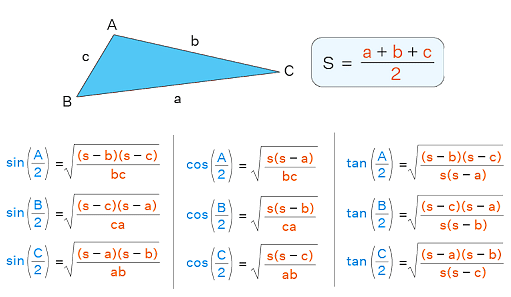
Our next section will show you how to calculate the half-angle formula using the semi perimeter. In other words, these are the half-angle formulas in terms of triangle sides. Here's an example of a triangle ABC, where AB = c, BC = a, and CA = b.
Formula for half angles using semi perimeters
This is one of the formulas we can use. Triangles have semi-perimeters
s = (a + b + c)/2.
In this case,
2s = a + b + c.
According to one of the formulas above,
Cos A = 2 cos2(A/2) - 1
(or) 2 Cos2(A/2) = 1 + cos A
Applying the law of cosines,
2 Cos2(A/2) = 1 + [(b2 + c2 - a2) / (2bc)]
2 Cos2(A/2) = [2bc + b2 + c2 - a2] / [2bc]
2 Cos2(A/2) = [ (b + c)2 - a2] / [2bc]………. [Using (a+b)2 formula]
2 Cos2(A/2) = [ (b + c + a) (b + c - a) ] / [2bc]………. [Using a2 - b2 formula]
2 Cos2(A/2) = [2s (2s - 2a)] / [2bc]………. [As 2s = a + b + c]
2 Cos2(A/2) = [ 2s (s - a) ] / [bc]
Cos2(A/2) = [s(s - a) ] / [bc]
Cos (A/2) = √[ s (s - a) ] / [bc]
A half-angle formula has been derived for the cosine of angle A/2. In the same way, we can deduce the half-angle identities of cosine by means of the semi perimeter. The semi perimeter can also be used to deduce the half-angle identities of sine.
Sin2(A/2)
= (1 − cos A)/2
= (1/2)[1−(b2+c2−a2)/2bc]………. (Using the law of cosines)
= (1/2)(a2−(b−c)2)/2bc
= (1/2)(a + b − c)(a + c − b)/2bc
= (1/2){(a + b + c) − 2c}{(a + b + c) − 2b}/2bc
= (1/2)(2s − 2c)(2s − 2b)/2bc
= (s − b)(s − c)/bc
⇒ sin (A/2) = √[(s − b)(s − c)/bc]
In a similar manner, we can derive other half-angle sine function formulas. The formula tan(A/2) = sin(A/2)/cos(A/2) can be used to calculate half-angle tangent functions.
Things to Remember
- The half-angle formulas are derived from the double angle formulas.
- The formula for half angles of sin is: sin A/2 = ±√[(1 - cos A) / 2]
- In half angles, cos A/2 = ±√[(1 + cos A) / 2]
- The half-angle formula for tan is: tan A/2 = ±√[1 - cos A] / [1 + cos A] (or) sin A / (1 + cos A) (or) (1 - cos A) / sin A
- Cos (A/2) = √[ s (s - a) ] / [bc]
- sin (A/2) = √[(s − b)(s − c)/bc]
Also Read:
Sample Questions
Ques. Can you explain trigonometric identities? (2 Marks)
Ans. Trigonometric identities are mathematical descriptions of equalities based on trigonometric functions and they are true for all values of the variables under discussion when both sides of the equality are accounted for. On the other hand, geometrically, these are simply identities that take into account only specified functions of one or more angles. These identities are quite different from triangle identities, which involve angles in addition to side lengths and other triangle lengths.
Simplifying trigonometric expressions using these identities is useful whenever trigonometric functions are involved. In the case of non-trigonometric functions, half-angle identities can be used for integration as the substitution law can first be applied to the function, and then the resulting integral can be simplified using a trigonometric identity.
Ques. What is the purpose of half-angle formulas? (2 Marks)
Ans. With respect to light and sound, trigonometry half-angle formulas have a wide variety of applications. Solving these problems often involves sines and cosines of x, 2x, 3x, 4x, and many more. You cannot get the value for sin 2x by doubling sin x, and neither can you get sin (2x) by halving sin x. The addition formulas for sine, cosine, and tangent can also be used to create double angle formulas.
For Latest Updates on Upcoming Board Exams, Click Here: https://t.me/class_10_12_board_updates
Check-Out:



Comments