



Education Journalist | Study Abroad Lead
Bacteria exist everywhere around us and even inside the human body. Most bacterias are harmless and they don’t affect our health as they grow. However, there are some strains of bacteria that are harmful to us. Bacterial diseases in humans are a result of bacterial infections caused by many pathogenic bacteria. Though bacteria have evolved and many of them have become antibiotic-resistant, many of them can be cured through vaccines and antibiotics. In this article, we will have a look at human bacterial diseases, their symptoms, causes, and prevention.
| Table of Content |
Key Terms: Pathogenic bacteria, microorganisms, human body, enzymes, parasites, fungi, vaccines, antibiotics, bacteria
What are Human Bacterial Diseases?
[Click Here for Sample Questions]
The bacterial diseases in humans are spread by some microorganisms which are very tiny in shape and size like viruses, parasites, and fungi, known as bacteria and those bacteria can be seen only by using a microscope. There are many bacteria that can be found in the human body, which can be either good bacteria or bad/harmful bacteria. The harmful one can cause bacterial diseases in the human body.
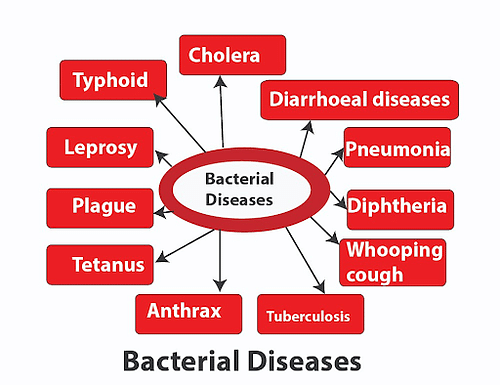
Bacterial Diseases
The bacteria which causes bacterial diseases in the human body are:
| Bacteria | Disease |
|---|---|
| Mycobacterium leprae | Leprosy |
| Yersinia pestis | Plague |
| Clostridium tetani | Tetanus |
| Bordetella pertussis | Pertussis |
| Vibrio cholerae | Cholera |
| Mycobacterium tuberculosis | Pulmonary Tuberculosis |
| Treponema pallidum | Syphilis |
When these harmful bacteria move into the human body, it starts to reproduce inside our body and also takes the place of healthy and good bacteria. It then slowly grows inside all the tissue and cells causing a variety of diseases.
Also Read: Electrocardiograph (ECG)
Structure of Bacteria
[Click Here for Previous Year Questions]
The bacteria consists of a gel-like matrix that contains water, nutrients, waste, gases, and enzymes and some cell structures like, plasmids, chromosomes, and ribosomes. The size of different bacteria is from 0.2 to 2.0 diameters. And the shape of the bacteria is like Spheres, Rods, and Spirals.
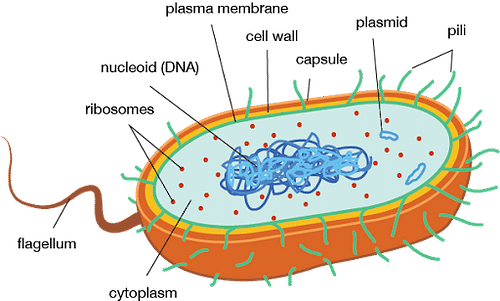
Structure of Bacteria
Symptoms of Bacterial Diseases
[Click Here for Previous Year Questions]
The symptoms that can be seen in a human body infected by bacteria are-
- Diarrhea
- Stiff neck
- Sweating
- Flu (cough, sneezing, headache, pain and aches, sore throat, fatigue, headache)
- Cramps
- Vomiting
- Nausea
- Rashes and lesions on the body
- Frequent urination
- Irritability
- Weakness

Symptoms of Cholera
Bacterial Diseases Causes
[Click Here for Sample Questions]
The factors that cause bacterial diseases in humans are-
- The bacteria can enter one human body to another through infected body fluids or feces.
- The bacteria can enter a human body through contaminated water or food because the bacteria grow and multiply with food and water rapidly and easily.
- It can spread through coughs, sneezes, touch, etc.
- The bacteria can enter the human body through material things, like, clothes, razors, etc. If a person who has a bacterial disease touched another person and also share their clothes and razors then that can also cause bacterial disease.
- It can spread also due to sexual contact with the infected person.
- The disease also spread by indirect contact when the insects and mosquitoes carry bacteria and transfer the bacteria to other uninfected persons.
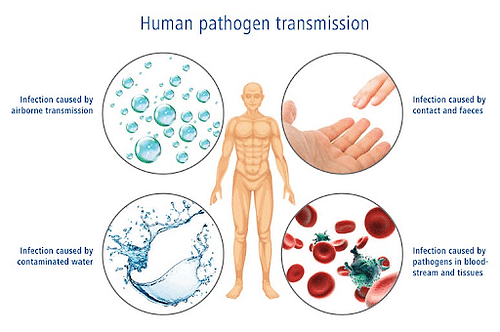
Human Pathogen Transmission
Also Read: What is Gestational Diabetes?
Risk Factors Involved
[Click Here for Previous Year Questions]
- Bacterias can infect a human body if they have other infectious diseases.
- It can infect a persons’ health through various genetic factors too.
- Bacterial diseases also impact those who are suffering from immunodeficiency diseases or disorders.
- People with weak immunity like old people and infants and children are also at risk of human bacterial diseases.
- Those who are sick and malnourished also get easily infected by these bacterial diseases.
Prevention of Bacterial Diseases
[Click Here for Sample Questions]
Bacterial diseases can be prevented through various measures such as-
- Always keep yourself safe and healthy and remember to keep your hands clean before and after coming in contact with any person.
- Maintain a certain distance from any person who is infected by bacterial diseases.
- Avoid touching your own face, especially, nose, eyes, and mouth area.
- Do not eat anything without washing your hands properly.
- Always eat healthy food and fruits that are washed properly with hot water.
- Clean the surfaces regularly.
Also Read:
| Chapter Related Topics | ||
|---|---|---|
| Difference Between Gram Positive and Gram Negative Bacteria | Binary fission | Population Interaction |
| Principles of Treatment | Heart Diseases | Vector Borne Diseases |
Things to Remember
- Bacterial diseases are due to the effect of harmful bacteria in the human body and it contains water, enzymes, nutrients, gases, etc.
- There are many bacteria that exist in the world which enter into the human body and the cells and infect us causing various diseases.
- The bacterial diseases in humans are spread by some microorganisms which are very tiny in shape and size like viruses, parasites, and fungi, known as bacteria.
- The size of different bacteria is from 0.2 to 2.0 diameters.
- The bacteria can enter a human body through contaminated water or food because the bacteria grow and multiply with food and water rapidly and easily.
- People with weak immunity like old people and infants and children are also at a high risk of getting infected with human bacterial diseases.
Previous Year Questions
- Which is the particular type of drug that is obtained from the plant whose one flowering branch is shown here?…. [NEET 2014]
- Which of the following diseases is caused by a protozoan?…. [NEET 2015]
- Which of the following diseases is now considered completely eradicated from India?…. [NEET 1997]
- Widal test is carried out to test…. [NEET 2012]
- Who discovered Plasmodium in R.B.C. of human beings?…. [NEET 1991]
- Which part of poppy plant is used to obtain the drug "Smack" ?…. [NEET 2018]
- Which one of the following is not a property of cancerous cells whereas the remaining three are?… [NEET 2012]
- Which one of the following acts as a physiological barrier to the entry of microorganisms in human body?….[NEET 2011]
- Which of the following is not an autoimmune disease?...[NEET 2018]
- Which is the particular type of drug that is obtained from the plant whose one flowering branch is shown here?…. [NEET 2014]
- Which of the following diseases is caused by a protozoan?... [NEET 2015]
- Dog distemper is a disease carried by a.... [KCET 2011]
- Natural killer lymphocytes are an example for... [KCET 2015]
- Damage to thymus in a child may lead to...[KCET 2009]
- Who among the following is recognised as the father of immunology?….[KCET 2008]
- In the immune system, interferons are a part of...[KEAM]
Sample Questions
Ques. What are bacteria? (2 marks)
Ans. The bacteria consists of a gel-like matrix that contains water, nutrients, waste, gases, and enzymes, and some cell structures like plasmids, chromosomes, and ribosomes. The size of different bacteria is from 0.2 to 2.0 diameters. And the shape of the bacteria is like Spheres, Rods, and Spirals.
Ques. How bacterial diseases can be prevented? (1 mark)
Ans. The disease can be prevented by maintaining distance from the infected person and always keep the hands clean and especially while eating foods. People also should consume healthy and nutritious food to stay healthy.
Ques. What are the diseases caused by bacteria in the human body? (5 marks)
Ans. The bacterial diseases are-
| Bacterial Diseases in Humans | Bacteria |
|---|---|
| Pulmonary Tuberculosis | Mycobacterium tuberculosis |
| Leprosy | Mycobacterium leprae |
| Tetanus | Clostridium tetani |
| Gonorrhea | Neisseria gonorrhoeae |
| Salmonellosis | Salmonella enteritis |
Ques. What are the components of bacteria? (3 marks)
Ans. The components of the bacteria are-
- Water,
- Nutrients,
- Wastes,
- Gases,
- Enzymes, and
- Some cell structures like plasmids, chromosomes, and ribosomes, etc.
Ques. How do Bacterial Diseases enter the human body? (3 marks)
Ans. Bacterial Diseases enter into a person’s body when they eat unhealthy and contaminated food and inhale toxic air by nose and lung.
- It enters into the body via eyes, ears, nose, and by kissing, touching, or other physical contact and communicating with a sick person.
- When an infected insect attacks a weak and sick person, the bacteria infect the body.
Ques. What are the risk factors involved in bacterial diseases in the human body? (5 marks)
Ans. Bacterial Disease attacks those who are weak and also sick like old people, kids, and infants, and who have a weak immune system. Other risk factors involved in bacterial diseases are-
- It infects whose people who are malnourished and dehydrated
- If a person consumes raw and undercooked eggs and meats then bacterial disease infects their body
- For people who are facing genetic disorders or other chronic diseases, the bacterial disease infects their body
- It infects the people who stay in dirty places and also does not washed their hands after touching raw foods, contaminated foods, and feces
Ques. What are the symptoms that we can see in an infected person? (3 marks)
Ans. Symptoms that we can see in an infected person are-
- Irritability
- Weakness
- Stiffness
- Diarrhea
- Flu (cold, fever, cough, headache, sore throat, body pain, etc.)
- Lesions
- Frequent vomiting
- Nausea
For Latest Updates on Upcoming Board Exams, Click Here:https://t.me/class_10_12_board_updates
Also check:



Comments