



Education Content Expert
Integration Rules are the rules used to integrate different types of functions. Integration is a means to calculate many useful quantities such as area, volume central point, and other kinds of parameters. The area beneath the curve in a graph is the most popular application of integration.
- Integration rules are used to solve complicated functions in integration.
- In addition to the integration rules, there are integration formulas for the purpose of substituting the integral form.
- Integration occurs when a derivative is already provided and the function needs to be derived through such a derivative accordingly.
- It is also known as anti-differentiation, as it is the inverse of differentiation.
Read More: NCERT Solutions For Class 12 Mathematics Chapter 7 Integrals
Key Terms: Integration, Functions, Integration Rules, Derivative, Differentiation, Power Rule, Integration by Parts, Trigonometry
What are Integration Rules?
[Click Here for Sample Questions]
Integration Rules are applied for integrating various kinds of functions. They are used to find the integral easily.
- For example, ∫ 2y dy = y2 + C as d/dy (y2) = 2y.
- Such an outcome is derived through the Power Rule of Integration where ∫yn dy = (yn+1/n+1) + C.
- Here, C the integration constant is C, which is added after the integral of any kind of integration function.
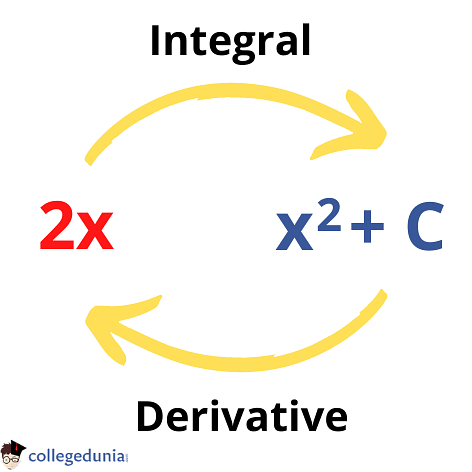
Integral and Derivative
The Integration Rules are mentioned as follows:
Power Rule of Integration
In accordance with the power rule of integration, if y is raised to the power n is integrated, the result is
| ∫yn dy = (yn+1/n+1) + C |
Example: Integrate ∫y4 dy.
∫y4 dx = y(4+1)/(4+1) = x5/5
Sum Rule of Integration
In accordance with the sum rule of integration, integrating the sum of two functions is equal to the sum of the integral of each function.
| ∫ (f + g) dy = ∫f dy + ∫g dy |
Example: ∫ (y + y3 )dy
= ∫y dy + ∫y3 dy
= y2/2 + y4/4 + C
Integration by Special Functions Video Explanation
Read More:
Difference Rule of Integration
Difference rule of integration bears similarity to the sum rule of integration. In accordance with the sum rule of integration, integrating the subtracted outcome of two functions equals the subtracted outcome of the integrals of the functions.
| ∫ (f - g) dy = ∫f dy - ∫g dy |
Example: ∫ (y - y3 )dy
= ∫y dy - ∫y3 dy
= y2/2 - y4/4 + C
Multiplication by Constant
When a constant and a function are multiplied with each other, the result is
| ∫ c f(y) dy = c ∫ f(y) dy |
Example: ∫4 y.dy
= 4 ∫ y.dy
= 4 y2/2 + C
= 2 y2 + C
Product Rule
The product rule is another term for the method “Integration by Parts”. It is applied when the multiplication of two functions takes place.
| ∫ u v dy = u ∫ v dy - ∫ (u' ∫ v dy) dy |
Here,
- The function of u(y) is u.
- The function of v(y) is v.
- The derivative of the function u(y) is u'.
Read More: Continuous Integration
Integration Rules of Basic Functions
[Click Here for Previous Years' Questions]
Integration rules are applicable to different types of functions. Given below are the basic rules for integration of the some common functions, such as:
- Constant
- Variable
- Square
- Reciprocal
- Exponential
- Trigonometry
Integration of Constant
The result of integrating the constant function would be
| ∫ b dy = by + C |
Example: ∫4 dx = 4x + C
Integration of Variable
If the variable provided is y, it can be denoted as
| ∫ y dy = y2/2 + C |
Integration of Square
If the function provided is a square, then the expression would be
| ∫ y2 dy = y3/3 |
Integration of Reciprocal
When 1/y is a reciprocal function of y, then the expression would be
| (1/y) dx = ln|y| + C (Natural log of x) |
Integration of Exponential Function
Integration rules of various exponential functions are as follows:
- ∫ fx dx = fx + C
- ∫ bx dx = bx / ln (b) + C
- ∫ ln (y) dy = y ln(y) − x + C
Integration of Trigonometric Function
The rules of Trigonometry are as follows:
- ∫ cos (y) dy = sin (y) + C
- ∫ sin (y) dx = - cos (y) + C
- ∫ sec2(y) dx = tan (y) + C
Read More: Integral Formulas
Integration Rules of Trigonometric Functions
[Click Here for Sample Questions]
The six Trigonometric Functions include sin, cos, tan, cosec, sec and cot. The Integration Rules of Trigonometric Functions are mentioned as follows:
- Integration of sin y - ∫ sin y dy = - cos y + C
- Integration of cos y - ∫ cos y dy = sin y + C
- Integration of tan y - ∫ tan y = In (sec y) + C (or) - In I(cos y) + C
- Integration of cosec y - ∫ cosec y dy = In I cosec y - cot y I + C (or) - In I cosec y + cot y I + C (or) In I tan (x/2) I +C
- Integration of sec y - ∫ sec y dy = In I sec y + tan y I + C (or) (½) In I (1 + sin y) / (1 - sin y) (or) In I tan [x/2 (π/4) ] | + C
- Integration of cot y - ∫ cot y dy = In I sin y I + C
In addition to the above, other Integration Rules of Trigonometric Functions are mentioned as follows:
- ∫ sec2y dy = tan y + C
- ∫ cosec2y dy = - cot y + C
- ∫ sec y. tan y dy = sec y + C
- ∫ cosec y . cot y dy = - cosec y + C
Integration Rules of Inverse Trigonometric Functions
[Click Here for Previous Years' Questions]
The six Inverse Trigonometric Functions include arcsin (sin−1), arccos (cos−1), arctan (tan−1), arccosec (cosec−1), arcsec (sec−1) and arccot (cot−1). The Integration Rules of Inverse Trigonometric Functions are mentioned as follows:
- ∫ sin-1y dy = y sin-1y + √(1 - y2) + C
- ∫ cos-1y dy = y cos-1y - √(1 - y²) + C
- ∫ tan-1y dy = y tan-1y - ½ ln |1+y2| + C
- ∫ cosec-1y dy = y cosec-1y + ln |y + √(y2 - 1)| + C
- ∫ sec-1y dy = y sec-1y - ln |y + √(y2 - 1)| + C
- ∫ cot-1y dy = y cot-1y + ½ ln |1+y2| + C
In addition to the above, other Integration Rules of Trigonometric Functions are mentioned as follows:
- ∫1/√(1 - y2).dy = sin-1y + C
- ∫ 1/(1 - y2).dy = - cos-1y + C
- ∫ 1/y√(y2 - 1).dy = sec-1y + C
- ∫ 1/y√(y2 - 1).dy = - cosec-1 y + C
- ∫1/(1 + y2).dy = tan-1y + C
- ∫ 1/(1 + y2).dx = - cot-1y + C
Integration Rules of Special Functions
[Click Here for Sample Questions]
There are rules for integrating special kinds of rational functions in which denominators square themselves. The Integration Rules of Special Functions are mentioned as follows:
- ∫1/ (y2 - a2) dy = (1/2a) log|(y-a)/(y+a)| +C
- ∫1/ (a2 - y2) dy = (1/2a) log|(a+y)/(a-y)| +C
- ∫ 1/ √(y2 + a2) dy = log |y + √(y2 + a2)|+C
- ∫1/ √(y2 - a2) dy = log |y + √(y2 - a2)|+C
- ∫1/ (a2 + y2) dy = (1/a) tan -1 (y/a) + C
- ∫ 1/ √(a2 - y2) dy = sin-1 (y/a) +C
The Rules of Integration involving square roots are as follows:
- ∫1/ (y2 - a2) dy = (1/2a) log|(y-a)/(y+a)| +C
- ∫1/ (a2 - y2) dx = (1/2a) log|(a+y)/(a-y)| +C
- ∫ 1/ √(y2 + a2) dy = log |y + √(y2 + a2)|+C
- ∫1/ √(y2 - a2) dy = log |y + √(y2 - a2)|+C
- ∫1/ (a2 + y2) dy = (1/a) tan -1 (y/a) + C
- ∫ 1/ √(a2 - y2) dx = sin-1 (y/a) +C
Read More:
ILATE Rule of Integration
[Click Here for Previous Years' Questions]
ILATE Rule is the Product Rule of Integration or the ‘Integration by Parts’ method. It is utilized for integrating the multiplied outcome of two functions. The ILATE Rule of Integration is denoted as
| ∫ u dv = uv - ∫ v du |
However, when the functions are u and dv, the integration rule is applied by following the approach provided below:
- I: Inverse Trigonometric Function
- L: Logarithmic Function
- A: Algebraic Function
- T: Trigonometric Function
- E: Exponential Function
The derivation of the rule is explained as follows:
∫ ln y dx = ∫ ln y · 1 dy
Here, the log function is y and the algebraic function is 1. Therefore, applying ILATE,
Let u = ln y and dv = 1. The outcome is
du = (1/y) dy and v = ∫ 1 dy = y
Applying the ‘Integration by Parts’ method,
∫ u dv = uv - ∫ v du
∫ ln y · 1 dy = (ln y) (y) - ∫ y (1/y) dy
∫ ln y dy = y ln y - ∫ 1 dy = y ln y - y + C
Read More: Double Integral
Methods of Integration
[Click Here for Sample Questions]
Methods of Integration are mentioned as follows:
Integration by Parts
Product Rule of Integration is considered while multiplying two functions. It is also used while applying the ILATE Rule of Integration as discussed above. Splitting into partial functions is the key thing for the effective application of this method, after which the rule 1/(ay + b) dy = (1/a) ln |ay + b| + C is applied for integrating each of the partial functions.
Solved ExampleExample: Find the integral of ∫ (4y + 1) / [ (y - 2) (y + 1)] dy Solution: Through the decomposition of the partial functions, the outcome is (4y + 1) / [ (y - 2) (y + 1)] = 3 / (y - 2) + 1 / (y + 1) When integral on both left and right hand sides are taken ∫ (4y + 1) / [ (y - 2) (y + 1)] dy = ∫ [3 / (y - 2) + 1 / (y + 1) ] dy Applying the rule 1/(ay + b) dy = (1/a) ln |ay + b| + C for each fraction ∫ (4y + 1) / [ (y - 2) (y + 1)] dy = 3 ln |y - 2| + ln |y + 1| + C |
By Parts Method of integrals Video Explanation
Integration by Substitution
The method is applied when an integral provided is modified into an integral in its simple form through substitution of independent variables through others. The ‘‘Integration by Substitution’ is important as it helps in the effective application of the Integration Rules of Trigonometric Functions, the Integration Rules of Inverse Trigonometric Functions, and the Integration Rules of Special Functions.
The method is explained as follows:
- Assumption of a part of integrand being v.
- Finding dv.
- Transforming the integral provided fully in terms of v
- Replacement of the value of v back in the outcome
Solved ExampleExample: Find the integral of ∫ 2y sin y2 dy. Solution: Let y2 = dy. Then 2y dy = dv. ∫ 2y sin y2 dy = ∫ sin v du = - cos v + C = - cos y2 + C |
Integration By Partial Fractions
In Integration by Partial Fractions, a rational function is split into partial fractions using a suitable rule and then integrated using the rule ∫ 1/(ax + b) dx = (1/a) ln |ax + b| + C to integrate each partial fraction.
| Rational Fractions | Partial Fractions |
|---|---|
| (px + q) / (x-a) (x – b), where a ≠b | A / (x – a) + B / (x-b) |
| (px + q) / (x-a)2 | A / (x – a) + B / (x-a)2 |
| (px2 + qx + r) / (x-a) (x-b) (x-c) | A / (x – a) + B/ (x-b) + C/ (x-c) |
| (px2 + qx + r) / (x – a)2 (x - b) | A / (x-a) + B/ (x-a)2 + C/ (x-b) |
| (px2 + qx + r) / (x2 – bx + c) | A / (x-a) + (Bx + C) / (x2 – bx + c) |
Where x2 – bx + c cannot be factorized further.
Solved ExampleExample: Evaluate: ∫ (4x + 1) / [ (x - 2) (x + 1)] dx. Solution: On decomposing the given fraction into partial fractions, we get (4x + 1) / [ (x - 2) (x + 1)] = 3 / (x - 2) + 1 / (x + 1). Now, take the integral on both the sides, ∫ (4x + 1) / [ (x - 2) (x + 1)] dx = ∫ [3 / (x - 2) + 1 / (x + 1) ] dx Using the rule ∫ 1/(ax + b) dx = (1/a) ln |ax + b| for each of the fractions, we get ∫ (4x + 1) / [ (x - 2) (x + 1)] dx = 3 ln |x - 2| + ln |x + 1| + C. |
Solved Examples on Integration Rules
[Click Here for Previous Years' Questions]
Here are a few solved examples on integration rules:
Example 1: What is ∫ 8 a3 da?
Solution: We will take 8 out of integral,
∫ 8 a3 da = 8 ∫ a3 da
= 8 a4 / 4 + C
= 2 a4 + C
Example 2: What is ∫ 4 a3 da?
Solution: We will take 4 out of integral,
∫ 4 a3 da = 4 ∫ a3 da
= 4 a4 / 4 + C
= a4 + C
Example 3: What is ∫ (Cos a + a) da ?
Solution: ∫ (Cos a + a) da = ∫ Cos a da + ∫ a da
= sin a + a2 /2 + C
Example 4: What is ∫ (Sin a + a) da ?
Solution: ∫ (Sin a + a) da = ∫ Sin a da + ∫ a da
= – Cos a + a2 /2 + C
Things to Remember
- Integration in calculus has led to the evolution of integral calculus.
- Integration is vital for deriving various parameters such as area, volume, central point, and other types of quantities.
- Integration Rules are used for functions such as constants, variables, squares, reciprocal and exponential functions, and trigonometry.
- The integration rules include Power Rule, Sum Rule, Difference Rule, Multiplication by Constant, and Product Rule.
- Integration Rules are of utmost importance in terms of carrying out the integration of functions in an effective and efficient manner.
- Integration Rules are used for the integration of complicated functions in order to derive the desired outcome without any major hindrances.
For Latest Updates on Upcoming Board Exams, Click Here: https://t.me/class_10_12_board_updates
Previous Years’ Questions
- If \(∫xlog\,(1 + {1 \over x})\)= dx = f(x)log(x+1) + g(x)x2 + Lx+C then... (BITSAT – 2017)
- The area (in s units) of the region {(x,y) : x≥0, x + y≤3, x2≤4y and... (JEE Main – 2017)
- For a>0, let the curves C1:y2 = ax and C2:x2 = ay intersect at origin O... (JEE Main – 2020)
- The area of the region A=[(x,y) : 0≤y≤x∣x∣+1 and −1≤x≤1] in s units is... (JEE Main – 2019)
- The area (in s units) bounded by the curves y... (COMEDK UGET - 2013)
- Let the straight line x=b divide the area enclosed by... (AMUEEE - 2014)
- The number of integral terms in the expansion…
- If \({x^2 + 5} \over {(x^2 + 1) (x-2)} \)= \(A \over {x-2} \) + \(Bx + C \over {x^2 + 1}\), then A+B+C... (TS EAMCET - 2017)
- You are given a curve, y=ln(x+e). What will be the area enclosed between... (JKCET - 2017)
- The integral ∫cos (logx) dx is equal to… (JEE Main - 2019)
Sample Questions
Ques. Evaluate the given integral ∫ (x4 + 3x2 + x) / x2 dx. (3 Marks)
Ans. Decompose the given fraction.
∫ (x4 + 3x2 + x) / x2 dx
= ∫ x4 / x2 dx + ∫ 3x2 / x2 dx + ∫ x/ x2 dx
= ∫ x2 dx + 3 ∫ 1 dx + ∫ (1/x) dx
Using the integration rules,
= (x3/3) + 3x + ln |x| + C
Ques. What is the Difference Rule of Integration? (3 Marks)
Ans. The integral of the difference between two functions equivalent to the difference between the individual functions integrated is the Difference Rule of Integration. The expression is denoted as follows:
∫ (f - g) dy = ∫f dy - ∫g dy
Example: ∫ (y - y3 )dy
= ∫y dy - ∫y3 dy
= y2/2 - y4/4 + C
Ques. What is the value of the integral ∫ x sin x dx. (3 Marks)
Ans. We know that the integrand has a product, thus, we will integrate using the integration by parts. Using ILATE rule, Let
- u = x
- dv = sin x dx.
Then
- du = 1 dx
- v = -cos x
Now, we would substitute these values in the rule below and apply the integration rules.
∫ u dv = uv - ∫ v du
∫ x sin x dx = x (-cos x) - ∫ (-cos x) dx
= - x cos x + ∫ cos x dx = - x cos x + sin x + C
Ques. What is the Sum Rule of Integration? (3 Marks)
Ans. According to the Sum Rule of Integration, the integral of the sum of two functions is equal to the sum of the individual functions integrated. The expression is denoted as follows:
∫ (f + g) dy = ∫f dy + ∫g dy
Example: ∫ (y + y3 )dy
= ∫y dy + ∫y3 dy
= y2/2 + y4/4 + C
Ques. Find the value of ∫ (x3) / (x4 - 1) dx. (3 Marks)
Ans. We will use the substitution method of integral calculus. Let x4 - 1 = u
4x3 dx = du and from this, x3 dx = (1/4) du.
The given integral becomes:
∫ (1/4) du 1/u = (1/4) ∫ 1/u du
= (1/4) ln |u| + C
Substitute u = x4 - 1,
= (1/4) ln |x4 - 1| + C
Ques. What is the Power Rule of Integration? (3 Marks)
Ans. The Power Rule of Integration is denoted as follows:
∫yn dy = (yn+1/n+1) + C
Example: Integrate ∫y4 dy.
∫y4 dx = y(4+1)/(4+1) = x5/5
Ques. What is Multiplication by Constant? (3 Marks)
Ans. If a function is multiplied by a constant, then, the integration of such function is given as
∫ c f(y) dy = c ∫ f(y) dy
Example: ∫4 y.dy
= 4 ∫ y.dy
= 4 y2/2 + C
= 2 y2 + C
Ques. What is the Product Rule of Integration? (3 Marks)
Ans. The multiplication of two functions is the Product Rule of Integration. It is also known as the Integration by Parts method. The expression is denoted as follows:
∫ u v dy = u ∫ v dy - ∫ (u' ∫ v dy) dy
Here
- u is the function of u(y).
- v is the function of v(y).
- u' is the derivative of the function u(y).
Ques. What is the Rule of Integration for a Reciprocal function? (3 Marks)
Ans. The Rule of Integration for a Reciprocal Function is expressed as follows:
(1/y) dy = ln|y| + C
Here, the reciprocal function or natural log of y is 1/y.
Ques. What is the Rule of Integration for an Exponential function? (3 Marks)
Ans. There are various Rules of Integration for an Exponential function. The rules for exponential functions are as follows:
- ∫ fx dx = fx + C
- ∫ bx dx = bx / ln (b) + C
- ∫ ln (y) dy = y ln(y) − x + C
Ques. How can one derive Integration Rules? (3 Marks)
Ans. Integration is just the reverse process of integration, thus, to find the integral of a function, we need to think about the derivative of what function gives the given function. For instance, in order to derive the integration rule for∫ cos x dx, just think "the derivative of what function is cos x", the answer can then be obtained as sin x. Now, just add the integration constant, then we get ∫ cos x dx = sin x + C.
However, all the integration rules can't be derived this easily though. For this, we need to refer to the integration rules.
Ques. What is the Rule of Integration for Trigonometry? (3 Marks)
Ans. There are various Rules of Integration for Trigonometry which are as follows:
- ∫ cos (y) dy = sin (y) + C
- ∫ sin (y) dx = - cos (y) + C
- ∫ sec2(y) dx = tan (y) + C
Check-Out:



Comments