



Education Journalist | Study Abroad Lead
Interpolation can be described as a type of estimation where the value of f(x) or function of x is determined from a set of two known values of the function. The unknown value of a point can be determined through this formula. If the values such as x0 <....< xn and y0 = f(x0).....yn = f(xn) are known, and if x0 < x < xn then then estimated values of f(x) is determined as an Interpolation. In interpolation, the word, ‘inter’ means entering into the data set. Apart from being useful in Statistics, it is also used in Science, business and many other real-life applications that fall within two existing data points.
| Table of Content |
Key Terms: Interpolation, Discrete Date, Linear Interpolation, Lagrange Polynomial, Interpolation Formula, Linear Interpolation Formula, Estimation
Also read: Isosceles Triangle Theorems
What is the Interpolation Formula?
[Click Here for Sample Questions]
Interpolation can be defined as a procedure to derive a basic function from the given discrete data set in such an order that the function passes through the given data points. In short, interpolation enables us to estimate the data points in between the given data.
In simpler words, we can define interpolation as a method of estimating the unknown values that fall in between the given data points. The process of interpolation is used to estimate the unknown values such as noise level, rainfall, elevation, etc for any geographical related data points.
Read More: Relations and Functions
Types of Interpolation Formula
[Click Here for Sample Questions]
In order to determine the unknown values of a given set of data points, two kinds of interpolation formulas are used: Linear interpolation formula and Lagrange interpolation formula.
- Linear Interpolation Formula
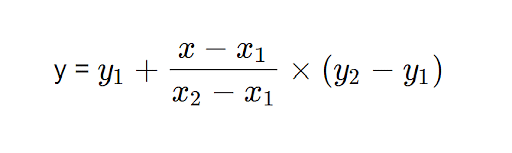
The method of Linear Interpolation has been used for filling the unknown values in tables since a very early time. The technique of using linear interpolation is believed to be used by Babylonian. The linear interpolation formula is as follows:

Linear Interpolation Formula
- Lagrange Interpolation Formula
The Lagrange Interpolation Formula is used to find a polynomial known as Lagrange polynomial, that takes on certain values at arbitrary points. Lagrange’s Interpolation can be described as an Nth degree polynomial approximation to f(x). The Lagrange interpolation formula is stated as follows:

Lagrange Interpolation Formula
Also read: First Order Differential Equation
Things to Remember
- Interpolation can be described as a type of estimation where the value of f(x) or function of x is determined from a set of two known values of the function.
- Interpolation can also be defined as a method of estimating the unknown values that fall in between the given data points.
- Basically, there are two kinds of interpolation formulas: Linear Interpolation Formula and Lagrange Interpolation Formula.
- Linear Interpolation, also known as simply interpolation, has been used for filling the unknown values in tables since a very early time.
- Lagrange’s Interpolation is used to find Lagrange polynomial and can be described as an Nth degree polynomial approximation to f(x).
Check More:
Sample Questions
Ques. Using the interpolation formula, find the value of y at x = 0, if given some set of values are (-2, 5), (1, 7)? (3 Marks)
Ans. Given the known values are,
x= 0
x0 = -2
x1 = 1
y0 = 5
y1 = 7
Using the interpolation formula,

y = 5 + (0 + 2)×(5 - 7)/(-2 - 1)
y = 5 + 4/3
y = 19/3 = 6.33...
Therefore, the value of y at (x = 0) = 6.333.
Ques. Determine the values of y at x = 4 given some set of values (2,4), (6,7) by using the interpolation formula. (3 Marks)
Ans. Given :
x0 = 4
x1 = 2
x2 = 6
y1 = 4
y2= 7
The interpolation formula is:
y = 4 + (4 - 2)/(6 - 2) * (7 - 4)
y = 4 + 3/2
y = 11/2
Ques. Using the interpolation formula, find the value of y at x = 1, if given some set of values are (-4, 5), (2, 6)? (3 Marks)
Ans. Given the known values are:
x= 1 ; x0 = -4 ; x1 = 2 ; y0 = 5 ; y1= 6 ;
Using the interpolation formula,

y = 5 + (1 +4)×(5 - 6)/(-4 - 1)
y = 5 + 5×1/5
y = 6
Therefore, the value of y at (x = 1) = 6
Ques. Find the value of y at x = 8 using the interpolation formula if some sets of values are given (2, 6), (5, 9). (3 Marks)
Ans. We know that
x =8
x1=2, x2=5, y1=6, and y2= 9
The interpolation formula is given as

Y = 6+ 8-2/5-2 x (9-6)
Y= 6+6
Y= 12
Ques. Consider the following table of data: Based on this chart, calculate the estimated height of the plant on the fourth day. (3 Marks)
Ans. This is an example of linear growth and hence the linear interpolation formula is very much suitable here. We may take (3,4) as the first data point and (5,8) as the second data point.
We have values as
y1 =4
x1 =3
y2 =8
x1 =5
Now, applying the formula:

Thus, for the fourth day x=4.
Hence, y = 2*4-2
Y = 6
Therefore, on the fourth day, the height will be 6 units.
Ques. Write the formula to find the value of ’x’ in finding the missing value of ’y’ using Newton’s method of interpolation. (2 Marks)
Ans. The formula for finding the value of x will be as
X= (The value of X is to be interpolated - The value of X at the origin)/The difference between the two adjoining values of X
Ques. Interpolate and extrapolate the production for the years 2000 and 2010 with the help of the following table:  (4 Marks)
Ans. Let x and y be the year and production.

The number of known values of ‘y’ : n = 6. So, the Binomial expansion (y – 1)6 = 0.
i.e., y6 – 6y5 + 15y4 – 20y3 + 15y2 – 6y1 + y0 = 0 …(1)
33 – 6y5 + 15 (18) – 20(15) + 15(13) – 6 (11) + 10 =0
-6y5 + 142 = 0;
– 6y5 = -142;
y5 = 142/6
= 23.67 tons is the production for the year
For extrapolation the suffixes of ‘y’ in equation (1) is increased by ‘1’
y7 – 6y6 + 15y5 – 20y4 + 15y3 – 6y2 + 6y1 =0
y7 – 6(33) + 15(23.67) – 20(18) + 15(15) – 6(13) + 11 = 0
y7 – 198 + 355.05 – 360 + 225 – 78 + 11 = 0
y7 – 44.95 = 0
∴ y7 = 44.95 tons is the production for the year 2010.
Ques. Interpolate and extrapolate the production for the years 1989 and 1991 with the help of the following table.  (4 Marks)
Ans. Let x and y be the year and production.

The number of known values of ‘y’ ; n = 4, the Binomial expansion (y – 1)4 = 0
i.e., y4 – 4y3 + 6y2 – 4y1 + y0 = 0 …(1)
135 – 4y3 + 6(126) – 4(122) +1 20 = 0
-4y3 + 523 = 0;
y3 = 523/4
= 130.75
is the production for the year 1989.
For extrapolation the suffixes of y has increased by in equation (1)
y5 – 4y4 + 6y3 – 4y2 + y1 = 0
y5 – 4(135) + 6(130.75) – 4(126) + 122 = 0
y5 – 540 + 784.5 – 504 + 122 = 0
y5 – 137.5 = 0; y5 = 137.5
is the production for the year 1991.
Ques. The annual sales of a company are given below. Interpolate and extrapolate the sales for the year 2002 and for the year 2005.  (4 Marks)
Ans. Let x and y be the year and Sales.

The number of known values of y n = 4 and so, the Binomial expansion (y – 1)4 = 0
i.e., y4 – 4y3 + 6y2 – 4y1 + yo = 0 …(1)
282 – 4(238) + 6y2 – 4(163) +125 =0
282 – 952 + 6y2 – 652 + 125 = 0
6y2 – 1197 = 0,
∴ y2 = 1197/6
= 199.5 is the sales for the year 2002.
For Extrapolation, the suffixes of ‘y’ has increased by T in equation (1) We get
y5 – 4y4 + 6y2 – 4y2 + y1 = 0
y5 – 4(282) + 6(238) – 4(199.5) + 163 = 0
y5 – 1128 + 1428 – 798 + 163 = 0
i.e., y5 – 335 = 0
∴ y5 = 335 is the sales for the year 2005.
Ques. Interpolate and extrapolate the production for the years 1982 and 1985 from the following data.  (4 Marks)
Ans. Let x and y be the year and production.

Number of known values of ‘y’ n = 5 and so, the Binomial expansion (y – 1)5 = 0
i.e., y5 – 5y4 + 10y3 – 10y2 + 5y1 – y0 = 0 …(1)
780 – 5(525) + 10y3 – 10 (150) + 5 (120) – 100 = 0
780 – 2625 + 10y3 – 1500 + 600 – 100 = 0
10y3 – 2845 = 0;
∴ y3 = 2845/10
= 284.5
Tons is the production for the year 1982.
For extrapolation suffixes of ‘y’ has increased by ‘1’ in equation (1). We get:
y6 – 5y5 + 10y4 – 10y3 + 5y2 – y1 =0.
y6 – 5(780) + 10 (525) y6 – 865 = 0 + 10(284.5) + 5(150) – 120 = 0
y6 – 3900 + 5250 – 2845 + 750 – 120 = 0;
∴ y6 = 865 tons is the production for the year 1985.
For Latest Updates on Upcoming Board Exams, Click Here: https://t.me/class_10_12_board_updates
Check-Out:



Comments