



Education Content Expert
Iris is a muscular pigmented membrane present in front of the eye between the lens and the cornea. Iris is a flat and ring-shaped membrane behind the cornea of the eye that has an adjustable circular opening in the center called a pupil. Iris provides an individual with eye color. Iris is present behind the anterior chamber, a space located behind the cornea and filled with a fluid known as aqueous humor. Iris also regulates the amount of light that can enter the retina. Iris has two layers of smooth muscles that help the pupils to control the density of light that reaches the retina and sense organs. The amount of pigment controls the eye color of the organism.
Read More: NCERT Solutions For Class 11 Biology Neural Control and Coordination
| Table of Content |
Key Terms: Iris, Eye, Retina, Light, Pupil, Cornea, Stroma, Human Eye, Melanin, Aqueous Humor, Lens
What is Iris?
[Click Here for Sample Questions]
Iris is a thin, pigmented structure in the eye that controls the amount of light that can enter the retina. Iris also determines the eye color of an organism.
- Iris is present at the front of the lens of the eye.
- It controls the size and diameter of the pupil and thus the amount of light entering the eye.
- It is the visible part of the eye that is pigmented and opaque.
- The amount of melanin pigment determines the color of the iris.
- The muscles of the iris control the size of the aperture, known as the pupil.
- When the light is bright the iris closes the pupil and allows less light to enter the eye.
- When the light is dim, the iris opens the pupil more to allow more light to enter the eye.

Iris
Read More:
| Relevant Concepts | ||
|---|---|---|
| Human Eye | The Human Eye and The Colourful World | Eye Diseases |
| Power of Accommodation of the Eye | Neural Control and Coordination | Blind Spot in Eye |
Iris Anatomy
[Click Here for Previous Year Questions]
Iris is present behind the cornea and above the lens of the eye. It originates from the ciliary body. The thick anterior part of the choroid layer of the eye, known as the ciliary body, extends further into the iris. It is a pigmented structure and the color depends on the amount and nature of pigments present in it.
Iris is made up of two layers:
- Stroma: The frontal pigmented fibrovascular layer.
- Pigmented Epithelial Cells: Present at the back.
Iris surrounds a small opening called the pupil. Iris contains two sets of muscles. When the circular muscles shrink, the pupil size reduces, and when the radially arranged muscles shrink, the pupil size raises. Thus, the iris plays an important role in controlling the amount of light that can enter the retina.
Read More: Neural Control and Coordination Important Questions
Muscles of Iris
[Click Here for Sample Questions]
Iris is a pigmented diaphragm with a central hole called the pupil. It is placed in front of the lens thus separating the anterior chamber from the posterior chamber which each contains aqueous humor passing through the pupil.
There are two muscles in the iris:
- Sphincter Pupillae: Constriction of the pupil is provided by parasympathetic fibers from the oculomotor nerve. It is a circular muscle. It compresses the pupil in bright light.
- Dilator Pupillae: The dilation of the pupil is provided by the sympathetic fibers. This muscle of the iris opens and expands upon contraction.
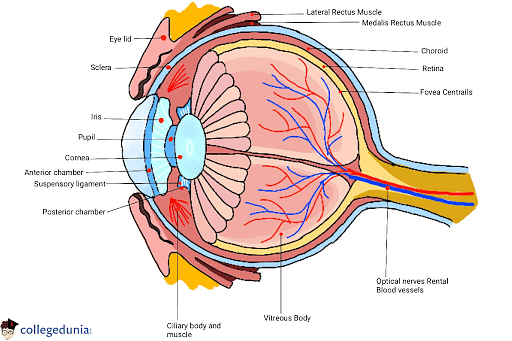
Structure of Human Eye
Use of Iris in Eye
[Click Here for Previous Year Questions]
Iris is an integral component of the human eye serving various other important functions which are as follows:
- Iris is a strongly pigmented structure that decides the color of the eye.
- Typical eye colors can be gray, blue, hazel, brown, and green.
- The most significant pigment contributing to the color of the iris is melanin.
- Iris saves the retina from getting blocked by too much radiation of the light and vice versa.
- Iris has muscles attached to it that help the eyes change their shape.
- Iris works with the pupils and helps people to see and perceive things.
Read More: Neural Control and Coordination MCQs
Types of Irises Eyes
[Click Here for Sample Questions]
Iris can be classified into six types namely blue, ombre, grey, brown, green, red, or hazel. There are a few types of irises like iris eye, flowers type iris eye, shakers type iris eye, and others.
- Gem types of iris eyes include irises that have brown dots or flakes. People with gem-type irises are believed to be knowledgeable and clear-headed.
- Those with the flower-type iris have eyes like round or curved flower petals.
- People with flower-type iris like being emotional, changing in temperament, and expressing their feelings and other personality traits.
- Shaker-type irises have freckles or dot-like pigments with circular apertures. People with these irises have qualities like progressive, unpredictable, driven, and extreme.
Check More:
| Related Topics | ||
|---|---|---|
| Hypermetropia | Sensory Perception | Photometry |
| Difference between Human Eye and Camera | Presbyopia | Myopia |
Things to Remember
- Iris is a thin, pigmented structure in the eye that controls the amount of light that can enter the retina.
- Iris is made up of two layers namely Stroma and Pigmented epithelial cells.
- Iris is situated behind the cornea and is liable for controlling the size of the pupil.
- There are two muscles in the iris namely the Sphincter Pupillae and Dilator pupillae.
- Iris safeguards the retina from getting blocked by the radiation of the light.
- Irises can be classified into six types such as blue, ombre, grey, brown, green, red, or hazel.
- There are a few other types of irises like iris eye, flowers type iris eye, shakers type iris eye, and others.
Previous Years’ Questions
- Iris is part of… (NEET 1993)
- Function of the iris is to… (NEET 1993)
- Human eye lens is… (JIPMER 1997)
- In a blind spot of the human eye… (KCET 2019)
- The cornea is a very important component of the human eye… (AIIMS 2010)
- The innermost layer of the human eye… (KEAM)
- Near and far points of the human eye are…
- Melanin protects from… (AIPMT 2002)
- Retina is most sensitive at… (NEET 1993)
- A normal human eye can clearly see all the objects beyond a certain…
Sample Questions
Ques. What is Iris? (3 Marks)
Ans. Iris is a dark-colored, round structure of the eye that is responsible for controlling the amount of light that enters the eyes through pupil constriction or dilation. Iris is comprised of the pigmented or vascular layer. Iris is around 12mm in diameter and is located behind the anterior chamber, a space behind the cornea and filled with a fluid known as aqueous humor. The pigmented or vascular layer comprises the iris.
Ques. What is Iris made of? (3 Marks)
Ans. Iris is located in the uveal tract, which is the eye's middle layer. Iris lies in front of the lens and behind the cornea and is made up of the following parts:
- Iris Pigment Epithelium: It contains melanin granules and chromatophores that make up the eye color.
- Dilator and Sphincter Muscles: They expand and contract to control the amount of light that gets in,
- Stroma: It is made up of connective tissue and blood vessels.
Ques. What determines eye color? (3 Marks)
Ans. Iris is the colored part of the eye and the eye color is determined by a combination of different pigments and saturation levels. The main pigments found in the eye are as follows:
- Melanin: It is a yellow-brown pigment that also determines skin tone.
- Pheomelanin: It is a red-orange pigment that causes red hair and is commonly present in green or hazel eyes.
- Eumelanin: It is a black-brown pigment that determines how intense or dark the iris would be.
Therefore, brown eyes have a higher amount of melanin, whereas blue eyes have very little pigment.
Ques. What is the color of the human iris? (2 Marks)
Ans. The color or pigmentation of the iris in humans differs from black to light brown which is based on the concentration of melanin in the iris pigment epithelium, the melanin content in the iris stroma, and the cellular density of the stroma. However, people might have blue or hazel eyes too.
Ques. What is a blue iris eye? (3 Marks)
Ans. In a blue iris eye, the appearance of blue rings around the Iris occurs due to the storage of cholesterol in the human retina. The storage items in the retina are yellowish or white in most cases, though it appears blue. Though, one should not consider this as a risk factor for the human eyes. According to the researchers, 20%-35% of people tend to have an Iris blue look.
Ques. What is the radial muscle of the iris? (1 Mark)
Ans. The radial muscle of the iris or the iris dilator muscle is the smooth muscle of the eye that radially runs in the iris and hence serves as a dilator.
Ques. What are the two layers of the iris? (2 Marks)
Ans. The two layers of the iris are stroma and pigmented epithelial cells. The stroma is a further pigmented fibrovascular layer below which pigmented epithelial cells exist.
Ques. Iris is part of the which component in the eye? (2 Marks)
Ans. The uvea is a heavily pigmented structure that is the middle layer of the eye. Below the uvea is the white part of the eye called the sclera. It comprises the iris, choroid, and ciliary body. The iris is the frontmost part of the uvea.
Ques. What is Heterochromia? (2 Marks)
Ans. Heterochromia is a congenital condition, that is often associated with other conditions, in which one eye is differently colored than the other. Apart from that difference, this condition is asymptomatic.
Ques. What are the reasons behind the different colors of the Iris? (3 Marks)
Ans. The main reason why people have different colors of irises is heterochromia. This may be the reason for having two different types of irises in the same body, such as blue and black. In many circumstances, heterochromia can be genetic, and it can be caused by certain diseases such as diabetes. Eye surgery and inflammation of the eye can also lead to heterochromia.
Ques. What is the meaning of iridology? (1 Mark)
Ans. Iridodiagnosis or iridology is a kind of alternative medicine method that examines the patterns, colors, and other characteristics of the iris to decide the systemic health of a patient.
Check-Out:



Comments