



Education Journalist | Study Abroad Lead
Iron is an element which makes up about 5% of the Earth’s crust and is next to aluminium in its abundance among the metals. Iron forms the primary constituent of the core of the Earth and is the most abundant element on Earth in totality, which is around 35%. On Earth, presence of free iron metal is rare and it predominantly occurs as terrestrial iron, that is, alloyed with 2-3% nickel in basaltic rocks in Greenland as well as carbonaceous sediments which are found in the United States along with some low-nickel meteoric iron, namely kamacite. The metal is extracted by processes such as smelting with coke (carbon) and limestone.
| Table of Content |
Key Takeaways: Iron, Metals, Smelting, Periodic Table, Oxidation, Melting Point, Alloy
What is Iron?
[Click Here for Sample Questions]
Iron (Fe) is a metal which belongs to group VIII of the periodic table. Iron is ductile, malleable, lustrous and silverish-grey in colour. It is the 10th most abundant element which is present in the universe. On Earth, iron is found in the core in molten form.

Iron has a shiny and lustrous appearance
Iron, as commonly available, nearly always contains a certain small percentage of carbon, which is picked up from the coke during the process of smelting. This results in modifying its properties, from hard and brittle cast irons containing up to 4% carbon to more malleable low-carbon steels containing less than 0.1% carbon.
Read Also:
| Related Articles | ||
|---|---|---|
| Minerals | Metals and Non-Metals | Electropositivity |
| Iron (III) Hydroxide Formula | Iron iii Nitrate Formula | Chemical Changes |
Characteristics of Iron
[Click Here for Sample Questions]
Pure iron is quite reactive in nature. In a very finely divided state, metallic iron is pyrophoric (i.e., it ignites spontaneously). It also reacts very vigorously with chlorine on mild heating as well as also with a wide variety of other non-metals, including all of the halogens, phosphorus, sulphur, boron, carbon, and silicon. Moreover, in these conditions, carbide and silicide phases play a predominant role in the technical metallurgy of iron.
Metallic iron dissolves readily in diluted mineral acids. With non-oxidising acids and in the absence of air, iron in the +2 oxidation state is present. With air present or when warm dilute nitric acid is used, some of the iron goes into solution as the Fe3+ ion. Very strongly oxidising mediums such as concentrated nitric acid or acids containing dichromate—passivate iron (i.e., cause it to lose its normal chemical activity), however, much as they do chromium. It is also observed that air-free water and dilute air-free hydroxides have little effect on the metal, but it is attacked by hot concentrated sodium hydroxide.
Human body also contains about 4 grams of iron, that is around 65% of the iron in the form of haemoglobin (used for transportation of molecular oxygen from lungs towards ret of the body), various enzymes which are responsible for controlling intracellular oxidation and rest of the iron present is stored in the body in spleen, liver and bone marrow for future conversion of those iron into haemoglobin.
Chemical Properties of Iron
[Click Here for Sample Questions]
The following table represents the common chemical properties of Iron:
| Group | VIII |
| Period | IV |
| Block | d |
| Atomic Number | 26 |
| Atomic Mass | 55.85 g.mol-1 |
| State at 20°C | Solid |
| Symbol | Fe |
| Electronic Configuration | [Ar] 3d64s2 |
| Melting Point | 1536 °C |
| Boiling Point | 2861 °C |
| Density (g cm−3) | 7.8 g.cm-3 at 20°C |
| Key Isotopes | 56Fe |
Physical Properties of Iron
[Click Here for Sample Questions]
The following points represent the physical properties of iron:
- It dissolves in dilute acids readily.
- It is magnetic in nature.
- It rusts in damp air but does not do so in dry air.
- At room temperature, this metal is in the form of ferrite or apha-form.
- It melts at 1536°C and boils at 2861°C.
- At 910°C, it changes to gamma-iron, which is much softer in nature.
Applications of Iron
[Click Here for Sample Questions]
The following points represent the uses of iron:
- It can be used to make magnets, alloys and other compounds.
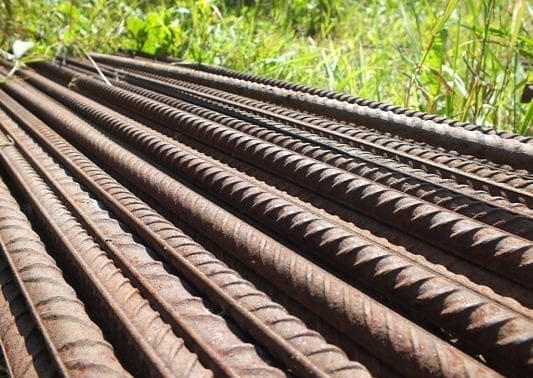
- It is used to make items such as iron boards, electric pylons, bridges, chains, cutting tools and so on.
- It is used to manufacture steel with additives such as nickel, chromium, tungsten, manganese etc.
- It is also used in civil engineering such as reinforcement of girders.
- It is used as a catalyst for producing ammonia using Haber’s process.
- As cast irons contain around 3-5% carbon, they can be used to produce pipes, valves, pumps and so on.
Uses of Iron
Things to Remember
- The symbol for iron is Fe and its atomic number is 26 having an atomic weight of 55.85 g.mol-1.
- Iron is the 6th most common element which is present in the Universe.
- The human body contains an average of 4 grams of iron.
- Iron is commonly used in industries such as electronics, manufacturing, construction and building.
- Iron makes around 5% of the crust of the Earth and is next to aluminium in abundance.
Read More:
Sample Questions
Ques. Why does iron have a high melting point? (2 marks)
Ans. In order to overcome the forces of attraction between the metal ions and the dislocated electrons to either melt or boil the metal, high melting and boiling points are observed in iron.
Ques. What are the different types of iron? (2 marks)
Ans. Plain iron, wrought iron, pig iron, cast iron and directly reduced iron are the different types of iron which are available for use.
Ques. What are the different uses of iron? (2 marks)
Ans. Iron is used for the following purposes:
- Acting as a building block of steel.
- Transportation of oxygen throughout the body via blood in animals.
- Acts as an important micronutrient for plants.
Ques. What is the electronic configuration of iron? (2 marks)
Ans. [Ar] 3d64s2
The electronic configuration of iron is 1s2 2s2 2p6 3s2 3p6 4s2 3d6, and the form [Ar] 4s2 3d6 is the abbreviated form.
Ques. What is rusting of iron? (3 marks)
Ans. Exposure of iron (or any other alloy of iron) to oxygen in the presence of moisture leads to the formation of rust. This reaction with moisture and iron is not instantaneous, it generally proceeds over a long time frame. The oxygen atoms bond with iron atoms, resulting in the formation of iron oxides. This weakens the bonds between the iron atoms in the object/structure.
The reaction of the rusting of iron results in increasing the oxidation state of iron which is accompanied by an eventual loss of electrons.
Rust is mostly made up of two different iron oxides that generally vary in the oxidation state of the iron atom. These oxides are:
- Iron(II) oxide or ferrous oxide. The oxidation state of iron in this compound is +2 and its chemical formula is FeO.
- Iron(III) oxide or ferric oxide, where the iron atom exhibits an oxidation state of +3. The chemical formula of this compound is Fe2O3.
Ques. How can the production of pig iron be increased? (2 marks)
Ans. By increasing the pressure conditions, a heightened production of pig iron can be achieved. This is because it reduces the dust carry over and thereby allows for higher rates of production.
Ques. Explain blast furnace processing technique for industrial iron production. (5 marks)
Ans. Industrial iron making starts with iron ores, principally hematite, which has a nominal formula Fe2O3, and magnetite, with the formula Fe3O4. These ores are reduced to the metal by treatment with carbon which is called a carbothermic reaction. The adaptation is typically conducted in a blast furnace at temperatures of about 2000°C. Carbon is provided in the form of coke. The process also contains a flux such as limestone, which is used to eliminate siliceous minerals in the ore, which would otherwise clog the furnace. The coke and limestone are fed into the top of the furnace, while a massive blast of air heated to 900°C, about 4 tons per ton of iron,116116 is forced into the furnace at the bottom.
In the furnace, the coke reacts with O2 in the air blast to create CO (Carbon monoxide):
2 C + O2 \(\to\)2 CO
The carbon monoxide results in reducing the iron ore (hematite) to molten iron, and thus transforming it to carbon dioxide in the process:
Fe2O3 + 3 CO \(\to\) 2 Fe + 3 CO2
Some iron at the high-temperature bottom part of the furnace reacts directly with the coke:
2 Fe2O3 + 3 C \(\to\) 4 Fe + 3 CO2
Furthermore, the flux which is responsible for melting impurities in the ore is principally limestone (calcium carbonate) and dolomite (calcium-magnesium carbonate). At the high temperature of the furnace the limestone flux decomposes to calcium oxide (also known as quicklime):
CaCO3 \(\to\)CaO + CO2
Then calcium oxide mixed with silicon dioxide to create a liquid slag.
CaO + SiO2 → CaSiO3
The slag dissolves at the high temperature of the furnace. In the base of the furnace, the molten slag floats on top of the denser molten iron, and apertures in the corner of the furnace are opened to run off the iron and the slag individually. The iron, once cooled, is called pig iron, while the remainder of the slag material can be used in road construction or to improve mineral-poor soils for agriculture.
Ques. What is direct iron reduction? (3 marks)
Ans. Due to environmental concerns, other methods of producing iron have been developed. Two major reactions contain the direct reduction process:
- Natural gas is to some extent oxidised (with heat and a catalyst):
2 CH4 + O2 \(\to\) 2 CO + 4 H2 - Iron ore is then further treated with the gases in a furnace, thus creating a solid sponge iron:
Fe2O3 + CO + 2 H2 → 2 Fe + CO2 + 2 H2O
Additionally, towards the end, silica is discarded by adding a limestone flux as described in the above equations.
Ques. Describe some of the mechanical properties of iron. (3 marks)
Ans. The properties of iron and its alloys can be simplified using a variety of tests, including the Brinell test, Rockwell test , and the Vickers hardness test. The mechanical properties of iron are drastically affected by the different results of purity: pure, individual crystals of iron are less hard than aluminium, and the purest industrially produced iron (99.99%) has a toughness of 20–30 Brinell. An increase in the amount of carbon content will cause a significant increase in the toughness and tensile strength of iron. The highest hardness of 65 Rc is achieved with a 0.6% carbon content, although the alloy has low tensile strength.
Ques. Can the consumption of coke be reduced in the manufacturing of pig iron? (2 marks)
Ans. Yes, coke consumption can be reduced in the manufacturing process by including supplementary oil injection in the process. Furthermore, it results in upto 20% savings of coke for the production of pig iron.
For Latest Updates on Upcoming Board Exams, Click Here: https://t.me/class_10_12_board_updates
Check-Out:



Comments