



Content Curator
Linkage and Recombination are the phenomena that describe the inheritance of the parent genes by the offspring. In linkage, two or more genes linked together are usually inherited in the same combination for more than two generations, whereas in recombination, genetic material is exchanged across different species, resulting in offspring with the combined features.
| Table of Content |
Keyterms: Linkage, Recombination, Genetic material, Genes, Dihybrid cross, Sexual reproduction, Crossing over
Also read: Tap Root System
Morgan’s Experiment
[Click Here for Sample Questions]
To examine sex-linked genes, Thomas Hunt Morgan performed multiple dihybrid cross experiments with Drosophila. Thomas Hunt Morgan studied Drosophila melanogaster (fruit flies) to figure out how sexual reproduction caused differences. For the following reasons, he liked to work with fruit flies or Drosophila melanogaster:
- In the laboratory, it could be easily grown on a synthetic medium.
- Have a short life expectancy (two weeks).
- Multiple progenies can result from a single mating.
- Male and female sexes are distinguishable.
- There are various forms of hereditary variances.
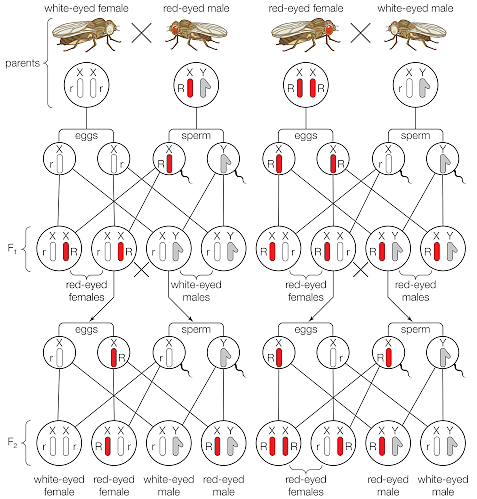
Morgan created a dihybrid cross between females with white eyes and yellow bodies and males with red eyes and brown bodies. Self-crossing of the F1 generation resulted in an F2 generation that did not have the 9:3:3:1 ratio. In the case of peas, the result differed from Mendel's dihybrid cross.
Also Read:
| Related Articles | ||
|---|---|---|
| Vestigial Organs | Human Reproductive System | Excretion in Human Beings |
| Nutrition in Human Beings | Chromoplasts | Inclusion Bodies |
Linkage
[Click Here for Sample Questions]
Morgan observed that when a set of characters was crossed, two genes did not obey Mendel's law because they did not split according to the law. In comparison to the non-parental combination, the likelihood of attaining a parental combination when two genes are on the same chromosome was relatively higher in the subsequent generation. Linkage was the term used to describe the physical relationship of genes.

When genes for various qualities are found in similar chromosomes and are thus linked, they are said to be related. It is a divergence from the Mendelian concept of independent assortment that is acceptable for genes on distinct chromosomes.
Types of Linkage
The absence or existence of non-parental combinations or novel combinations can be used to classify linkages into two categories:
Complete Linkage: Complete linkage occurs when two or more qualities are inherited and generally appear in two or more generations in their parental combinations. There are no non-parental combinations generated by these genes. The genes that show these connections are found on the same chromosome. In male Drosophila, genes for large wings and a grey body are examples.

Incomplete Linkage: Genes that generate a fraction of non-parental combinations display it. Because of the infrequent or inadvertent deconstruction of chromosomal segments ,while crossing across, these genes are located at a distance on the chromosomes.

Linkage and Crossing Over
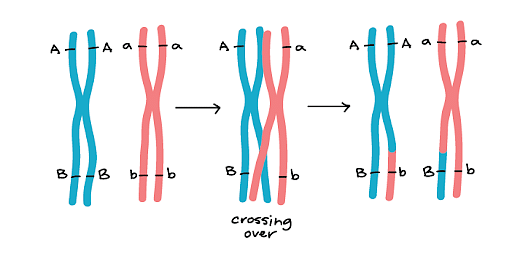
Crossing over is the interchange of chromosomal sections to shatter existing ties and form new linkages, whereas linkage is the tendency of genes present in the chromosome to stay intact and transfer to the next generation.
Parental kinds are generated via linkages, and the age of the tie increases as the linkage grows. Crossing over causes recombinations which reduce with age. Crossing over between two genes is reduced when they are close together; however, the linkage strength between two genes improves when a chromosome is close by.

Crossing over, on the other hand, serves as a source of variations to produce new varieties, while linkages help to preserve a newly improved variety. Crossing over, or the exchange of segments between non-sister chromatids in homologous chromosomes, occurs at the pachytene stage of prophase-I during the cell division process of meiosis and always occurs inside connected genes. Crossing over promotes the recombination of related genes, which plays an important role in evolution.
Recombination
[Click Here for Sample Questions]
Recombination is the process of creating novel allele combinations by recombining DNA molecules. Because genetic material (DNA) is exchanged between two separate chromosomes or between different portions of the same chromosome, it is also known as genetic recombination. Both eukaryotes and prokaryotes go through this procedure. It boosts sexually reproducing organisms' genetic diversity.

Types of Recombination
The types of recombination are as follows:
- Homologous Recombination: During meiosis, this type of recombination occurs between chromosomes with identical sequences.
- Non- homologous Recombination: This happens when two chromosomes are dissimilar.
- Site- specific Recombination: This can be seen in very short sequences that have a lot of similarities.
- Mitotic Recombination: During interphase, mitotic recombination occurs. This sort of recombination, on the other hand, is usually detrimental and can lead to malignancies. When cells are exposed to radiation, it rises.
The prokaryotic cells undergo recombination through one of the three processes:
- Conjugation
- Transformation
- Transduction
Recombination of Linked Genes
To further understand the recombination of related genes, consider freckles and red hair.
People get freckles and red hair because the genes for both are on the same chromosome. The DNA is rarely split between the two genes during homologous recombination. Although homologous recombination happens frequently, the two traits are usually inherited together because the chances of the DNA coding for these two genes splitting up are extremely low. As a result, genes are frequently inherited jointly.
Also Read:
| Related Articles | ||
|---|---|---|
| Excretion in Human Beings | Blood | Hypertension |
| Autotrophic Nutrition | Heterotrophic Nutrition | Excretion |
Things To Remember
- Linkage and Recombination are the phenomena that describe the inheritance of the parent genes by the offspring.
- Morgan created a dihybrid cross between females with white eyes and yellow bodies and males with red eyes and brown bodies. Self-crossing of the F1 generation resulted in an F2 generation that did not have the 9:3:3:1 ratio. In the case of peas, the result differed from Mendel's dihybrid cross.
- Morgan observed that when a set of characters was crossed, two genes did not obey Mendel's law because they did not split according to the law.
- Recombination is the process of creating novel allele combinations by recombining DNA molecules.
- People get freckles and red hair because the genes for both are on the same chromosome. The DNA is rarely split between the two genes during homologous recombination.
Sample Questions
Ques.1: What is the difference between linkage and recombination? (1 Mark)
Ans: Recombination is the mechanism by which DNA segments separate during meiosis crossing over, whereas linkage serves to maintain genes together on the same chromosome.
Ques.2: Is recombination and crossing over the same thing? (1 Mark)
Ans: When two homologous chromosomes break and rejoin to separate end pieces, this is known as crossing over. Recombination occurs when two chromosomes break at the same location in the base pair sequence, resulting in the exchange of genes.
Ques.3: What variables can lead to linkage inequity? (2 Marks)
Ans: The following things contribute to linkage disequilibrium:
- Recombination rate of genes
- Rate of mutation
- Drift in the genetic code
- Population structure and mating system
For Latest Updates on Upcoming Board Exams, Click Here: https://t.me/class_10_12_board_updates
Check-Out:



Comments