



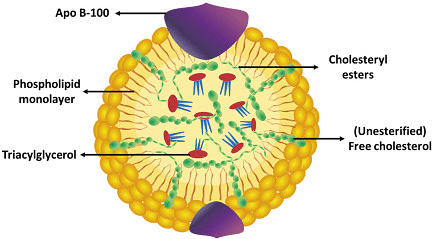
Lipoproteins are unique particles made up of droplets of fats. They are unique in the way that they are amphipathic, which means they have polar and nonpolar ends. Further, these fat droplets are surrounded by only one layer of phospholipid molecules.
- Lipoproteins are overall complex particles made by a combination of cholesteryl ester and triacylglycerol.
- These are encompassed by a single surface layer of cholesterol molecule and amphipathic phospholipid.
- Lipoproteins are a kind of biomolecule that comprises protein and lipids molecules.
- These molecules together function by allowing the movement of fats with the help of water molecules.
| Table of Content |
Key words: Lipoproteins, Fats, Protein, Lipids molecules, Cholesterol, Phospholipid, Biomolecule, Phosphorus, Apolipoproteins
Read More: Heterotrophic Bacteria
What are Lipoproteins?
[Click Here for Sample Questions]
Lipoproteins are a kind of biomolecule that comprises protein and lipids molecules. Further, Lipoproteins are unique particles made up of fat droplets.
- These fat droplets are encased by a layer of phospholipid molecules.
- The phospholipid is basically a fat molecule that comprises a phosphorus-containing group attached to it.
- These molecules are amphipathic which means that they have both polar and non-polar ends.
Also Read:
Types of Lipoproteins
[Click Here for Sample Questions]
There are different types of Lipoproteins based on apolipoproteins. Apolipoproteins are proteins surrounded by the phospholipid outer layer. *
- This plays a major role to stabilize the fat molecule by binding to the cell surface receptors.
- This whole process contributes to allowing the cell to take up the lipoprotein through endocytosis mediated by receptor.
- Some of the different types of Lipoproteins are mentioned below:
Chylomicrons
These are the largest type of Lipoprotein and they have the least density.
- They contain most triglycerides.
- The molecules of chylomicron are made of a product released by the liver.
- These molecules are surrounded by cholesterol and fats.
VLDL
VLDL stands for Very low-density lipoprotein.
- This is made up of protein, fats and cholesterol which are produced by the liver.
- After being produced by the liver these are released to the bloodstream.
- VLDL is related to five other apoproteins which are: B-100, C-I, C-II, C-III, and E.
Low-density Lipoprotein
LDL is a VLDL residue. It is mainly composed of Cholesterol.
- It has only one protein connected to be ApoB-100.
- As a combined result, both of these make up the transport for fat and cholesterol.
High-Density Lipoprotein
HDL or High-density protein has the highest protein to lipid ratio. Hence, it is the densest Lipoprotein.
- It also has only one apoprotein associated with it named A-1.
- It is also known as “health cholesterol”.
- It is called so because it plays a major role in transporting cholesterol from tissues to the liver as a result of lowering blood cholesterol levels.

Some Interesting Facts about Lipoproteins
[Click Here for Sample Questions]
There are some facts about the lipoproteins and its constitiutes.
- Cholesterol comes from the Greek word chole which means bile and stereos which means solid.
- The polar ends of a phospholipid molecule face towards the out of the molecule.
- This polar face interacts with the water which in turn is a polar molecule.
- This interaction makes lipoprotein mix with the blood and not float in the blood like cream on the milk.
- In a way, lipoprotein molecules act as a transport to carry the fat molecule in the bloodstream.
Read More: Difference Between Fats and Oils
Things to Remember
- Lipoproteins are fat droplets that are surrounded by only one layer of phospholipid molecules.
- These molecules together function by allowing the movement of fats with the help of water molecules.
- Chylomicron, LDL, VLDL, HDL are some of the different types of Lipoproteins.
- Chylomicrons are the largest type of Lipoprotein and they have the least density.
- VLDL is related to five other apoproteins which are: B-100, C-I, C-II, C-III, and E.
- In a molecule of Lipoprotein, there are two poles.
- The polar ends of a phospholipid molecule face towards the out of the molecule.
- This polar face interacts with the water which in turn is a polar molecule.
Also Read:
| Related Articles | ||
|---|---|---|
| Enzymes | Rancidity | Sucrose |
| Carbohydrates | Difference between Lipids and Fats | Test for Fats |
Sample Questions
Ques: What do you understand by Lipoprotein? (3 marks)
Ans. Lipoproteins belong to the category of a biomolecule that comprises protein and lipids molecules. These are unique particles made up of fat droplets. These fat droplets are covered by a layer of phospholipid molecules. The phospholipid is basically a fat molecule that is comprised of a phosphorus-containing group attached to it. These molecules are amphipathic which means that they have both polar and non-polar ends. This polar face interacts with the water which in turn is a polar molecule.
Ques: Define the types of Lipoproteins? (4 marks)
Ans. There are different types of Lipoproteins as mentioned below:
- Chylomicrons: these are the largest type of Lipoprotein with the least density. They contain most triglycerides.These molecules are surrounded by cholesterol and fats.
- VLDL: VLDL means Very low-density lipoprotein. This is made up of protein, fats and cholesterol. These are released to the bloodstream. VLDL is related to five other apoproteins which are: B-100, C-I, C-II, C-III, and E.
- Low-density Lipoprotein: LDL is a residue of VLDL . It is mainly composed of Cholesterol. It has only one protein connected to be ApoB-100. Both of these make up the transport fat and cholesterol.
- High-Density Protein: high-density protein has the highest protein to lipid ratio. Therefore it is the densest Lipoprotein. It also has only one apoprotein associated with it ( A-1). It is also known as “health cholesterol” because it plays a major role in transporting cholesterol from tissues to the liver as a result of lowering blood cholesterol levels.
Ques: What is the importance of Lipoprotein? (2 marks)
Ans. They show different patterns which correlate with reducing the risk of having a fatal cardiovascular event. Also, high HDL reduces cholesterol levels and hence cardiovascular risk. High measurement of Apo-A-1 correlates with reducing atherosclerosis risk. It is important to note that cigarettes, rise with regular exercise, alcohol, estrogen levels, weight loss, and smoking reduce HDL levels.
Ques: What is the full form of HDL, LDL, and VLDL? (2 marks)
Ans. HDL, VLDL, LDL are the types of Lipoproteins.
HDL stands for high-Density Lipoprotein.
LDL stands for Low-Density Lipoprotein.
VLDL stands for Very Low-Density Lipoprotein.
Ques: What do you understand by Apolipoproteins? (2 marks)
Ans. Apolipoproteins are a kind of serum protein. They mediate the carriage of cholesterol and some more lipids in the serum. They form the protein part in the LDL (Low-Density Lipoprotein) and HDL (High-Density Lipoprotein).
A high level of B Apolipoprotein led to higher levels of “bad cholesterol” i.e. LDL and VLDL cholesterol.
Ques: What is meant by HDL cholesterol? (2 marks)
Ans. HDL, which is also known as high-density lipoprotein, is densest as it has the highest protein-to-lipid ratio, where Apoprotein A-1 is found. It's also called "healthy cholesterol" as it transports cholesterol from the tissues to the liver while lowering blood cholesterol levels. High HDL cholesterol levels are connected to a lower risk of heart disease. Exercise, higher estrogen levels, alcohol intake, and weight loss are all interconnected with higher HDL levels.
Many lipids, as well as protein species, are carried by HDL, some of which possess very low concentrations however are biologically active. HDL and its protein and lipid components, for instance, help to prevent inflammation, oxidation, endothelial activation, and coagulation. All of these characteristics can play a pivotal role in HDL's ability in order to protect against atherosclerosis.
Ques: What does LDL cholesterol mean? (4 marks)
Ans. Low-density lipoprotein, also known as LDL, is the last VLDL residue, which primarily contains cholesterol. ApoB-100 is the only apoprotein that is associated with it. This is the reason why both of these forms transport fats and cholesterol from the liver to the tissues.
VLDL and LDL cholesterols are to be considered as "poor" cholesterols as they can lead to plaque accumulation in the arteries. The name for this buildup is Atherosclerosis. Plaque is a sticky material that is made up of fat, cholesterol, calcium, and other substances contained in the blood that builds up over time. Plaque hardens and narrows the arteries with time. This helps reduce the amount of oxygen-rich blood that reaches our body, and it has the potential to cause coronary heart disease.
For Latest Updates on Upcoming Board Exams, Click Here: https://t.me/class_10_12_board_updates
Check-Out:



Comments