



Exams Prep Master
The SI unit of specific resistance is ohm meter (Ωm). Specific resistance or Resistivity of a material can be defined as a measure of the resistance, that it offers to the flow of current through it. Specific resistance, the intrinsic property of a material, depends on the composition, temperature, and pressure of the material. The reciprocal of resistivity is the specific conductance that amounts to the ability to conduct electricity. The value of resistivity is very low for conductors and very high for insulators. The Specific resistance of a conducting substance can be stated mathematically as,
| ρ = RA/L |
Where,
R = the conductor's resistance.
L = the conductor's length.
A = conductor's cross-sectional area.
ρ = the material's proportionality constant, often known as its specific resistance or resistivity.
Check Also: NCERT Solutions for Class 12 Physics
Very Short Answer Question [1 mark Questions]
Ques: A wire of resistance 8R is bent in such a way that it takes the shape of a circle. What is the effective resistance between the ends of a A diameter 2AB? (Delhi 2008)

Ans: The effective resistance between A and BO

Ques: The plot of the variation of potential difference across a combination of three identical cells in series, versus current is as shown in the figure. Find the emf of each cell? (Delhi 2008)

Ans: Total emf of three cells in series = P.D corresponding to zero current = 6V
∴ The emf of each cell = 6/3 = 2V
Ques: A resistance R is connected across a cell of emf ε and internal resistance r. A potentiometer now measures the potential difference between the terminals of the cell as V. What is the expression for ‘r’ in terms of ε, V and R? (Delhi 2011)
Ans: Expression can be written as: r = (ε/V – 1)R
Ques: When electrons drift in metal from lower to higher potential, does that mean all the free electrons of the metal are moving in the same direction? (Delhi 2012)
Ans:

No, only the drift velocities of the electrons are superposed over their random thermal velocities. The solid line shows the random path followed by a free electron in the absence of an external field. The electron proceeds from A to B, making six collisions on its path. Moreover, the dotted curve shows how the random motion of the same electron gets modified when an electric field is applied.
Ques: Show the variation of resistivity with temperature for a typical semiconductor on a graph. (Delhi 2012)
Ans:

Resistivity of a semi conductor decreases rapidly with temperature.
Ques: Two wires of equal length, one of copper and the other of manganin have the same resistance. Which wire is thicker? (All India 2012)
Ans: As R = ρl/A
Therefore, A = ρl/R
For both wires R and l are same and ρ copper < p manganin.
∴ A copper < A manganin
i.e. Manganin wire is thicker than copper wire.
Read more: Cells In Series and Parallel
Short Answer Question [2 marks Questions]
Ques: Why the emf of a cell is always greater than its terminal voltage? Give reason. (Delhi 2013)
Ans: Emf is the p.d. when no current is drawn. When the current is drawn, there will be a potential drop in the internal resistance of the cell. So, terminal voltage will be less than the emf.
Ques: What is meant by the term ‘drift velocity’ of charge carriers in a conductor and write its relationship with the current flowing through it? (Delhi 2014)
Ans: Drift velocity is the velocity with which a free electron in the conductor gets drifted under the influence of the applied external electric field.

Ques: I – V graph for a metallic wire at two different temperatures, T1 and T2. Which of the two temperatures is lower and why? (All India 2015)
Ans: The temperature T1 is lower. Larger the slope of V-I graph, smaller the resistance. As the resistance of a metal increases with the increase of temperature, resistance at temperature T1 is lower.
Ques: A cell of emf ‘E’ and internal resistance V is connected across a variable resistor ‘R’. Plot a graph showing the variation of terminal potential ‘V’ with resistance R.
Predict from the graph the condition under which ‘V’ becomes equal to ‘E’. (Delhi 2009)
Ans:
(i) V = ε – Ir gives the terminal voltage and can be plotted as shown in Figure 1.
(ii) The graph between V and R, is shown in Figure 2.

V becomes E when no current is down.
Ques: A wire of 15 Ω resistance is gradually stretched to double its original length. It is then cut into two equal parts. These parts are then connected in parallel across a 3.0 volt battery. Find the current drawn from the battery. (All India 2009)
Ans: R = 15 Ω
On stretching to double its original length, the resistance becomes R1 = 60 Ω, as on stretching volume is constant and Rα l2.
The two cut parts will have a resistance of 30 Ω each as they are connected in parallel, the
Req = 30/2 = 15Ω
Current drawn from the supply = I = V/Req
Therefore, I = 3/15 = 1/5 = 0.2 A.
Read More: Current Electricity Ncert Solutions
Long Answer Questions [3 marks Questions]
Ques: A wire of 20 Ω resistance is gradually stretched to double its original length. It is then cut into two equal parts. These parts are then connected in parallel across a 4.0-volt battery. Find the current drawn from the battery. (All India 2009)
Ans: On stretching, the resistance of the wire will get to four times, i.e., 80 Ω as volume is constant and
R α l2.
So the two equal parts will have a resistance of 40 Ω each.
When connected in parallel, the equivalent resistance will be 20 Ω
Therefore, current drawn is V/Req = 4/20 =1/5 = 0.2 A.
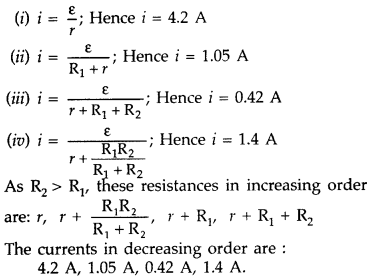
Ques: A cell of emf E and internal resistance r is connected to two external resistances R1 and R2 and a perfect ammeter. The current in the circuit is measured in four different situations:
(i) without any external resistance in the circuit
(ii) with resistance R2 only
(iii) with R1 and R2 in series combination
(iv) with R1 and R2 in parallel combination
The currents measured in the four cases are 0.42A, 1.05A, 1.4A and 4.2A, but not necessarily in that order. Identify the currents corresponding to the four cases mentioned above.
Ans:
Ques: The network PQRS, shown in the circuit diagram, has the batteries of 4 V and 5 V and negligible internal resistance. A milliammeter of 20 Ω resistance is connected between P and R. Calculate the reading in the milliammeter. (Comptt. All India 2012)

Ans: Applying loop rule to loop PQRP
-4 = 60(I – I1) – 20 I1 = 0
or – 4 = 60I – 60I1 – 20I1
or 20I1 -15 I = 1 …[+ by 4 …(i)]
Applying loop Yule to loop PRSP, we get
-5 + 200 I + 20 I1 = 0
4I1 + 40 I = 1 …[+ by 5 …(ii)]

∴ Reading of milliammeter = 0.064 A
Read Also: Electric Current
Very Long Answer Questions [5 marks Questions]
Ques: The figure shows the experimental setup of a meter bridge. When the two unknown resistances X and Y are inserted, the null point D is obtained 40 cm from end A. When resistance of 10 Ω is connected in series with X, the null point shifts by 10 cm.

Find the position of the null point when the 10 Ω resistance is instead connected in series with resistance ‘Y’. Determine the values of the resistances X and Y. (Delhi 2008)
Ans:

Ques: In the circuit, the reading of the (ideal) ammeter shown here, equals :
(i) I when key K1 is closed but key K2 is open.
(ii) I/2 when both keys K1 and K2 are closed.
Find the expression for the resistance of X in terms of the resistances of R and S. (Comptt. Delhi 2012)

Ans: To find the expression for the resistance X,
(i) Current I when K2 is open and Kj is closed E

Read more:
Check out:



Comments