



Education Journalist | Study Abroad Lead
Marginal Cost refers to the expenses incurred by any business when it has to produce additional units of any goods or services. To put it another way, marginal cost is the difference between the total production cost and the cost of generating one additional unit of output. It is computed by dividing the overall cost of producing the extra items by the change in the total number of goods produced. Variable costs like material and labour are included in the marginal cost. It also takes into account any increases in fixed expenditures such as overhead, administrative, and sales.
| Table of Content |
Key Terms: Marginal Cost, Cost of Production, Production, Variable Costs, Marginal Cost Curve, Marginal Cost Formula, Fixed Cost, Goods and Services, Expenditure
What is Marginal Cost?
[Click Here for Sample Questions]
Marginal Cost can be defined as the difference in the overall cost of production caused by producing one additional unit of output. Firms can utilize the marginal cost to understand the influence of producing an additional unit on the overall cost of production and as a result, make relevant production decisions in their company. The usual variable costs included in the calculation are labour and materials, as well as any estimated increases in fixed costs, such as administration, overhead, and selling expenses. To optimize cash flow generation in financial modelling, the marginal cost formula can be employed.
Marginal Cost can also be defined as the ratio of change in total production costs to the change in the unit production. Marginal Costs cannot be defined at the zero level of production i.e. when the quantity produced is zero.
Also Read: Disposable Income Formula
Marginal Cost Formula
[Click Here for Sample Questions]
The formula designated for the calculation of Marginal Cost is \(\bigtriangleup\)C/\(\bigtriangleup\)Q, wherein \(\bigtriangleup\) denotes change. In the given formula, ΔC denotes the change in the total cost of production and \(\bigtriangleup\)Q denotes the change in quantity.

Marginal Cost Formula
The marginal cost of the Nth unit of production may also be determined using the following formula when the quantity is increased by one unit:
MCn = TCn - TCn-1
MC denotes marginal cost, whereas TC denotes total cost. It's vital to distinguish the marginal cost from the average cost of production since the average cost refers to the cost of generating one unit of output, whereas the marginal cost refers to the cost of creating an additional unit of output.
-
Change in Cost
Costs of Production may rise or fall at every stage of production and throughout time, particularly when the demand to generate more or less output develops. If producing more units necessitates the hiring of one or two more workers and raises the cost of raw materials, the entire production cost will alter.
To calculate the cost difference, simply subtract the cost of production incurred during the first output run from the cost of production in the next batch when output has increased.
-
Change in Quantity
Given the fluctuating levels of production, the quantity of output will inevitably increase or decrease. The volumes involved are usually large enough to assess cost changes. The cost of things manufactured increases or decreases as the volume of products produced increases or decreases.
The number of goods produced in the first production cycle is subtracted from the amount of output produced in the subsequent production run to ascertain the changes in quantity.
Read More: GDP
Calculating Marginal Cost
[Click Here for Sample Questions]
The following steps must be followed systematically to determine the marginal costs of production:
- Determine \(\bigtriangleup\)C’s value i.e., change in the overall cost of production
- Calculate the value of \(\bigtriangleup\)Q i.e., change in the overall quantity
- Calculate \(\bigtriangleup\)C/\(\bigtriangleup\)Q by dividing the result of Step 1 by the result of Step 2.
Let's look at determining marginal cost as an example. The data on a company's cost of producing school bags are provided below. By analyzing changes in the overall cost and the output produced, we will be able to determine the marginal cost.
| Number of Bags (Output) | Total Cost (in Rupees) | Marginal Cost (\(\bigtriangleup\)C/\(\bigtriangleup\)Q) |
|---|---|---|
| 5 | 68 | 68/5 = Rs. 13.6 |
| 6 | 76 | (76-68)/(6-5) = 8/1 = Rs. 8 |
| 8 | 88 | (88-76)/(8-6) = 12/2 = Rs. 6 |
| 9 | 96 | (96-88)/(9-8) = 8/1 = Rs. 8 |
| 10 | 110 | (110-96)/(10-9) = 14/1 = Rs. 14 |
Marginal Cost Curve
[Click Here for Sample Questions]
A U-shaped curve represents the Marginal Cost Curve. It implies that the marginal cost is initially relatively high when production begins since it reflects the overall cost, including the variable and fixed costs. The production cost is usually higher in the beginning because it comprises the cost of machines, cost of setting up the plant, and other costs as well.
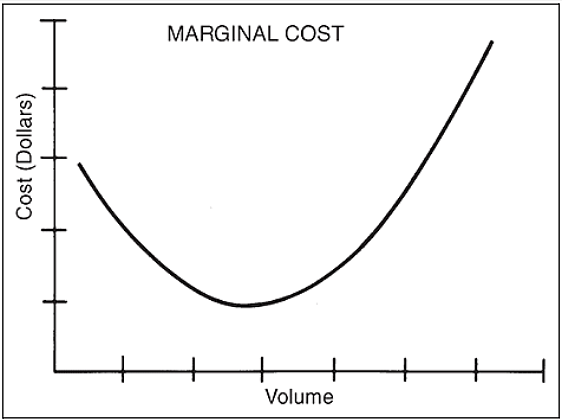
Marginal Cost Curve
As a result, the marginal cost curve begins at a higher point. Then there’s a drop since more units are produced for the same fixed cost, keeping the production cost low. It begins to grow again after reaching the minimal level of point, indicating an increase in production costs. This occurs due to a lack of resources or an excessive usage of resources.
Also Read:
Things To Remember
- Marginal cost is the difference between the total production cost and the cost of generating one additional unit of output. It is computed by dividing the overall cost of producing the extra items by the change in the total number of goods produced.
- The usual variable costs included in the calculation are labour and materials, as well as any estimated increases in fixed costs, such as administration, overhead, and selling expenses.
- Marginal Costs cannot be defined at the zero level of production i.e. when the quantity produced is 0
- The formula designated for the calculation of Marginal Cost is \(\bigtriangleup\)C/\(\bigtriangleup\)Q, wherein Δ denotes change.
- The marginal cost (MC) curve is specified as total cost change divided by energy output change. The MC curve is much like the firm's supply curve in perfectly competitive marketplaces.
Sample Questions
Ques. Complete the following table using Marginal Cost Formula: (3 Marks)

Ans. The following table can be completed using the marginal cost formula as follows:
| Quantity | Total Cost (in Rupees) | Marginal Cost |
|---|---|---|
| 0 | 20 | - |
| 1 | 35 | 35 - 20= 15 |
| 2 | 35 + 10 = 45 | 10 |
| 3 | 53 | 53 - 45= 8 |
| 4` | 65 | 65 - 53= 12 |
Ques. If a corporation spends INR 20 to produce two units of output, what is the marginal cost of production? (3 Marks)
Ans. Given,
Cost of producing 2 units = INR 20
\(\bigtriangleup\)C = INR 20 and\(\bigtriangleup\)Q = 2
Hence, using Marginal Cost Formula, we obtain,
MC = \(\bigtriangleup\)C/\(\bigtriangleup\)Q
= 20/2
= INR 10
Therefore, it has been proved that the Marginal Cost of Production is INR 10.
Ques. Arjun has a textile company that produces 200 gowns every year at a cost of INR15,000 apiece. He begins to see an upsurge in demand, with a total of 20 extra gowns being requested. As a result, he wants to figure out if making these extra garments is worthwhile. Calculate the marginal cost of each dress based on these facts. (3 Marks)
Ans. He adds up the materials and other expenditures and discovers that making an extra 20 outfits will set him back INR 2,000. By dividing the costs by the quantity, these marginal costs may be computed.
So, INR 2,000 divided by 20 is INR 100 for each dress.
In order to earn his profit, he would have to demand that customers pay more than INR 100 for each outfit.
Ques. A total cost of INR 23,000 is incurred if a company produced 8 tablets. The entire cost is INR 24,000 if 9 tablets are made. Determine the Marginal Cost of the 9th tablet. (2 Marks)
Ans. The corporation will spend INR 24,000 - INR 23,000 = INR 1800 on the ninth tablet.
As a result, the 9th tablet's marginal cost is INR 1800/1 = INR 1800.
Ques. Give the relationship between AC and MC. (3 Marks)
Ans. The relationship between AC and MC is as follows:
- When MC < AC, then AC falls
- When MC is equivalent to AC, then AC is constant
- When MC > AC, then AC rises
- The MC curve intersects AC curve at its minimum point always
Ques. Elaborate upon the relationship between TC and MC. (3 Marks)
Ans. The relationship between Total Cost and Marginal Cost is as follows:
- When MC is rising, TC increases at an increasing rate
- When MC is falling, TC increases at a diminishing rate
- When MC is constant, TC increases at a constant rate
Ques. Calculate the AC and MC for the given data. (3 Marks)

Ans. Here is the solution for the question:
| Output (Q) | TC | AC (AC = TC/Q) | MC (MC = TCn - TCn-1) |
|---|---|---|---|
| 6 | 120 | 20 | 45 |
| 5 | 75 | 15 | 20 |
| 4 | 55 | 13.75 | 10 |
| 3 | 45 | 15 | 5 |
| 2 | 40 | 20 | - |
Ques. Calculate the Marginal Cost for the given data. (3 Marks)

Ans. Here is the solution for the question:
| Output (Units) | TC | MC (MC = TCn - TCn-1) |
|---|---|---|
| 0 | 12 | - |
| 1 | 18 | 6 |
| 2 | 22 | 4 |
| 3 | 27 | 5 |
| 4 | 36 | 9 |
| 5 | 47 | 11 |
Ques. A manufacturing company's current cost of production is Rs. 1,000,000 for 1000 books, and its future output expectation is 2000 books at a cost of production of Rs. 125,000. What will be the Marginal Cost here? (3 Marks)
Ans. To calculate the marginal cost,
| Particulars | Amount |
|---|---|
| Existing Unit of Production | 1000 |
| Existing Production Cost | Rs. 1,00,000 |
| Future Production Unit | 2000 |
| Future Production Cost | Rs. 1,25,000 |
In the above situation,
Marginal Cost = Change in the Total Costs/Change in the Quantity
Change in Total Cost = 1,25,000 - 1,00,000 = Rs 25,000
Change in Quantity = 2000 - 1000 = 1000
Therefore, Marginal Cost = 25000/1000
= Rs. 25
Ques. Avantika is the owner of Leaf Motorbikes, which is a privately owned company. She makes and sells tons of motorcycles for INR 1,00,000 in her first year of the company, which costs her INR 50,000 to produce. In her second year, she produced and sold 15 motorcycles for INR 1,50,000 each, despite the fact that they cost INR 75,000 to produce. Considering all these facts, find out the Marginal Cost of each motorcycle. (3 Marks)
Ans. We begin by calculating the change in overall cost. In this situation, the rise was from INR 50,000 to INR 75,000, or an INR 25,000 rise.Now, we compute the changes in quantity, which has increased by 5 from 10 to 15.The difference in overall price (INR 25,000) is further divided by the change in quantity i.e., 5, yielding the marginal cost of INR 5,000 per motorbike.
For Latest Updates on Upcoming Board Exams, Click Here: https://t.me/class_10_12_board_updates
Check-Out:



Comments