



Content Curator
Modification of roots can be described as the process through which the roots modify their shape for absorbing and transporting water as well as minerals from the soil to different areas of the plant. The root is an underground part of the plant that absorbs water and minerals from the soil and anchors the plant decisively. Roots accomplish more functions such as storage of food and support to weak stems or tall trees.
| Table of Content |
Key Terms : Roots, Modification of Roots, Tap Roots, Adventitious Root, Root system, Plants
Types of Root System
[Click Here for Sample Questions]
There are two important kinds of root systems. Those are-
To implement functions, the tap roots and adventitious roots go over a few modifications in their morphology and structure.
Learn More About:
| Concepts Related to Parts of a Flower | ||
|---|---|---|
| Androecium | Excretion in Plants | Photomorphogenesis |
| Modifications of Stem | Modifications of Stem | Plant Cell |
| Vegetative Character of Solanaceae | Plant and Tree | Vegetative Character of Liliceae |
Reasons for Modifications of Tap Roots
[Click Here for Previous Year Questions]
Here are some reasons behind the modification of Tap Roots-
1. Storage Food
Storage roots grow into being fleshy by the gathering of stored food. The aerial parts of plants die out during unfavorable seasons, and when the season is favorable, new buds sprout either from the underground fleshy root itself or from a small part of the stem. The reserve food is used by the plant through flowering and fruiting.
Based upon the different shapes, the Tap Roots are further classified into four main types-
- Conical Roots (Example- Carrots)
- Fusiform Roots (Example- Radish)
- Napiform Roots (Example- Turnip)
- Tuberous Roots (Example- Sweet Potato)
2. Nitrogen Fixation
Nodular root members of the family have swellings called root nodules on their main roots and their branches. These nodules store nitrogen fixing bacteria called Rhizobium which repair atmospheric nitrogen into nitrates and supply them to the plants. These nodules are red due to the existence of a pigment well-known as leg hemoglobin.
3. Respiration Process
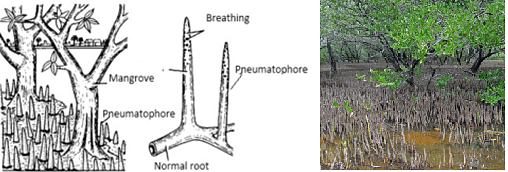
In the case of some plants, the tap roots grow upwards and emerge from the soil to receive enough oxygen which is important for the respiratory process for the plants.

Roots growing upwards
Also Read: Difference between Photosynthesis and Respiration
Modifications of Adventitious Roots
[Click Here for Sample Questions]
The Adventitious Roots can be modified due to the reasons mentioned below-
- Storage of Food: Adventitious roots turn swollen due to the storage of food.
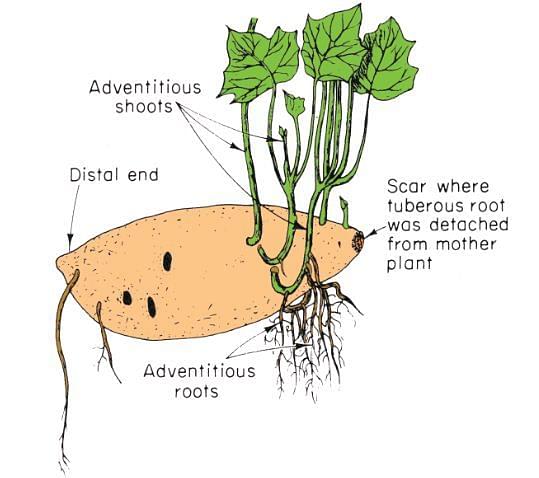
- Tuberous - The roots are swollen but have no shape and they grow from the nodes of the prostate stem. Like, sweet potato.
- Fasciculate - The swollen roots improve in clusters at the base of the stem and have fixed shapes. Like, dahlia and asparagus.
- Nodules - Only the tips of the roots come to be swollen due to the accumulation of food. Like, mango, and ginger.
- Moniliform - The roots are swollen at fixed intervals giving a beaded presence. Like, bitter gourd.
- Annulated - The roots seem as if they are formed of numerous discs placed one above the other. For example, Ipecac.
Swollen Adventitious roots
- Assimilatory Roots
In a few trees, when surface roots get visible, they turn green by the growth of chlorophyll and carry some carbon assimilation. Epiphytic roots are assimilatory but plants like Tinospora have longer green aerial roots whose key function is carbon assimilation.
- Epiphytic Roots
Epiphytic or Aerial absorbing roots are the peculiar mutual roots found hanging from the orchids. Epiphytes are provided with aerial roots in accumulation to the clinging roots. Aerial roots are covered with spongy velamen tissue that absorbs atmospheric moisture.
- Mycorrhizal Roots
These are the roots of the mycorrhizal saprophytes which grow in humus and roots which are infested with fungal mycelia. The mycelia form a mantle on the root that absorbs food solutions utilized by both the host plant and mycorrhizal fungus.
- Respiratory Roots
The roots of a few trees and shrubs grow in saline marshes from the lack of oxygen. To cope with such a situation root branches grow straight up into the air from the horizontal secondary roots. Atmospheric air enters the roots over the pores of special lenticels which are visible on the root tips.
- Reproductive Roots
Adventitious buds grow on roots and function as a reproduction. Plantings arise from the base of various garden plants. Root cuttings are an essential mode of reproduction in plants like sweet potato, and ipecac.
- Sucking Roots
These are the sucking roots of parasites who penetrate the small adventitious rootlets in the tissues of the host to make a connection between the conducting systems of the two plants.
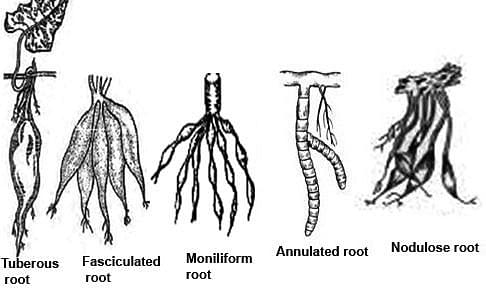
Different Types Modifications of Adventitious roots
Also Read: Plant roots
Modifications to Carry on Special Mechanical Functions
[Click Here for Previous Year Questions]
Modification of the Roots may also happen to take care of some special and specific mechanical functions, for example-
- Prop Roots:
Tropical trees Ficus benghalensis also known as the banyan tree which has horizontal aerial branches giving a rise to the roots which are given with root caps and hang down from the boughs like strings. These grow down and on reaching the soil and becoming anchored, they stouten and become strong as the main trunk.

Prop Roots in Banyan Tree
- Stilt Roots
Few small trees and shrubs like screw pine develop on the edges of tanks, marshes, and more, where the anchorage is not strong. In cases like this, short roots grow diagonally downwards from near the base of the stem and act like stilts giving additional support and anchorage to the stem.

Stilt Root Formation
- Climbing Roots
Climbers can climb up supporting the adventitious roots raised from the nodes of frail climber twine round and clasp the support as if the climber has been tied to it.
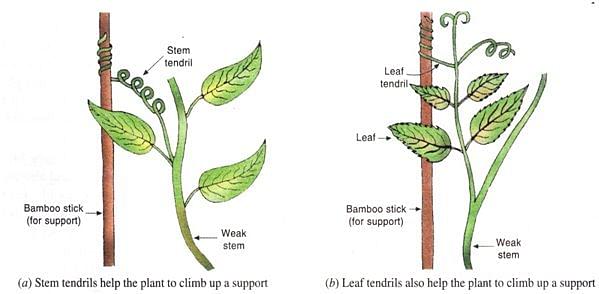
Climbing Roots Modification
- Clinging Roots
Epiphytes like orchids cling to their support using superior clinging roots which go in the crevices of the support and fix the epiphyte. Clinging roots pass absorption but are different from aerial roots.

Clinging Root Modification
- Root Buttresses
Excessive plank roots are radiating from the base of the tree like wings. These are known as buttresses and are partially root and stem. They might be seen in old trees of Bombax ceiba.

Root Modification: Root Buttresses
- Floating Roots
Aquatic floating plants like jussiaea repens have exceptional roots developing from the nodes in addition to the ordinary adventitious roots. These roots look-alike masses of white cotton and are exceptionally spongy. If taken out of the water they dry and shrivel up rapidly.

Floating Roots
- Pull Roots
Plants with underground stems have roots that are diverse from the others as they are found to contract or swell so that the aerial shoot or the underground parts are kept at an appropriate level in the soil. These roots are known as contractile roots and might be seen in Canna, Lilium.

Pull Roots of Daffodils
- Root Thorns
Few adventitious roots from the base of the stem become hard pointy like thorns. These are termed root thorns. They indirectly help as an Armature to the plants in driving out marauding animals.
Root thorns
Things to Remember
[Click Here for Sample Questions]
- The roots need to carry water and other important minerals to every part of the plant, for this reason, they need to modify themselves.
- There are two main types of roots- Tap Roots and Adventitious Roots.
- The Tap Roots are modified for better respiration, Nitrogen consumption, and storage of food.
- The Adventitious Roots are modified for reproduction, assimilations, respiratory functions, support purposes and many more.
- There are few other kinds of modifications that are needed for specific mechanical improvements in a plant.
Learn More About:
Previous Year Questions
- Vexillary aestivation is characteristic of the family….[NEET 2012]
- Vascular cambium produces...[NEET 2010]
- Where do the casparian bands occur?...[NEET 1990]
- A bicollateral vascular bundle is characterised by...[NEET 1992]
- Madhunashini is the popular name for…..[COMEDK UGET 2006]
- The roots that originate from the base of the stem are… [NEET 2020]
- Death of protoplasm is a pre-requisite for a vital function like...[NEET 1989]
- Out of diffuse porous and ring porous woods, which is correct?...[NEET 1989]
- In which of the following plant sunken stomata are found...[NEET 2001]
- What is the eye of potato?…[ NEET 2001]
- Edible part of banana...[ NEET 2001]
- Which is correct pair for edible part?….[NEET 2001]
- Tracheids differ from other tracheary elements in...[ NEET 2014]
- Commercial cork is obtained from… [NEET 1991]
- Botanical name of cauliflower is…. [NEET 1991]
- The cork cambium, cork and secondary cortex are collectively called...[NEET 2011]
- Tricarpellary syncarpous superior ovary is….[JKCET 2007]
- The edible part in hesperidium fruit is...[JKCET 2007]
- The bladders of Utricularia and pitchers of….[JKCET 2004]
- Phylloclades are...[JKCET 2004]
- A major characteristic of monocot root is the presence of... [NEET 2015]
Sample Questions
Ques. What is the modification of roots? (3 marks)
Ans. In a few plants, the roots keep changing their shape as well as modify to absorb and transport water, minerals from the soil to different areas of the plant. They are modified for support, food storage, and respiration and they perform two main purposes which are Physiological and Mechanical modification.
Ques. What does the modification of roots mean along with an example picture? (4 marks)
Ans. The modified roots are swollen and turn into different forms to carry food and oxygen to every part of the plant. Hence, the roots are modified as spindle-shaped like radish, top shaped like beet, turnip, cone-like carrot, and indefinite shape like sweet potatoes.
Sample Picture of Root Modifications
Ques. When is the root cap absent in Hydrophytes? (1 marks)
Ans. The Hydrophytes are known as aquatic plants and these plants do not own root caps, instead, they own root pockets and perform as complementary organs.
Ques. What is the main modification of adventitious roots? (2 marks)
Ans. We know that to carry water and other important minerals in every part of the plant, the roots need to modify themselves. Therefore, the Tuberous roots are the adaptation of adventitious roots and it is fleshy, don't have a specific shape, and frequently get swollen. In the situation of tuberous roots, shoots sprout from one end while roots rise from the further end.
Ques. How are the roots of a leguminous plant modified? (2 Marks)
Ans. Roots of the leguminous plants are modified into root nodules which consist of nitrogen fixing bacteria known as Rhizobium. They assist in fixing the atmospheric nitrogen in nitrates and make it available for the plant.
Ques. From the tree banyan branches, roots usually keep hanging are:
A) Primary root
B) Fibrous root
C) Prop root
D) Pneumatophore
State the reason behind this. (1+ 2= 3 Marks)
Ans. Prop Root is the correct answer.
The reason behind this is to maintain a specific work, that is to provide the tree more support. These roots reach the soil again and anchor themselves so that the trees like banyan can get more strength and support.
Ques. What are the main reasons behind the Tap Root modifications? (5 Marks)
Ans. Tap Roots can be defined as “a primary root that grows vertically downward and gives off small lateral roots”. Sometimes these roots can be seen modifying themselves for specific reasons. There are three important reasons behind this-
- To store more food: They reserve food that is used by the plant through flowering and fruiting. Based on this there are four types of roots-
Conical Roots (Example- Carrots)
Fusiform Roots (Example- Radish)
Napiform Roots (Example- Turnip)
Tuberous Roots (Example- Sweet Potato)
- For Nitrogen Fixation: Nitrogen is very important for the plants to survive. Hence, this is another reason behind the Tap Root Modifications.
- To receive more Oxygen: Oxygen is important for the respiratory system to work properly, therefore, to get enough oxygen, the tap roots are modified sometimes.
Also Check:



Comments