


NCERT Solutions For Class 12 Biology Chapter 8: Human Health and Diseases

Jasmine Grover logo

Jasmine Grover

Education Journalist | Study Abroad Lead

NCERT Solutions for Class 12 Biology Chapter 8 Human Health and Diseases are provided in this article. It covers all the important definitions, concepts, and methodologies that will be really beneficial for the students appearing for CBSE Class 12 Exam 2022-23. The important topics that are included in this chapter are:

Expected no. of Questions: 1-2 questions of around 4 marks.

Download PDF: NCERT Solutions for Class 12 Biology Chapter 8 Human Health and Diseases


NCERT Solutions for Class 12 Biology Chapter 8
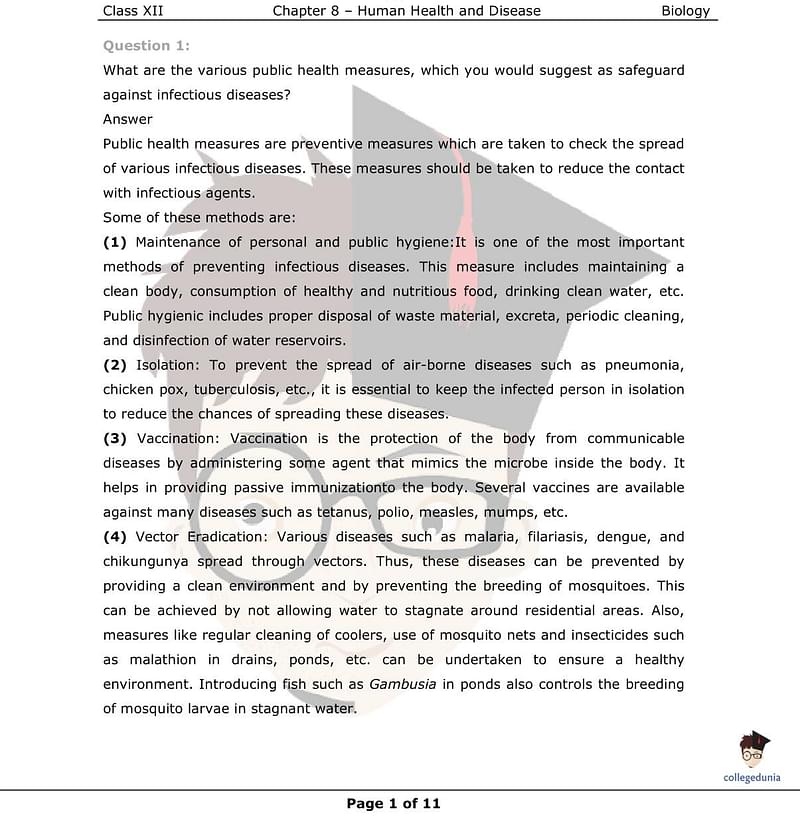
Ncert SolutionsNcert SolutionsNcert SolutionsNcert SolutionsNcert SolutionsNcert SolutionsNcert SolutionsNcert SolutionsNcert SolutionsNcert SolutionsNcert Solutions

Class 12 Biology Chapter 8 Human Health and Diseases: Important Topics

The term health has been a topic of discussion from the beginning of humanity. The early Greeks like Hippocrates and the principles of Ayurveda stated that health is a state of body and mind in balance. Some of the important topics that are covered in this chapter are:

  • Health and Disease

As defined by the World Health Organisation (WHO), Health is referred to as a state of mental, social as well as a physical being. On the contrary, Disease is a hindrance to the well-being of our body that affects the functioning of organs and organ systems. Therefore, the relationship between health and disease can be considered as the state of entire well-being.

  • Cancer

Cancer is caused due to uncontrolled cell division that results in the formation of tumours. A breakdown of regulatory mechanisms takes place in the oncogenic transformation of normal cells. Cancerous cells do not possess contact inhibition property, which inhibits further growth of cells in contact with other cells.

  • HIV and AIDS 

AIDS is caused by HIV (Human Immuno Deficiency Virus), and is a retrovirus with RNA as its genome. In the host by the enzyme reverse transcriptase, the virus produces viral DNA. The viral DNA gets incorporated into the host genome and multiple copies of the virus are produced. 

  • Vaccines

A vaccine can be referred to as a biological preparation in order to provide acquired immunity for a particular disease. Generally, vaccines contain a weakened or killed form of the disease-causing agent, its surface proteins or its toxins. 


Also Read:

Check-Out: 

CBSE CLASS XII Related Questions

  • 1.
    Read the following passage and answer the questions that follow:
    India is one of the megadiverse countries housing around 8·1 per cent of global species diversity, although its land area is only 2·4 per cent of the world’s land area. Many of the species are highly threatened due to human activities like deforestation, mining and habitat fragmentation. Laws like Wildlife (Protection) Act, 1972 were enacted by the Government of India to preserve our biological wealth. Various conservation measures are being implemented to save the threatened species. The following bar graph shows the number of species conserved under different biodiversity conservation methods.

    Which other methods shown in the diagram are opposite to the one identified by you in question ? How are these two conservation approaches different?
    (c) Write two features of Biodiversity hotspots.
    (c) To which category do sacred groves belong and how do they help in bio-conservation?


      • 2.
        "Early and accurate diagnosis of diseases is vital in medical technology."
        Name the conventional methods of diagnosis and their disadvantages.
        Which three diagnostic techniques have been developed through Biotechnology ? Explain how each one helps in detecting diseases.


          • 3.
            Work out the crosses between:
            Normal female and Haemophilic male
            Carrier female and Normal male
            (III) Carrier female and Haemophilic male
            Write the conclusions you draw from these crosses. Comment on the type of inheritance of the disease.
            (Use: $X$ - Normal, $X^h$ - Haemophilic)


              • 4.
                In vitro fertilization (IVF) is a popular method these days that is helping childless couples to bear a child.
                Write the different steps that are carried out in this technique.
                Would you consider gamete intra fallopian transfer as a type of IVF? Justify your answer.


                  • 5.

                    Read the following passage and answer the questions that follow: 
                    The data below shows the concentration of nicotine smoked by a smoker taking 10puffs/minute.


                      • 6.
                        What is the carrying capacity of a species in a habitat?
                        Explain the growth curve that takes this capacity into account.

                          CBSE CLASS XII Previous Year Papers

                          Comments


                          No Comments To Show
