



Content Curator
Root nodule formation is an interesting example of mutualistic symbiosis between legumes and nitrogen-fixing bacteria, especially those of the genus Rhizobium.
- Root nodules are found on the roots of plants, especially legumes, and form a symbiotic relationship with nitrogen-fixing bacteria.
- In nitrogen-limiting conditions, capable plants create a symbiotic association with a host-specific strain of bacteria known as rhizobia.
- This method has evolved several times in legumes as well as other plants in the Rosid group.
- Legume crops consist of beans, peas, and soybeans.
| Table of Content |
Key Terms: Root nodules, Leguminous plants, Nitrogen-fixing bacteria, Amino acids, Formation of root nodules, Rhizobia, Non-Leguminous plants, Epidermal cells, Symbiosome
What are Root Nodules?
[Click Here for Sample Questions]
Root nodules are structures created by the symbiotic interaction between leguminous plants and nitrogen-fixing bacteria.
- The formation of root nodules is due to the requirement for nitrogen for the synthesis of amino acids, energy molecules such as ATP, and nucleotide assimilation.
- Because plants are unable to use air nitrogen directly, they depend on Rhizobia, to form specialized structures known as root nodules.
- Rhizobia is a general term for nitrogen-fixing bacteria.

Also Read:
| Related Articles | ||
|---|---|---|
| Rhizobium | Denitrification | Calcium Deficiency |
Why are Root Nodules Useful for Plants?
[Click Here for Sample Questions]
The nodule is a specialized organ or outgrowth on the roots of the host plant, especially those of the family Fabaceae (Leguminosae), that contains bacteria preferably Rhizobium.
- Rhizobia bacteria can convert nitrogen gas (N2) to ammonia (NH3) in a process called nitrogen fixation.
- Any symbiotic microorganism, generally a diazotrophic bacterium, reduces N2 to ammonium.
- The ammonia is subsequently converted to nitrates, amino acids, and other cellular constituents such as vitamins, flavones, and hormones.
- These constituents are essential to the growth of the plant.
- Sugar which is formed through photosynthesis is converted into organic acids by the plant root cells.
- This serves the bacteria the needed energy for nitrogen fixation.
Leguminous and Non-Leguminous Plants
[Click Here for Sample Questions]
The flowering plant family of the plant kingdom is said to include both leguminous and non-leguminous plants.
- In contrast to non-leguminous plants, legumes have the ability to fix atmospheric nitrogen due to the presence of Rhizobium especially in their roots.
- The nitrogenase complex found in these diazotrophs helps in the conversion of nitrogen into ammonia.
- However, several non-leguminous plants have been shown to fix atmospheric nitrogen.
Leguminous Plants
Leguminous plants are a kind of angiosperm that enriches soil with nitrogen-rich compounds through the process of biological nitrogen fixation. Leguminous plants can also enhance soil quality and can prevent erosion.
Leguminous Plants Examples
Leguminous plants are an essential component of our diet. The most common legumes include beans, cowpeas, chickpeas, kidney beans, alfalfa, and groundnuts. The leaves of the plant are prescribed and compounded. The fruits are the pods.
Non-Leguminous Plants
Except for Fabaceae, non-leguminous plants are classified into several classes.
- These plants do not produce pods, nor do they have Rhizobium sp. associated with their roots.
- These plants lack the ability to replace the soil with nitrogen.
- Instead, they deplete the soil's nitrogen.
Non-Leguminous Plants Examples
Non-leguminous plants include Tal or Asian palm (B.flabellifer Sorisha) and black mustard (B.nigra). Other non-leguminous plant examples include rose, mango, and ficus.

Legumes Plant
Types of Root Nodules
[Click Here for Sample Questions]
There are two types of root nodules. These are
- Indeterminate Nodules
- Determinate Nodules
Indeterminate Nodules
They are found in most of them such as peas, alfalfa, clover, vetch, etc., They have an active meristem that is responsible for the growth of new cells as the nodule grows. They are generally found to have a cylindrical shape and have long branches.
Their growth is classified zone-wise.
Zone I
This zone is the Active meristem zone, where a new nodule is formed.
Zone II
Infection zone that has infection threads full of bacteria and the plant cells get larger.
Zone III
This zone is known as the Nitrogen Fixation Zone. Bacteroides fix nitrogen actively. These cells are pink in color which is due to leghemoglobin supplied by the plant.
Zone IV
This zone is known as the Senescent Zone. The plant and bacterial cells are degraded here. The greenish color present at the base of nodules is due to the breakdown of leghemoglobin.
Determinate Nodules
They are found in tropical legumes such as soybeans, Common beans, etc., and on some temperate legumes like Lotus.
- The nodules here are spherical in shape.
- After initiation, these nodules lose meristematic activity.
- Their growth is only due to cell expansion.
- Determinate modules are found in a wide range of shrubs, trees, and herbs.
Root Nodule Formation Steps
[Click Here for Sample Questions]
The root nodule formation begins when nitrogen levels in the soil are low. Cell signaling is used by the two symbiotic partners to associate and develop nodules. The steps of nodulation are:
- The roots of legumes release flavonoids, which attract rhizobia. Rhizobia gathers around root hairs.
- Rhizobia produces nodulation factors, which cause root hairs to curl around them.
- Nod factors stimulate a variety of developmental processes, including membrane depolarization, root hair curling, cell division in the root cortex, and intracellular calcium transport.
- The nod factor binds to receptors on the plasma membrane of the root hairs, resulting in the formation of the infection thread. Rhizobia can also enter through gaps in root cells.
- Infection threads allow germs to enter epidermal cells.
- Rhizobia then enters cortex cells, and each bacteria is surrounded by a plant-derived membrane known as a symbiosome.
- Rhizobia produces chemicals that lead to nodule formation. The calcium-dependent signal transduction pathway causes biochemical changes that contribute to cell division and nodule formation.
- Cytokinin also plays a significant function in nodule formation.
- Bacteria within nodules develop into nitrogen-fixing bacteroids. Vascular tissues form around nodules to facilitate nutrient exchange.
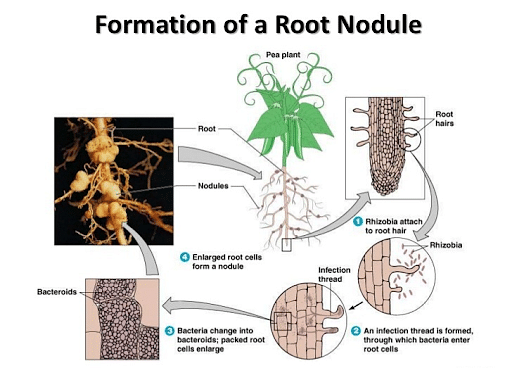
Formation of Root Nodules
Factors Affecting Nodule Formation
[Click Here for Sample Questions]
Nodulation is influenced by both external and internal factors.
- External factors include heat, acidity, soil nitrate level, and so on.
- If the soil is rich in nitrogen, it interferes with nodule formation and symbiotic relationships since plants have enough nitrogen and do not require more.
- Nitrogen fixation is an oxygen-sensitive process.
- Leghaemoglobin, a heme pigment found in root nodules, increases oxygen transport.
- Leaf tissues regulate the formation of nodules independently.
- Plants have evolved defensive mechanisms to prevent infection.
- Ethylene also controls nodule formation internally.
- The exogenous application of ethylene has been found to inhibit nodule formation.
Things to Remember
- Root nodules are structures created by the symbiotic interaction between leguminous plants and nitrogen-fixing bacteria.
- Legumes have the ability to fix atmospheric nitrogen due to the presence of Rhizobium especially in their roots.
- Rhizobia bacteria can convert nitrogen gas (N2) to ammonia (NH3) in a process called nitrogen fixation.
- Leguminous plants are a kind of angiosperm that enriches soil with nitrogen-rich compounds through the process of biological nitrogen fixation.
- There are two types of root nodules: Indeterminate Nodules and Determinate Nodules
- The root nodule formation begins when nitrogen levels in the soil are low.
Also Read:
Sample Questions
Ques. How are nodules formed and when? (2 Marks)
Ans. Root nodules are formed when the soil runs low on nitrogen levels. Root hairs and Rhizobia are called symbiotic partners. They use cell signaling which aids in the development of root nodules. (1 Mark)
Ques. Are Rhizobium and legume symbiotic organisms?
Ans. Yes, Rhizobium and legumes are symbiotic organisms. Rhizobium delivers amino acids to plants while receiving organic acids in exchange.
Ques. What is non-symbiotic nitrogen fixation? (1 Mark)
Ans. Non-symbiotic nitrogen fixation refers to the fixing of nitrogen by free-living microbes in the soil that are not symbiotically associated with plants.
Ques. What are flavones/isoflavones? (1 Mark)
Ans. They are released by legume roots. It’s a signal to rhizobium that a legume is present and is ready to modulate.
Ques. Why do plants need nitrogen fixation? (1 Mark)
Ans. This process is completely necessary when the organism (plant) requires low oxygen and high energy requirement.
Ques. What is leghemoglobin? (2 Marks)
Ans. It’s a plant-specific hemoglobin-like gene. Plants can’t fix nitrogen without this, and they produce a red color. It contains two symbiotic molecules: Apo-plant apoprotein, and heme-from bacteria.
Ques. What is the role of the host plant in nodule formation? (1 Mark)
Ans. The host plant produces flavonoids and is responsible for the activation of plant genes required for nodule formation. It also suppresses genes that repel microbial invaders.
Ques. What is called the Nod factor? (2 Marks)
Ans. Rhizobium bacteria synthesize N-acylated beta-1,4-N-acetylglucosamine lipooligosaccharides, called Nod factors, which act as morphogenic signal molecules to legume roots during the development of nitrogen-fixing nodules.
Ques. Explain a few words about the enzyme Nitrogenase. (3 Marks)
Ans. Nitrogenase is the enzyme complex responsible for nitrogen fixation. This has been characterized as two components, and neither is active without the other. Component I is dinitrogenase. It is known as MoFe protein. Component II is dinitrogenase reductase, known as Fe protein. Nitrogenase is extremely sensitive to oxygen, requiring low oxygen tension for activity. This fixation of nitrogen needs not only nitrogenase but also ATP, reduced ferredoxin.
Ques. List some Aerobic bacteria. (1 Mark)
Ans. Azonomas, Azotobacter Beijerinckia, Mycobacterium, Methylomonas.
Ques. List some photosynthesis bacteria. (1 Mark)
Ans. Rhodomicrobium, Rhodopseudomonas, Rhodospirillum, Chromatium, Chlorobium etc.
Ques. What are the factors affecting nodule formation in legumes? (4 Marks)
Ans. The factors affecting nodule formation in legumes are:
- A variety of factors affect nodulation or nodule formation, including external factors such as heat, soil acidity, drought, and the availability of nitrate compounds, as well as internal factors such as ethylene-mediated root nodule formation.
- A soil that is rich in nitrogen sources inhibits the nodule formation and symbiotic relationship between Rhizoids and plants. This is because nitrogen is available in abundance to the plants.
- The leaf tissues autoregulated the nodule formation which has specific molecules that send them signals whenever there is an opening of an infection thread. And therefore they regulate by sending signals to stop from opening more infection threads and so on.
- Ethylene internally affects the root nodule formation.
For Latest Updates on Upcoming Board Exams, Click Here: https://t.me/class_10_12_board_updates
Check-Out:



Comments