



Content Curator
Rhizobium is a nitrogen-fixing root nodule bacterial symbiont. It belongs to the genus of Gram-negative soil bacteria. It attacks the root nodules of the plants and converts the atmospheric nitrogen into organic nitrogen or ammonia.
| Table of Content |
Keyterms: Rhizobium, Nitrogen fixation, Genus, Gram-negative soil bacteria, Gram-positive bacteria, nitrogen, ammonia, plants, atmosphere, enzyme, nitrogenase
Also Read: Gram-Positive Bacteria
What is Rhizobium?
[Click Here for Sample Questions]
Rhizobium belongs to the genus of Gram-negative soil bacteria. It is known for its endosymbiotic nitrogen-fixing relationship with the roots of legumes and other flowering plants.
Rhizobium attacks the root nodules and converts the atmospheric nitrogen into ammonia. This is achieved with the help of an enzyme called nitrogenase. As a result of the symbiotic relationship, Rhizobium provides organic nitrogenous compounds such as glutamine and ureides to the plant whereas, the plant provides the bacteria with organic compounds made by photosynthesis. Additionally, Rhizobium can also solubilize phosphorous.
Structure of Rhizobium
[Click Here for Sample Questions]
Rhizobium has a rod-like structure with two cell membranes in its cell wall. The different cell organelles present in Rhizobium are ribosomes, mesosomes, cytoplasm, capsules, and nucleoids (DNA). The Rhizobia living outside the plant have flagella whereas the ones living inside do not have flagella. Rhizobium engages in asexual reproduction by creating spores. The process of spore formation is called sporogenesis.
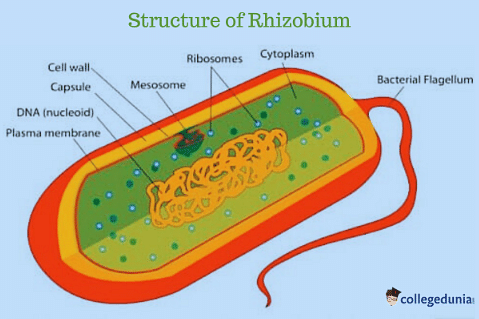
Structure of Rhizobium
Also Read:
| Related Articles | ||
|---|---|---|
| Gram-positive and Gram-negative Bacteria | Heterotrophic Bacteria | Antimicrobial Resistance |
| Origin and Evolution of Man | Antibiotics Classification | Microbiology |
Classification of Rhizobium
[Click Here for Sample Questions]
The classification of Rhizobium is based on the plant with which it forms a symbiotic relationship and its growth. The classification is listed as follows:
| Rhizobium alamii | Rhizobium indigoferae | Rhizobium leguminosarum |
| Rhizobium freirei | Rhizobium fabae | Rhizobium mesosinicum |
| Rhizobium alkalisoli | Rhizobium huautlense | Rhizobium vallis |
| Rhizobium galegae | Rhizobium etli | Rhizobium tubonense |
| Rhizobium azibense | Rhizobium herbae | Rhizobium sullae |
| Rhizobium gallicum | Rhizobium endophyticum | Rhizobium jaguaris |
| Rhizobium calliandrae | Rhizobium halophytocola | Rhizobium lusitanum |
| Rhizobium cauense | Rhizobium daejeonense | Rhizobium sophorae |
| Rhizobium giarginii | Rhizobium hainanense | Rhizobium pisi |
| Rhizobium grahamii | Rhizobium cellulosilyticum | Rhizobium oryzae |
Nitrogen Fixation
[Click Here for Sample Questions]
Nitrogen Fixation is a chemical process in which molecular Nitrogen (N2), a non-reactive molecule, is converted into ammonia (NH3). In nature, this process is carried out by bacterial species like Rhizobium, Azatobacter, etc. Nitrogen Fixation is an important life process as it fulfills the need for nitrogen compounds which are essential for the biosynthesis of all nitrogen-containing organic compounds.
Also Read: Bacterial Transformation
Role of Rhizobium in Nitrogen Fixation
[Click Here for Sample Questions]
Nitrogen is abundant in the atmosphere but it cannot be used directly by the plants because of the non-reactive nature of Nitrogen. In plants, this problem is solved through the symbiotic relationship between the plant and Rhizobium.
The biochemical reaction involved in nitrogen fixation is as follows-
N2 + 8 H+ + 8 e− → 2 NH3 + H2
In the reduction of N2 into NH3, 6 protons and 6 electrons and 12 molecules of ATP are also involved.
Rhizobium attacks the root nodules of legumes and flowering plants and converts atmospheric nitrogen into ammonia. This is achieved with the help of an enzyme called nitrogenase. As a result of the symbiotic relationship, Rhizobium provides organic nitrogenous compounds such as glutamine and ureides to the plant whereas, the plant provides the bacteria with organic compounds made by photosynthesis.
Additionally, it also enhances soil productivity and fertility. It also keeps a check on nutrient deficiency, drought stress, salt stress, and harmful effects of fertilizers and pesticides.
Diseases caused by Rhizobium
[Click Here for Sample Questions]
Some Rhizobium species are pathogenic. These species are:
Rhizobium Rhizogenes
Rhizobium rhizogenes species is responsible for infectious hairy roots in dicotyledonous plants. It is also known as Agrobacterium rhizogenes.
Rhizobium Radiobacter
Rhizobium radiobacter species is responsible for crown gall disease. The species is also known as Agrobacterium tumefaciens.
Also Read:
| Related Articles | ||
|---|---|---|
| E.coli Bacteria | Difference Between Archaea and Bacteria | Reproduction in Bacteria |
| Binary Fission | Urine Infection | Human Bacterial Diseases |
Things to Remember
- Rhizobium belongs to the genus of Gram-negative soil bacteria.
- It is a nitrogen-fixing root nodule bacterial symbiont.
- Rhizobium has a rod-like structure with two cell membranes in its cell wall.
- The cell organelles present in Rhizobium are ribosomes, mesosomes, cytoplasm, capsules, and nucleoids (DNA).
- The classification of Rhizobium is based on the plant with which it forms a symbiotic relationship.
- Nitrogen Fixation is a chemical process in which molecular Nitrogen (N2), a non-reactive molecule, is converted into ammonia (NH3).
- Rhizobium attacks the root nodules of legumes and flowering plants and converts atmospheric nitrogen into ammonia.
Sample Questions
Ques: Name any one symbiont, which serves as a biofertilizer. Mention its specific role. (All India 2010C, 1 Mark)
Ans: One symbiont bacteria that serve as a biofertilizer is Rhizobium. These bacteria fix the atmospheric nitrogen into organic forms. It is further used by the plants as nutrients.
Ques: What are the different cell organelles present in Rhizobium? (1 Mark)
Ans: The different cell organelles present in Rhizobium are capsule, nucleoid (DNA), cytoplasm, mesosome, and ribosomes.
Ques: What is Nitrogen Fixation? (1 Mark)
Ans: Nitrogen Fixation is a chemical process in which molecular Nitrogen (N2), a non-reactive molecule, is converted into ammonia (NH3).
Ques: Why is Rhizobium categorized as a symbiotic bacterium? How does it act as a biofertilizer? (Delhi 2012, 2 Marks)
Ans: Rhizobium forms symbiotic association with leguminous plants due to this they are considered symbiotic bacteria. The nodules on the roots of leguminous plants are formed by Rhizobium bacteria for their survival. These bacteria fix atmospheric nitrogen into an organic form, which is used by the plant as nutrients.
Rhizobium converts the atmospheric nitrogen into an organic form which is further used by the plants as a nutrient. So, it is used as a biofertilizer.
Ques: What are the diseases caused by Rhizobium? (2 Marks)
Ans: The different diseases caused by Rhizobium are infectious hairy roots in dicotyledonous plants caused by Rhizobium rhizogenes species and crown gall disease is caused by the species called Rhizobium radiobacter.
Ques: What is the role of Rhizobium in Nitrogen Fixation? (2 Marks)
Ans: Rhizobium fixes the atmospheric nitrogen with the help of an enzyme called nitrogenase. This fixation results in the formation of organic compounds such as glutamine and ureides which are used by plants.
The biochemical reaction involved in nitrogen fixation is as follows-
N2 + 8 H+ + 8 e− → 2 NH3 + H2
Ques: What is symbiotic nitrogen fixation? Name the proteins involved in the symbiotic nitrogen fixation. (2 Marks)
Ans: Symbiotic relationship of nitrogen fixation established between the microorganism and plant is called Symbiotic nitrogen fixation. There are different species of Rhizobium involved in symbiotic nitrogen fixation. The two types of proteins involved in symbiotic nitrogen fixation are leghaemoglobin and nodulin.
Ques: What are the functions of Rhizobium? (2 Marks)
Ans: The functions of Rhizobium are listed as follows:
Fixing atmospheric nitrogen and providing the plants with the necessary nitrogen-based organic compounds.
It enhances soil productivity and fertility.
It checks nutrient deficiency, drought stress, salt stress, and harmful effects of fertilizers and pesticides in plants.
Ques: Name the bind of interaction present between the following:- (4 Marks)
i) Indian Nightingale & crow
ii) Nodulated roots & rhizobium
iii) Plasmoduim& man
iv) Orchids & Mongo tree
Ans: i) Indian Nightingale & crow: Brood parasitism
ii) Nodulated roots & rhizobium: Mutualism
iii) Plasmoduim& man: Parasitism
iv) Orchids & Mongo tree: Commensalism.
Ques: Brief out the mechanism of Symbiotic Nitrogen fixation. (4 Marks)
Ans: Symbiotic relationship of nitrogen fixation established between the microorganism and plant is called Symbiotic nitrogen fixation.
Roots nodules of leguminous plants contain nitrogenase enzymes and leghaemoglobin pigments due to which symbiotic nitrogen fixation occurs in the roots nodules. These enzymes are necessary for nitrogen fixation. Synthesis of symbiotic nitrogenase enzyme is controlled by nif genes of Rhizobium bacteria. The nitrogenase enzyme is made up of proteins and minerals-molybdenum and iron elements. It functions by converting free atmospheric nitrogen molecules into ammonia. It also uses the produced energy molecules ATP in this process. The complete chemical reaction involved is given below:
N2 + 8H+ + 8e– + 16 ATP → 2NH3 + H2 + 16ADP + 16 Pi
For Latest Updates on Upcoming Board Exams, Click Here: https://t.me/class_10_12_board_updates
Check-Out:



Comments