



Exams Prep Master
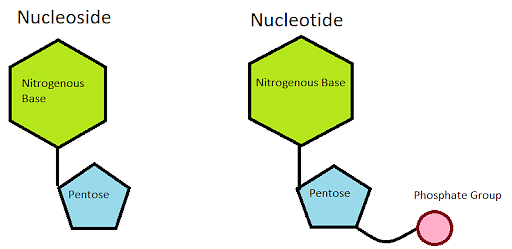
A nucleotide is made up of three parts: a nitrogenous base, a phosphate group, and a sugar molecule. A nucleoside is made up of two parts: a nitrogenous base and sugar. The fundamental distinction between a nucleotide and a nucleoside is this. The primary distinction between nucleotide and nucleoside is critical in comprehending the essential differences between the two. They are nucleic acid building blocks because they contain the same components as nucleic acids, such as a nitrogenous base, sugar, and phosphate group. The fundamental distinction is that nucleosides include simply sugar and a base, whereas nucleotides comprise sugar, base, and a phosphate group. Let's take a look at the basic differences between nucleotide and nucleoside before we get into the specifics.
| Table of Content |
Key Takeaways: Nucleotide, Nucleoside, Sugar, Phosphate, Nitrogen, Nucleic acids, Nitrogenous base, DNA, RNA, Adenine (A), cytosine (C), guanine (G), and thymine (T)
What is Nucleotide?
[Click Here for Sample Questions]
The basic building block of a specific acid, the nucleic acid, is referred to as a nucleotide. This clearly demonstrates the distinction between nucleotide and nucleic acid. A nucleotide also contains a sugar molecule bound to a phosphate group, as well as a nitrogen-containing base. The units and substances that are strung together to produce nucleic acids, most notably RNA and DNA, are known as nucleotides. Both of these are long strings of nucleotides that repeat. Adenine (A), cytosine (C), guanine (G), and thymine (T) are the four bases used in DNA (T). The nucleotide uracil (U) replaces thymine in RNA.

Also Read:
| Related Articles | ||
|---|---|---|
| Amino Acids | Insectivorous Plants | What are Fossils? |
| Prokaryotic and Eukaryotic Cells | Chloroplasts | Autotrophic Nutrition |
What is Nucleoside?
[Click Here for Sample Questions]
A nucleoside is a structural block of nucleic acids, which are the heredity-controlling components of all living cells and are made up of a sugar molecule connected to a nitrogen-containing organic ring group. The sugar is either ribose or deoxyribose, and the nitrogen-containing component is either a pyrimidine (cytosine, thymine, or uracil) or a purine in the most significant nucleosides (adenine or guanine). Nucleosides are usually made by decomposing nucleic acids chemically or enzymatically.

Difference Between Nucleotide and Nucleoside
[Click Here for Sample Questions]
A nucleoside is a sugar (ribose or deoxyribose) with a nitrogenous base covalently linked but no phosphate group. A nucleotide is made up of one to three phosphate groups, a nitrogenous base, and a sugar (ribose or deoxyribose).
| Nucleotide | Nucleoside |
|---|---|
| A nitrogenous base, one to three phosphate groups, and sugar-like deoxyribose and ribose make up Nucleotide. | A nucleoside is made up of a nitrogenous base that is covalently attached to a sugar and lacks the phosphate group. |
| It forms strands of nucleic acid by forming covalent connections with other nucleotides. | Phosphorylation occurs, resulting in the production of nucleotides. |
| It is made up of nucleotides and one or more phosphate groups. | In addition to pentose sugar, it has a nitrogenous base. |
| They are still one of the leading causes of cancer-causing chemicals today. | They are largely employed in medicine to combat infections and cancer-causing substances. |
| Adenosine, guanosine, and other nucleotides are examples of nucleotides. | Some of the most common nucleosides are nucleotides with phosphate groups added. |
Biological Function of Nucleotides
[Click Here for Sample Questions]
Nucleotides play an important role in several ways. They begin by forming nucleic acid bases. Second, they help trigger and even engage in cell function by operating outside of nucleic acid. Two triphosphate nucleotides must link via hydrogen atoms in a process known as "base pairing" to generate nucleic acid. Complementary nucleotides, one purine, and one pyrimidine make up each base. Co-enzymes can be made up of nucleotides. An enzyme is a protein that is produced by living organisms and functions as a catalyst to initiate a biological reaction. When coupled with an enzyme, they can help speed up chemical reactions.
The function of the co-enzyme is determined by a number of parameters, including the nucleotide's binding partner. ATP, in particular, is widely used as a co-enzyme and is regarded as the primary source of energy in living cells. Because ATP is so stable, it remains in a cell until it's time to use it, at which point it releases energy to initiate a chemical reaction. Nucleotides are also essential for cellular metabolism. This is a chemical process that occurs in cells that causes the cells to disintegrate.
Also Read:
Relationship Between Nucleotide and Nucleoside
[Click Here for Sample Questions]
Nucleotides are formed when nucleosides are phosphorylated on the sugar's main alcohol group (-CH2-OH) by certain kinases (a type of enzyme in the cell). Nucleotidases are hydrolytic enzymes that degrade nucleotides (such as thymine) into nucleosides (like thymidine) and phosphate. A nucleotide can be thought of as a phosphodiester of a nucleoside in terms of structure. A nucleoside, on the other hand, is an N-glycoside with ribose or deoxyribose as the sugar component and aglucon as the pyrimidine or purine base.

A nucleoside is a molecule that combines a pentose sugar with a pyrimidine or purine base. A general dehydration synthesis reaction is used to bind the two components, in which a molecule of water is eliminated from between the base and the sugar. The sugar component of a nucleoside reacts with phosphoric acid during dehydration synthesis to generate a nucleotide. A nucleoside is an N-glycoside with ribose or deoxyribose as the sugar component and pyrimidine or purine as the aglucon. Ribonucleosides are nucleosides that contain ribose. Deoxyribonucleosides are those that contain deoxyribose.
Also Read: Reproductive Health
Combinations of adenine, guanine, cytosine, or thymine with deoxyribose and phosphate make up the four nucleotides found in DNA. Combinations of adenine, guanine, cytosine, or uracil with ribose and phosphate make up the four nucleotides found in RNA.
Things to Remember
- In DNA or RNA, nucleotide and nucleoside can act as polynucleotide precursors. A nucleoside is made up of a nitrogenous base and sugar called pentose. A nucleotide, on the other hand, is made up of a nitrogenous base, pentose sugar, and phosphate groups.
- As a result, a nucleoside can be thought of as a nucleotide's predecessor. The sugar pentose can be ribose, deoxyribose, or deoxyribose. In sequencing, nucleotides containing deoxyribose sugars can be utilized to stop the chain from growing.
- The polynucleotide chain in DNA contains the nucleotides adenine, guanine, cytosine, and thymine. Thymine is replaced by uracil in RNA. The correlation between nucleotide and nucleoside is the fundamental distinction between the two.
- The components nucleotide and nucleoside are crucial. They are essential components for nucleic acid manufacturing, which requires improving the human body's metabolism. They are also involved in the transmission and coding of genetic information across the body.
- To summarise, DNA is made up of a polynucleotide chain whose building block is a nucleotide, which is made up of nucleosides that have been phosphorylated. Nucleosides, on the other hand, are exclusively important for building nucleotides.
Also Read:
Sample Questions
Ques: What is the major difference between nucleotide and nucleoside? (2 marks)
Ans: One of the major differences is that a nucleotide contains sugar, phosphate, and base, whereas a nucleoside just has sugar and a base. Adenine, guanine, thymine, and cytosine are the four chemicals that make up DNA bases. Each base has a sugar attached to it, and sugars are linked by a phosphate molecule.
Ques: What are nucleotide derivatives? (2 marks)
Ans: Purine and pyrimidine heterocyclic bases are glycosylated to form nucleotides. Adenine and guanine are purine derivatives, while cytosine, uracil, and thymine (acronyms A, G, C, U, T) are pyrimidine derivatives. Thymine is a deoxyribonucleotide, whereas uracil is a ribonucleotide.
Ques: What is the chemical composition of nucleoside? (2 marks)
Ans: A nucleoside is made up of just a nucleobase (also known as a nitrogenous base) and a five-carbon sugar (ribose or 2'-deoxyribose), whereas a nucleotide has a nucleobase, a five-carbon sugar, and one or more phosphate groups.
Ques: What are nucleotide coenzymes? (2 marks)
Ans: In a wide range of oxidation and reduction reactions, the nicotinamide nucleotide coenzymes operate as proton and electron carriers. NAD and NADP were previously known as coenzymes I and II, respectively until their molecular structures were discovered.
Ques: How are nucleoside triphosphates synthesized? (2 marks)
Ans: TTP is not a nucleic acid synthesis substrate, hence it is not produced in the cell. Instead, after conversion to their respective deoxyribose forms, dTTP is produced indirectly from either dUDP or dCDP. The allosteric regulation of orotate synthesis by UDP and UTP regulates pyrimidine production.
Ques: Why are nucleotide triphosphates used in DNA synthesis? (2 marks)
Ans: NTPs are utilized to make RNA primers, while ATP is used as an energy source for some of the enzymes that start and keep DNA synthesis going at the replication fork. Base pairing with the template strand of the DNA selects the nucleotide that will be integrated into the developing DNA chain.
Ques: What do nucleotides do? (3 marks)
Ans: Toxoplasma gondii and other apicomplexan parasites rely heavily on nucleotides and amino acids for replication and growth. In rapidly dividing stages, nucleotides are especially important for DNA replication and RNA transcription. Nucleotides are also involved in a variety of metabolic functions, including producing cellular energy sources (ATP and GTP).
Ques: Nucleoside is a pyrimidine or purine base? (2 marks)
Ans: A purine or pyrimidine base is joined to a ribose or deoxyribose sugar by a -glycosidic connection to form nucleosides. These chemicals are linked to RNA (ribose sugars) and DNA structures (deoxyribose sugars).
Ques: How does nucleoside differ from nucleotide? (4 marks)
Ans: Pentose sugar and nitrogenous base are found in both nucleotide and nucleoside. Nucleotide differs from nucleoside in that it contains phosphoric acid, whilst nucleoside does not. The main distinction is that nucleosides only include sugar and a base, whereas nucleotides comprise sugar, base, and phosphate group. A nucleotide is the building block of RNA and DNA, whereas a nucleoside is the building block of the nucleotide itself.
Ques: What is the difference between a nucleoside triphosphate and a nucleotide? (2 marks)
Ans: Nucleosides with a variable amount of phosphate groups attached to the 5' carbon are known as nucleotides. A specific type of nucleotide is nucleoside triphosphate. The five most frequent nitrogenous bases found in DNA and RNA are adenine, guanine, cytosine, thymine, and uracil.
For Latest Updates on Upcoming Board Exams, Click Here: https://t.me/class_10_12_board_updates
Check-Out:



Comments