



Education Journalist | Study Abroad Lead
Partial Differential Equations (PDE) are composed of a function and its partial derivatives of several unknown variables. In other words, partial differential equations facilitate the derivation of partial derivatives for functions having several variables. The swirly-d symbol, ∂, often called "del", is used to differentiate partial derivatives from ordinary single-variable derivatives. These equations are considered differential equations. Many phenomena such as sound, heat, diffusion, electrostatics, electrodynamics, fluid dynamics, elasticity, gravity, and quantum mechanics are represented by it. These are employed in areas like physics, chemistry, economics, and biology for processing models that incorporate the rates of change of the variable.
| Table of Content |
Key Terms: Partial differential equation, variable, Independent Variables, Homogeneous, Sound, Heat, Diffusion, Electrostatics, Electrodynamics, Fluid dynamics, Elasticity, Gravity, Quantum mechanics
What is a Partial Differential Equation?
[Click Here for Sample Questions]
A partial differential equation is a mathematical equation having two or more independent variables, an unknown function that is dependent on those variables, With the partial derivatives of the unknown function with respect to the independent variables. The swirly-d symbol, ∂, often called "del", is used to differentiate partial derivatives from ordinary single-variable derivatives.

Denoting Partial Differential Equation
Types of Partial Differential Equations
[Click Here for Sample Questions]
The different types of PDE are:
- First-order Partial Differential Equation
- Second-order Partial Differential Equation
- Quasi-Linear Partial Differential Equation
- Homogeneous Partial Differential Equation
First-Order Partial Differential Equation
A first-order partial differential equation is a partial differential equation that only involves the first derivatives of the unknown function of the n variable.
F(x1,x2,……,xn,w,\(\frac{{\partial}w}{{\partial}x_1}\),\(\frac{{\partial}w}{{\partial}x_2}\),…,\(\frac{{\partial}w}{{\partial}x_n}\))= 0
Derivatives of the first order can be both linear and nonlinear. If the dependent variable and all of its partial derivatives occur linearly. The derivatives of a linear partial differential equation are not squared or multiplied.
Second-Order Partial Differential Equation
The highest partial derivatives in second-order partial differential equations are of the second order. Linear, semi-linear, and non-linear are types of the second-order partial differential equation.
The second partial derivative of \(f\) with respect to x then
\(f\)xx=\(\frac{{\partial}fx}{{\partial}x}\)
The second partial derivative of f with respect to x then y
\(f\)yy=\(\frac{{\partial}fy{\partial}y}{{\partial}y}\)
Quasi-Linear Partial Differential Equation
If all the terms with highest order derivatives of dependent variables occur linearly, the coefficients of such terms being functions of only lower-order derivatives of the dependent variables, the partial differential equation (PDE) is called quasi-linear.
\(f\)(x,y,w)\(\frac{{\partial}w}{{\partial}x}\)+ g(x,y,w)\(\frac{{\partial}w}{{\partial}y}\)= h(x,y,w)
Homogeneous Partial Differential Equation
The nature of the variables in terms determines whether a partial differential equation is homogeneous or non-homogeneous. A partial differential equation (PDE)is homogeneous if, after writing the terms in order, the right-hand side is equal to zero.
\(\frac{{\partial}^2U}{{\partial}x^2}\)-\(\frac{{\partial}w}{{\partial}y}\)=0
The above equation is homogeneous.
Order and Degree of Partial Differential Equations
[Click Here for Sample Questions]
Partial differential equations are classified according to their order and degree. The first-order and second-order partial differential equations are the most often employed.
- Partial Differential Equations in Order
The order of a partial differential equation is defined as the order of the PDE's highest derivative term. Consider the following partial differential equation.
\(\frac{dy}{dx}\)+\(\frac{dy}{dx}\)+4y=0
This is a first-order partial differential equation since the highest derivative's order is 1.
- Partial Differential Equations Degree
The maximum derivative in a partial differential equation determines the degree of the PDE. Equation of partial differential,
\(\frac{dy}{dx}\)+\(\frac{dy}{dx}\)+4y=0
In this case, the degree is 1.
Classification of Partial Differential Equation
[Click Here for Sample Questions]
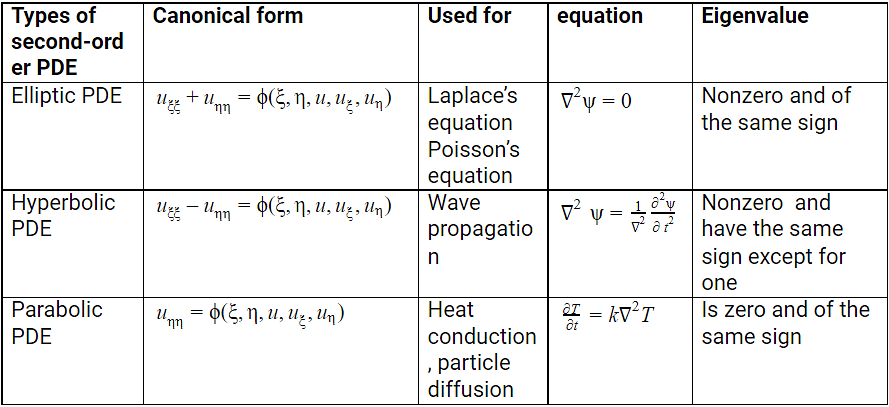
The following are the different types of second-order partial differential equations:

Things to Remember
- Adrien-Marie Legendre (1786) invented the present partial derivative notation (although he later abandoned it, Carl Gustav Jacob Jacobi reintroduced the symbol in 1841).
- Differentials with regard to numerous independent variables are contained in partial differential equations (PDEs).
- In any PDE, if the dependent variable and all of its partial derivatives occur linear, the equation is referred to as a linear PDE; otherwise, it is referred to as a non-linear PDE.
- A partial differential equation is governing equation for mathematical models in which the system is both spatially and temporally dependent.
- Partial differential equations are divided into four groups. These include first-order, second-order, quasi-linear, and homogeneous partial differential equations.
- The partial derivative is also expressed by the symbol ∇ (Nabla) in some circumstances, such as when learning about wave equations or sound equations in Physics.
Also Read:
Sample Questions
Ques. When utilizing the variable separable approach to solve a partial differential equation, we equal the ratio to which constant? (3 Marks)
a. can be a positive or negative integer, or zero
b. can be a positive or negative rational number, or zero;
c. It has to be a positive number.
d. It has to be a negative number.
Ans. The constant may be any rational number, hence the answer is b. For example, while solving a 1-Dimensional wave equation, we use a positive rational number; when solving a 1-Dimensional heat equation, we use a negative rational number; and when we have a steady-state, we use 0. The choice of constant is determined by the nature of the situation at hand.
Ques. What are the methods used to solve partial differential equations? (3 Marks)
Ans. The various methods used to solve the PDEs are Method of characteristics, Integral transform, change of variables, separation of variables, fundamental solution, Finite element method, Finite difference method,Superposition principle, Methods for nonlinear equations, Lie group method, Semi-analytical method, and Finite volume method.
Ques. How should I solve the partial differential equation \(\frac{{\partial}u}{{\partial}t }\)=4\(\frac{{\partial}u}{{\partial}x }\)? (5 Marks)
Ans. Let’s assume u(x,t=0)=x . The PDE can be written in the general form
ut+uux=0
Now we make x and t dependent on a further variable namely s , hence
u(s)=u(x(s),t(s))
\(\frac{du}{d s }\)=\(\frac{{\partial}u}{{\partial}x }\)\(\frac{dx}{ds }\)+\(\frac{{\partial}u}{{\partial}t }\)\(\frac{dt}{ds }\)
\(\frac{dy}{dx }\)=0→u=c1
\(\frac{dt}{ds }\)=1→dt=ds
\(\frac{dx}{ds }\)=\(\upsilon\)→\(\frac{dx}{dt }\)=\(\upsilon\)→dx=\(\upsilon\)dt→x=\(\upsilon\)t
Let’s consider
u(x(s),t(s))=x(s)
for s=0 , therefore we get
u(x(s=0),t(s=0)=0)=x(s=0)→u(x0,0)=x0
Since
u(s=0)=x0→u(s=0)=c1=x0→u=x0
x(s=0)=x0→x(s=0)=v+t(s=0)+c2→c2=x0
→x=vt+x0→x0=x-vt
So, the solution is
u(x,t)=x-vt
Note that v=-4 in this specific case.
Ques. What are some of the real-life applications of( PDE) partial differential equations? (5 Marks)
Ans. Partially differential equations are used to represent fluid mechanics, heat and mass transfer, and electromagnetic theory, all of which have numerous real-world applications. lower-order mechanics are utilized to better understand how the circulatory system works, how rockets and planes fly, and even how the weather behaves to some extent.
- All electricity and everything that involves light, from X-rays to pulse oximetry and laser pointers, is based on electromagnetism.
- Heat and mass transfer are utilized to figure out how medication delivery systems function, how renal dialysis works, and how to manage heat for temperature-sensitive objects. It also explains why thermos’s functions. Heat and mass transfer are utilized to figure out how medication delivery systems function, how renal dialysis works, and how to manage heat for temperature-sensitive objects. It also explains why thermos’s functions.
Ques. Describe the formation of a Partial differential equation? (3 Marks)
Ans. A partial differential equation can be formed by eliminating the arbitrary constants that are present in the functional relationship between the dependent and independent variables, a PDE may be generated and also by removing arbitrary functions from a particular dependent-independent variable relationship.
Ques. Mention three sorts of partial differential equation solutions and define general and full partial differential equation integrals. (3 Marks)
Ans. A complete integral/complete solution is a solution that has the same number of arbitrary constants as the number of independent variables.
A particular integral/particular solution is a solution produced by assigning specific values to the arbitrary constants in a full integral. A general integral/general solution is a solution of a partial differential equation m that incorporates the greatest number of arbitrary functions feasible.
Ques. What is the order of the partial differential equation that follows? (3 Marks)
uxx+2uxy+\(\frac{7}{5}\)uyy=10y
Ans. The highest ordered partial derivatives in the equations determine the order of the equation.
uxx+2uxy+\(\frac{7}{5}\)uyy=10y
These are the partial derivatives:
uxxuxyuyy
This problem is a second-order partial differential equation because each partial derivative has two variables.
Ques. What is the order of the following partial differential equation? (3 Marks)
uxyz+uxy=ey
a. Second Order
b. First Order
c. Homogeneous
d. Third Order
e. Non-homogenous
Ans. (D) Third Order
Partial differential equations, like ordinary differential equations, can be classified according to their order. The highest ordered partial derivatives in the equations determine the order of the equation.
Taking a look at the problem at hand- uxyz+uxy=ey
The partial derivatives are: uxyz,uxy
The partial derivative contains three variables thus this equation is of the third-order partial differential equation.
For Latest Updates on Upcoming Board Exams, Click Here: https://t.me/class_10_12_board_updates
Check-Out:



Comments