



Exams Prep Master
Partial Pressure is the pressure that is exerted by one among the mixture of gases if it occupies the same volume on its own. Dalton's law states that the total pressure exerted by a mixture of Ideal gases is the sum of partial pressure exerted by individual gases. This law was given by John Dalton in 1801. Ideal gas is the composition of randomly moving small particles, these particles are not subjected to inter-particle reaction between them.
| Table of Content |
Keyterms: Partial Pressure, equilibrium, gaseous states, thermodynamics, mixture, gas, Ideal gas, particles
Read more: Vaporization
What is Partial Pressure?
[Click Here for Sample Questions]
This is the pressure exerted by an individual gas upon the walls of vessels, given a certain volume. The pressure exerted by an ideal gas ( or unreactive mixture of gas) is equal to the sum of partial pressure exerted by individual gases in that mixture.
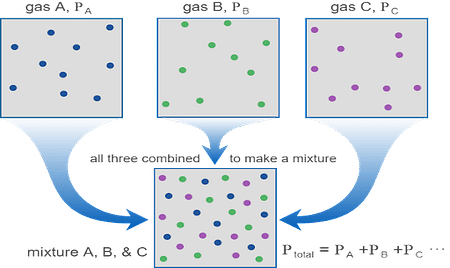
Partial Pressure
Also the ratio of partial pressure of any particular gas to the total pressure of mixture of gas, is equal to the ratio of volume occupied by a particular gas to the total volume occupied by the mixture of gases. The ratio is also equal to the ratio of the number of particles of that gas to the total number of particles of the mixture. The total pressure of a mixture of an ideal gas is the sum of the partial pressure of the individual gases in the mixture, as shown below:
Vx / Vtot = Px /Ptot = nx /ntot
Where,
Vx = the partial pressure of the particular gas.
Px = the partial pressure of the gas x.
Vtot = the total volume of the mixture.
Nx = the amount of gaseous substance.
Ptot = the total pressure of the mixture.
Ntot = the total amount of substance in a mixture.
Read More:
| Related Concepts | ||
|---|---|---|
| Boyle’s Law | Real Gas | Law of Multiple Propotions |
| Phase Changes | Charles Law | Law of Chemical Combinations |
Partial Pressure of Ideal Gases
[Click Here for Sample Questions]
The behaviour of the ideal gases allows the gas mixture to be specified quite simply. Especially, the ideal gas law holds for each component of the mixture separately. Each component exerts its own pressure which is the partial pressure. In other words, the partial pressure is the measure of the thermodynamic activity of gas molecules. Based on their partial pressure, the ideal gases diffuse and react and do not concentrate on a gaseous mixture.

Dalton’s Law of Partial Pressure
[Click Here for Sample Questions]
The total pressure exerted by a mixture of ideal gases is the sum of partial pressure exerted by individual gases. In the below example where partial pressure of all the gases (forming a mixture called air) are added, then the resultant pressure is equal to the pressure exerted by the mixture of all of these gases.
Ptotal = P1 + P2 + P3…
Where, P1 + P2 + P3 are the partial pressures of gas 1, 2 and 3. As it is known that every gas has an independent behaviour, the pressure of that gas can be found using its number of moles, the volume of the container and temperature.
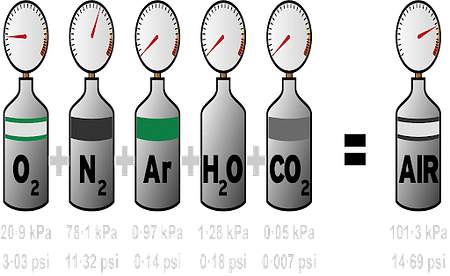
This law can be proved by adding the partial pressure of each gas in the mixture, which will equate with the pressure of the mixture of gases. The same has been shown in the example above. For example, a mixture of an ideal gas that consists of nitrogen, hydrogen and ammonia is taken.
P = PN2 + PH2 + PNH3
Where,
PN2 = Partial pressure of nitrogen
PH2 = Partial pressure of hydrogen
PNH3 = Partial pressure of ammonia

Things to Remember
- Partial pressure is the pressure exerted by individual gases on the walls of vessels under same temperature and volume
- Dalton's law states that the total pressure exerted by a mixture of gases is equal to the sum of partial pressure exerted by individual gases.
- To hold Dalton's law true the gases should be unreactive to each other. That’s why temperature should be such that the gases don’t lose their unreactive characteristics.
- The conditions such as temperature and volume must remain the same during the whole process.
- Famous Example; The mixture of nitrogen gas, argon gas and helium gas have pressure of 2 atm combined. All these gases don’t react with each other. Partial pressure of nitrogen is 0.8 atm, partial pressure of helium is 0.5 atm and partial pressure of argon is 0.7 atm.
Read More: Avogadro’s Law
Sample Questions
Ques: What is Dalton's Law? Explain in brief with an example. (2 marks)
Ans: Dalton's law states that the pressure exerted by a mixture of gases is the sum of partial pressure exerted by individual gases.
In a mixture of helium and oxygen gas, the total pressure exerted will be the sum of partial pressure of helium and oxygen.
Ques: The partial pressure of oxygen is 24 psi, carbon is 45 psi and helium is 10 psi at certain temperatures. At that particular pressure all three of these gases don’t react with each other. What will be the total pressure of the mixture of all three gases at the same temperature? (1 mark)
Ans: The total pressure of the mixture of gases will be the sum of partial pressure of gases i.e. 24+45+10=80 psi.
Ques: Partial Pressure is directly proportional to: (1 mark)
(1) v
(2) v2
(3) 1/v
(4) v3
Ans: (2) The pressure of any gas is equal to (1/3).((mi .ni )/V) . v2
m= molecular mass, n = number of molecule, V is volume and v is speed
Ques: Will the reactivity of gases have any impact on the pressure exerted by the mixture? (2 marks)
Ans: Reactivity of gas will have a huge impact on the pressure exerted by the mixture because with reaction molecular mass, number of particles and volatility changes and so does pressure. The pressure can increase or decrease depending on the characteristics of the resultant compound.
Ques: At what temperature does Dalton's law work? And if it does not work at a certain temperature explain why? (5 marks)
Ans: Dalton's law is universal law and is applicable at all temperatures and all mixtures of ideal gases . Ideal gases are gases which don’t react with each other at normal temperature.
The basic constraint in Dalton's Law is that the partial pressure of gases should also be calculated at the same temperature at which pressure of mixture of gases is calculated. Changes in the temperature during the process violate the basic condition and hence don’t give proper results.
Dalton's law may not work for certain gases at extremely high temperatures, because these gases may become highly reactive and lose their ideal gases characteristics. This violates the basic condition of non- reactivity of gases.
Ques: Why does the mixture of NH3 and HCl gases not follow Dalton’s law of partial pressure? (3 marks)
Ans: The mixture of NH3 and HCl gases do not follow Dalton’s law of partial pressure as the gases are reactive. They react to form ammonium chloride which is solid and Dalton’s law of partial pressure can not be applied to solids and reactive gases.
NH3 + HCl → NH4Cl
Ques: What is the unit for partial pressure? (3 marks)
Ans: The partial pressures can be denoted by any standard unit of pressure. Some of the most commonly used examples are Pascals or atmospheres (Pa). Pascals are identical with N m-2 (newtons per square metre). A homogeneous equilibrium is one in which everything is present in the equilibrium combination.
Ques: What does partial pressure depend on? (3 marks)
Ans: In a gas mixture, the partial pressure of all the gas is proportional to its fraction of the mole. The partial pressure exerted by each gas in the mixture is independent of the pressure that is exerted by all the other gases present.
Ques: What is the importance of partial pressure? (2 marks)
Ans: Partial pressure becomes important when forecasting a gas flow. For instance, when gases in two regions that are connected tend to equalize their pressure, this process suggests partial pressure.
For Latest Updates on Upcoming Board Exams, Click Here: https://t.me/class_10_12_board_updates
Check-Out:



Comments