



Content Curator
Phloem is a complex living tissue in plants. The distribution and transportation of the carbohydrates created during photosynthesis are carried out by the vascular plant tissue known as phloem.
- The vascular bundles of the stem, the abaxial part of every leaf, and the exterior portion of the root cylinders are all places where the phloem can be found because the plant is a single entity.
- Phloem is a fundamental tissue in the plant body.
- Besides transporting sugar, it also serves as a vehicle for hormones, signalling molecules like mRNAs, defence against biotic and abiotic threats, food for the organs, gas exchange, and the storage of numerous waste products like starch, calcium oxalate crystals, and tannins.
- Phloem, a unique type of living conducting cell known as a sieve element, is present in all vascular plants.
- During development, sieve elements' nuclei, ribosomes, and other organelles degenerate.
Key Terms: Phloem, Xylem, Phloem Transport, Sieve Cells, Sieve Tubes, Phloem Parenchyma, Phloem Sclerenchyma, Phloem Fibres, Bast Fibres, Companion Cells
What is Phloem?
[Click Here for Sample Questions]
Phloem is defined as a complex tissue that serves as a transport system in vascular plants for the transportation of soluble organic substances.
- The living tissues that make up the food-making tissue in plants move sugar to plant organs like the fruits, flowers, buds, and roots using turgor pressure and ATP energy.
- This movement of sugar being transported to other plant organs like fruits, flowers and more is known as Translocation.
- Water and minerals are transported from the root to different sections of the plant through the xylem (another component of the vascular plant transport system).
Read Also: Difference Between Monocot and Dicot System
Types of Phloem
[Click Here for Previous Year Questions]
Primary and Secondary Phloem are two different forms of phloem.
Primary Phloem
A vascular plant's primary meristem produces this kind of phloem. Primary phloem is phloem that comes from the procambium during primary growth.
- The constituents of the primary phloem are protophloem or metaphloem.
- It can be found in the primary plant body.
- Opposed to the secondary phloem, it can be found in the periphery.
- The primary phloem does not have a radial system.
Secondary Phloem
In vascular plants, the secondary meristems are where the secondary phloem is produced. This expansion is a result of the vascular cambium, a meristematic tissue.
- During secondary growth, the vascular cambium gives rise to the secondary phloem.
- Secondary growth is what causes the increase in plant width, which is mostly seen in trees.
- The stems and roots are known to consist of the secondary phloem, developing within the primary phloem.
- It contains a radial arrangement of phloem rays.
- Phloem fibres (otherwise known as bast fibres), sieve tubes, phloem parenchyma, and sclereids can be found more in content in the secondary phloem than in the primary phloem.
Read More:
Phloem Tissue Structure
[Click Here for Sample Questions]
The phloem tissue is made up of a variety of different parts. Together, each of these elements carries out a variety of tasks, including enabling the transport of amino acids and carbohydrates from source tissues to sink tissues, where they are used up or stored. The following are the components of phloem:
- Sieve Elements
- Sieve Plates
- Companion Cells
- Phloem Parenchyma
- Phloem Sclerenchyma
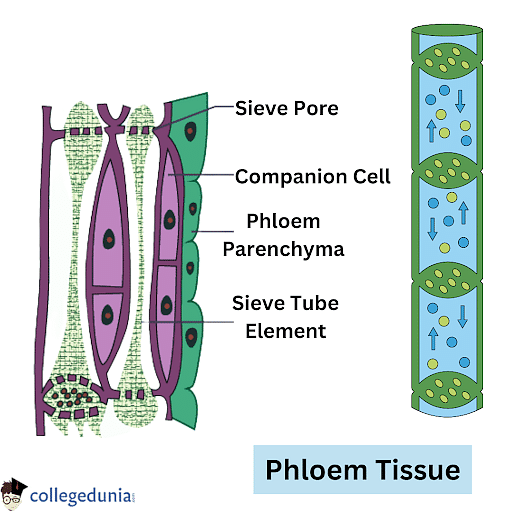
Structure of Phloem Tissue
Sieve Elements
The phloem's sieve tube structure is made up of elongated, narrow cells that serve as the sieve elements. They are regarded as the most specialised cell types seen in plants. To maximise the area available for material transfer, these elements lack the nucleus at maturity as well as organelles including ribosomes, cytosol, and Golgi apparatus.
There are two primary categories of sieve elements, and both come from the same sort of mother cell.
- Sieve tubes In Angiosperms
- Sieve cells in Gymnosperms
Sieve Plates
Sieve member cells, which are modified plasmodesmata, are connected by sieve plates, which are situated in between the connections. These sections of pores, which are both big and thin in structure, aid in the interchange of materials between the element cells.
- The sieve plates also serve as a barrier when the phloem is cut or damaged, as is frequently done by an insect or herbivorous mammal.
- Phloem-protein, also known as P-protein, a special protein created within the sieve element, is released from its anchor site following the injury and builds up to form a "clot."
- These clots, which are located on the sieve plate's pores, aid in reducing sap loss at the damaged area by blocking the pores.
Compared to angiosperms, gymnosperms' sieve components have more primitive characteristics. In place of sieve plates that allow material to pass through directly, they feature many pores at the tapered end of their cell walls.
Companion Cells
In angiosperms, a "companion cell" and in gymnosperms, a "Strasburger cell" or an albuminous cell are closely related to each other. Companion cells have a nucleus that is surrounded by a lot of cytoplasms.
- There are many ribosomes and mitochondria in the cytoplasm.
- Companion cells are in charge of carrying out several metabolic processes as well as other cellular tasks as a result.
- The sieve element is deficient in the proper organelles as a result of which it is unable to participate in the process of metabolic reactions.
- The companion cells are necessary for the sieve elements to operate and survive.
- The sucrose, proteins, and other molecules can be transferred to the sieve elements through the plasmodesmata, a small channel linking the cytoplasm of the cells that connect the sieve tube and companion cells.
- Companion cells help in the loading of sieve tubes with the products of photosynthesis, and the loaded products get discharged at the sink tissues.
- Companion cells also help in the transfer of materials around the plant and to the sink tissues.
A group of cells known as the parenchyma serves as the "filler" in plant tissues. They feature cellulose walls that are thin and flexible. Starch, lipids, and proteins are primarily stored by the parenchyma in the phloem, and in the case of some plants, they also aid in the storage of tannins and resins.
Phloem Parenchyma
A group of cells known as the parenchyma serves as the "filler" in plant tissues.
- They feature cellulose walls that are thin and flexible.
- Starch, lipids, and proteins are primarily stored by the parenchyma in the phloem, and in the case of some plants, they also aid in the storage of tannins and resins.
Phloem Sclerenchyma
The primary phloem tissue that gives the plant stability, rigidity, and strength is called the sclerenchyma.
- Both fibres and sclereids, two types of sclerenchyma, have thick secondary cell walls and are typically dead when they reach maturity.
- While permitting the phloem to be flexible, the bast fibres provide tensile strength.
- They are elongated, narrow cells with a limited lumen and walls made of thick cellulose, hemicellulose, and lignin.
Sclereids: They are somewhat shorter, atypically shaped cells that contribute to the phloem's increased compression strength but limit its flexibility. Sclereids provide a rough texture when chewed, acting as a deterrent to herbivory.
Bast: Plant tissues called bast or phloem carry nutrients from the leaves to the remainder of the plant. The phloem contains a variety of unique cells, including phloem tubes, companion cells, phloem fibres, and phloem parenchyma cells.
Phloem Formation
[Click Here for Previous Year Questions]
Primary phloem is produced by the apical meristems (zones of new cell production) of root and shoot tips.
- Depending on whether the cells mature before or after elongation (growth) of the area in which it is located, the primary phloem can either be protophloem or metaphloem.
- As the plant ages, the protoplast sieve tubes are torn and destroyed because they are unable to expand along with the lengthening tissues.
- The numerous cell types of the phloem can become fibres.
- The later mature metaphloem in plants with a cambium is replaced by secondary phloem, but it is not destroyed and may continue to function for the duration of the plant's life.

Phloem in Yucca
Phloem Loading and Unloading
[Click Here for Sample Questions]
Through photosynthesis, the leaf's mesophyll cells create sugar. These sugars go via the phloem's sieve tube components. Phloem loading and phloem unloading are terms used to describe the movement of sugar from mesophyll cells (the source) to sieve tube elements and from sieve tube elements to roots or other storage cells, respectively.
Phloem Loading
Phloem loading processes come in two ways.
- Active Loading: It is also known as the sucrose-H+ cotransporter mechanism or active phloem loading. To sieve phloem tubes, this technique uses an energy-driven migration of sugars from apoplast or cell walls outside the plasma membrane.
- Passive Loading: Organic solutes travel easily from mesophyll cells through symplast, or from cell to cell, to sieve tubes of phloem element via companion cells through plasmodesmata. This process is known as passive phloem loading.
Active phloem loading happens throughout the following steps:
- The photosynthetic tissue of the leaf generates sucrose.
- Diffusion from photosynthesising tissue carries sucrose to the apoplast.
- A carrier protein actively pushes H+ ions across the partner cells' plasma membrane and into the apoplast. ATP is used in this process.
- Here, co-transportation occurs. As the concentration of H+ in the apoplast rises, a proton gradient is created, and H+ and sucrose subsequently diffuse back to partner cells. A cotransporter protein is also utilised in this process.
After phloem loading, sucrose is translocated to sink organs at the consuming end, and the sugar is delivered there. Phloem unloading is the phrase used to describe this process.
Phloem Unloading
Similar to phloem loading, phloem unloading can be accomplished by apoplast or symplast. Sugar is discharged from the filter tube into the cells or sinks when it reaches the other end. Three different phloem emptying mechanisms exist.
- Sieve element unloading: Imported sugars depart sink tissue sieve components during this process, which involves sieve element unloading.
- Short-Distance Transport: The sugars are now transported to the cells in the sink via a short-distance pathway, also referred to as post-sieve element transfer.
- Storage and Metabolism: Carbohydrates are ultimately either stored or metabolised in the cells of the sink.
Symplast is typically utilised for phloem unloading when sucrose consumption rates are very high and sink cells are metabolically very active, such as in the meristematic tissue of growing roots, fruits, leaves, etc. Sucrose unloading occurs through the apoplast in storage organs with sink cells, such as fruits (grapes, oranges, etc.) and roots.
Functions of Phloem
[Click Here for Previous Year Questions]
The many Phloem functions include:
- The thinnest branches and terminals of the vein sieve tubes are home to metastatic and marginal parenchymal cells, also known as phloem parenchyma, which is also important in the food chain.
- The soft fibres utilised in trade are made out of long, flexible cells called phloem fibres (such as flax and hemp).
- The vascular plant's phloem is a biological tissue that transfers photosynthesis, a soluble organic molecule created during photosynthesis, to various parts of the plant. This kind of transfer is referred to as translocation.
Read Also:
Things to Remember
- Vascular tissues in plants are of two types: Xylem and Phloem.
- Phloem is a food-conducting complex living tissue found in vascular plants It is located outside the xylem in roots, stems, and leaves
- Phloem is made up of sieve cells, sieve tubes, companion cells, phloem parenchyma, and phloem sclerenchyma.
- The chief function of the phloem is to transport food materials from leaves to other parts of the plant body.
- Phloem is of two types: Primary Phloem and Secondary Phloem. It is based on the size of the lumen.
- Phloem fibres are also called Bast Fibres. They are strong and have commercial value.
Previous Year Questions
- The vascular bundles in the stem…[OJEE - 2007]
- A cell organelle containing hydrolytic enzymes is … [NEET 2016]
- Water soluble pigments found in plant cell vacuoles are … [NEET 2016]
- Which of the following are not membrane-bound? … [NEET 2015]
- Besides giving out secretory vesicles … [NEET 1994]
- Interfascicular cambium develops from cells of… [NEET 2013]
- Ground tissue includes… [AIPMT 2011]
- Vascular tissues in flowering plants develop from… [AIPMT 2008]
- The lowest water potential in the xylem will be of… [UPSEE 2018]
Sample Questions
Ques: What are vascular tissues? Give some examples. (2 marks)
Ans: The primary transport systems of plants, the xylem and phloem, make up vascular tissue. They often coexist in vascular bundles that cross the roots, stems, and leaves of all plant organs. Water and dissolved ions are moved upward through the plant through the xylem, starting at the roots.
Ques: Define phloem. What components makeup phloem? (3 marks)
Ans: Phloem, a complex tissue found in vascular plants, functions as a transport system for soluble chemical compounds. The following are the parts of phloem tissue:
- Sieve elements
- Sieve plates
- Companion cells
- Phloem parenchyma
- Phloem sclerenchyma
Ques. Describe phloem in brief. (3 marks)
Ans: The vascular plant tissue phloem is in charge of transporting and distributing the sugars produced by photosynthesis. Due to the plant's continuity, phloem can be found in the stem vascular bundles, the abaxial portion of every leaf's venation, and the external portion of the root cylinders. Even though the phloem is frequently external to the xylem in roots and stems and abaxial in leaves, there are discernible taxon-specific variations. Internal phloem is often referred to as intraxylary phloem.
Ques: What are the functions of phloem? (3 marks)
Ans: Functions of phloem are
- Metastatic and marginal parenchymal cells sometimes referred to as phloem parenchyma, are found in the smallest branches and terminals of the vein sieve tubes and are crucial in the food chain.
- Phloem fibres, which are long, flexible cells, are the source of the soft fibres used in trade (such as flax and hemp).
- Phloem is a biological tissue found in vascular plants that transports photosynthesis—a soluble organic molecule produced during photosynthesis—to different regions of the plant. Translocation is the term used to describe this type of transfer.
Ques: The relationship between the source and sink can change. Explain. (2 marks)
Ans: Both the source and sink functions are interchangeable. In an ideal setting, leaves serve as a significant food source, supplying organs that serve as sinks by storing sugar. These storage organs serve as sources during the dry season, while leaves and other organs serve as sinks.
Ques: Define exudation. (2 marks)
Ans: Exudation is the discharge of liquid substances from plant tissue that has been harmed or diseased's pores and wounds. It occurs generally through hydathodes in graminaceous plants.
Ques: Who developed the pressure-flow hypothesis' mechanism? (2 marks)
Ans: The pressure flow hypothesis, also known as the mass flow hypothesis, which describes how sap travels through the phloem, is the theory with the most supporting data. It was first suggested in 1930 by German plant scientist Ernst Münch.
Ques: Draw a diagram of phloem tissue. (2 marks)
Ans: A digrammatic representation of Phloem Tissue is:

Structure of Phloem
Ques: What are the types of phloem? (3 marks)
Ans: Primary and Secondary Phloem are two different forms of phloem.
Primary Phloem: A vascular plant's primary meristem produces this kind of phloem. Primary phloem is phloem that comes from the procambium during primary growth.
Secondary Phloem: In vascular plants, the secondary meristems are where the secondary phloem is produced. This expansion is a result of the vascular cambium, a meristematic tissue.
Ques: What are the differences between the xylem and phloem? (5 marks)
Ans: The difference between xylem and phloem include:
| Type | Xylem | Phloem |
|---|---|---|
| Definition | Xylem tissues are water-conducting tissue without cross-walls. | Phloem tissues are food-conducting tissue with cross-walls. |
| Location | Centre of the vascular bundle. | The outer side of the vascular bundle. |
| Size of fibres | Smaller. | Larger. |
| Plant Parts | Roots, stems and leaves. | roots, fruits and seeds. |
| Movements | Unidirectional. (only in one direction – upward direction) | Bidirectional. (both ways – up and down) |
| Nature of elements | Hollow dead cells. | Living with cytoplasm but without the nucleus. |
| Quantity | The total amount of xylem tissue is more. | The total amount of phloem tissue is less. |
| Structure | Ttrachieds, vessel elements, xylem parenchyma, xylem sclerenchyma and xylem fibres. | Companion cells, sieve tubes, bast fibres, phloem fibres, intermediary cells and the phloem parenchyma. |
| Functions | Conduction of water, mineral nutrients and mechanical strength to plant parts | Conduction of food materials from leaves to other plant parts |
Also Read:



Comments