



Content Curator
Proline, also known as L-proline, is an amino acid or a molecule with both carboxyl and imine functional groups. The glutamate semialdehyde's main amine often creates a Schiff base, from which the aldehyde reduces to produce proline.
- The proline is the only naturally occurring amino acid with a secondary amine group, which contributes to the structure's distinctive helix rings.
- Since the proteins made from proline also have distinct secondary structures, they don't look like the proteins made from open-chain proteins.
- Richard M. Willstätter developed the D, L-racemate produced from N-methylproline in 1900.
- Researchers referred to proline as the "simplest enzyme," which was later clarified as proline being one of the few catalysts enabling prebiotic development.
- Proline is thought of as an asymmetrical catalyst in numerous protein syntheses.
Read Also: Metabolites
Key Terms: Proline, Hydrogen Bond, Double Helix, L-Proline, Enzyme, Schiff Base, Protein Synthesis, Carboxylic Acid, Catalysis
What is Proline?
[Click Here for Sample Questions]
Proline is an imino acid rather than an amino acid. However, it is still referred to as an amino acid. Proline can be defined as:
| “A non-essential amino acid existing in form of crystals with a transparent nature.” |
- Glutamate semialdehyde's main amine on the carbon forms a Schiff base with the aldehyde, which is then reduced to produce proline.
- Proline is also called L-proline.
- IUPAC name of Proline: (2S)-Pyrrolidine-2-Carboxylic Acid.
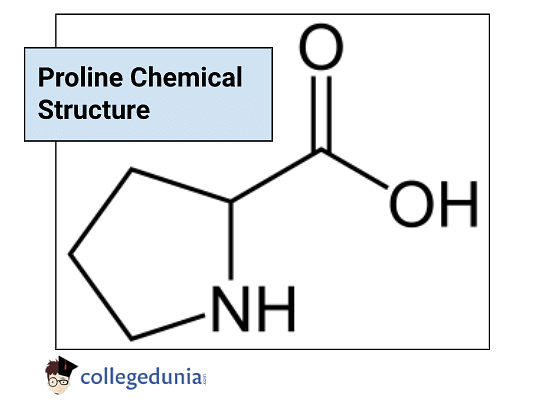
Proline
- Proline cannot give a hydrogen bond to stabilize a helix when it is in a peptide bond because it lacks hydrogen in the amino group.
- It is a common misconception that proline cannot reside in an alpha helix. Because there is no hydrogen bond where proline is present, the helix will slant slightly when proline is present.
Proline can exist in the cis-configuration in peptides, unlike other amino acids that are nearly exclusively found in the transformation in polypeptides.
Read Also:
| Important Concept-Related Articles | ||
|---|---|---|
Proline Structure
[Click Here for Previous Year Questions]
Since a proline molecule contains no alpha hydrogen, it cannot form any hydrogens bonds that help to stabilize the secondary protein structures. It cannot exist in form of secondary structures, such as the alpha-helix and the beta-sheet protein forms, thus acting as hydrogen acceptors.
- The lack of a hydrogen atom causes prolines at the end of the helix to bend, and they can occur in isoenergetic cis-and-trans versions.
- Because of their ability to sustain life, amino acids are essential parts of both animal and human biological systems.
- These are widely distributed across cells, muscles, eggs, and other animal activities, and they can aid in controlling insulin production, mend muscular tissues, and support our body’s metabolism.
- These amino acids, denoted by P, are composed of an R group, an amino group, and a carboxyl group linked to the central Carbon atom to form a helix structure.
- L-proline originates from pyrrolidine, a cyclic amine in which a carboxyl group replaces the pro-S hydrogen atom.
- Its structure turns it into an enantiomer of D-proline and contains the conjugate acid of L-prolinate.
- Since it is found as the first residue of an alpha helix near the edge strands of beta sheets, solvent molecules are exposed by amino acid molecules.
Proline has another structural characteristic known as cis-trans configurations, which are only displayed by proline and play a key role in the folding of proteins. Due to reduced steric resistance between the amide hydrogen and the trans-isomer than the cis-isomer, the majority of peptide bonds choose this form.
The gradual process of cis-trans proline isomerization can obstruct the development of protein folding by encasing one or more proline residues required for folding in non-native isomers.
Proline Synthesis
[Click Here for Sample Questions]
As an imino acid, proline needs a carbon-nitrogen double bond and is readily produced from glutamic acid. Glutamate semialdehyde is created when the -carboxyl group is converted into an aldehyde.
This aldehyde then interacts with the -amino group to create water and Schiff base (a sub-class of imines). The Schiff base is also broken down to produce proline.
| Type | Classification |
|---|---|
| IUPAC Name | (2S)-pyrrolidine-2-carboxylic acid |
| Chemical Formula | C5H9NO2 |
| Melting Point | 205 - 228 oC |
| Boiling Point | 252.2 oC |
| Appearance | White crystals |
| Mass of Proline | 115.13 g/mol |
Properties of Proline
[Click Here for Previous Year Questions]
A peptide proline's nitrogen atom does not stay bound to the hydrogen, which has a significant impact on how susceptible peptide bonds are. The hydrophobic interaction of the pyrrolidine ring with the proline might lead to aggregation. Several characteristics of proline include:
- Prolines are hydrophobic and aliphatic amino acids that help biosystems with intracellular signaling.
- The peptidases that are produced as a result of biological activities involving proline enable proline synthesis throughout its existence in its aminopeptidase P and prolidase forms.
- The Xaa-Pro peptide bond formation caused by the HIV-I protease enzyme has the potential to play a crucial role in several immunological processes.
- In its aqueous state, proline can exhibit several properties, including solubility, density, and viscosity, that may not be comparable to those of other lighter-molecular-weight molecules.
- By allowing hydrophobic contact with the protein surface and increasing the hydrophilic area, proline solutions can improve the solubility of other proteins.
- Although proline is frequently found as the first residue of an alpha helix and in the edge strands of beta sheets, it also functions as a structural disruptor in the middle of typical secondary structure elements like alpha helices and beta sheets.
Read Also: Carbohydrate Metabolism
Uses of Proline
[Click Here for Sample Questions]
There are several uses of L-Proline. Some of them are:
- L-Proline, which helps support body metabolism, is also available as crystalline Proline in several nutritional supplements.
- In our kidneys, L-Proline can occasionally be oxidized by Glycogenic, and upon further oxidation, this produces L-Glutamic acid, which is crucial in the treatment of chordae and arthrosis.
- Since L-proline is frequently utilized to make L-glutamate, it is well known for its potential as an energy fuel.
- It is one of the essential amino acids found in human cartilage that promotes healthy skin, speeds up muscle recovery, and strengthens heart muscles and connective tissues. It is also essential to the overall function of human joints and tendons.
- As a precursor to glutamic acid, proline amino acids help to create essential chemicals like glutamine, glutathione, and gamma-aminobutyric acid.
- Proline can also be converted into hydroxyproline, a protein molecule that is an important part of collagen, used to treat damage and maintain the health of the joints and vertebrae.
Also Read:
Things to Remember
- The molecular formula of proline is C5H9NO2 and the molecular mass is 115.13 g mol-1.
- Only L-proline has a secondary amino group, alpha, to the carboxyl group among the twenty amino acids transcribed by DNA.
- Proline has numerous uses, including treating Chordae and Arthosis, making L-glutamate, glutamine, glutathione, and gamma-aminobutyric acid.
- One of the two amino acids, along with glycine, that deviates from the standard Ramachandran plot is proline.
- Proline has a variety of possible applications, including as a flavour enhancer, a precursor to the creation of collagen, and a remedy for illnesses that cause muscular atrophy.
Previous Year Questions
- RNA and DNA are chiral molecules, their chirality is… [NEET 2007]
- The hormone that helps in the conversion of… [NEET 2004]
- During the process of digestion, the proteins… [ NEET 2006]
- Which of the following does not exhibit the phenomena… [NEET 2010]
- Which one of the following statements is not true regarding… [NEET 2011]
- Vitamin B₁₂ contains… [NEET 2003]
- α-D-glucose and β-D-glucose are… [NEET 2000]
- Deficiency of vitamin… [NEET 2012]
- In a protein molecule, various amino acids are… [NEET 2016]
- Statement I: The codon 'AUG' codes for methionine and phenylalanine…. [NEET 2021]
Sample Questions
Ques. What is the main function of proline? (2 marks)
Ans. Proline is a crucial component of protein structure and synthesis, metabolism (especially the synthesis of arginine, polyamines, and glutamate via pyrroline-5-carboxylate), nutrition, immunological function, and wound healing. Proline and hydroxyproline are found in the highest concentrations per gram in milk and collagen, and proline is needed in the greatest amounts of all amino acids for the creation of whole-body proteins.
Ques. Why is proline called imino acid? (2 marks)
Ans. Instead of a main amine group, proline has a secondary amine group known as an imine. Proline is referred to be an imino acid as a result. The proline's three-carbon R-group is fused to the -nitrogen group, giving this substance a rigid-ring structure that is restricted in its rotation. Prolyl residues in a polypeptide thus impose constraints on chain folding.
Ques. What type of compound is proline? (2 marks)
Ans. The non-essential amino acid proline is produced from glutamic acid. It is crucial for the healthy operation of tendons and joints and is a vital component of collagen. One of the twenty amino acids that make up proteins and are used by living things is proline. Although the IUPAC definition of an imine demands a carbon-nitrogen double bond, proline is occasionally referred to as an imino acid.
Ques. Where is proline found in cells? (2 marks)
Ans. Two enzymes work together in the chloroplast and/or cytoplasm to produce proline from glutamate during proline biosynthesis. P5CR catalyzes the conversion of P5C to proline, whereas P5CS catalyzes the production of 1-pyrroline-5-carboxylic acid (P5C) from glutamate. Ornithine can also produce P5C, and the ornithine aminotransferase (OAT) enzyme is responsible for catalyzing this process.
Ques. Is proline polar or non-polar? (1 mark)
Ans. The ring structure of proline, which also contains the amine group, makes it nonpolar. As a result, the side chain of proline is regarded as nonpolar since it lacks any full or partial charges. Glycine, alanine, valine, leucine, isoleucine, methionine, and tryptophan are further nonpolar amino acids.
Ques. How Proline is formed? (1 mark)
Ans. L-glutamate, an amino acid, serves as the metabolic starting point for proline. Glutamate 5-kinase, an ATP-dependent enzyme, and glutamate-5-semialdehyde dehydrogenase first produce glutamate-5-semialdehyde (which requires NADH or NADPH).
Ques. Are proline neutral in its charges? (1 mark)
Ans. Proline is shown to be in its neutral form rather than a zwitterion by the spectrum data, and calculations are consistent in that some neutral conformers are energetically low-lying and replicate the observed spectra.
Ques. What is the use of Proline macromolecules? (3 marks)
Ans. The uses of Proline macromolecules are:
- Dietary consumption and a source of energy
- Building and repairing muscle
- Repairing bone
- Building hormones
- Immune function
- Making enzymes (proteins that help biochemical reactions occur)
Ques. What is an imino acid? (1 mark)
Ans. Imino acids are amino acids that include a secondary amine. A peptide acid is proline. It has carboxyl and imino (=NH) functional groups. Alpha-amino acid is it. It is produced using glutamate. In intracellular signaling, it is significant. It is made from cartilage and collagen.
Ques. Explain the structure of the detailed Proline? (4 marks)
Ans. Proline is a secondary amino group known as an imino group that is a part of a five-member ring and has the IUPAC name Pyrolidine-2-carboxylic acid.
- Proline molecules operate as hydrogen acceptors because they lack the alpha hydrogen necessary to form hydrogen bonds that stabilize the secondary structures of proteins and allow for the formation of the alpha-helix and beta-sheet forms of proteins.
- Since it is the first residue of an alpha helix near the edge strands of beta sheets, solvent molecules are exposed by amino acid molecules.
- The polyproline helix seen in the secondary structure of collagen protein is further stabilized by hydroxylation in the presence of prolyl hydroxylase and additional additions of electrons along withdrawing groups like fluorine.
- Due to reduced steric resistance between the amide hydrogen and the trAns.isomer than the cis-isomer, the majority of peptide bonds choose this form.
Ques. What are the applications of Proline? (4 marks)
Ans. Proline is used effectively in the following –
- Athletic ability. Teenagers who consume more proline in their diets don't appear to be more physically fit than those who consume less proline.
- Low bone density (osteopenia). It doesn't appear that increasing proline in the diet will prevent osteopenia.
- Brittle and fragile bones (osteoporosis). It doesn't appear that increasing proline in the diet will prevent osteoporosis.
- Proline's efficacy for these uses needs to be evaluated with further data.
- As a precursor to glutamic acid, proline amino acids help to create essential chemicals like glutamine, glutathione, and gamma-aminobutyric acid. It is also converted in to hydroxyproline, a protein molecule which is an essential part of collagen.
Ques. What structural feature distinguished proline from other naturally occurring Amino Acids? (1 mark)
Ans. Proline differs from other naturally occurring -amino acids in that it contains a secondary amine. They are CCU, CCC, CCA, and CCG in their codons. Because it is not a necessary amino acid, the human body can produce it.
Check Out:



Comments