



Education Content Expert
Ionic Compounds are crystalline solids that are neatly packed with ions of opposite charges. The force of attraction between these ions makes the ionic compounds different from neutral compounds.
- Ionic compounds involve the complete transfer of electrons from one atom or molecule to another.
- They have strong electrostatic forces of attraction and are also referred to as electrovalent compounds.
- There is no sharing of electrons among the constituent elements, unlike covalent bonds.
- The total charge of Ionic Compounds is always neutral.
- Properties of Ionic Compounds are what makes them different from Covalent Compounds.
Key Terms: Ionic Compounds, Ionic Bond, Electron, Sodium Chloride, Metals, Atoms, Electrostatic Force, Cations
What are Ionic Compounds?
[Click Here for Sample Questions]
Ionic Compounds are defined as crystalline solids formed by neatly packed ions of opposite charge.
- Ionic compounds are usually formed when metals react with non-metals.
- They are compounds that are bound together by ionic bonds.
- To attain stability as a noble gas, elements can either gain or lose electrons.
- For the completion of the octet, ions are formed (either by adding or losing electrons), which helps in their stability.
In a reaction with non-metals, metals normally lose electrons to complete their octet while non-metals typically gain electrons to complete their octet. Typically, metal and non-metal reactions result in the formation of ionic compounds.
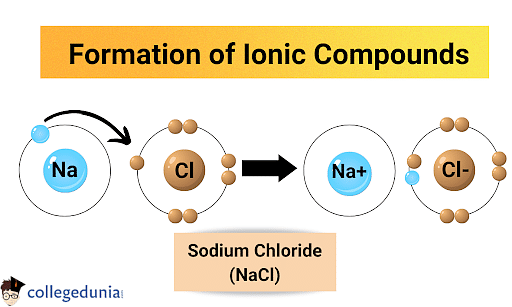
Formation of Ionic Compounds
The video below explains this:
Properties of Ionic Compounds Detailed Video Explanation:
Structure of Ionic Compounds
[Click Here for Sample Questions]
The structure of Ionic Compounds is based on the relative sizes of the anions and the cations. Examples of ionic compounds include salts, oxides, hydroxides, sulfides, and the bulk of inorganic substances. Ionic solids are held together by the electrostatic interaction of the positive and negative ions.
Example of Ionic Compounds
- Sodium ions attract Chlorine ions, and chlorine ions attract sodium ions.
- As a result, Na+ and Cl- ions are arranged alternately in a three-dimensional framework.
- The ions are kept in the structures by the forces of attraction between them.
- A massive ionic structure is created as a result of these ionic connections between the charged particles.
- It requires a lot of energy to completely break all of the links because the ions are securely bound together in these enormous complexes.
Read More:
Properties of Ionic Compounds
[Click Here for Sample Questions]
Given below are some prominent properties of Ionic Compounds:
- Ionic Compounds are solid and difficult to break because positive and negative ions attract one another strongly.
- They are brittle because they break under pressure.
- Ionic compounds are strongly attracted to one another.
- Breaking the ionic bonds between the atoms needs a lot of energy.
- Ionic compounds have high melting and boiling points.
- Polar solvents such as water, methanol, and formamide can dissolve ionic substances.
- Non-polar solvents like chloroform, hydrocarbons, etc. do not completely dissolve ionic compounds.
- Ionic compounds don't conduct electricity while they are solid, but they do when they are liquid.
- Ionic compounds cannot conduct electricity because ions cannot travel in a solid state.
- The heat released, however, overcomes the electrostatic forces that would otherwise prevent ionic compounds from conducting electricity when they are in a molten state.
Check More:
Things to Remember
- Ionic Compounds are crystalline solids formed by neatly packed ions of opposite charge held together by ionic bonds.
- They are created as a result of the electrostatic forces that attract oppositely charged ions.
- The structure of Ionic compounds is based on the sizes of their cations and anions.
- Ionic compounds are brittle in nature and can be broken into pieces under pressure.
- They are not good conductors of electricity when they are solid except in their molten state.
- They are extremely strong and have high boiling and melting points.
Sample Questions
Ques. What are Ionic Compounds? (3 Marks)
Ans. Ionic Compounds are defined as those solid compounds that are made up of ions. These ions are usually atoms that gain or lose electrons, creating a net positive or negative charge. Metals lose electrons, thus, have a net positive charge and are cations whereas Non-metals gain electrons, creating a net negative charge of anions. Thus, the formation of ionic compounds usually takes place when there is a reaction between metals and non-metals.
Ques. Why are Ionic Compounds usually Hard? (3 Marks)
Ans. Ionic Compounds are formed by ionic bonds created during the reaction between metals and non-metals. Ionic Bond is an electrostatic attraction between two ions with opposing charges. Ionic compounds can crystallize and become strong solids because positive and negative ions have a powerful attraction to one another. Ionic compounds are also brittle as they can break down in pieces easily under pressure.
Ques. List some Ionic Compounds. (3 Marks)
Ans. Some Ionic Compounds are as follows:
- Hydroxides
- Sulphides
- Oxides
- Salts
- Majority of Inorganic Compounds
Ques. Sodium Chloride has a higher melting point than Magnesium Oxide. State whether the given statement is true or false. Justify. (3 Marks)
Ans. The given statement is true. Compared to Sodium Chloride (NaCl), which has a melting temperature of about 2,800 degrees Celsius, Magnesium Oxide (MgO) has a greater melting point. It is because Mg2+ and O2- ions may form stronger ionic connections than the Na+ and Cl- ions in sodium chloride, which have fewer charges. Magnesium oxide is utilized for high-temperature electrical insulation because it remains non-conductive and solid at such high temperatures.
Ques. Is MgO an Ionic Compound? (3 Marks)
Ans. The M shell of magnesium has two electrons, whereas oxygen requires two electrons to form a stable octet. With 12 protons and 10 electrons in the L shell, Mg loses two electrons to create a stable octet. While oxygen picks up the two electrons lost by magnesium to complete its stable octet. Electrostatically, an ionic connection is created between the ions as the opposing charge is delivered. MgO, the result, is an ionic compound.
Ques. Why are Ionic Compounds insoluble in kerosene? (3 Marks)
Ans. Ionic Compounds are held together by ionic bonds between the atoms of an element. These compounds are created by the bonding of positively charged cations and negatively charged anion particles (negatively charged). Kerosene is an example of a non-polar inorganic solvent. The kerosene molecule has covalent and non-polar connections. Kerosene cannot break the ionic link between the ions of a chemical, hence it cannot dissolve them.
Ques. How do Ionic Compounds get formed? (3 Marks)
Ans. When one atom can contribute electrons to create the inert gas electron configuration and the other atom lacks electrons, an ionic bond is created. It is a chemical link created when electrons are moved from one atom to another.
These ionic bonds are also known as electrovalent bonds, and compounds that include ionic bonds are referred to be ionic. So, you could claim that ions create ionic compounds on their own. A compound is known as an ionic compound when a metal and a non-metal combine to form an ionic bond.
Ques. Do Ionic Bonds conduct electricity? (2 Marks)
Ans. Ionic compounds conduct electricity when they are molten (liquid) or in an aqueous solution (dissolved in water) because their ions are free to move around. Ions in ionic compounds are maintained in fixed locations and are unable to move, therefore they cannot conduct electricity when solid.
Ques. Do Ionic Compounds dissolve in water? (2 Marks)
Ans. Polar solvents, particularly water, help ionic molecules dissolve. This happens when the negative anion of the ionic solid is drawn to the positive end of the water molecule (oxygen) and the positive cation of the ionic solid is drawn to the negative end of the water molecule (hydrogen).
Ques. Why do Ions form after ionic bonding? (2 Marks)
Ans. Atoms gain or lose electrons to produce ions. Since electrons have a negative charge, an atom will become positively charged if it loses one or more electrons and negatively charged if it obtains one or more. The attraction between ions with opposite charges is known as ionic bonding.
Ques. Why are ionic bonds weak? (2 Marks)
Ans. The creation of the crystal lattice structure in an ionic bond is often drawn by a powerful electric force of attraction. Van der Waal's forces of attraction are the sole forces that keep a covalent bond and its shared electron together. This connection could easily be broken.
Check More:



Comments