



Education Content Expert
Prothallus is the gametophytic phase in the life cycle of ferns and other pteridophytes. It is a monoecious structure that carries both male and female reproductive organs, i.e. antheridia and archegonia respectively.
- It refers to gametophytes of liverwort or bog moss.
- Prothallus is a fungus that develops from germinated spores.
- They have a short life duration and are heart-shaped structures.
- The structure and appearance of prothallus differ according to the species.
Some of the prothalli are photosynthetic which means they are autotrophs while the others are colorless saprotrophs, i.e., nutritionally dependent on the dead and decaying matter.
Read More: NCERT Solutions For Class 11 Biology Plant Kingdom
Key Terms: Prothallus, Antheridia, Archegonia, Alternation of Generation, Spores, Pteridophyte, Moss, Liverwort
What is Prothallus?
[Click Here for Sample Questions]
Prothallus represents the gametophyte stage of the pteridophyte plants. It develops from germinating spores and a short-lived phase of the life cycle of the pteridophyte. They are typically heart-shaped in structure.
- Prothallus is responsible for producing gametes which eventually fuse to form a new plant.
- It produces both sperm and eggs, with the sperm being produced in small, flask-shaped antheridia, and the eggs in small, bulb-shaped archegonia.
- Development of prothallus starts with the release of spores from the sporangia of the parent plant.
- It can undergo the process of alternation of generations, a characteristic of ferns and related plants.
- Prothallus is important to ferns as it reproduces them asexually, making it a vital step in the reproduction of these plants.

Prothallus
Examples of Prothallus
Here are some examples of Prothallus:
- Fern
- Liverwort
- Algae
- Moss
- Club Mosses
- Horsetails
- Psilopsida
- Lycopsida
- Sphenopsida
- Pteropsida
Read More:
| Relevant Concepts | ||
|---|---|---|
| Classification of Plants | Difference between Bryophytes and Pteridophytes | Botanical Name and Biological Classification |
| Thallophyta | Diversity In Living Organism | Bryophyta |
Development of Prothallus
[Click Here for Previous Year Questions]
The development of the prothallus is described as follows:
- In the main plant body called sporophyte, there are certain spore-bearing structures which are called sporangia where spore formation takes place.
- Sporangia contain numerous diploid spore-mother cells that meiotically divide to give rise to haploid spores.
- Once the spores are matured, they are liberated and they germinate in the soil independently to produce the structure of prothallus.
Structure of Prothallus
[Click Here for Sample Questions]
Prothallus is a small, inconspicuous, multicellular structure made up of mainly two parts namely Thallus and rhizoids.
- Thallus is a multicellular, flattened, heart-shaped, often photosynthetic structure that is not divided into roots, leaves, and stems.
- The vascular tissue is also absent.
- Rhizoids are root-hair-like, unicellular structures present underneath the thallus, used for anchorage and absorption.
- In the heart-shaped structure of the gametophyte, there is a notch at an apical region which is known as the apical notch.
- On the ventral side of the prothallus male antheridia and female archegonia develop.
- Antheridia are present at the central part and archegonia are present at the apical region of the prothallus.
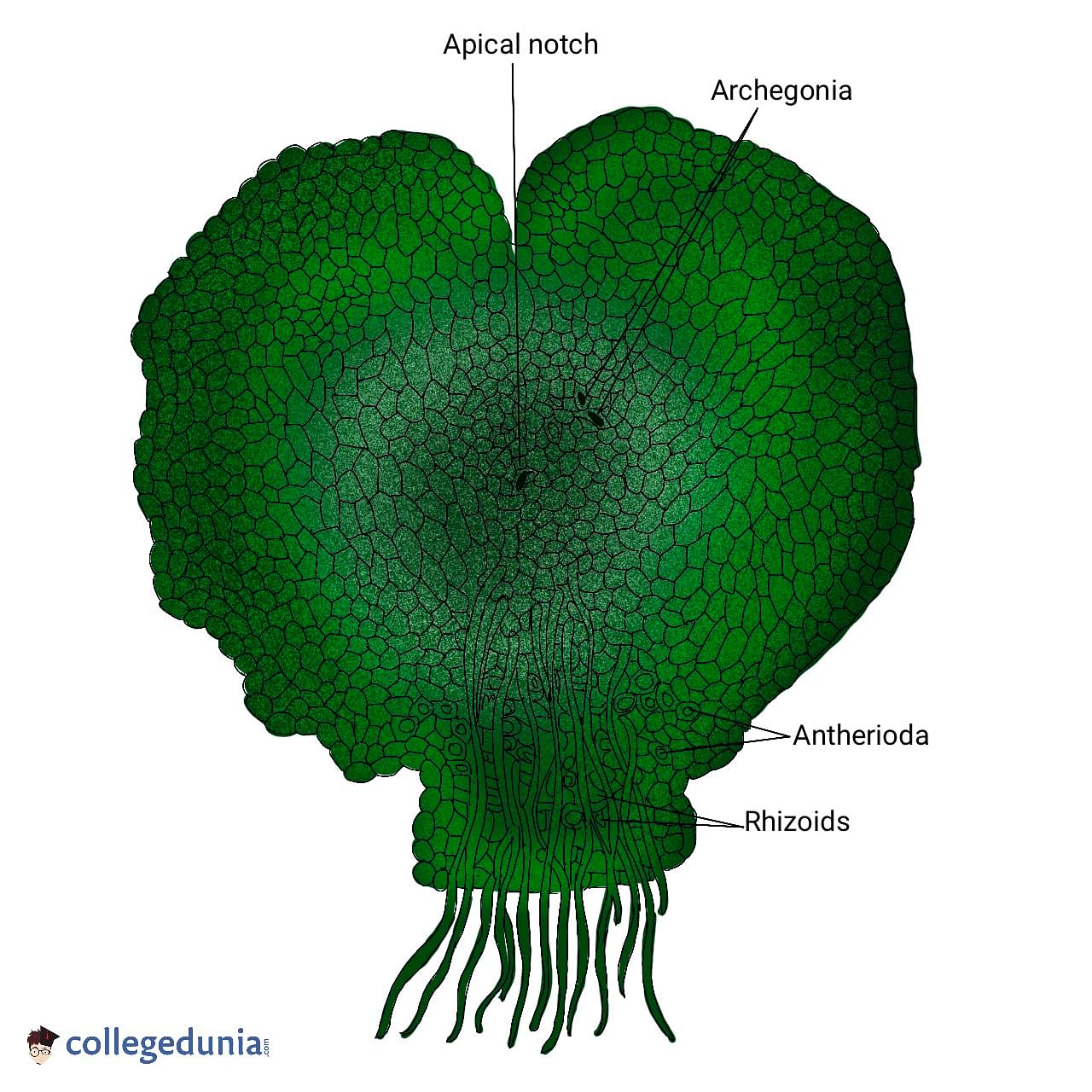
Fern Prothallus
Read More: Plant Kingdom Class 11 Important Questions
Antheridia and Archegonia of Prothallus
[Click Here for Previous Year Questions]
The properties of the Antheridia and archegonia of prothallus are as follows:
- Antheridium is surrounded by a uni-layered jacket.
- Antherozoids form inside the antheridium. Antherozoids can be either biflagellate (e.g.- Selaginella) or multiflagellate (e.g.- Equisetum), i.e. they are motile.
- Antherozoids are attracted to the neck of the archegonium chemotactically.
- Single archegonium consists of four vertical rows of neck cells, 1-2 neck canal cells, ventral canal cells, and egg cells.
- Water is essential for fertilization. This type of fertilization is called zooidogamous fertilization.
- The fertilization leads to the formation of the zygote or oospore which ultimately develops into a sporophyte.
Functions of Prothallus
[Click Here for Sample Questions]
Prothallus performs the following functions:
- Prothallus carries both antheridia and archegonia which are male and female reproductive organs of the plant respectively.
- Both the male and the female gametes are produced in such organs.
- The male and the female gametes fuse to form a zygote.
- Prothallus serves as the site for the fusion of the gametes.
- The zygote draws its nutrition from the prothallus itself.
- It provides protection to the zygotes from adverse environmental conditions.
Read More: Plant Kingdom MCQs
Alternation of Generation
[Click Here for Previous Year Questions]
Alternation of a generation is a phenomenon involving the alternation of ploidy numbers from one generation to the other.
- Alternation of generation can be defined as the life cycle consisting of distinct haploid and diploid phases.
- The haploid phase of the lifecycle is called the gametophyte while the diploid phase is called the sporophyte.
- In the case of ferns, the sporophytic phase is dominant and longer than the gametophytic phase which is short-lived.
- Sporophytes contain sporangia in which the spore mother cells undergo meiosis and produce haploid spores.
- Then these spores develop to form the gametophyte through mitotic cell division.
- The gametophyte in turn carries the gamete bearing structures- antheridia (male) and archegonia (female) that produce haploid gametes.
- After the maturation of the gamete-bearing structures, the gametes liberate and fertilize to form a zygote with which the sporophytic generation begins again.

Alternation of Generation
Significance of Alternation of Generations
[Click Here for Sample Questions]
The importance of the alternation of generations is as follows:
- Due to alternate changes in the ploidy level, the chromosome structure remains constant for a species.
- As the spore-mother cells are undergoing meiosis the exchange of the chromosomal segments takes place which is also termed as ‘crossing over’.
- It is crucial from the evolutionary perspective.
- The empirical observations show that the homosporous pteridophytes are neither highly inbred nor evolutionally stagnant.
- To prevent such an incident intra-gametophytic crossing, sperm fertilizing an egg of a different gametophyte where both plants have come from separate sporophytes takes place.
- Most of the ferns are allopolyploids. It occurs when two haploid sets of chromosomes have come from two different species of ferns.
- During meiosis, the homologous chromosomes cannot match up because they are somewhat dissimilar.
Check More:
| Related Topics | ||
|---|---|---|
| Lichens | Fungi | Rhizopus |
| Phaeophyceae | Five Kingdom Classification | Two Kingdom Classification |
Things to Remember
- Prothallus is the gametophyte of the fern and other pteridophytes species.
- Prothallus is a small, flat, green, heart-shaped structure often attached to a parent plant's rhizome.
- Antheridia and archegonia, the male and female reproductive organs of the plant are present in prothallus.
- It provides protection to the zygotes from adverse environmental conditions.
- It is often photosynthetic and nutritionally autotrophic.
Previous Years’ Questions
- Prothallus is… (BCECE - 2006)
- A prothallus is…
- Prothallus of Petridophytes is… (JKCET - 2014)
- Fern gametophyte is generally… (OJEE - 2010)
- In gametophyte of fern… (JIPMER - 2003)
- Gametophyte of Pteridophyte is called… (UPSEE - 2016)
- Fern gametophyte bears… (Punjab PMET - 2004)
- Calyptra develops from… (MP PMT - 2009)
- Gametophytic and sporophytic phases are independent in… (UP CPMT - 2007)
- Male gametophyte with least number of cells… (AIPMT - 2014)
Sample Questions
Ques. What is Prothallus? (2 Marks)
Ans. Prothallus is the small, multicellular, short-lived, cordate, haploid gametophyte structure bearing both male and female reproductive organs of a plant. It is usually observed in primitive groups of plants such as pteridophytes.
Ques. Discuss how the prothallus is developed in the pteridophytes. (3 Marks)
Ans. Prothallus is the haploid gametophytic phase in the life cycle of a pteridophyte. Its development has been outlined below:
- The sporophyte is the diploid phase in the life cycle of a plant with certain spore-bearing structures which are called sporangia where spore formation takes place.
- The sporangia contain numerous diploid spore-mother cells that mechanically divide to give rise to haploid spores.
- When the spores are matured, they are liberated and they germinate in the soil independently to produce the structure of prothallus.
Ques. Describe the structure of the prothallus. (2 Marks)
Ans. The structure of the prothallus is quite simple. It consists of two parts which are Thallus and rhizoids.
- Thallus is a multicellular, flattened, heart-shaped structure that is not divided into roots, leaves, and stems.
- Rhizoids are root-hair-like, unicellular structures present underneath the thallus. They are used for anchorage and absorption.
Ques. What are the functions of the prothallus? (3 Marks)
Ans. Prothallus is the gametophytic phase in the life cycle of a fern. It functions are as follows:
- Prothallus has both antheridia and archegonia, the male and female reproductive organs of the plant respectively.
- The male and the female gametes are produced in the same.
- Prothallus is the site for the fusion of the gametes.
- It is used by the zygote for drawing its nutrition.
- Prothallus also offers protection to the zygotes from adverse environmental conditions.
- Prothalli are often photosynthetic and nutritionally autotrophic.
Ques. What is an Alternation of Generation? (1 Mark)
Ans. Alternation of generation can be defined as the life cycle consisting of distinct haploid and diploid phases i.e. the gametophytic and the sporophytic phases.
Ques. What is the importance of Alternation of Generation? (3 Marks)
Ans. The importance of alternation of generation is stated below:
- If this phenomenon occurs, it means due to alternate changes in the ploidy level, the chromosome structure remains constant for a species.
- As the spore-mother cells undergo meiosis the exchange of the chromosomal segments takes place which is also termed as ‘crossing over’ It is crucial from the evolutionary perspective.
Ques. Write a short note on the shape of the prothallus of a fern. (5 Marks)
Ans. Prothallus is the gametophyte stage of the life cycle. Prothallium is a brief-lived, inconspicuous structure with a heart-shaped form that is typically 2 to 5 millimeters broad with a variety of rhizoids (hairs that resemble roots) developing underneath. While some ferns are colorless and feed themselves as saprotrophs underground, others are green and carry out photosynthesis. A fern's prothallus is a flat, autotrophic, dorsiventral, small (approximately 5–10 mm), independent, free-living, nonvascular gametophyte.
- It is haploid.
- It originated from a meiotic spore that had grown.
- It is anchored to the earth by tiny rhizoids rather than vascular tissue.
- Archegonia are the female sex organs, while antheridium is the male sex organs. The way that different animals look differs greatly.
- The sperm are expelled from the antheridium and go through a thin layer of water to a nearby archegonium where they fertilize the egg.
Ques. What are the various characteristics of Prothallus? (5 Marks)
Ans. Prothallus is a term used to refer to the gametophytic stage of a fern's life cycle. It is characterized by the following:
- Small Size: Prothallus is usually very small and can range in size from a few millimeters to a few centimeters.
- Simple Structure: Prothallus has a simple, flattened structure with a single layer of cells. It does not have roots, stems, or leaves.
- Reproductive Function: Prothallus is primarily responsible for reproducing the fern. It typically has both male and female reproductive organs, such as antheridia (sperm-producing organs) and archegonia (egg-producing organs) on the same prothallus.
- Photosynthesis: Prothallus is capable of photosynthesis, and it usually has chloroplasts, which allow it to carry out the process.
- Absorption: Prothallus typically absorbs water and nutrients through its surface cells, which allows it to carry out its metabolic processes.
Ques. How is a Thallus different from a Prothallus? (5 Marks)
Ans. Thallus and a prothallus are both simple, flattened structures, but they are different in terms of their functions and characteristics. Some key differences between a thallus and a prothallus include
- Life Cycle Stage: A prothallus is the gametophytic stage of a fern's life cycle, while a thallus can refer to any plant that does not have distinct leaves, stems, or roots.
- Reproductive Function: The primary function of the prothallus is to reproduce the fern, while a thallus may not have any reproductive function.
- Structure: Prothalli are usually small and simple, while thalli can vary in size and complexity.
- Photosynthesis: Both prothalli and thalli have chlorophyll and are capable of photosynthesis, but the prothalli use energy to produce sperm and eggs, while thalli are used to supply energy to the entire organism.
- Presence of Stem and Leaves: Prothalli are simple, flattened structures that lack stem and leaves, while thalli can be differentiated into stem-like structures and leaf-like structures.
- Presence of Roots: Prothalli are flattened structures that lack roots, while thalli can have structures similar to roots which are called rhizoids.
Ques. In which stage of the Plant Life Cycle, Prothallus is formed? (5 Marks)
Ans. Prothallus is formed during the sporophytic stage of a fern's life cycle. Specifically, the following steps describe how the prothallus is formed:
- Spore Production: Ferns produce spores that are contained in sporangia, which are typically found on the underside of the mature fern fronds.
- Germination: Once the spores are released, they can germinate under suitable conditions and develop into a prothallus.
- Prothallus Development: As the spore germinates, it develops into the prothallus, which is a small, flattened structure with a single layer of cells.
- Mitosis: The cells of the prothallus then undergo mitosis, the process of cell division, which allows the prothallus to grow in size.
- Tissue Differentiation: Some of the cells of prothallus differentiate into various types of cells, including rhizoids, which absorb water and nutrients, and reproductive cells (antheridia and archegonia) that produce sperm and eggs respectively.
Check-Out:



Comments