



Education Journalist | Study Abroad Lead
Quotient Rule Formula governs the derivative of a quotient with existing derivatives. This formula is applied in solving any differentiation-related solutions. To apply the quotient rule the quotient and numerator must be differentiable and the quotient must not equal zero. Furthermore, Two equal functions never give derivatives. The quotient rule takes a cue from the product rule. Hence, two differentiable functions are divided with a certain quotient ruling to find out the derivatives. In addition, differentiation problems solving using quotient rule has more appropriate and precise derivatives of the solutions.
Key Terms: Quotient Rule Formula, Differentiation, Derivative, Quotient, Numerator, Denominator, Function, differentiable functions
Quotient Rule Formula
[Click Here for Sample Questions]
The quotient rule formula lets us calculate two differentiable functions. However, there is a strike to it. The quotient should always be greater than zero. Otherwise, you won't be able to apply the quotient rule formula and find its derivatives.
Below is how the quotient rule derivative is formulated:
f'(x) = [u(x)/v(x)]' = [v(x) × u'(x) - u(x) × v'(x)]/[v(x)]²
In this,
- f(x) = This is the function to get derivatives from the form u(x)/v(x).
- u(x) = It is a numerator (one differentiable function)
- v(x)= It is a denominator (one differentiable function)
- u'(x) = It is the derivative of function u(x)
- v'(x) = It is the derivative of the function v(x)

Quotient Rule Formula
Read More: Difference Quotient Formula
Below is the solved example to understand the concept of quotient rule easily:
Example: Derive the functions by the quotient rule: f(x) = x2/(x+1).
Solution: Here, f(x) = x2/(x + 1)
u(x) = x2 and v(x) = (x + 1)
⇒u'(x) = 2x
⇒v'(x) = 1
⇒f'(x) = [v(x)u'(x) - u(x)v'(x)]/[v(x)]2
⇒f'(x) = [(x+1)•2x - x2•1]/(x + 1)2
⇒f'(x) = (2x2+ 2x - x2)/(x + 1)2
⇒f'(x) = (x2 + 2x)/(x + 1)2
The derivative of x²/(x + 1) is (x2+ 2x)/(x + 1)2.
Discover about the Chapter video:
Continuity and Differentiability Detailed Video Explanation:
Read More: Differentiation Rules
Quotient Rule Derivation
[Click Here for Previous year Questions]
Although, we have learned the quotient rule formula until now. Now let's investigate the formulation of the quotient rule with different methods. There are three methods involved to verify the quotient rule formula. The method is stated below:
- Limit and derivatives properties
- Implicit differentiation
- Chain Rule
Below we will evaluate each method to testify to the quotient rule formula.
Read More:
Quotient Rule Formula Proof Using Limit and Derivative Properties
In order to prove the quotient rule formula using the definition of derivative or limits, let the function f(x) = u(x)/v(x).
Hence, the derivative of the assumed function is explained as.
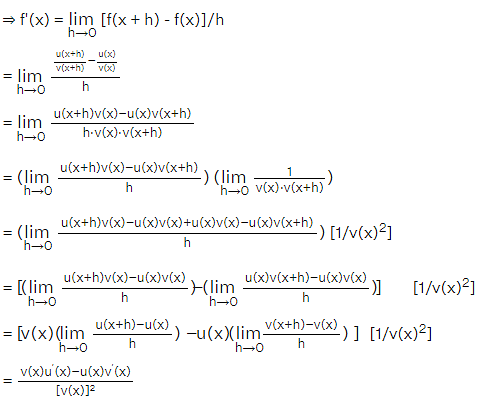
Quotient Rule Formula Proof Using Limit and Derivative Properties
This is the most difficult method to prove the quotient rule. Yet it is the most detailed proofing of the quotient rule formula.
Read More: Calculus Formula
Quotient Rule Formula Proof Using Implicit Differentiation
For proofing quotient rule formula by utilizing the implicit differentiation formula. We need to assume a differentiable function
f(x) = u(x)/v(x)
Now if we write like this u(x) = f(x)⋅v(x).
Both equations are still the same.
Now with the help of the product rule,
We can write the functions as
u'(x) = f'(x)⋅v(x) + f(x)v'(x).
Now let's solve it.
f'(x) = u′(x)−f(x)v′(x)/v(x)
Substitute f(x),
f'(x) = u′(x)−u(x)/v(x)×v′(x)/[v(x)]
f'(x)= u′(x)v(x)−u(x)v′(x)/[v(x)]²
The quotient rule is proved.
Quotient Rule Formula Proof Using Chain Rule
This is the last method to verify the quotient rule. Now let's evaluate the chain rule for the quotient rule.
Assume f(x) be a differentiable function f(x) = u(x)/v(x).
Now, f(x) = u(x)v-1(x)
When we use the product rule,
f'(x) = u'(x)v-1(x) + u(x)×[d/dx(v‐¹(x)]
Now here we will apply the power rule to solve the derivative for the second round
f'(x)=u'(x)v-1(x)+u(x)×(-1)(v(x)‐²)v'(x)
f'(x) = u′(x)/v(x)−u(x)v′(x)/v(x)²
f'(x)=d/dx[u(x)/v(x)]=u′(x)v(x)−u(x)v′(x)/v(x)²
This is how the quotient rule formula is proved using the chain rule.
Read More: Differential Equations Formula
How to Use Quotient Rule Formula in Differentiation?
[Click Here for Sample Questions]
To use the quotient rule formula in a differentiation equation. Let's assume
the derivative of function f(x) = u(x)/v(x).
Here, u(x) and v(x) must be differentiable functions to each other.
Below are the steps to apply the quotient rule formula to get the derivation of f(x) = u(x)/v(x).
- Write u(x) and v(x) values separately.
- The next step is to get the values of u'(x) and v'(x).Now apply the quotient rule formula which can be written as: f'(x) = [u(x)/v(x)]' = [u'(x) × v(x) - u(x) × v'(x)]/[v(x)]²
Read More: Differential Equations Applications
Things to Remember
- Quotient Rule is a method used to find the derivative of any function given in the form of a quotient obtained from the result of the division of two differentiable functions.
- If a function of the form f(x) = u(x)/v(x) is given to us, then, we can find the derivative of this function using the quotient rule formula as f'(x) = [u(x)/v(x)]' = [v(x) × u'(x) - u(x) × v'(x)]/[v(x)]2
- The derivatives of the quotient rule formula can be testified using the three methods: limit and properties derivatives, chain limit and implicit differentiation. Among all the limits and properties method can be a bit tricky. The other two methods are simple to understand.
- As the quotient rule requires two different functions that have quotients not equal to zero. They must be differentiable from each other. Hence, you cannot find the derivatives of the two equal functions using the quotient rule.
Previous Year Questions
- The Value Of Integral Int Limits 1 1 Frac Left X 2
- Find The Coordinates Of The Point Where The Line J… [BITSAT 2012]
- The Foot Of The Perpendicular From The Point 7 14… [BITSAT 2012]
- What Is The Value Of N So That The Angle Between T…. [BITSAT 2012]
- Let F X X 5 1 X 3 1 G X X 2 1 X 2 X 1 And Let H X…. [BITSAT 2013]
- 0 4 1 X Dx Is Equal To… [BITSAT 2006]
- If Vmatrix A A 2 1 A 3 B B 2 1 B 3 C C 2 1 C 3 Vma
- For A Certain Function U X Given That U 0 3 U 1 12
- For Non Zero Vectors A And B If Left Vec A Vec B R
- If The Volume Of The Parallelopiped With A B And C
- If A 2 B 3 C 0 Then A B B C C A
- If A B A B Then The Angle Between A And B Is
- The Value Of X Obtained From The Equation Vmatrix
- The Values Of The Determinant Begin Vmatrix X 1 X
- The Value Of X So That The Matrix Begin Bmatrix X
- The Value Of X Where Bmatrix 6 X 2 3 X Bmatrix Has
- The Value Of The Determinant Of Bmatrix X 1 X 2
- The Value Of Delta Begin Vmatrix 5c 0 5c 3 14 0 3e
- The Value Of Delta Begin Vmatrix 10 C 4 10 C 5 11
- The Solution Set Of The Equation Vmatrix 1 4 20 1
Sample Questions
Ques 1. Get a derivative for cosx/x by quotient rule formula. (3 Marks)
Ans. Let f(x) = cos x and g(x) = x.
d/dx{f(x)/g(x)}=g(x)f′(x)−f(x)g′(x)/[g(x)]²
=x(−sinx)−cosx(1)/x²
=−x sinx+cosx/x²
The derivative of cosx/x = −x sinx+cosx/x²
Ques 2. Find a derivative of f(x)=(log x)/x by quotient rule formula. (3 Marks)
Ans. Let f(x) = log x and g(x) = x.
d/dx{f(x)g(x)}=g(x)f′(x)−f(x)g′(x)/[g(x)]²
=x(1/x)−log x/x²
=1−logx/x²
The derivative of f(x)= (log x)/x = (1-log x)/x²
Ques 3. Use quotient rule formula to differentiate f(x)= (1-2x)/x. (3 Marks)
Ans. Let f(x) = (1-2x)/x
f'(x) = d/dx . (1−2x)/x=[x.d/dx (1-2x) - (1-2x) d/dx.x]/x²
f'(x) = [x(-2) - (1-2x) (x)]/x² = (-2x - 1 + 2x)/x² = -1/x²
The derivative of f(x)= (1−2x)/x is -1/x²
Ques 4. Differentiate W'(z)=(3z+9)/(2-z)using the quotient rule formula. (3 Marks)
Ans. Let W'(z)=3z+9/2-z
Since both the functions are different, so directly apply the quotient rule.
W(z)=3(2-z)-(3z+9)(-1)/(2-z)²
=(6-3z)-(3z+9)/(2-z)²
=(6+9)/(2-z)²
=15/(2-z)²
The derivative of W'(z)=(3z+9)/(2-z) is 15/(2-z)²
Ques 5. Evaluate h(x)=(4√x)/(x²−2) using the quotient rule formula. (3 Marks)
Ans. Let h(x)=4√x/x²−2
Apply the quotient rule formula
h′(x)=4(1/2)x−½(x²−2)−4x½(2x) / [x²−2]²
=2x³/²−4x−½−8x³/² /[x²−2]²
=−6x³/² −4x−½ / [x²-2]²
= 10x/ [x²-2]²
The derivative of h(x)=(4√x)/(x²−2) is 10x/ [x²-2]²
Ques 6. Find solution f(x)=4/x⁶ by quotient rule formula. (3 Marks)
Ans. Let f(x)=4/x⁶
Apply the quotient rule formula
f(x)=(0)(x⁶)-4(6x⁵) / (x⁶)²
=-24x⁵ / (x⁶)²
The derivative of f(x)=4/x⁶ is -24x⁵ / (x⁶)²
Ques 7. Find the derivative of f(x) = (x + 2)/(3x) by the quotient rule formula. (3 Marks)
Ans. f(x) = (x + 2)/(3x)
= [2(3x)-(x+2)(3)]/(3x)²
=[6x-3x+6]/(3x)²
=3x+6/ (3x)²
The derivative of f(x) = (x + 2)/(3x) is 3x+6/ (3x)².
Ques 8. Solve f(x) = (x - 1)/(3x) by the quotient rule formula. (3 Marks)
Ans. Let f(x) = (x - 1)/(3x)
= [1(3x)-(x-1)3] / (3x)²
=(3x-3x+3) / (3x)
=3/(3x)²
The derivative of f(x) = (x - 1)/(3x) is 3/(3x)²
Ques 9. Find out the derivative of tan x by quotient rule formula. (3 Marks)
Ans. Since tan x= sin x/cos x
Assume tan x as dy/dx
Now put the quotient rule formula,
dy/dx = [ cos x × d/dx (sin x) - sin x × d/dx (cos x)] / (cos²x)
= [cos x · cos x - sin x (-sin x)] / (cos²x)
= [cos²x + sin²x] / (cos²x)
Now cos²x + sin²x is 1 by Pythagoras theorem
= 1/ (cos²x) which is
= sec²x
The derivative of tan x is sec²x.
For Latest Updates on Upcoming Board Exams, Click Here: https://t.me/class_10_12_board_updates
Check-Out:



Comments