



Exams Prep Master
Red algae or Rhodophyceae are called so due to the presence of a red pigment called r-phycoerythrin. Most of these species are marine and mostly found in warmer areas. The red thallus of most red algae is multicellular while some have complex organisation. Their food storage is in the form of floridean starch, which is similar in structure to amylopectin and glycogen. Example: Gracilaria, Gelidium, Porphyra, Polysiphonia.
Also read: Green Algae
Key Terms: Organism, Species, Pigment, algae, habitat, eukaryotes.
What are Algae?
[Click Here for Sample Questions]
An algae (singular) is referred to as a living, eukaryotic, and photosynthetic organism that is usually grown in moist areas. Hence, they are called members of aquatic organisms. Like plants, these organisms also absorb chlorophyll and other biological pigments that act as a primary colouring agent and also help in absorbing energy from light.
Types of Algae
[Click Here for Previous Year Questions]
Algae are grouped under Kingdom Protista. Furthermore, they are classified into seven different types:
- Pyrrophyta
- Euglenophyta
- Rhodophyta/ Red Algae
- Phaeophyta/ Brown Algae
- Chlorophyta/ Green Algae
- Xanthophyta/ Yellow-Green Algae
- Chrysophyceae/ Golden-brown Algae
![Types of Algae]()
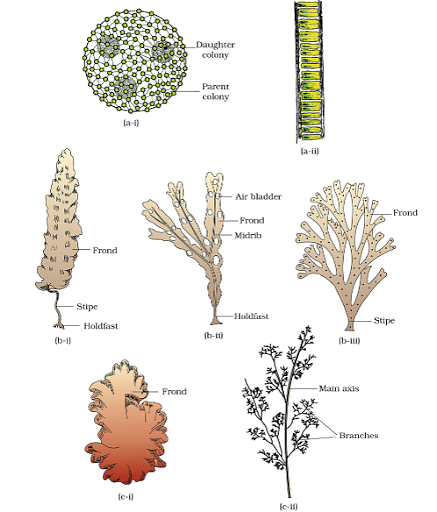
Types of Algae: (a) Green algae (i) Volvox (ii) Ulothrix (b) Brown algae (i) Laminaria (ii) Fucus (iii) Dictyota (c) Red algae (i) Porphyra (ii) Polysiphonia
Red Algae or Rhodophyta
[Click Here for Sample Questions]
Red Algae, whose scientific name is Rhodophyta, belong to Class Rhodophyceae. There are mainly two classes of red algal namely the Florideophyceae and Bangiophyceae. Both Florideophyceae and Bangiophyceae constitute 99% of red algal diversity in marine and freshwater habitats.
Red algae or Rhodophyta is a distinctive type of species that is mainly found in freshwater lakes. They are the oldest type of eukaryotic algae and are red in colour due to the presence of a pigment called chlorophyll A, phycocyanin, and phycoerythrin. They are members of the tribe Amansieae (Rhodomelaceae, Ceramiales, Rhodophyta), wherein only Aneurianna and Lenormandia Sonder have foliar blades. They are a distinctive type of species, mostly found in deep freshwater bodies.

General Characteristics of Red Algae
[Click Here for Previous Year Questions]
Red algae are different from other groups apart from diatoms. The general characteristics of Red Algae are as follows:
- It lacks flagella and centrioles
- It contains photosynthetic pigments: chlorophyll a, d, alpha and beta carotenes, xanthophylls and biliproteins: r-phyocerythrin and r-phycocyanin. They are red and blue in colour respectively.
- It is found both in marine habitats as well as freshwater
- Multicellular, filamentous, blade structure
- Food is stored in the form of starch and polymers of galactan sulphate
- A pit connection between two algal cells
- Mode of nutrition is saprophytic, parasitic or also epiphytic.
- Cell wall consists of cellulose and different types of carbohydrates
- They can be found growing on solid surfaces or attached to other algae.
- Cytoplasm has coloured plastids called chromatophores.
- Some Red Algae are coralline: Secrete and deposit calcium carbonate.
Structure of Red Algae
[Click Here for Sample Questions]
The structure of red algae is:
- Cell walls of red algae are doubled.
- Agarise and Agaropectin removed as agar are found in outer layers.
- Celulose is abundant on the inside walls.
- Lack of flagella and centrioles
- Rhodophyceae contain spindle fibres, microtubules, photosynthetic membranes, but lack chloroplast endoplasmic reticulum
Reproduction of Red Algae
[Click Here for Previous Years Questions]
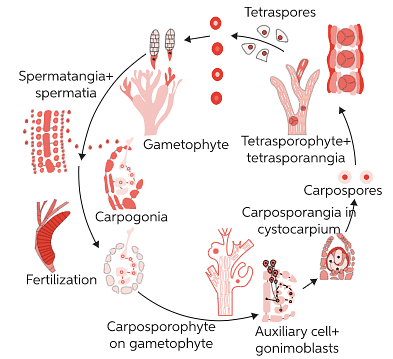
Red Algae reproduces both asexually and sexually. Asexual reproduction is conducted via spore formation and vegetative reproduction.
Sexual Reproduction: Red Algae sperm are not motile, therefore they have to rely on water currents for the transfer of games to the female although their sperm can glide to the trichogyne of a carpogonium.
- Trichogyne will continue to grow until it contacts a spermatium. After fertilisation, the cell wall thickens and isolates itself from the rest.
- Spermatium and carpogonium walls disintegrate on collision.
- Male nucleus splits and enters the carpogonium, while one half merges with the nucleus of the carpogonium.
- Polyamine spermine is generated.
Common Red Algae
[Click Here for Sample Questions]
Common Red Algaes found in nature are:
Polysiphonia
It is a little, vertical and bushy marine alga found along the Atlantic and Pacific coasts. Some species exist as epiphytes on mangroves or brown seaweeds. Its plant body is fixed to the substratum. It has dwarf and long branches.
Dwarf branches are called trichoblasts, which includes sex organs, antheridia, and archegonia. After fertilization, a diploid carposporophyte is formed which in turn forms diploid carpospores. After germination, each carpospore forms a tetrasporophyte. Each tetraspore germinates to develop a gametophytic plant.
Gracilaria
It is an agar-yielding red alga that grows in lagoons. The thallus is highly branched, cylindrical that has a cartilaginous texture.
Its sexes are separate. Male plants develop spermatia. Female plants bear carpogonium branches. On fertilization form cystocarps which have carpospores. Every carpospore forms the gametophytic plant body.
Uses of Red Algae
[Click Here for Sample Questions]
Red Algae have great ecological importance because they form a vital part of the food chain. Moreover, they are also involved in producing about 40 to 60 percent of the total global oxygen for aquatic habitats. The ecological and commercial importance of red algae are:
- Source of food for fishes and other aquatic animals
- Most important commercial food in Japan and the North Atlantic region.
- Agar is a jelly-like substance used in puddings, dairy and other food products.
- It is used as a source of food rich in vitamins, minerals and a rich source of calcium, magnesium, and antioxidants.
- They are good sources of dietary fibre as they promote healthy circulation, lower bad cholesterol and regulate blood sugar levels.
- They also nourish the skin, boost the immune system and help improve bone health.
Also Read:
Things to Remember
- There are three types of algae: Red Algae (Rhodophyaceae), Brown Algae (Phaeophyaceae) and Green Algae (Chlorophyaceae)
- They are mostly marine.
- Cell wall consists of cellulose, pectin and lipopolysaccharide.
- Photosynthetic pigments in Red Algae are chlorophyll a, chlorophyll d, alpha-beta carotenes, xanthophylls and biliproteins.
- Red Algae is red due to the presence of a red pigment: r-phycoerythrin.
- They reproduce both sexually as well as asexually (fragmentation)
- Storage of food is in the form of starch.
Previous Year Questions
- The plant group that produces spores and embryo but lacks vascular tissues and seeds is…? [NEET 1992]
- Which one of the following is not common between Funaria and Selaginella…? [NEET 1992]
- A plant having seeds but lacking flowers and fruits belongs to…? [NEET 1992]
- In Pinus; the pollen grain has 6 chromosomes then in its endosperm will have…? [NEET 1992]
- Bryophytes are dependent on water, because…? [NEET 1998]
- Ulothrix can be described as a…? [NEET 1998]
- Largest sperms in the plants world are found in…? [NEET 1998]
- Which one of the following statements about Cycas is incorrect?... [NEET 1998]
- Phylogenetic system of classification was supported by…? [JIPMER 1998]
- The development of sporophyte from vegetative cells of gametophyte is called…? [KCET 1998]
- Select the correct statement…? [NEET 2016]
- A plant in which sporophytic generation is represented by zygote is…? [NEET 1992]
Sample Question
Ques: What is Red Algae? (2 marks)
Ans: They are the oldest eukaryotic algae grouped under Kingom Protista and Phylum rhodophyta. They consist of Chlorophyll and are autotrophs i.e they can make their own food via photosynthesis.
Ques: Why are they called Red Algae? (2 marks)
Ans: Red Algae are called so due to their red colour which is due to the presence of a pigment called phycoerythrin. The pigment reflects red light and absorbs blue light and hence the red colour appears on the algae.
Ques: Distinguish between Red Algae and the others. (2 marks)
Ans: The one distinguishable character of Red Algae is the presence of a whipe like structure called flagella, which helps in locomotion and perform sensory functions.
Ques: What is the importance of Red Algae? (2 marks)
Ans: They are an important part of the ecosystem (food chain). They are consumed by various organisms such as crustaceans, fish, worms and humans. They also produce agar that is used as a food additive. It is rich in calcium, therefore is used in vitamin supplements.
Ques: What are the pigments found in Rhodophyceae? (2 marks)
Ans: The different pigments found in Red Algae are the following:
- Red Phycoerythrin
- Blue Phycocyanin
- Zeaxanthin
- Alpha, Beta carotenes
- Lutein
Ques: Where are Red Algae mostly found, give examples. (2 marks)
Ans: Red Algae are mostly found in coral reefs and tide pools. They can survive at great depths, compared to other algae due to the presence of phycocyanin which absorbs blue light and reaches great depths and allows the algae to conduct photosynthesis seamlessly.
Ques: What are the benefits of consuming Red Marine Algae? (2 marks)
Ans: Red Marine Algae helps support a healthy and steady immune system because it contains sulfated polysaccharides. They also are beneficial for the maintenance of healthy skin, hair, nails, and overall immunity.
Ques: What is the cause of Red Tide? (2 marks)
Ans: Red tide is used to describe red algae blooms along the coastal areas due to high concentrations of aquatic microorganisms that include protozoans and dinoflagellates and diatoms. Sewage, fertilizer, and waste dumped in the seas aid blooms. The transport of nutrient-rich water to the surface is what causes algal blooms.



Comments