



Content Writer
A regular square pyramid is a three-dimensional geometrical figure that has square bases with four triangular sides. All four triangular faces meet at a point called the vertex. This figure has five vertices and eight edges.
- A regular square pyramid is a type of polyhedron that is classified according to the shape of its polygonal base.
- Triangular pyramids, Rectangular pyramids, Square pyramids and Pentagonal pyramids are common shapes of polygonal bases.
- Since it has five faces, it is also known as pentahedron.
- Volume and Surface area are two major formulas for this three dimensional figure.
- The Great Pyramid of Giza is the most common example of a Regular Square Pyramid.
Volume of a square pyramid: 1/3.a2.h
Surface area of the square pyramid: a(a+√a2+4h2)
Key Terms: Regular Square Pyramid Formula, Square Pyramid, Polyhedron, Square, Pentahedron, Volume of Square Pyramid, Surface Area of Square Pyramid, Polygon, Triangle, Equilateral Square Pyramid, Right Square Pyramid
Square Pyramid
[Click Here for Sample Questions]
Square Pyramid is a three-dimensional polyhedron geometrical figure formed by connecting a polygonal base and a point called the apex. The apex and the edge of each base form a triangle called a lateral side.
- A pyramid has n side base, n+1 vertices, n+1 faces, and 2n edges.
- It is a pyramid that has a square base and four triangular lateral faces.
- The figure is differentiated on the basis of the lengths of their edges and the position of the apex.
- The Louvre, a museum in Paris, is another architectural example of the Square Pyramid.
Regular Square Pyramid Formula consists of the following components which are as follows:
- An apex which is the top vertex or point of the pyramid
- Next is the base of the pyramid in a square shape
- Lastly, there are four triangular faces in the figure.
Pyramids are named according to their bases.
- If the base is a triangle, it is a triangular pyramid.
- If the base square, it is a square pyramid.
- If the base is a pentagon, it is a pentagonal pyramid.
Example of Square PyramidExample: Assume that the height (h) and the length of the base edge (a) are 8 units and 3 units, respectively. Then, the volume of the square pyramid is: Volume = 1/3 x 32 x 8 = 1/3 x 3 x 3 x 8 = 24 cubic units |
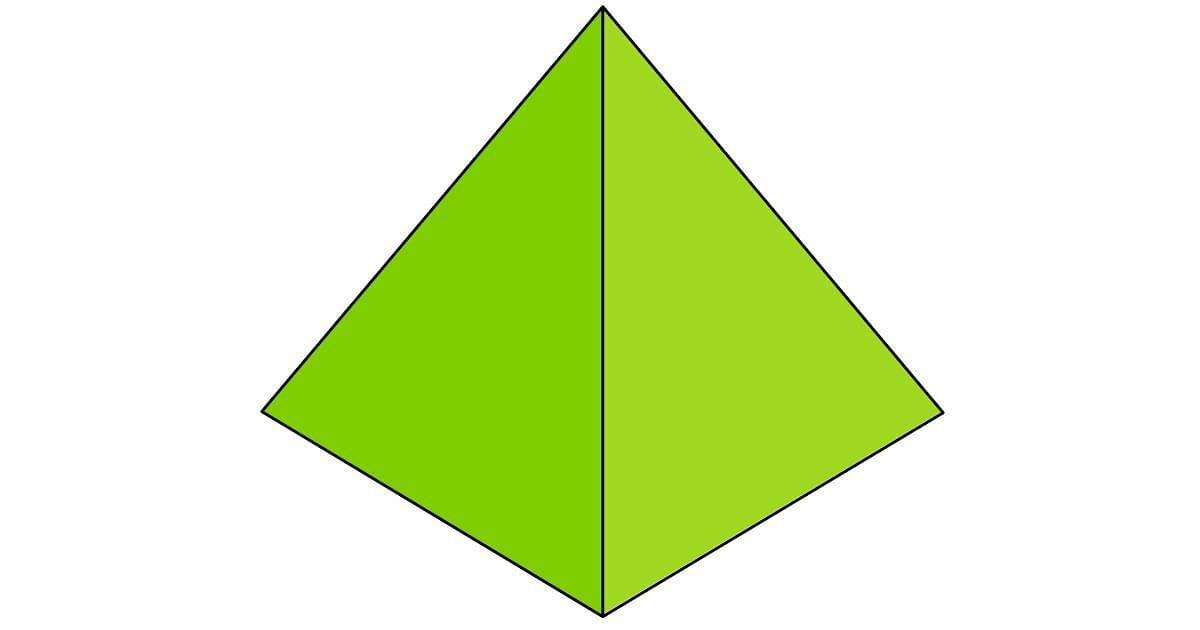
Pyramid
Also Read:
Types of Regular Square Pyramid
[Click Here for Sample Questions]
There are three different types of regular square pyramids:
Equilateral Square Pyramid
If the edges of all the triangular faces are of equal length, then the sides of the figure form an equilateral triangle, and the pyramid formed is called an equilateral square pyramid.
Height (h) = ( 1/ √2 )
Area (a) = (1+ √3)²
Volume(V) = (√2/6)³

Equilateral Square Pyramid
Right Square Pyramid
If the top of the square pyramid is right above the center of the base forming a perpendicular with the base also all the lateral edges are of the same length and the sides other than the base are congruent isosceles triangles it will call a right square pyramid.
Volume (V) = \(V = \frac{1}{3}.b^{2}.h\)
Example of Right Square PyramidExample: Assume that the height (h) and the length of the base edge (a) are 8 units and 15 units, respectively. Then, the volume of the square pyramid is: Volume = 1/3 x 152 x 8 = 1/3 x 15 x 15 x 8 = 600 cubic unit |
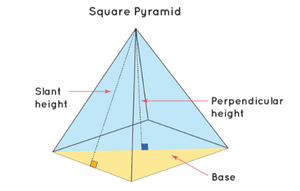
Right Square Pyramid
Oblique Square Pyramid
If the top of the square pyramid is not aligned right above the center of the base of a pyramid, then it is called an oblique square pyramid.
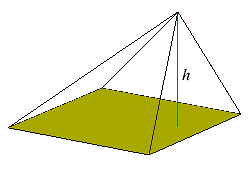
Regular Square Pyramid Formula
[Click Here for Sample Questions]
Regular Square Pyramid Formula consists of formulas for volume, height, base area, and surface area. It also helps determine the total surface area (TSA) and lateral surface area (LSA) of the square pyramid.
Volume of a Square Pyramid
The volume of square pyramid is given by the formula:
V= [(1/3)a2h]
- where, a is the length of the base and h is the perpendicular height.
Example of Volume of a Square PyramidExample: Assume that the height (h) and the length of the base edge (a) are 12 units and 3 units, respectively. Then, the volume of the square pyramid is: Volume = 1/3 x 32 x 8 = 1/3 x 3 x 3 x 12 = 36 cubic unit |
Surface Area of Square Pyramid
The surface area of a square pyramid is given by the formula:
Total Surface area of the square pyramid: a(a+√a2+4h2)
Total Surface area of the square pyramid = 2al + a2 square units
- where, a is the length of the base, l is the slant height and h is the perpendicular height.
Example of Surface Area of Square PyramidExample: Assume that the height h and the length of the base edge a are 2 units and 4 units, respectively. Then, the surface area of the square pyramid is: Surface area = (4)2 + 2 x 4 √[(42/4) + 22] = 16 + 8 √[(4) + 4] = 16 + 8√(8) = 38.56 square units. |
Lateral Surface Area of Square Pyramid
The lateral surface area of square pyramid are as follows:
Lateral surface area of the regular square pyramid (LSA)= 2al
Lateral surface area of the square pyramid (LSA)= 2a√(a2/4 + h2)
- where, a is the length of the base, l is the slant height and h is the perpendicular height.
Example of Lateral Surface Area of Square PyramidExample: Assume that the slant height h and the length of the base edge a are 12 units and 4 units, respectively. Then, the lateral surface area of the square pyramid is: Lateral Surface area = 2al = 2 x 12 x 4 = 96 square units. |
Base Area of a Square Pyramid
The base area of a square pyramid is as follows:
Base Area of a Square Pyramid = a2
- where, a is the side of the base.
Example of Base Area of a Square PyramidExample: Assume that the base edge of a square pyramid is given as 8 units. Then, the base area of the square pyramid is: BA = 8 × 8 = 64 square units |
Also Read:
Things to Remember
[Click Here for Sample Questions]
- The regular Square Pyramid Formula consists of five vertices and eight edges.
- The four sides of the three dimensional figure are a triangle.
- The apex is the common point where all triangular faces meet.
- Equilateral Square Pyramid, Right Square Pyramid and Oblique Square Pyramid are three types of square pyramids.
- The regular Square Pyramid Formula is mainly used to find the total surface area and volume of the figure.
Sample Questions
Ques: Find the volume of a regular square pyramid of base length 6 cm and height 10cm? (2 marks)
Ans: As the base length ‘a’ = 6cm
And the Height is given ‘h’= 10cm
Then according the formula of a regular square pyramid is
V = (1/3)a²h
V = (1/3)x6×6×10
V = 120 cm³
Ques: Find the surface area of the regular square pyramid of base area 4cm and Slant height 5cm? (2 marks)
Ans: Slant height of the pyramid given = 5cm
Base area ‘a’ = 4cm
Then according to the Square Pyramid formula = a² + 2al
= 4×4+2×4×5
= 56 cm²
Ques: A close square pyramid-shaped aquarium has a base edge of 10cm and the slant height is 20 cm. What is the total surface area of the aquarium? (2 marks)
Ans: Given, the slant height of the square pyramid is 20cm
And the base edge is 10cm
Then according to the total surface area of the aquarium is a² + 2al
The Surface area of the aquarium = 10×10 + 2×10×20
Surface area = 500cm²
The total surface of the aquarium is 500cm²
Ques: A vessel in the form of an inverted regular square pyramid has to be filled with water. The altitude of the vessel is 11cm and the base edge is 9 cm. What is the volume of the water that can be filled in the vessel? (2 marks)
Ans: The height of the vessel is given as 11 cm
Base edge is given as 9cm
Then according to the formula of the volume of the square pyramid
V = (1/3)a²h
V= (1/3)×9×9×11
V= 297cm²
The water that can be filled in the vessel is 297cm³
Ques: The base area of the square pyramid is 12cm and its volume is given as 720cm². Calculate the height of the square pyramid? (2 marks)
Ans: Given,
Base area of the square pyramid = 12cm
And the volume is = 720cm²
Then according to the formula, the height will be
V = (1/3) a² h
720 = (1/3)×12×12×h
720× 3/12×12 = h
Height will be 15 cm
Ques: Jiya Constructed a square pyramid whose perimeter of the base is 20 cm and the height measure is 15 cm. Manika made a square pyramid with a base edge of 10cm and a height of 18cm. Find the volume of the pyramids and compare both these measurements? (4 marks)
Ans: Jiya’s square pyramid dimensions are,
The Base edge is 20cm (A1) and the Height is 15cm (H1).
Volume = (1/3)a² h
The Volume of Jiya’s Square pyramid = (1/3)× 20 × 20 × 15
Volume = 2000 cm³
Manika’s square pyramid dimensions are,
The Base edge is 10cm (A2) and the Height is 18cm (H2).
Volume = (1/3)a² h
Volume of Manika’s Square pyramid = (1/3)× 10 × 10 × 18
Volume = 600 cm³
Volume of Jiya’s Square pyramid = Volume of Manika’s Square pyramid
Now, Comparing the measurements,
Dimension of Jiya’s = Dimension of manika’s
A1 = 20 A2 = 10
H1 = 15 H2 = 18
A1 / A2 = 20/10
A1 = 2A2
Jiya’s square pyramid base edge is 2 times the base edge of Manika’s square pyramid
H1 / H2 = 15/8
H1 = 1.8H2
Jiya’s square pyramid height is 1.8 times the height of Manika’s square pyramid
Ques: The base edge of the regular square pyramid is given as 8cm and the vertical height is 3cm. Calculate its slant height and lateral edge of the square pyramid? (4 marks)
Ans: Given the base edge perimeter = 8cm
And height ‘h’= 3cm
Now,
Slant Height = Height of a lateral face

Lateral edge = Edges between the lateral face

In XOY
XY² + OY² = XY²
3² + 4² = XY²
XY = √16+ 9 = 5cm
Slant Height = 5cm
Lateral Edge =

In XOC,
XO² + OC² = XC²
5² + 4² = XC²
XC = √25+16
XC = √41 cm
Hence the Slant Height and Lateral Edge = 5 cm and √41 cm
Ques: Calculate the surface area of a square pyramid with base edges 10 cm and lateral edges 13 cm? (3 marks)
Ans: Given,

In right OAB,

OA² + AB² = OB²
H² + 5² = 13²
H = √169 - 25
H = √144
H = 12cm
Area of square base ‘a²’ = 10×10 = 100cm²
Area of four triangles = 4 × ½ bh
= 2 × 10× 12
= 240cm²
TSA of square pyramid = 100 + 240
= 340 cm²
The surface area of the square pyramid is 340cm²
Ques: The lateral sides of a square pyramid are given as equilateral triangles whose base perimeter is 30 cm. Calculate its surface area? (4 marks)
Ans: Given base perimeter = 30 cm
Now,

The surface area of the square pyramid = area of the base square + area of four equilateral triangles
Area of base square
Side = 30 cm
Area = (30)² = 900
Area of four equilateral triangles,
Side = 30cm
Area = √3/4 a²
= √3/4 (30)²
Area of 1 equilateral triangles = 225√3 cm²
Area of 4 equilateral triangles = 4(225√3)cm²
= 900√3 cm²
Surface area of the square pyramid = area of the base square+ area of 4 equilateral triangle
= 900cm² + 900√3 cm²
= 900(1+√3)cm²
Hence the surface area of the square pyramid is 900(1+√3)cm²
Ques: All the edges of the square pyramid are 20cm. What is its volume? (4 marks)
Ans: Given all the edges are 18cm
Now,

In ABC, ∠B = 90°
and AC = hypotenuse
AC² = AB² + BC² …………….(Pythagoras Theorem)
= 18² +18²
= √324+324
= √2×324
= 18√2 cm
AC = 18√2 cm
AE = ½ of AC
= 18√2/2
= 9√2 cm
AE² + OE² = OA² ……………..(Pythagoras Theorem)
(9√2)² + h² = 18²
h = √(18)² - [9√2]²
= √324 - 81×2
= √162
= 9√2
Volume of the square pyramid = (1/3) x (Base Area) × Height
= (1/3) x (18)² × 9√2
= 972√2 cm³
Hence the Volume of the square pyramid is 972√2 cm³.
Ques: Dany is constructing a closed square pyramid-shaped aquarium in his backyard. The base edge of the square pyramid is 20 inches and the slant height is 10 inches. Help Dany determine the total surface area of the aquarium? (2 marks)
Ans: Given, the slant height l of the square pyramid is 10 inches, the base edge a of the square pyramid is 10 inches.
Thus, The total surface area of the aquarium is given by: a2 + 2al
= 202 + 2 × 20 × 10
= 400 + 400 = 800 in2
Ques: Sophia has a vessel in the form of an inverted regular square pyramid that has to be filled with water. The altitude of the vessel is 20 inches and the base edge is 21 inches. What is the volume of water Sophia can fill in the vessel? (2 marks)
Ans: Given, the height h of the vessel is 20 inches and the base edge of the vessel is 21 inches.
Thus, the volume of the vessel is given by: [(1/3)a2h]
= [(1/3) × (21)2 × (20)]
= 2940 inch3
For Latest Updates on Upcoming Board Exams, Click Here: https://t.me/class_10_12_board_updates
Also Check:



Comments