



Education Journalist | Study Abroad Lead
The relative standard deviation formula is a well-used method in statistics to find out the standardized percentage of a dataset by measuring the ratio of standard deviation to the mean. This formula basically gives an idea of the size of the standard deviation in comparison with the mean of the dataset.
- Relative standard deviation gives a percentage of the scattering of data along the dataset.
- This determines if the data is more precise or more spread out.
- Relative standard deviation calculation is a very useful method in comparing data and analyzing financial affairs in the stock market.
Read More: Standard Error Formula
| Table of Content |
Key Terms: Standard Deviation, Mean, Statistics, Dataset, Median, Mode, Probability Distribution.
What is Standard Deviation?
[Click Here for Sample Questions]
Standard Deviation mostly indicates the distribution of data around the mean or average. A low standard deviation suggests that data is grouped around the mean, but a large standard deviation shows that data is more spread out.
- While observing standard deviation, calculating the mean of the data is very necessary.
- It helps to measure the variation of data points from the mean value.
- Standard deviation can be explained as the square root of the variance of a dataset.
- Standard Deviation is denoted by σ.
- For example, Assume a number of chocolate 5 kids own; 4, 2, 5, 8, 6. Then,
Mean: \(\bar{X} = \frac{\sum x}{n}\)
= \(\frac{x_1 + x_2 + x_3 + x_4 + .....+ x_n}{n}\)
So, Mean = (4 + 2 + 5 + 8 + 6) / 5 = 5
Now, xn for each value of the sample:
= x1 – \(\bar{x}\) = 4 – 5 = 1
= x2 – \(\bar{x}\) = 2 – 5 = – 3
= x3 – \(\bar{x}\) = 5 – 5 = 0
= x4 – \(\bar{x}\) = 8 – 5 = 3
= x5 – \(\bar{x}\) = 6 – 5 = 1
Therefore,
∑ (xn – \(\bar{x}\))2
= (x1 – \(\bar{x}\))2 + (x2 – \(\bar{x}\))2 + …. + (x5 – \(\bar{x}\))2
(- 1)2 + (- 3)2 + 02 + 32 + 12
= 20
And for Standard Deviation, we have,
S.D = \(\sqrt{\frac{\sum (x_n - x)^2}{n-1}}\)
= \(\sqrt{20/4} = \sqrt{5}\) = 2.236
Read More: Median
What is Relative Standard Deviation?
[Click Here for Sample Questions]
Relative Standard Deviation is a statistical measure to calculate the percentage of data scattering along the dataset to understand the size of standard deviation while comparing it with another dataset. This formula indicates the dispersion of data in a dataset mostly around the mean and standard deviation.
- In a statistical dataset how precise the data is can be determined through this method.
- Relative standard deviation (RSD) is calculated by division of the standard deviation of dataset values by the mean of them.
- For example, For example, if the standard deviation is 0.5 and the mean is 4.5, the RSD for this set of numbers is 100 x 0.5 / |4.5| = 11.11%. Which is precisely a small RSD value along the mean of 4.5 compared to the dataset. So, it means the data is not very dispersed.
- But an RSD value of 58% will be indicating that the data is more dispersed compared to before.
Read More: Coefficient of Variation Formula
When to Use Relative Standard Deviation?
[Click Here for Sample Questions]
Relative standard deviation is used in various statistical analyses for regular daily life purposes. As it determines the dispersion of data along a set of data so with this phenomenon data analysis can be easier and more fruitful. A few examples of such scenarios are–
- Calculation of the relative standard deviation of a collection of values using a statistics equation is possible.
- In industrial testing the degree of homogeneity can be determined by this.
- Comparing datasets along various companies can be done.
- Progression of stock price can be observed by this approach.
- In investment analysis the return of a monetary invested risk can be compared along different company’s different datasheets.
- In laboratory assay and measuring the economic differences it can also be used.
Read More: T-Test Formula
Formula of Related Standard Deviation
[Click Here for Sample Questions]
The relative standard deviation formula can determine if the standard deviation of a dataset is close to the average of the dataset or is it larger than the group average value. Taking the standard deviation of a set of numbers and dividing it by the average of the values the relative standard deviation can be measured.
- The precision of the data in a dataset is measured by this formula.
- The smaller the RSD the more precise the data.
- Large percentage of RSD indicates the wider dispersion of data along the dataset.
- Relative standard deviation can be calculated by –
Relative standard deviation = 100 × s / |x̄|
Here, s = the standard deviation of the data and x̄ = sample mean of the data
Solved Examples
[Click Here for Sample Questions]
Example 1: 4 measurements were collected as a sample 41,52,50 and 56. Calculate the relative standard deviation.
Solution: The average of all the measurements will be – x̄ = (41 + 52 + 50 + 56) / 4 = 49.75
So, Standard Deviation (S) =
\((\sqrt{(41-49.75)^2+(52-49.75)^2+ (50-49.75)^2 + (56-49.75)^2)} / \sqrt{(4-1)}\)
= \(\sqrt{(-8.75)^2 + (2.25)^2 + (0.25)^2 + (6.25)^2} / \sqrt{3}\)
= \(\sqrt{76.5625 + 5.0625 + 0.625+39.625} / \sqrt{3}\)
= \(\sqrt{40.4375}\)
= 6.359
Relative standard deviation = 100 × s / |x̄| = 100 × (6.359 / 49.75) = 12.782%
This can be expressed as 49.75 ± 12.782%
Example 2: Company XYZ wants to determine the relative standard deviation of a set of numbers that relate to its stock value over the past five years. The numbers in the sample used include 25, 23, 27, 29, 32, and 26. The standard deviation for this sample is 5. What will be the RSD value?
Solution: The mean of the sample numbers is used to calculate the relative standard deviation. Thus, 25 + 23 + 27 + 29 + 32 + 26 = 162. This figure is then divided by six which results in 27. Now, the collection of numbers mean, or average, is 27.
To calculate the relative standard deviation. The following is the formula: (S x 100)/ |x̄| is the relative standard deviation.
S equals 5 (the standard deviation) and x equals 27 (the mean) in this issue. So, 5 times 100 = 500, and 500 divided by 27 equals 18.5. This implies that the RSD for the sample is 18.5.
Also Read:
Things to Remember
- Relative standard deviation is the percentage of data scattering along the dataset.
- Standard Deviation is a method in statistics describing the dispersion of a data along the dataset.
- Standard deviation of a data set is the square root of its variance.
- Relative standard deviation (RSD) is calculated by dividing the standard deviation of a dataset's values by the mean of them.
- Large percentage of RSD indicates the wider dispersion of data along the dataset.
- Relative standard deviation = 100 × s / |x̄|, Here, s = the standard deviation of the data and x̄ = Mean of the data.
Sample Questions
Ques: Marks obtained by 3 students in a test are as follows: 98, 64, and 72. But first, calculate the relative standard deviation. (3 Marks)
Ans: From the data,

the Calculated Mean will be,
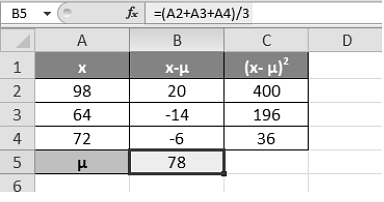
μ = Σxi/ n
where μ is the mean; Σxi is a summation of all the values, and n is the number of items
μ = (98+64+72) / 3
μ= 78
Now, calculated standard deviation =

Now, (x- μ)2 we get 632
Therefore, Σ(x- μ)2 = 632
Calculation of Standard Deviation:
σ = √ [Σ(x- μ)2 / N]
=√632/3
σ = 14.51
Now, Formula = (Standard Deviation / Mean) * 100
= (14.51/78)*100 = 78 +/- 18.60%
Ques: Here are 4 measurements: 51.3, 55.6, 49.9 and 52.0. Calculate the average, standard deviation, and relative standard deviation. (3 Marks)
Ans: Average, x̄ = \(\frac{51.3 + 55.6 + 49.9 + 52.0}{4} = \frac{208.8}{4}\) = 52
standard deviation, S = \(\sqrt{\frac{(51.3 - 52.2)^2 + (55.6 - 52.2)^2 + (49.9 - 52.2)^2 + (52.0 - 52.2)^2}{4 -1}}\)
= \(\sqrt{\frac{(-0.9)^2 + (3.4)^2 + (-2.3)^2 + (-0.2)^2}{3}}\)
= \(\sqrt{\frac{0.81 + 11.56 + 5.29 + 0.04}{3}} \)
= \(\sqrt{5.9}\)
= 2.4
relative standard deviation, RSD = 100S / \(\bar{X}\) = \(\frac{2.4}{52.2} \times 100\) = 4.2%
Our final result for this example can be written as 52.2 ± 2.4 or 52.2 ± 4.6%
Ques: Following is the data of scored marks obtained by 4 students in the math examination: 50, 88, 55, 75. Use the relative standard deviation formula to find RSD. (3 Marks)
Ans: Here, μ = Σxi/ n
where μ is the mean; Σxi is a summation of all the values, and n is the number of items
= (50 + 88 + 55 + 75) / 4
= 67
For, the calculation of standard deviation

According to the formula,
S = s = \(\sqrt{\frac{(x - \bar{x}^2)}{n-1}}\)
S = \(\sqrt{\frac{938}{3}}\)
= 17.66
So, Relative standard deviation would be, 100 × s / |x̄|
= (17.66 * 100) / 67
= 26.358%
Ques: Determine the relative standard deviation of a set of numbers. The set of numbers includes the following values: 50, 47, 54, and 62. You have already found the standard deviation for this set of numbers to be 2.5. (3 Marks)
Ans: To calculate the relative standard deviation, first get the mean of the set. The mean may be calculated by summing the four integers and then dividing them by four. So 50 + 47 + 54 + 62 = 213. Then multiply 213 by 4 to obtain 53.25. This indicates that the sample mean is 53.25.
To compute the relative standard deviation using the formula: (S x 100)/ |x̄| is the relative standard deviation. In this calculation, S equals 2.5 and x equals 53.25. So, 2.5 times 100 is 250.
Ques: What is an example of a relative standard deviation? (2 Marks)
Ans: For example, in an experiment, the standard deviation is 0.1 and the mean is 4.4. For this collection of values, RSD is 100 x 0.1 / |4.4| = 2.3%. This indicates that the standard deviation is 2.3% of the mean of 4.4, which is quite low.
Ques: What is the meaning of RSD value? (2 Marks)
Ans: The absolute value of the coefficient of variation is the relative standard deviation. It's usually represented as a percentage. The relative variance, which is the square of the coefficient of variation, is a related word that is occasionally used.
Ques: What does high RSD mean? (2 Marks)
Ans: The deviation of a group of numbers distributed around the mean is measured by the relative standard deviation. It may be calculated as the standard deviation to mean ratio for a collection of values. The greater the deviation, the greater the divergence from the mean.
Ques: What is the difference between standard deviation and RSD? (2 Marks)
Ans: The standard deviation evaluates the precision of your results. It indicates how near the findings are to the mean value. Relative standard deviation, on the other hand, assesses the standard deviation or accuracy of the mean value. The abbreviation for standard deviation is standard deviation, while the abbreviation for relative standard deviation is RSD.
For Latest Updates on Upcoming Board Exams, Click Here: https://t.me/class_10_12_board_updates
Check-Out:



Comments