



Content Curator
T-test is one of the most crucial tests used in mathematical statistics. T-tests are used to calculate the difference between two means of two groups. T tests are carried out for small samples, since the normal sample tests are applicable for large samples. T tests, F tests, and Fisher's Z transformation are used for small samples. All these tests were discovered by W.S. Gosset (1908).
| Table of Content |
Key Takeaways: T Test, paired t test, pooled t test, one tailed
What is a T-test?
[Click Here for Sample Questions]
T-test is one of the most crucial tests used in mathematical statistics. T tests are used to calculate the difference between two means of two groups. T tests are carried out for small samples since the normal sample tests are applicable for large samples. T tests, F tests, and Fisher's Z transformation are used for small samples. All these tests were discovered by W.S. Gosset (1908).
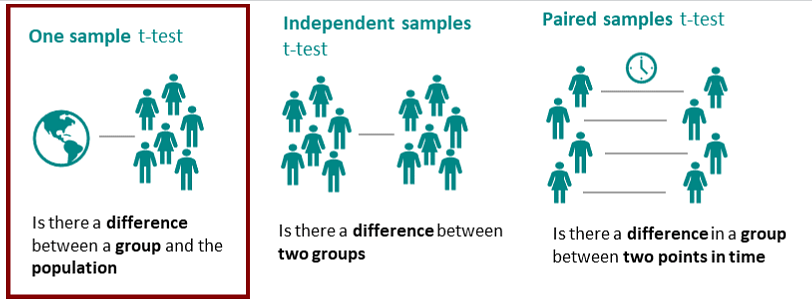
T Test
Evaluation and performing T tests require setting up a null hypothesis. Null hypothesis is the hypothesis based on the question. On the basis of the T test, we reject or accept the null hypothesis. There are three types of T tests, they are broadly put under dependent, and independent variables.
Read More:
T Table
There are a set of numerical values for T Tests allotted for one tailed, two tailed tests and for different levels of significance, as shown below:

T Test Table
Read More:
Types of T tests
[Click Here for Sample Questions]
There are three types of T tests, they are broadly put under dependent, and independent variables.
Correlation/Paired T Tests (Dependent T Test)
The correlated t-test is performed when the samples under analysis typically consist of similar units, or same pairs. This method also applies to cases where the samples have matching characteristics.
The formula for calculating the t-value is:
\(t = \frac{(x_1 - x_2)}{\sqrt{\frac{(S_1)^2}{n_1} + \frac{(S_2)^2}{n_2}}}\)Read More:
Equal Variance (Pooled/ Independent T test)
The equal variance t-test is used when the number of samples in each group is the same or equal. The following formula is used for calculating t-value and degrees of freedom for equal variance t-test:
T-Value = \(\frac{mean1 - mean2}{\frac{(n1 - 1) \times var1^2 + (n2-1) \times var2^2}{n1+n2-2} \times \sqrt{\frac{1}{n1} + \frac{1}{n2}}}\)
T= Calculated value of T Test
Mean1 and mean2 = mean of two set of datas
SD = Standard Deviation
n1 and n2 = sample size
Var1 and var2 = variance
Read More: Data Set
Unequal variance (Pooled/ Independent T test)
This test is used when the number of samples in each group is different, and the variance of the two data sets under evaluation is also different. This test is also called the Welch's t-test. The formula used to calculate t-value for an unequal variance t-test:
T-Value = \(\frac{mean1 - mean2}{\sqrt{\frac{ver1}{n1} + \frac{ver2}{n2}}}\)
T = Calculated value of T Test
Mean1 and mean2 = Mean of two set of datas
SD = Standard Deviation
n1 and n2 = sample size
Var1 and var2 = variance
Also Read:
How to Solve a T test Based Question?
[Click Here for Sample Questions]
Follow the following steps to solve a T test based question:
- Set up a null and alternate hypothesis.
- Determine the mean of the two sets of samples.
- Calculate the differences of the means
- Calculate the standard deviation values
- Determine the number of samples.
- Calculate the value of T test
- Compare it to the tabulated T test value.
- If the Tcal>Ttab, then reject the null hypothesis, or vice versa.
Also read:
| Difference Between Variance and Standard Deviation | Relation Between Mean Median and Mode |
| Median | Frequency Distribution Table Statistics |
Things to Remember
[Click Here for Sample Questions]
- T tests are used to calculate the difference between two means of two groups. T tests are carried out for small samples, since the normal sample tests are applicable for large samples.
- T tests, F tests, and Fisher's Z transformation are used for small samples.
- There are three types of T tests namely, Correlation/Paired T Tests (Dependent T Test), Equal variance (pooled/Independent T-test) and Unequal variance (Pooled/Independent T test)
Also Read:
Sample Questions
Ques: There are two sets: (2,7,6,9) and (4,3,2,1). Calculate t-test for the same. (2 marks)
Ans: Mean of the first set = 6
Mean of the second set = 2.50
Standard deviation of group 1 = 2.63
Standard deviation of group 2 = 1.29
Number of sample = 4 in each group
Mean 1- mean 2 = 3.50
T test value = 0.073
Ques: There are two sets: (2,5,6,9) and (4,3,2,1). Calculate t-test for the same. (2 marks)
Ans: Mean of the first set = 5.50
Mean of the second set = 2.50
Standard deviation of group 1 = 2.89
Standard deviation of group 2 = 1.29
Number of sample = 4 in each group
Mean 1- mean 2 = 3
T test value = 0.1066
Ques: There are two sets: (2,5,6,9) and (4,3,2,0). Calculate t-test for the same. (2 marks)
Ans: Mean of the first set = 5.50
Mean of the second set = 2.25
Standard deviation of group 1 = 2.89
Standard deviation of group 2 = 1.71
Number of sample = 4 in each group
Mean 1- mean 2 = 3.25
T test value = 0.1007
Ques: There are two sets: (2,7,5,9) and (4,3,2,1). Calculate t-test for the same. (2 marks)
Ans: Mean of the first set = 5.75
Mean of the second set = 2.50
Standard deviation of group 1 = 2.99
Standard deviation of group 2 = 1.29
Number of sample = 4 in each group
Mean 1- mean 2 = 3.29
T test value = 0.0927
Ques: There are two sets: (2,7,6,8) and (4,3,2,0). Calculate t-test for the same. (2 marks)
Ans: Mean of the first set = 5.75
Mean of the second set = 2.25
Standard deviation of group 1 = 2.63
Standard deviation of group 2 = 1.71
Number of sample = 4 in each group
Mean 1- mean 2 = 3.50
T test value = 0.0671
Ques: There are two sets: (3,7,6,9) and (4,3,2,1). Calculate t-test for the same. (2 marks)
Ans: Mean of the first set = 6.25
Mean of the second set = 2.50
Standard deviation of group 1 = 2.50
Standard deviation of group 2 = 1.29
Number of sample = 4 in each group
Mean 1- mean 2 = 3.75
T test value = 0.0372
Ques: There are two sets: (2,7,6,9) and (4,3,2,1). Calculate t-test for the same. (2 marks)
Ans: Mean of the first set = 6
Mean of the second set = 2.50
Standard deviation of group 1 = 2.63
Standard deviation of group 2 = 1.29
Number of sample = 4 in each group
Mean 1- mean 2 = 3.50
T test value = 0.073
Ques: There are two sets: (5,7,6,9) and (4,3,2,4). Calculate t-test for the same. (2 marks)
Ans: Mean of the first set = 6.75
Mean of the second set = 3.25
Standard deviation of group 1 = 1.71
Standard deviation of group 2 = 0.96
Number of sample = 4 in each group
Mean 1- mean 2 = 3.50
T test value = 0.0117
Ques: There are two sets: (9,7,6,9) and (4,3,2,4). Calculate t-test for the same. (2 marks)
Ans: Mean of the first set = 7.75
Mean of the second set = 3.25
Standard deviation of group 1 = 1.50
Standard deviation of group 2 = 0.96
Number of sample = 4 in each group
Mean 1- mean 2 = 4.50
T test value = 0.0023
Ques: There are two sets: (2,7,6,2) and (4,3,2,3). Calculate t-test for the same. (2 marks)
Ans: Mean of the first set = 4.25
Mean of the second set = 3.00
Standard deviation of group 1 = 2.63
Standard deviation of group 2 = 0.82
Number of sample = 4 in each group
Mean 1- mean 2 = 1.25
T test value = 0.3990
Also Read:



Comments