


The SI unit of universal gravitational constant is:

Collegedunia Team logo

Collegedunia Team

Content Curator

The SI unit of the universal gravitational constant (G) is m3 kg-1 s-2. This unit is used to express the strength of the gravitational interaction between two masses.

The unit is derived from the formula for the gravitational force between two masses:

F = G * (m1 * m2) / r2

where F is the force of gravity, m1 and m2 are the masses of the two objects, and r is the distance between them. In this formula, the units of G are such that when multiplied by the masses (in kilograms) and divided by the distance (in meters) squared, the result is a force (in newtons).

Thus, the unit of G can be expressed as m3 kg-1 s-2, which indicates that it is a measure of the strength of the gravitational interaction between two masses in cubic meters per kilogram per second squared.
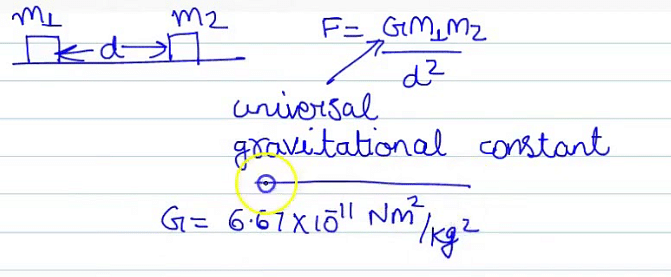
Universal Gravitation Constant

Universal Gravitation Constant

Also check:

CBSE CLASS XII Related Questions

  • 1.
    Two metal spheres of radii $r_1$ and $r_2$ ($> r_1$) having charges $q_1$ and $q_2$ respectively kept in air, are brought in contact. Which of the following statements is not correct ?

      • The total charge of the two spheres is conserved.
      • Both spheres attain the same potential.
      • The final potential of the system equals $\frac{1}{4\pi\epsilon_0} \frac{(q_1 + q_2)}{(r_1 + r_2)}$
      • The final potential of the system equals $\frac{1}{4\pi\epsilon_0} \frac{(q_1 + q_2) (r_1 + r_2)}{r_1 r_2}$

    • 2.
      Read the following paragraph and answer the questions that follow.
      In an experiment with convex lens of focal length f, the screen is fixed at a distance D from the object. A student slowly moves the lens away from the object towards the screen and finds that she is able to form sharp image of the object for two positions of the lens. The distance between these two positions of the lens is d.


        • 3.
          The resistance of a metal wire at \( 20^\circ \text{C} \) is \( 1.05 \, \Omega \) and at \( 100^\circ \text{C} \) is \( 1.38 \, \Omega \). Determine the temperature coefficient of resistivity of this metal.


            • 4.
              Two air-filled capacitors of capacitances $C_1$ and $C_2$ are connected in parallel with a dc battery. After the capacitors are fully charged, a slab of dielectric constant K is inserted between the plates of each capacitor. How will the (i) charge on each capacitor and (ii) energy stored in the capacitor affected after the slab is introduced.


                • 5.
                  A charged particle $+q$ in an electric field $\vec{E}$ experiences a force in the direction of the electric field. As a result, its kinetic energy changes. Similarly, the charged particle also experiences a force when it moves in a magnetic field $\vec{B}$. But this magnetic force is perpendicular to both velocity $\vec{v}$ of the charged particle and the magnetic field $\vec{B}$, so it cannot change the kinetic energy of the charged particle. Consider two charged particles 1 and 2 of masses $m$ and $\frac{m}{2}$ having charges $-q$ and $+2q$ respectively. They are accelerated from rest through the same potential difference $V$ and acquire kinetic energy $K_1$ and $K_2$. Then they enter in a region of uniform magnetic field $\vec{B}$ perpendicular to their velocities.


                    • 6.
                      Capacitors are manufactured with certain standard capacitances and working voltages. However, these standard values may not be the ones that are actually needed in a particular application. Two or more capacitors can be grouped in series or in parallel to achieve desired capacitance and voltage. When connected in series, the total capacitance decreases while the voltage rating increases, whereas in parallel connections, the total capacitance increases and maintains the same voltage rating. A capacitor stores energy in the electric field between its plates and stored energy is proportional to the square of the voltage and capacitance $U = \frac{1}{2}CV^2$, where symbols have their usual meanings.
                      Two capacitors, one of $3 \ \mu$F and the other of $6 \ \mu$F, are connected in series in the circuit as shown in the figure, for a long time. }

                        CBSE CLASS XII Previous Year Papers

                        Comments


                        No Comments To Show
