



Content Curator
Value of Gravitational Constant accurate up to five decimals is 6.67408 × 10⁻¹¹ Nm2 kg-2. Thus,
| G = 6.67408 × 10⁻¹¹ Nm2 kg-2 |
The Gravitational constant is an empirical Physical Constant. It is denoted by G and is also termed the Universal gravitational constant or Cavendish gravitational constant. The Gravitational constant(G) is used to measure the attraction force (Gravitational force) acting between the two bodies and hence, the mass of the body in this universe. Henry Cavendish(1731-1810) was the first scientist, who measured the value of the Universal constant(G) in 1798. This experiment is widely known as Cavendish Experiment.
| Table of Content |
Key Terms: Gravitational Constant, Gravitational Force, Cavendish Experiment, Newton’s Law of Gravitation, Acceleration, Gravity, Force
What is Gravitational Constant?
[Click Here for Sample Questions]
Gravitational constant has a fixed value in the universe. Therefore, it is called the Universal Gravitational constant. It is denoted by “G.” It is equal to the force of attraction (Gravitational force) acting between the two bodies each of mass 1 unit and is separated by unit distance from their center. Let us consider two bodies of mass m1 and m2, separated through a distance r apart. Here,
- m1 = m2 = 1 unit
- r = 1 unit
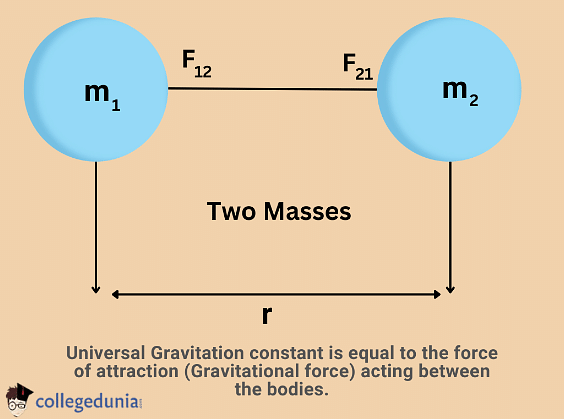
Newton’s Law of Gravitation
From, Newton’s Law of Gravitation ⇒ F= G.\(\frac{m_1.m_2}{r_2}\)
⇒ F= G.\(\frac{1×1}{1×1}\)
F = G
Thus, Hence, the Universal Gravitation constant is equal to the force of attraction (Gravitational force) acting between the bodies.
- The gravitational constant(G) is a constant of proportionality.
- It is a scalar quantity.
- Its value is constant throughout the universe irrespective of the nature and size of the bodies.
- The value of G is also independent of the nature of the medium between the bodies.
- Its value in the SI unit is 6.67 × 10⁻¹¹ Nm2 kg-2.
- Its value in the CGS unit is 6.67 × 10⁻⁸ dyne cm2 g-2.
- The dimensional formula for G is M-1L3T-2.
The video below explains this:
Relation Between G And g Detailed Video Explanation:
Read more: Gravitation
Derivation of Universal Gravitational Constant
[Click Here for Previous Year Questions]
Henry Cavendish(1731-1810), measured the Physics value of the Gravitational constant in 1798 in the laboratory. He used a Torsion Balance invented by the Geologist Rev to measure the Physics value of G.
Cavendish Experiment
- Here in the Cavendish Torsion Balance two small spheres each of mass ‘m’ attached at the ends of a light bar length ‘l’.
- The bar is suspended horizontally from the mid through a rigid thin wire of uniform cross-section.
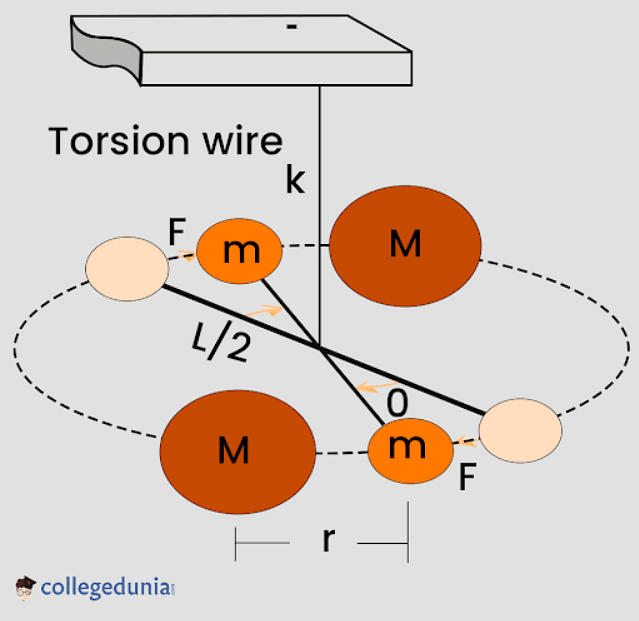
Cavendish Experiment
- Two big spheres each of mass ‘M’ are brought close to the small spheres at a distance of d on opposite sides.
- The Force of attraction(Gravitational force) on a small sphere due to the big sphere is:
F = G . \(\frac{M.m}{r_2}\)
- Both small spheres experience equal force but in opposite directions.
- The net resultant force is equal to zero but a Gravitational Torque acts on it.
- Gravitational Torque = Force Length of the bar
= F.l = G.\(\frac{M.m}{r_2}\).l
- The bar twist through an angle ‘’ from its axis about the wire because of Gravitational Torque.
- Thus a Restoring Torque appears due to this twist.
Restoring Torque = Gravitational Torque
τ.θ = G.\(\frac{M.m}{r_2}\).l
Where,
- τ = Torque acting
- θ = Angle of Rotation
Hence, knowing all these terms value of ‘G’ can be calculated.
Read more:
Difference between G and g
[Click Here for Sample Questions]
The acceleration due to gravity is denoted by the small ‘g’, whereas the Big ‘G’ denotes the Universal Gravitational Constant.
- The acceleration due to gravity is the force of gravity. It acts on a free-falling body under the effect of the gravity of that planet alone.
- Its value of earth is 9.8 m/s2.
Thus, the difference between G and g is:
| Universal Gravitational Constant(G) | Acceleration due to gravity(g) |
|---|---|
| It is the force of attraction acting between two bodies. | It is the gravitational pull on a body lying on or near the surface of the planet. |
| The Universal Gravitational Constant (G)has a fixed Physics value in the universe. | The acceleration due to gravity(g) has a variable Physics value. Its value decreased with the increase in height from the surface of the Earth or with an increase in the depth from the surface of the Earth. |
| Its value is 6.67 × 10⁻¹¹ Nm2 kg-2. | The value of small ‘g’ on Earth is 9.8 m/s2 and on Moon, it is one-sixth of the Earth. |
| It is a scalar quantity. | It is a vector quantity. |
| The direction of Gravitational force on body A due to B is along the line joining AB. | The direction of force of gravity is directed towards the center of the earth or the planet. |
Application of Universal Gravitation Constant
[Click Here for Previous Year Questions]
In Newton’s law of Gravitation:
- Universal Gravitational constant(G) appears in Newton’s Law of Gravitation.
- Newton’s law of gravitation states that every body in this universe attracts every other body with a force.
- The force is directly proportional to the product of their masses and is inversely proportional to the square of the distance between them.
F=G.\(\frac{m_1.m_2}{r_2}\)
In Einstein's field equations of General Relativity:
- Universal Gravitational constant(G) appears in Einstein's field equations of General Relativity.
In calculating the mass of the object in the universe:
- Universal Gravitational Constant unlocks the mass of the object of the universe.
- By knowing the value of the Universal Gravitational constant we can measure the mass of the Earth. Once the mass of the Earth is calculated we can calculate the mass of the moon, the sun, the universe, and even the mass of the galaxy(our galaxy is Milkyway.)
In calculating acceleration due to gravity (g) of a planet:
- As the Universal gravitational appears in the formula of calculating ‘g’, we can calculate the value of ‘g’ of Earth or a planet.
g = \(\frac{G.M}{r_2}\)
Where,
- g = acceleration due to gravity of the planet.
- M = mass of the planet
- r = radius of the planet or the distance between the center and the surface of the planet.
Previous Year Questions
- Two astronauts are floating in gravitational free space after… (NEET 2017)
- The acceleration due to gravity at a height h above the earth… (AP EAPCET)
- A black hole is an object whose gravitational field is so strong… (NEET 2014)
- The force of gravitation is… (AIIMS 2007)
- Law of gravitation is not applicable if A) Velocity of… (COMEDK UGET 2000)
- If suddenly the gravitational force of attraction between earth… (JMI-EEE 2005)
- If the gravitational force between two objects were proportional… (NEET 1994)
- The acceleration due to gravity at a height of 1km above the earth… (NEET 2017)
- Gravitational acceleration on the surface of a planet is…
- Calculate the acceleration due to gravity on the surface of a… (AMUEEE 2012)
Things to Remember
- The calculated value of the Gravitational Constant since the Cavendish experiment has been improved.
- The present acceptable Physics value of the Universal Gravitational Constant is 6.67 × 10⁻¹¹ Nm2 kg-2.
- The instrument used in the Cavendish experiment is Torsion Balance.
- Since the Universal gravitational arises in calculating ‘g’, the value of ‘g’ of Earth or a planet is: g=\(\frac{G.M}{r_2}\)
Read more:
Sample Questions
Ques: Earth is continuously pulling the Moon towards its center. Why does it not Moon fall onto Earth? (1 mark)
Ans: The gravitational attraction of the earth provides the necessary centripetal force to the moon for its orbital motion around the earth. That is why the moon does not fall onto the earth.
Ques: Why does a body lose weight at the centre of the earth? (1 mark)
Ans: The weight of the body is the force with which the body is attracted by the earth towards its centre. At the centre of the earth g = 0, and weight = mg, therefore the weight at the centre of the earth is zero.
Ques: Why is newton’s law of gravitation called a universal law? (1 mark)
Ans: Newton’s law of gravitation holds good irrespective of the nature of two bodies that is big or small or at what location are they located. That is why newton’s law of gravitation is called a universal law.
Ques: The earth is acted upon by the gravitational force of attraction due to the sun. Then why does the earth not fall towards the sun? (1 mark)
Ans: Earth is orbiting around the sun in a stable orbit. The gravitational attraction of the sun exerted on earth provides the necessary centripetal force for the earth to revolve around the sun. This is the reason the earth does not fall towards the sun.
Ques: What are the properties of Gravitational Force? (2 Marks)
Ans: The characteristics of gravitational force include:
- The gravitational force is a force of attraction that draws two things together.
- The gravitational force is a long-distance force between two objects regardless of their medium.
- The gravitational force always works along the line connecting the centers of two objects, thus the phrase "central force."
Ques: Is the value of ‘g’ the same everywhere on the surface of the earth? (2 marks)
Ans: The value of g is different at different places on the surface of the earth. The shape of the earth is not exactly spherical; it is flattened at the poles and bulging out at the equator. Due to this, the radius of the earth is smaller at the poles and larger at the equator. As the acceleration due to gravity is inversely proportional to the distance, the value of g is smaller at the equator than that at the poles.
Ques: Gravitational force is the weak force but still it is considered the most important force. Why? (2 marks)
Ans: Gravitational force is the weakest force among the four but it plays an important role in explaining many natural phenomena such as the initiation of the birth of stars, the size of astronomical objects, etc.
Ques: Two identical copper spheres of radius R are in contact with each other. If the gravitational attraction between them is F, find the relation between F and R. (2 marks)
Ans: Let M =mass of each copper sphere = density of the copper Then,
M = 4/3*π.R3.
Thus F = GMM/(2R)2 = 4/9*π2.GR4. p2
Ques: A sphere of mass 40 kg is attracted by the second sphere of mass 60 kg with a force ‘f’. Calculate the distance between them. (3 marks)
Ans: Here M1 = 40kg
M2 = 60kg
F = f We know,
F=G.\(\frac{m_1.m_2}{r_2}\)
f = 6.67 × 10-11 * 60*40/r2 r = \(\sqrt{6.67 × 10-11 * 60*40/f meter}\)
Ques: Prove that a body which has been thrown vertically upward, comes with the time of ascent equal to the time of descent. (5 marks)
Ans: In the Upward motion, v = u + gt1 0 = u – gt1 Thus, t1 = u/g …(1)
And for Downward motion, v = u + gt2 v = 0 + gt2
It is as the body falls back to the earth with the same velocity as it was thrown vertically upwards.
∴ v = u Thus, u = 0 + gt2 t2 = u/g …(2)
Now from the equation (1) and (2), we can get t1 = t2 ⇒ Time of ascent = Time of descent
Check-Out:



Comments