



Content Curator
Thorax is an important part of human physiology that is situated between the brain and the abdomen. It works as a connector between these two parts which is usually known as the chest of the human anatomy.
- Thorax can be seen in fish, amphibians, birds, mammals, and reptiles.
- It can also be considered the breast part of these animals.
- Along with the evolution period, this thorax part of mammals and tetrapods has been modified accordingly.
- Thorax includes two parts- Thoracic Wall and Thoracic Cavity.
- This part supports the basic human structure.
Read More: Aerobic and Anaerobic Respiration
| Table of Content |
Key Terms: Thorax, Human Anatomy, Chest, Thoracic Wall, Thoracic Cavity.
What is Thorax?
[Click Here for Sample Questions]
The Thorax is a cage-like part that connects the head and abdomen parts of any animal. In the case of vertebrates, this part is protected by an exoskeleton or bones and it's more complicated than in the case of invertebrates. Human Thorax is the most unique and complicated among all animals.
- Important organs like the heart, lungs, muscles, and, other internal parts are situated in this part.
- The bones that constructed this part are usually known as the breast ribs.
- Thorax includes 12 thoracic vertebrae along with 12 pairs of ribs.

Thorax in Various Types of Animals
Read More:
| Related Articles | ||
|---|---|---|
| Bones | Nerves | Tissues |
| Movement | Skeletal System | Rib Cage |
| Difference Between Bone and Cartilage | Difference between Cardiac Muscle and Skeletal Muscle | What are the 22 Bones of the Skull |
Structure Of Thorax
[Click Here for Previous Year Questions]
The basic structure of the human thorax mainly has two parts- Thoracic Wall and Thoracic Cavity. But this part also includes some important vascular arteries and important organs. Therefore, the structure of the thorax is discussed in two parts-
- Thoracic Wall: Breastbone, muscles, ribs, and cartilage are included in this part of the Thorax. It is the inner lining of the Thoracic Cavity.
- Thoracic wall has five muscles.
- 12 thoracic vertebrae along with 12 pairs of ribs are also important parts of this wall.
- This part helps with the movements of our upper body.
- Thoracic Wall helps in the human respiratory process.
- This part also provides support to the Thoracic Cavity.
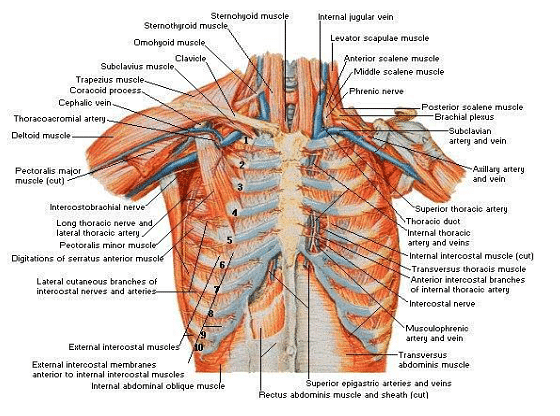
Anatomy Of Thoracic Wall
- Thoracic Cavity: A cavity can be defined as an empty part of the human thorax that contains some major internal organs. It is guarded by the diaphragm, which is a powerful muscular platform beneath the lungs that helps in breathing.
- This part includes a pair of lungs, a heart, and major blood vessels.
- Thoracic Cavity takes part in cardiovascular activities.
- The mediastinum and the pleural cavity can be counted as the two distinguishable compartments of this part.

Thoracic Cavity
Importance Of Thorax
[Click Here for Sample Questions]
Being an important part of the human anatomy, Thorax has its importance as well.
- Providing Support: By far the understanding is clear about what thorax is.
- Therefore, the human thorax part includes important organs like the heart, lungs, etc.
- As the lungs remain stationary without deflating or contracting, the Thoracic wall and Cavity provide the required support to carry forward the human respiratory process.
- Providing Protection: As these inner organs, muscles, and arteries are very delicate, another mention-worthy importance of The thoracic Cavity and Thoracic Wall is to protect them from getting injured.
- Helping the Movement Process: Thorax is a connection between the brain, neck, and abdomen. It has a few muscles which help with the human upper body movements.

Thorax Protecting Inner Organs
Also Read:
Clinical Issues Related to Thorax
[Click Here for Previous Year Questions]
In 25% of cases, thoracic trauma, thoracic damage, or chest trauma can be life-threatening
- It may happen due to restricted air or blood flow, or leaks in the digestive system.
- Clinical issues like Atelectasis and Pneumothorax may also cause discomfort in the human thorax part.
- pneumothorax occurs when air or gas can accumulate in the pleural space.
- Atelectasis is a condition in which a section of the lung collapses as a result of losing all of its air.
Things to Remember
- Thorax is situated between the brain and the abdomen.
- The Thorax is a cage-like part that connects the head and abdomen part of any animal.
- Important organs like the heart, lungs, muscles, and other internal parts are situated in this part.
- Thorax includes 12 thoracic vertebrae along with 12 pairs of ribs.
- Thorax provides support and protection to the inner organs and helps with upper body movement.
- Thoracic Cavity and Thoracic Wall make up the majority of the human thorax's fundamental anatomy.
- Among all mammals, the human thorax is the most distinctive and intricate.
Previous Year Questions
- Which of the following is correct?...[JIPMR 2009]
- Fusion reaction takes place at high temperature because...[NEET UG 2011]
- Trien is...[AIIMS 2018]
- Sucrose on hydrolysis gives...[NEET UG 2020]
- Which of the following has zero dipole moment?...[NEET UG 1996]
- A disc of mass 2kg and diameter 2m is performing rotational motion. Find the work done, if the disc is rotating from 300rpm to 600rpm.
- The angle between two diagonals of a cube is….[KCET 2014]
- The electric field at a point is..
- Extraction of zinc from zinc blende is achieved by...[JEE Advanced 2007]
- The nucleic acid base having two possible binding sites is...[AIIMS 2004]
Sample Questions
Ques. What is Thorax? (2 Marks)
Ans. The thorax is the cage-like part that connects the animal's head and abdomen. In vertebrates, this part is protected by an exoskeleton or bone and is more complex than in invertebrates.
- The human thorax is the most unique and complex of all animals.
- Vital organs such as the heart, lungs, and muscles are located here.
- The bones that make up this segment are commonly known as the sternum.
- The rib cage consists of 12 pairs of ribs and 12 thoracic vertebrae.
Ques. What are the main parts of the human Thorax? (1 Mark)
Ans. The human thorax includes two parts- Thoracic Cavity and Thoracic Wall.
Ques. What is the Thoracic Wall? (2 Marks)
Ans. The Thoracic Wall is one of the core parts of the human thorax. The breastbones, ribs, and cartilages are included in this part of the Thorax. It is the inner lining of the Thoracic Cavity.
- The chest wall has five muscles.
- 12 thoracic vertebrae and 12 pairs of ribs are included in this part.
- This part helps with the movement of the upper body.
- This part also supports the thoracic cavity.
Ques. What is the Thoracic Cavity? (2 Marks)
Ans. Thoracic Cavity is another important part of the human thorax. A cavity can be explained as the empty part of the human thorax that contains some major internal organs.
- It is guarded by the diaphragm, which is a powerful muscular platform beneath the lungs that helps in breathing.
- This part includes a pair of lungs, a heart, and major blood vessels.
- Thoracic Cavity takes part in cardiovascular activities.
- The mediastinum and the pleural cavity can be counted as the two distinguishable compartments of this part.
Ques. What are the importances of the human thorax? (4 marks)
Ans. Here are the most important significance of the human thorax-
- Providing Protection: As the inner organs like the heart, lungs etc, muscles and arteries are very delicate, the most important significance of the Thoracic Cavity and Thoracic Wall is to protect them from getting injured.
- Providing Support: We know that the human thorax part includes important organs like the heart, lungs, etc. As the lungs remain stationary without deflating or contracting, Thoracic wall and Cavity provides the required support to carry forward the human respiratory process.
- Helping the Movement Process: Thorax is a connection between the brain, neck, and abdomen. It has a few muscles which helps with the human upper body movements.
Ques. What organs are in the human thorax? (2 Marks)
Ans. The Human Thorax includes organs and tissues that are used in the respiratory process like- lungs, bronchi, trachea,and pleura; cardiovascular organs like- the heart, pericardium, and lymphatics; and digestive systems related organs lthe ike esophagus.
Ques. What does the thoracic cavity include? (2 Marks)
Ans. The vagus nerve, sympathetic chain, phrenic nerve, recurrent laryngeal nerve, lungs, bronchi, trachea, pleura, heart, pericardium, great vessels, lymphatics, immune (thymus), digestive (esophagus), and cardiovascular systems are all represented in the thoracic cavity.
Ques. State the difference between the thoracic cage and the thoracic wall. (4 marks)
Ans. The thoracic cage (rib cage) is the skeleton of the thoracic wall. The sternum, 12 pairs of ribs with their corresponding costal cartilages, and the 12 thoracic vertebrae make up this structure. The 12 thoracic vertebrae support the vertical sternum or breastbone, which is located anteriorly.
The thoracic wall, on the other hand, is comprised of a bony structure that is connected by twelve thoracic vertebrae, which in turn give birth to the ribs that ring the anterior and lateral thoracic cavities. It grows independently of the ribs. Rarely, the sternum partially develops, exposing the heart underneath.
For Latest Updates on Upcoming Board Exams, Click Here: https://t.me/class_10_12_board_updates
Check-Out:



Comments