



Education Journalist | Study Abroad Lead
Throat cancer refers to the malignant growth of the tumor in the organs that help us to breathe, swallow and speak. It includes the pharynx (throat), larynx (voice box), oral cavity, and nasal cavity. Throat cancer can be cured if it has not spread to the lymph nodes or surrounding tissues. About a half of the patients suffering from throat cancer can be cured when detected in an early stage.
| Table of Content |
Key Takeaways: Cancer, Throat, Larynx, Throat cancer, Pharynx, Tumor, Tissues, Oral cavity, Nasal cavity, Lymph
What is Throat Cancer?
[Click Here for Sample Questions]
Cancer comes under the category of diseases in which the cells multiply abnormally in any part of the body. Forming a malignant growth known as a tumor.
Your throat is a hollow tube that starts behind your nose and ends at the top of your windpipe. The tube also carries food to the esophagus (food pipe) and air to the trachea (windpipe) and larynx. The technical name for the throat is the pharynx which is 12-14 cm long in size.
When there is an unnatural growth of tumour or lump in the throat that doesn’t cure easily and leads to problems in swallowing with persistent sore throat it might be due to throat cancer. It can either be cured through surgery, radiation or chemotherapy.
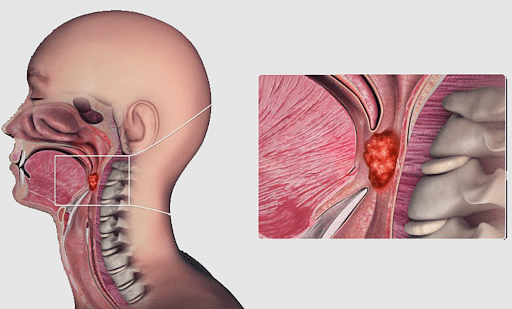
Throat Cancer
Types of Throat Cancer
[Click Here for Sample Questions]
There are various types of throat cancer depending on the region in which it has formed. Cancer that forms in any part of the pharynx are as follow:
- Laryngopharynx cancer- This is the type of cancer that forms in the hypopharynx which is the bottom part of the throat just behind the voice box.
- Nasopharyngeal cancer- This is the type of cancer that forms behind your nose (nasal cavity) in the upper part of your throat.
- Oropharyngeal cancer- This is the type of cancer that forms in the oropharynx which is the area at the back of your mouth it includes your tonsils, soft palate, side and back wall of the throat. The oropharynx is also the part that produces saliva and starts to help you digest the food you eat.
- Laryngeal cancer- This is a type of cancer that forms in the larynx (voice box). Laryngeal cancer is further divided into three parts.
- Glottic cancer- It forms in the true vocal cords in the voice box.
- Supraglottic cancer- It forms in the upper part of the voice box this cancer also affects the epiglottis which is the small piece of cartilage that sits just above the larynx to block food from going into the trachea(windpipe).
- Subglottic cancer- It forms in the lower part of the voice box just below the vocal cords.
Also Read: Active and Passive Immunity
Symptoms of Throat Cancer
[Click Here for Sample Questions]
The symptoms of throat cancer depend on the region in which it has formed.
| Hypopharynx | Nasopharynx | Oropharynx |
|---|---|---|
| Change in your voice (hoarseness) | Headache | Persistent Sore throat and neck lumps |
| Swallowing problems | Ear infection and hearing problems | White patches on the mouth and tongue |
| Sore throat | Nasal congestion and breathing issues | Unexplained Weight loss |
| Lump in neck | Blood from mouth or nose | Difficulty in moving and opening of tongue |
| Persistent ear pain | Sore throat | Jaw pain |
Because the symptoms of pharynx (throat) cancer are similar to those of the common cold and allergies. This makes it difficult for anyone to identify throat cancer in the early stages on their own. In most cases, it is identified by a dentist or a doctor while the person is getting treated for some other disease. The most common symptoms of throat cancer include persistent lumps, sore throats, and coughing. So, if a person is suffering from any of these symptoms for more than two weeks, they should visit the doctor immediately.
Things to Remember
- Throat cancer is a type of head and neck cancer.
- Throat cancer can be treated easily if an early diagnosis is made.
- Chemotherapy and radiotherapy are the most commonly used treatments.
- Squamous cell carcinoma, which affects the flat cells lining the neck, is the most prevalent kind of throat cancer.
Also Read:
Sample Questions
Ques. What are the different forms of cancers of the throat? (5 marks)
Ans. There are several forms of throat cancer, which are distinguished by the portion of the throat where cancer began or developed. The following are the many forms of throat cancers:
- Cancer of the glottis.
- Subglottic carcinoma is a kind of cancer that affects the voice box.
- Supraglottic carcinoma is a kind of cancer that affects the throat.
- Oropharyngeal carcinoma is a kind of cancer that affects the mouth and throat.
- Nasopharyngeal carcinoma is a kind of cancer that affects the nose and throat.
- Cancer of the hypopharynx.
Ques. What causes cancer of the throat? (5 marks)
Ans. The following factors contribute to the creation or expansion of cancer cells in the throat:
- Smoking tobacco in excessive quantity
- Excessive alcohol consumption
- Betel quid and gutka(mostly common in some parts of Asia)
- Human papillomavirus (HPV16,18)
- Epstein-Barr virus (EBV)
Ques. How can we diagnose or detect throat cancer at home? (3 marks)
Ans. One can detect throat cancer by doing a self-examination in the following ways.
- Check your mouth and tongue for any white-colored patches.
- Check for any swelling inside your cheeks, lips, and gums.
- Check your neck for any lymph nodes.
Ques. What are the common signs of throat cancer? (2 marks)
Ans. The symptoms of throat cancer are:
- A sore in your mouth that doesn't heal
- A painful throat
- Lumps or patches in your mouth
- Problems swallowing
- Changes in your voice
- Lump in your neck are all the common signs of throat cancer.
Ques. What is oropharyngeal cancer? (2 marks)
Ans. Oropharyngeal cancer is a type of cancer that affects the tonsils and tongue base and is frequently linked to HPV(Human papillomavirus). Oral cancers, on the other hand, are malignancies that develop in the mouth and are frequently caused by tobacco and alcohol usage.
Ques. How can throat cancer be diagnosed? (5 marks)
Ans. Through the following methods throat cancer can be diagnosed:
- Biopsy
- A tiny sample of tissue or cells will be removed by the doctor and examined under a microscope to discover whether cancer cells are present.
- Laryngoscopy is a type of endoscopy that examines the inside of the throat.
- An endoscope (a tiny tube with a light on one end) will be put via the nose to examine the throat for abnormalities.
- Ultrasound
- A transducer is a tiny device that sends out soundwaves that reverberate when they contact anything substantial, such as an organ or tumor.
- X-rays
- A chest x-ray may be performed to assess your overall health or to determine whether cancer has spread to your lungs. A (computerized tomography) CT scan creates comprehensive cross-sectional pictures of the inside of your body using x-ray rays.
- MRI
- A Magnetic resonance imaging MRI) scan creates comprehensive images of the interior of your body using a magnet and radio waves.
Ques. How can throat cancer be treated? (3 marks)
Ans. Throat cancer can be treated in the following ways:
- Removing cancer from the part by performing surgery.
- Chemotherapy uses cancer-killing drugs to treat cancer.
- Radiotherapy(radiation therapy) is used to kill cancer cells and shrink tumors with high doses of radiation.
For Latest Updates on Upcoming Board Exams, Click Here: https://t.me/class_10_12_board_updates
Check-Out:



Comments