



Education Content Expert
Trigonometry Angles in Mathematics, are the angles that represent the ratios of the trigonometric functions. An angle is defined as the space between (in degrees) two interesting lines or surfaces at or close to the point where they meet.
- The two rays which form the angle are known as the sides or the legs of the angle.
- The common meeting point of the rays is called the vertex.
- 0°, 30°, 45°, 60°, and 90° are considered the standard angles of the six trigonometric ratios namely sin, cosec, cos, tan, sec, and cot.
- All these trigonometric angles have different values from each other with different trigonometric functions.
Read More: NCERT Solutions of Class 10 Maths Introduction to Trigonometry
Key Terms: Trigonometry Angles, Standard Angles, Sine, Tangent, Secant, Radians, Trigonometric Functions
What are Trigonometry Angles?
[Click Here for Sample Questions]
Trigonometry is a branch of mathematics that deals with the measurement of the sides and angles of a triangle. The six different trigonometric ratios of an angle are :
Trigonometry Angles are the angles formed by the above-mentioned six ratios of the trigonometric functions. The value of the angle varies from 0°- 360°. All the important Trignometry Angles are 0°, 30°, 45°, 60°, 90°, 180°, 270°, and 360°.
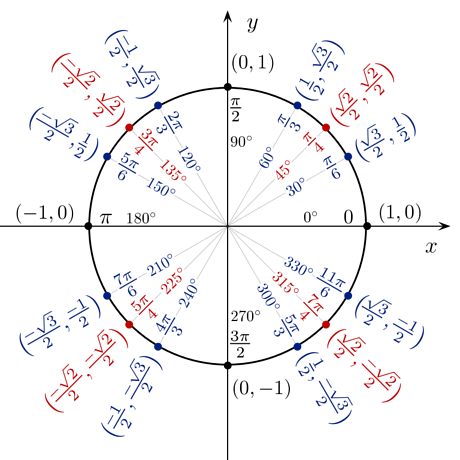
Trigonometry Angles
Radians and Degrees
[Click Here for Sample Questions]
Radians and Degrees are the two different units used to measure an angle.
- Radian is the SI unit for measuring angles.
- However, Degree is the most familiar unit of measurement of an angle.
After one complete rotation around the circle, the radius subtends an angle at the center of the circle, which is equal to 2π radians. This angle is the ratio of the length of the arc to the length of the radius. Radian is denoted as rad.

Radian and Degree
After one complete rotation, the angle subtended at the center of the circle is equal to 360°. Consider a circle that is divided into 360 equal parts and each part is called a degree. It is an accepted unit for measurement of an angle and is denoted by “°”. A protractor is an instrument that is used to measure an angle in degrees.
Therefore,
- 360 degrees = 2π Radians
- 180 degrees = π Radians
To convert an angle in radians to degree, you can use the below mentioned formula:
| Angle in Radians x 180°/π = Angle in Degrees |
Read More:
Trigonometry Table
[Click Here for Sample Questions]
Trigonometry Table consists of the values of the six trigonometric ratios from 0° to 360°. The given trigonometric table features all the values of trigonometric ratios.
| Angle (in Degrees) | 0° | 30° | 45° | 60° | 90° | 180° | 270° | 360° |
|---|---|---|---|---|---|---|---|---|
| Angle (in Radians) | 0 | π/6 | π/4 | π/3 | π/2 | π | 3π/2 | 2π |
| Sin | 0 | 1/2 | 1/√2 | √3/2 | 1 | 0 | -1 | 0 |
| Cos | 1 | √3/2 | 1/√2 | 1/2 | 0 | -1 | 0 | 1 |
| Tan | 0 | 1/√3 | 1 | √3 | ∞ | 0 | ∞ | 0 |
| Cot | ∞ | √3 | 1 | 1/√3 | 0 | ∞ | 1 | ∞ |
| Sec | 1 | 2/√3 | √2 | 2 | ∞ | -1 | ∞ | 1 |
| Cosec | ∞ | 2 | √2 | 2/√3 | 1 | ∞ | -1 | ∞ |
Read More: Introduction to Trigonometry Important Questions
Important Angles of Trigonometry
[Click Here for Sample Questions]
Trigonometric Table comprises all the angles from 0° to 360°. However, only the angles from 0° to 90° are the common angles that are used while computing various trigonometric problems. These angles are often used more when compared to the other angles, that is why they are known as special or important angles.
Positive and Negative Angles
The angles can be of two types namely Positive angles and Negative angles.
- The angle which is measured by rotating counterclockwise from the positive x-axis is called a positive angle.
- The angles measured by clockwise rotation from the positive x-axis are known as negative angles. The direction of both the angles is opposite from each other.
Angles Greater than 360° (2π)
If a circle is started from 0° and ends at 360°, a full circle is made. It means one cycle is completed in the 2-D (X-Y) plane. Thus, if we keeo on rotating it will be observed that the angles are increasing beyond 360°such as 405°, 450°, 540°, 630°, 720°, and so on.
- At 720°, two rotations are fully completed which is 4π in radians. At 1080°, three cycles are completed which is 6π in radians.
- The value of radians after completion of each cycle is calculated as n x 2π.
The table below shows the value of the different number of cycles:
| Number of Cycle | Angle (n x 360°) | Radians (n x 2π) |
|---|---|---|
| 1 | 360° | 2π |
| 2 | 720° | 4π |
| 3 | 1080° | 6π |
| 4 | 1440° | 8π |
| n | n x 360° | 360°n |
Read More: Introduction to Trigonometry Formula
Trigonometric Angles Formulas
[Click Here for Sample Questions]
Following are the formulas for trigonometric angles:
Supplementary Angles
They are those angles whose sum is 180° (π).
- Sin ( 180°– θ) = Sin θ
- Cos (180° - θ ) = – Cos θ
- Tan (180° - θ ) = – Tan θ
- Cot (180° - θ) = – Cot θ
- Sec (180° - θ) = – Sec θ
- Cosec (180° - θ) = Cosec θ
Anti-Supplementary Angles
They are those angles whose difference is 180°(π).
- Sin ( 180°+ θ ) = – sin θ
- Cos (180°+ θ ) = – cos θ
- Tan (180°+ θ) = tan θ
- Cot (180°+ θ ) = cot θ
- Sec (180°+ θ) = – sec θ
- Cosec (180°+ θ) = – cosec θ
Complementary Angles
They are those angles whose sum is 90° (π/2).
- Sin (90° - θ) = cos θ
- Cos (90° - θ) = sin θ
- Tan (90° - θ) = cot θ
- Cosec (90° - θ) = sec θ
- Sec (90° - θ) = cosec θ
- Cot (90° - θ) = tan θ
Opposite Angles
They are those angles whose sum is 360° (2π).
- Sin (360° - θ) = - sin θ
- Cos (360° - θ) = cos θ
- Tan (360° - θ) = - tan θ
- Cosec (360° - θ) = - cosec θ
- Sec ( 360° - θ) = sec θ
- Cot ( 360° - θ) = - cot θ
Check More:
Solved Examples
[Click Here for Sample Questions]
Here are some solved examples on Trigonometry Angles:
| Example 1: Find the value of sin 30o – cos 60o. Solution: Using the Trigonometry Table,
Substituting the values, we get sin 30o – cos 60o = √3/2 – √3/2 = 0 Thus, sin 30o – cos 60o is equal to 0. Example 2: Evaluate the value of 10 sin 30o + tan 45o. Solution: Using the Trigonometry Table,
Substituting the values, we get 10 sin 30o + tan 45o = 10(1/2)+1 = 5 + 1 = 6 Thus, 10 sin 30o + tan 45o is equal to 6. |
Read More: MCQs on Introduction to Trigonometry
Things to Remember
- Trigonometry Angles are the angles formed by the six ratios, namely Sin, Cos, Tan, Cosec, Sec, Cot .
- There are six different trigonometric ratios, each possesses different values pertaining to different angles.
- Trigonometry Table is used to find the value of different trigonometry angles.
- Radians and Degrees are the two important units used to measure degrees.
- There are two types of angles namely negative and positive angles, based on the direction of rotation.
- Angles greater than 180° and less than 360° are called Reflex Angles.
- The value of radians at each cycle for angles greater than 360°, is increased as n×2π.
Sample Questions
Ques. What is the value of sin 60° + 2 tan 45° – cos 30°? (3 marks)
Ans. Using Trigonometry Table,
- Value of sin 60°= √3/2
- Value of tan 45°= 1
- Value of cos 30°= √3/2
Substituting these values, we get,
sin 60° + 2 tan 45° – cos 30°
= √3/2 + 2.1 - √3/2
= √3/2 + 2 – √3/2
= 2
Thus, sin 60° + 2 tan 45° – cos 30° is 2.
Ques. Find the value of sin 90° – cosec 90°. (3 marks)
Ans. Using Trigonometry Table,
- Value of sin 90°= 1
- Value of cosec 90°= 1
Putting the values we get,
sin 90° – cosec 90°
= 1 – 1
= 0
Thus, sin 90° – cosec 90° is 0.
Ques. If A = 60°, verify that sec2 A – tan2 A =1. (2 Marks)
Ans. sec2 A – tan2 A = (sec 60°)2 – (tan 60°)2
= [ 22 – (√3)2]
= 4 - 3
= 1
Hence, verified.
Ques. Evaluate: (cos 0°+ cosec 30°+ sin 30°). sec 60°. (3 Marks)
Ans. Substituting the values of various T-ratios, we get
= (cos 0°+ cosec 30°+ sin 30°). sec 60°
= (1 + 2 + ½ ) . 2
= (3+ ½) . 2
= 7/2 . 2
= 7
Thus, (cos 0°+ cosec 30°+ sin 30°). sec 60° is 7.
Ques. Without using trigonometric tables, prove that sin 26° – cos 64° = 0. (2 Marks)
Ans. To Prove: sin 26° – cos 64° = 0
= sin (90°– 64°) – cos 64°
= cos 64° – cos 64°
= 0
Hence Proved.
Ques. If sin 2a = cos (a-36°), find the value of a. (2 Marks)
Ans. Given, sin 2a = cos (a- 36°)
We can write, sin 2a as cos (90°- 2a)
Then, cos (90°-2a) = cos (a-36°)
90° - 2a = a- 36°
90°+ 36° = 3a
126°= 3a
a = 126°/ 3
Therefore, a = 42°.
Ques. If x = 30°, verify that : cos3x= 4cos3x−3cosx. (3 Marks)
Ans. Given, x=30°
cos 3x = 4cos3 x − 3cos x.
cos 3. 30° = 4. (cos 30°)3 – 3. cos 30°
cos 90° = 4. cos3 30° – 3. cos 30°
0 = 4. (√3/2)3 – 3. √3/2
0 = 4. 3√3/8 – 3√3/2
0 = 3√3/2 – 3√3/2
0 = 0
Hence Proved.
Ques. If x = 30°, verify that 3 sin x – 4 sin3 x = sin 3x. (3 Marks)
Ans. L.H.S = 3 sin x – 4 sin3 x
= 3 sin 30° – 4. sin3 30°
= 3 ∙ (1/2) – 4 ∙ (1/2)3
= 3/2 – 4 ∙ 1/8
= 3/2 – ½
= 1
R.H.S. = sin 3x
= sin 3 ∙ 30°
= sin 90°
= 1
L.H.S. = R.H.S
Hence Proved.
Ques. If x = 60° and y = 30°, prove that sin (x – y) = sin x cos y – cos x sin y. (3 Marks)
Ans. L.H.S. = sin (x – y)
= sin (60° – 30°)
= sin 30°
= ½
R.H.S. = sin x cos y – cos x sin y
= sin 60° cos 30° – cos 60° sin 30°
= (√3/2)×(√3/2)−(1/2)×(1/2)
= ¾ – ¼
= 2/4
= ½
L.H.S. = R.H.S.
Hence Proved.
Ques. If sin 3C = cos (C-26°), where 3C is an acute angle, find the value of C. (3 Marks)
Ans. Given that, sin 3C = cos (C-26°) ….(1)
Since, sin 3C = cos (90° – 3C), we can write (1) as:
cos(90°- 3C)= cos (C- 26°)
Since, 90°-3C = C – 26°
Therefore,
90° + 26° = 3C + C
4 C = 116°
C = 116° / 4 = 29°
Therefore, the value of C is 29°.
For Latest Updates on Upcoming Board Exams, Click Here: https://t.me/class_10_12_board_updates
Check-Out:



Comments