CBSE Class 12 Mathematics Set 3- (65/5/3) Question Paper 2026 is available for download here. CBSE conducted Class 12 Mathematics exam on March 9, 2026 from 10:30 AM to 1:30 PM. The Mathematics theory paper is of 80 marks, and the internal assessment is of 20 marks.

Mathematics question paper includes MCQs (1 mark each), short-answer type questions (2 & 3 marks each), and long-answer type questions (4 & 6 marks each) which makes up the total of 80 marks.

Download CBSE Class 12 Mathematics Set 3- (65/5/3) Question Paper 2026 with detailed solutions from the links provided below.

CBSE Class 12 Mathematics Set 3- (65/5/3) Question Paper 2026 with Solution PDF

CBSE Class 12 Mathematics Question Paper 2026 Set 3- (65/5/3) Download PDF Detailed Solutions

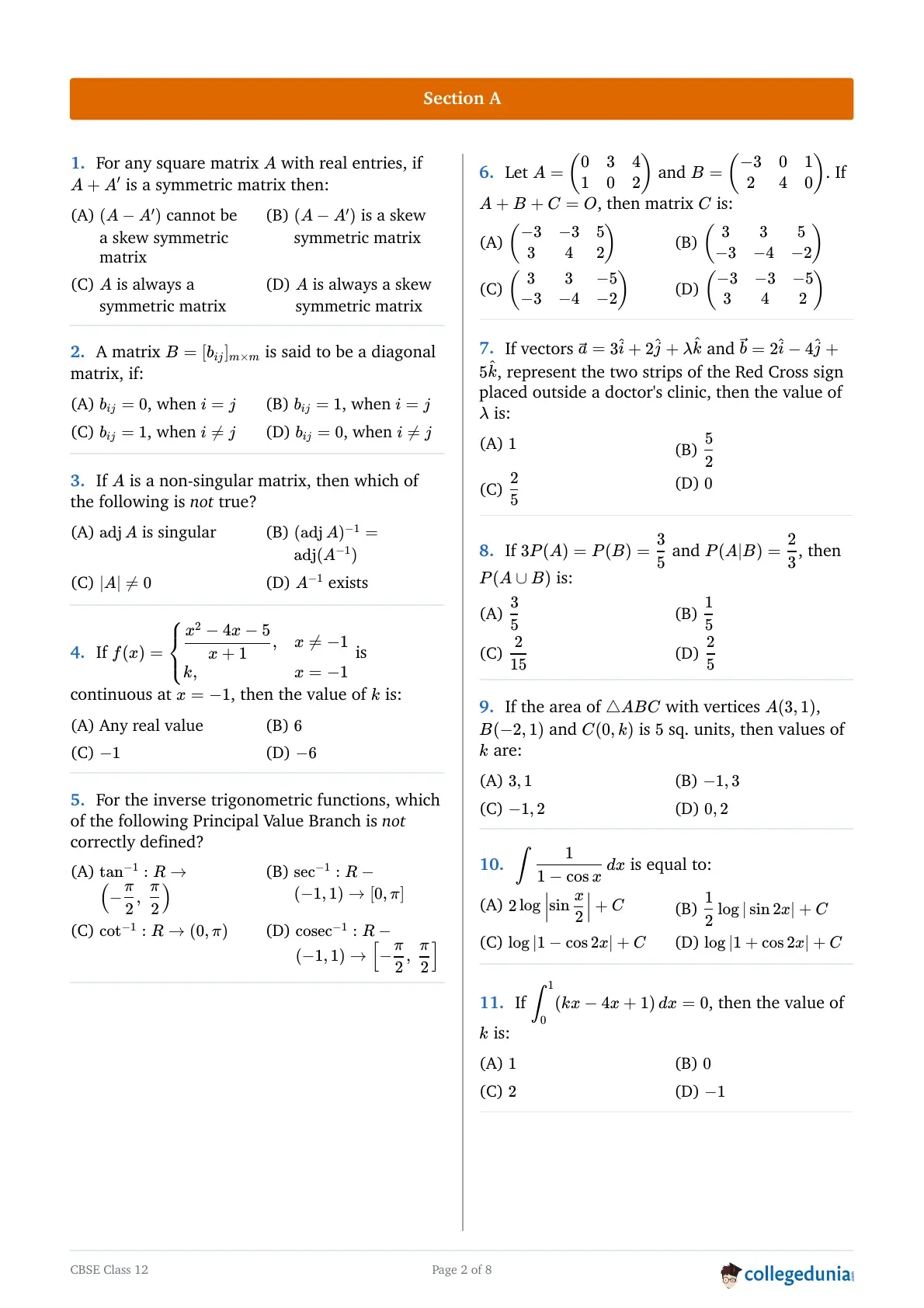
Question 1:

For any square matrix \( A \) with real entries, if \( A + A' \) is a symmetric matrix then :

  • (A) \( (A - A') \) cannot be a skew symmetric matrix
  • (B) \( (A - A') \) is a skew symmetric matrix
  • (C) \( A \) is always a symmetric matrix
  • (D) \( A \) is always a skew symmetric matrix
Correct Answer: (B) \( (A - A') \) is a skew symmetric matrix
View Solution


Concept:

A square matrix \( M \) is defined as symmetric if \( M' = M \).
A square matrix \( M \) is defined as skew-symmetric if \( M' = -M \).
For any square matrix \( A \), the sum \( A + A' \) is always symmetric.
For any square matrix \( A \), the difference \( A - A' \) is always skew-symmetric.


Step 1: Define the matrix and calculate its transpose

Let the matrix be \( X = A - A' \).


To find if it is symmetric or skew-symmetric, we compute its transpose \( X' \):
\[ X' = (A - A')' \]


Applying the transpose property \( (P - Q)' = P' - Q' \):
\[ X' = A' - (A')' \]


Step 2: Simplify the expression using transpose properties

We know that the transpose of a transpose of a matrix is the matrix itself, i.e., \( (A')' = A \).


Substituting this into our equation:
\[ X' = A' - A \]


Factor out the negative sign from the right-hand side:
\[ X' = -(A - A') \]


Step 3: Conclude the type of matrix

Since \( X = A - A' \), we can write:
\[ X' = -X \]


By definition, any matrix \( X \) that satisfies \( X' = -X \) is a skew-symmetric matrix.

Therefore, \( A - A' \) is a skew-symmetric matrix. Quick Tip: Any square matrix \( A \) can be represented as the sum of a symmetric and a skew-symmetric matrix: \( A = \frac{1}{2}(A + A') + \frac{1}{2}(A - A') \).
Standard results: \( (A + A') \) is always symmetric and \( (A - A') \) is always skew-symmetric.


Question 2:

A matrix \( B = [b_{ij}]_{m \times m} \) is said to be a diagonal matrix, if :

  • (A) \( b_{ij} = 0 \), when \( i = j \)
  • (B) \( b_{ij} = 1 \), when \( i = j \)
  • (C) \( b_{ij} = 1 \), when \( i \neq j \)
  • (D) \( b_{ij} = 0 \), when \( i \neq j \)
Correct Answer: (D) \( b_{ij} = 0 \), when \( i \neq j \)
View Solution


Concept:

A diagonal matrix is a square matrix where all the elements outside the main diagonal are zero.
The main diagonal elements are those where the row index equals the column index (\( i = j \)).
Non-diagonal elements are those where the row index does not equal the column index (\( i \neq j \)).


Step 1: Identify the condition for diagonal elements

In a matrix \( B = [b_{ij}]_{m \times m} \), the elements \( b_{11}, b_{22}, \dots, b_{mm} \) are diagonal elements.


For these elements, the condition is \( i = j \).


In a diagonal matrix, these elements can be any value (zero or non-zero).


Step 2: Identify the condition for non-diagonal elements

All other elements in the matrix are called non-diagonal elements.


For these elements, the condition is \( i \neq j \).


By definition, for a matrix to be diagonal, every non-diagonal element must be zero.
\[ b_{ij} = 0 for all i \neq j \] Quick Tip: A scalar matrix is a special diagonal matrix where all diagonal elements are equal (\( b_{ii} = k \)).
An identity matrix is a special diagonal matrix where all diagonal elements are equal to 1 (\( b_{ii} = 1 \)).


Question 3:

If \( A \) is a non-singular matrix, then which of the following is not true ?

  • (A) \( adj A \) is singular
  • (B) \( (adj A)^{-1} = (adj A^{-1}) \)
  • (C) \( |A| \neq 0 \)
  • (D) \( A^{-1} \) exists
Correct Answer: (A) \( \text{adj } A \) is singular
View Solution


Concept:

A matrix \( A \) is non-singular if its determinant is non-zero, i.e., \( |A| \neq 0 \).
For any square matrix \( A \) of order \( n \), the inverse \( A^{-1} \) exists if and only if \( A \) is non-singular.
The determinant of the adjoint is related to the determinant of the matrix by \( |adj A| = |A|^{n-1} \).


Step 1: Analyze the definition of a non-singular matrix

By definition, if \( A \) is non-singular, then:
\[ |A| \neq 0 \]


This confirms that statement (C) is true.


Since \( |A| \neq 0 \), the inverse of the matrix exists, calculated as \( A^{-1} = \frac{1}{|A|} adj A \).


This confirms that statement (D) is true.


Step 2: Evaluate the nature of the adjoint matrix

Let \( A \) be of order \( n \).


We use the property: \( |adj A| = |A|^{n-1} \).


Since \( A \) is non-singular, \( |A| \neq 0 \).


This implies that \( |A|^{n-1} \neq 0 \) (assuming \( n > 1 \)).


Therefore, \( |adj A| \neq 0 \), which means \( adj A \) is also a non-singular matrix.


Thus, statement (A), which claims \( adj A \) is singular, is false.


Step 3: Verify statement (B)

The property \( (adj A)^{-1} = adj (A^{-1}) \) is a standard identity for non-singular matrices.


Since the question asks for what is not true, (A) is the correct choice. Quick Tip: Determinant properties to remember:
1. \( |AB| = |A||B| \)
2. \( |adj\,A| = |A|^{n-1} \)
3. \( |kA| = k^n|A| \), where \(n\) is the order of the matrix.


Question 4:

If \( f(x) = \begin{cases} \frac{x^2 - 4x - 5}{x + 1}, & x \neq -1
k, & x = -1 \end{cases} \) is continuous at \( x = -1 \), then the value of \( k \) is :

  • (A) Any real value
  • (B) \( 6 \)
  • (C) \( -1 \)
  • (D) \( -6 \)
Correct Answer: (D) \( -6 \)
View Solution


Concept:

A function \( f(x) \) is continuous at a point \( x = c \) if the limit of the function as \( x \to c \) exists and is equal to the value of the function at that point.
Mathematically: \( \lim_{x \to c} f(x) = f(c) \).


Step 1: Calculate the limit of the function as \( x \) approaches \( -1 \)

Since \( x \neq -1 \) for the limit, we use the expression \( \frac{x^2 - 4x - 5}{x + 1} \):
\[ L = \lim_{x \to -1} \frac{x^2 - 4x - 5}{x + 1} \]


Factorize the numerator \( x^2 - 4x - 5 \):

Find two numbers that multiply to \( -5 \) and add to \( -4 \). These are \( -5 \) and \( +1 \).
\[ x^2 - 4x - 5 = (x - 5)(x + 1) \]


Substitute this back into the limit:
\[ L = \lim_{x \to -1} \frac{(x - 5)(x + 1)}{x + 1} \]


Step 2: Simplify and evaluate the limit

Cancel the common factor \( (x + 1) \) since \( x \to -1 \) means \( x \neq -1 \):
\[ L = \lim_{x \to -1} (x - 5) \]


Substitute \( x = -1 \):
\[ L = -1 - 5 = -6 \]


Step 3: Apply the condition of continuity

For \( f(x) \) to be continuous at \( x = -1 \), we must have:
\[ \lim_{x \to -1} f(x) = f(-1) \]


From the function definition, \( f(-1) = k \).


From our calculation, \( \lim_{x \to -1} f(x) = -6 \).


Equating the two:
\[ k = -6 \] Quick Tip: When evaluating limits of the form \( \frac{0}{0} \), always look for algebraic simplification like factorization or rationalization first.
Alternatively, you can use L'Hôpital's Rule: differentiate the numerator and denominator separately.


Question 5:

For the inverse trigonometric functions, which of the following Principal Value Branch is not correctly defined ?

  • (A) \( \tan^{-1} : \mathbb{R} \to \left( -\frac{\pi}{2}, \frac{\pi}{2} \right) \)
  • (B) \( \sec^{-1} : \mathbb{R} - (-1, 1) \to [0, \pi] - \left\{ \frac{\pi}{2} \right\} \)
  • (C) \( \cot^{-1} : \mathbb{R} \to (0, \pi) \)
  • (D) \( \csc^{-1} : \mathbb{R} - (-1, 1) \to \left[ -\frac{\pi}{2}, \frac{\pi}{2} \right] \)
Correct Answer: (D) \( \csc^{-1} : \mathbb{R} - (-1, 1) \to \left[ -\frac{\pi}{2}, \frac{\pi}{2} \right] \)
View Solution


Concept:

Principal Value Branches refer to the range of the inverse trigonometric functions within which the function is one-to-one and onto.
These ranges are standardized to maintain consistency in calculations.


Step 1: Verify the branch for \( \tan^{-1} \) and \( \cot^{-1} \)

The range of \( \tan^{-1} x \) is the open interval \( \left( -\frac{\pi}{2}, \frac{\pi}{2} \right) \).


Thus, (A) is correctly defined.


The range of \( \cot^{-1} x \) is the open interval \( (0, \pi) \).


Thus, (C) is correctly defined.


Step 2: Verify the branch for \( \sec^{-1} \)

The domain of \( \sec^{-1} x \) is \( (-\infty, -1] \cup [1, \infty) \), often written as \( \mathbb{R} - (-1, 1) \).


Its range is \( [0, \pi] \) excluding the value where \( \cos \theta = 0 \), which is \( \frac{\pi}{2} \).


Range of \( \sec^{-1} = [0, \pi] - \left\{ \frac{\pi}{2} \right\} \).


Thus, (B) is correctly defined.


Step 3: Verify the branch for \( \csc^{-1} \)

The domain of \( \csc^{-1} x \) is \( \mathbb{R} - (-1, 1) \).


Its range is \( \left[ -\frac{\pi}{2}, \frac{\pi}{2} \right] \) excluding the value where \( \sin \theta = 0 \), which is \( 0 \).


Correct Range of \( \csc^{-1} = \left[ -\frac{\pi}{2}, \frac{\pi}{2} \right] - \{0\} \).


Option (D) provides the range as \( \left[ -\frac{\pi}{2}, \frac{\pi}{2} \right] \) without excluding \( \{0\} \).


Therefore, (D) is not correctly defined. Quick Tip: Memory trick for ranges:
- Group 1 (\( \sin^{-1}, \tan^{-1}, \csc^{-1} \)) are related to \( [-\pi/2, \pi/2] \).
- Group 2 (\( \cos^{-1}, \cot^{-1}, \sec^{-1} \)) are related to \( [0, \pi] \).
Remember to exclude points where the original function is undefined (denominator zero).


Question 6:

Let \( A = \begin{bmatrix} 0 & -3 & 4 \\ 1 & 0 & 2 \end{bmatrix} \) and \( B = \begin{bmatrix} -3 & 0 & 1 \\ 2 & 4 & 0 \end{bmatrix} \). If \( A + B + C = O \), then matrix \( C \) is :

  • (A) \( \begin{bmatrix} -3 & -3 & 5 \\ 3 & 4 & 2 \end{bmatrix} \)
  • (B) \( \begin{bmatrix} 3 & 3 & 5 \\ -3 & -4 & -2 \end{bmatrix} \)
  • (C) \( \begin{bmatrix} 3 & 3 & -5 \\ -3 & -4 & -2 \end{bmatrix} \)
  • (D) \( \begin{bmatrix} -3 & -3 & -5 \\ 3 & 4 & 2 \end{bmatrix} \)
Correct Answer: (C) \( \begin{bmatrix} 3 & 3 & -5 \\ -3 & -4 & -2 \end{bmatrix} \)
View Solution


Concept:

Matrix addition is performed by adding corresponding elements of the matrices.
The zero matrix \( O \) of a particular order has all its elements equal to zero.
In the equation \( A + B + C = O \), the matrix \( C \) can be found by isolating it: \( C = -(A + B) \).


Step 1: Calculate the sum of matrices \( A \) and \( B \)

The matrices are given as:
\[ A = \begin{bmatrix} 0 & -3 & 4 \\ 1 & 0 & 2 \end{bmatrix}, \quad B = \begin{bmatrix} -3 & 0 & 1 \\ 2 & 4 & 0 \end{bmatrix} \]


Perform element-wise addition:
\[ A + B = \begin{bmatrix} 0 + (-3) & -3 + 0 & 4 + 1 \\ 1 + 2 & 0 + 4 & 2 + 0 \end{bmatrix} \]

\[ A + B = \begin{bmatrix} -3 & -3 & 5 \\ 3 & 4 & 2 \end{bmatrix} \]


Step 2: Find matrix \( C \) using the given equation

The problem states that \( A + B + C = O \).


Subtracting \( (A+B) \) from both sides:
\[ C = O - (A + B) \]

\[ C = \begin{bmatrix} 0 & 0 & 0 \\ 0 & 0 & 0 \end{bmatrix} - \begin{bmatrix} -3 & -3 & 5 \\ 3 & 4 & 2 \end{bmatrix} \]


Step 3: Distribute the negative sign to find final elements

Negate every element in the resulting sum matrix:
\[ C = \begin{bmatrix} -(-3) & -(-3) & -(5) \\ -(3) & -(4) & -(2) \end{bmatrix} \]

\[ C = \begin{bmatrix} 3 & 3 & -5 \\ -3 & -4 & -2 \end{bmatrix} \] Quick Tip: To avoid calculation errors with signs, calculate \( A+B \) first as a single matrix, then simply flip the sign of every element to get \( C \) when \( A+B+C=O \).


Question 7:

If vectors \( \vec{a} = 3\hat{i} + 2\hat{j} + \lambda\hat{k} \) and \( \vec{b} = 2\hat{i} - 4\hat{j} + 5\hat{k} \), represent the two strips of the Red Cross sign placed outside a doctor's clinic, then the value of \( \lambda \) is :

  • (A) \( 1 \)
  • (B) \( \frac{5}{2} \)
  • (C) \( \frac{2}{5} \)
  • (D) \( 0 \)
Correct Answer: (C) \( \frac{2}{5} \)
View Solution


Concept:

The Red Cross sign consists of two rectangular strips that are perpendicular to each other.
If two non-zero vectors \( \vec{a} \) and \( \vec{b} \) are perpendicular, their dot product must be zero: \( \vec{a} \cdot \vec{b} = 0 \).
Dot product of \( a_1\hat{i} + a_2\hat{j} + a_3\hat{k} \) and \( b_1\hat{i} + b_2\hat{j} + b_3\hat{k} \) is \( a_1b_1 + a_2b_2 + a_3b_3 \).


Step 1: Identify the geometric relationship between the vectors

The question mentions the "Red Cross sign".


In a Red Cross sign, the two strips intersect at right angles (\( 90^\circ \)).


Therefore, the vectors \( \vec{a} \) and \( \vec{b} \) representing these strips are perpendicular to each other.


Step 2: Apply the condition for perpendicularity

For \( \vec{a} \perp \vec{b} \), we have:
\[ \vec{a} \cdot \vec{b} = 0 \]


Substitute the components of the given vectors:
\[ (3\hat{i} + 2\hat{j} + \lambda\hat{k}) \cdot (2\hat{i} - 4\hat{j} + 5\hat{k}) = 0 \]


Step 3: Solve for \( \lambda \)

Multiply the corresponding components:
\[ (3 \times 2) + (2 \times -4) + (\lambda \times 5) = 0 \]

\[ 6 - 8 + 5\lambda = 0 \]

\[ -2 + 5\lambda = 0 \]

\[ 5\lambda = 2 \]

\[ \lambda = \frac{2}{5} \] Quick Tip: Perpendicular vectors always have a zero dot product. This is the most common way to find an unknown parameter in vector questions involving geometry.


Question 8:

If \( 3P(A) = P(B) = \frac{3}{5} \) and \( P(A|B) = \frac{2}{3} \), then \( P(A \cup B) \) is :

  • (A) \( \frac{3}{5} \)
  • (B) \( \frac{1}{5} \)
  • (C) \( \frac{2}{15} \)
  • (D) \( \frac{2}{5} \)
Correct Answer: (D) \( \frac{2}{5} \)
View Solution


Concept:

Definition of conditional probability: \( P(A|B) = \frac{P(A \cap B)}{P(B)} \).
Addition theorem of probability: \( P(A \cup B) = P(A) + P(B) - P(A \cap B) \).


Step 1: Determine the individual probabilities \( P(A) \) and \( P(B) \)

From the given equation \( 3P(A) = P(B) = \frac{3}{5} \):


For \( P(B) \):
\[ P(B) = \frac{3}{5} \]


For \( P(A) \):
\[ 3P(A) = \frac{3}{5} \implies P(A) = \frac{1}{3} \times \frac{3}{5} = \frac{1}{5} \]


Step 2: Calculate the intersection probability \( P(A \cap B) \)

Use the conditional probability formula:
\[ P(A|B) = \frac{P(A \cap B)}{P(B)} \]


Substitute the known values:
\[ \frac{2}{3} = \frac{P(A \cap B)}{3/5} \]

\[ P(A \cap B) = \frac{2}{3} \times \frac{3}{5} = \frac{2}{5} \]


Step 3: Apply the addition theorem

To find \( P(A \cup B) \):
\[ P(A \cup B) = P(A) + P(B) - P(A \cap B) \]


Substitute the values obtained in the previous steps:
\[ P(A \cup B) = \frac{1}{5} + \frac{3}{5} - \frac{2}{5} \]

\[ P(A \cup B) = \frac{1 + 3 - 2}{5} = \frac{2}{5} \] Quick Tip: Always start by listing down what is given and identifying which formula connects the required quantity with the given values. Here, finding the intersection first was mandatory.


Question 9:

If the area of \( \triangle ABC \) with vertices \( A(3, 1) \), \( B(-2, 1) \) and \( C(0, k) \) is 5 sq. units, then values of \( k \) are :

  • (A) \( 3, 1 \)
  • (B) \( -1, 3 \)
  • (C) \( -1, 2 \)
  • (D) \( 0, 2 \)
Correct Answer: (B) \( -1, 3 \)
View Solution


Concept:

The area of a triangle with vertices \( (x_1, y_1) \), \( (x_2, y_2) \), and \( (x_3, y_3) \) is given by:
\[ Area = \frac{1}{2} |x_1(y_2 - y_3) + x_2(y_3 - y_1) + x_3(y_1 - y_2)| \]
Alternatively, it can be expressed in determinant form:
\[ Area = \frac{1}{2} \left| \det \begin{bmatrix} x_1 & y_1 & 1 \\ x_2 & y_2 & 1 \\ x_3 & y_3 & 1 \end{bmatrix} \right| \]


Step 1: Set up the equation for the area

Substitute the given coordinates \( A(3, 1) \), \( B(-2, 1) \), and \( C(0, k) \) into the area formula:
\[ 5 = \frac{1}{2} |3(1 - k) + (-2)(k - 1) + 0(1 - 1)| \]

\[ 10 = |3 - 3k - 2k + 2| \]


Step 2: Simplify the absolute value expression
\[ 10 = |5 - 5k| \]


Divide both sides by 5 inside the absolute value:
\[ 2 = |1 - k| \]


Step 3: Solve the absolute value equation for \( k \)

This yields two possible cases:


Case 1: \( 1 - k = 2 \)
\[ -k = 1 \implies k = -1 \]


Case 2: \( 1 - k = -2 \)
\[ -k = -3 \implies k = 3 \]


So, the possible values for \( k \) are \( -1 \) and \( 3 \). Quick Tip: When solving for variables using area, never forget to use the modulus sign. Area is always positive, which leads to two possible geometric configurations and hence two values for the variable.


Question 10:

\( \int \sqrt{\frac{1 + \cos x}{1 - \cos x}} \, dx \) is equal to :

  • (A) \( 2 \log \left| \sin \frac{x}{2} \right| + C \)
  • (B) \( \frac{1}{2} \log |\sin 2x| + C \)
  • (C) \( \log |1 - \cos 2x| + C \)
  • (D) \( \log |1 + \cos 2x| + C \)
Correct Answer: (A) \( 2 \log \left| \sin \frac{x}{2} \right| + C \)
View Solution


Concept:

Half-angle trigonometric identities:
\[ 1 + \cos x = 2 \cos^2 \left( \frac{x}{2} \right) \]
\[ 1 - \cos x = 2 \sin^2 \left( \frac{x}{2} \right) \]
Basic integral of cotangent: \( \int \cot \theta \, d\theta = \log |\sin \theta| + C \).


Step 1: Simplify the integrand using trigonometric identities

Substitute the half-angle formulas into the expression:
\[ I = \int \sqrt{\frac{2 \cos^2(x/2)}{2 \sin^2(x/2)}} \, dx \]


The factor of 2 cancels out:
\[ I = \int \sqrt{\frac{\cos^2(x/2)}{\sin^2(x/2)}} \, dx \]

\[ I = \int \sqrt{\cot^2(x/2)} \, dx \]

\[ I = \int \cot(x/2) \, dx \]


Step 2: Integrate the simplified expression

Let \( u = \frac{x}{2} \), then \( du = \frac{1}{2} dx \implies dx = 2 du \).


Substituting these into the integral:
\[ I = \int \cot(u) \cdot 2 du \]

\[ I = 2 \int \cot(u) du \]


Step 3: Write the final answer in terms of \( x \)

Using the standard formula for \( \int \cot u \, du = \log |\sin u| + C \):
\[ I = 2 \log |\sin u| + C \]


Substitute back \( u = x/2 \):
\[ I = 2 \log \left| \sin \frac{x}{2} \right| + C \] Quick Tip: Whenever you see \( \sqrt{1 \pm \cos x} \), the first instinct should be to use half-angle identities to eliminate the square root and the constant term.


Question 11:

If \( \int_0^1 (6x^2 - 4x + k) \, dx = 0 \), then the value of \( k \) is :

  • (A) \( 1 \)
  • (B) \( 0 \)
  • (C) \( 2 \)
  • (D) \( -1 \)
Correct Answer: (B) 0
View Solution


Concept:

Power Rule of Integration: \( \int x^n \, dx = \frac{x^{n+1}}{n+1} \).
Fundamental Theorem of Calculus: \( \int_a^b f(x) \, dx = F(b) - F(a) \), where \( F \) is the antiderivative.


Step 1: Find the antiderivative of the given function

The given integral is \( \int_0^1 (6x^2 - 4x + k) \, dx \).


Apply the sum rule and power rule for integration:
\[ \int (6x^2 - 4x + k) \, dx = 6\left(\frac{x^3}{3}\right) - 4\left(\frac{x^2}{2}\right) + kx \]


Simplify the expression:
\[ = 2x^3 - 2x^2 + kx \]


Step 2: Apply the limits of integration

Substitute the upper limit \( 1 \) and the lower limit \( 0 \) into the antiderivative:
\[ [2x^3 - 2x^2 + kx]_0^1 = (2(1)^3 - 2(1)^2 + k(1)) - (2(0)^3 - 2(0)^2 + k(0)) \]


Simplify the resulting expression:
\[ = (2 - 2 + k) - 0 = k \]


Step 3: Equate to zero and solve for \( k \)

The problem states that the definite integral is equal to zero.

\[ k = 0 \] Quick Tip: For polynomial integration, integrate term by term. If the lower limit is zero, terms containing \( x \) will vanish, making the calculation dependent only on the upper limit.


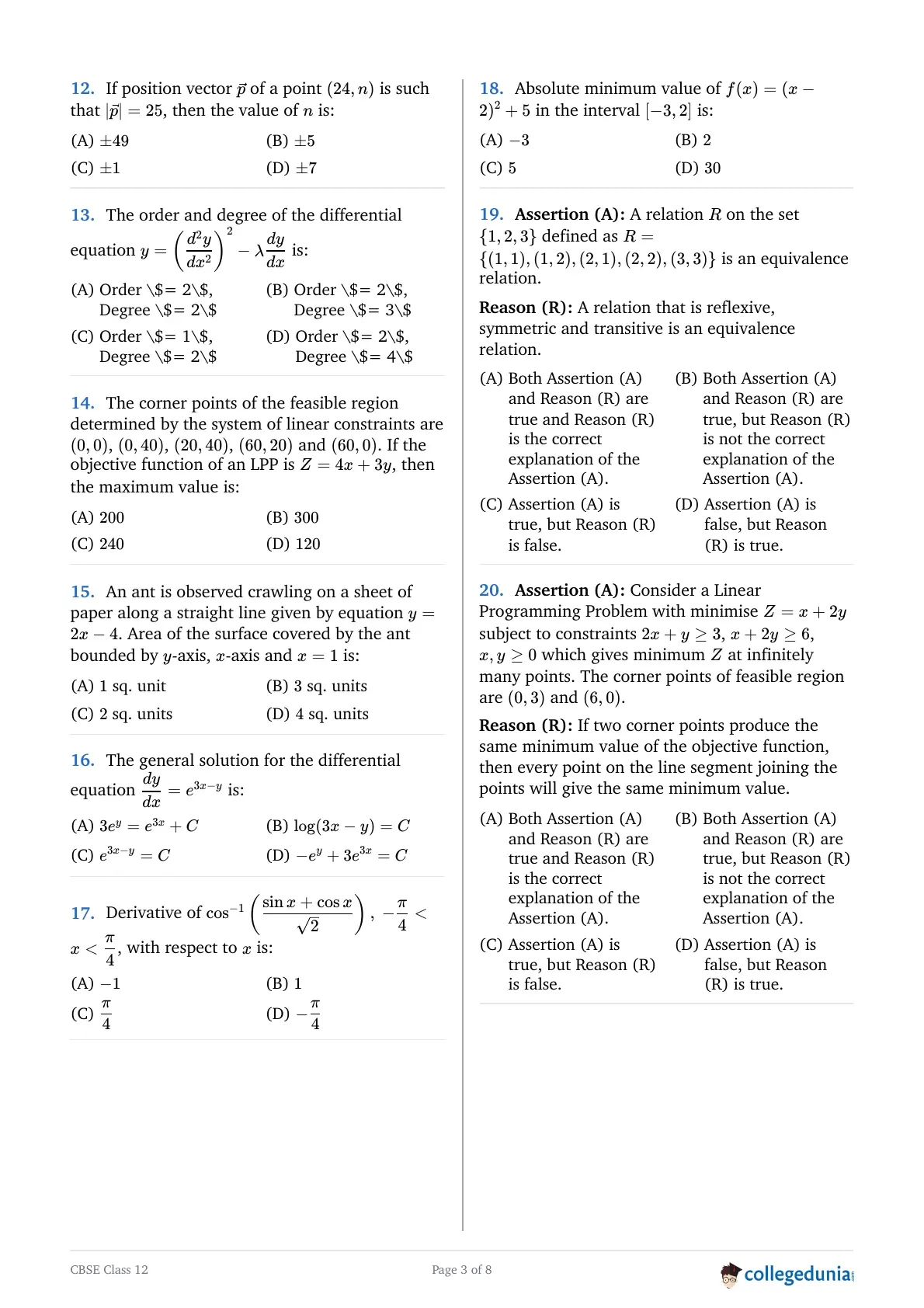
Question 12:

If position vector \( \vec{p} \) of a point \( (24, n) \) is such that \( |\vec{p}| = 25 \), then the value of \( n \) is :

  • (A) \( \pm 49 \)
  • (B) \( \pm 5 \)
  • (C) \( \pm 1 \)
  • (D) \( \pm 7 \)
Correct Answer: (D) \( \pm 7 \)
View Solution


Concept:

The position vector of a point \( (x, y) \) is \( \vec{p} = x\hat{i} + y\hat{j} \).
The magnitude (length) of a vector \( \vec{v} = a\hat{i} + b\hat{j} \) is given by \( |\vec{v}| = \sqrt{a^2 + b^2} \).


Step 1: Express the position vector and its magnitude

For the point \( (24, n) \), the position vector is:
\[ \vec{p} = 24\hat{i} + n\hat{j} \]


The magnitude is given as:
\[ |\vec{p}| = \sqrt{24^2 + n^2} \]


Step 2: Set up the equation using the given magnitude

We are given that \( |\vec{p}| = 25 \).

\[ \sqrt{24^2 + n^2} = 25 \]


Square both sides of the equation to remove the square root:
\[ 24^2 + n^2 = 25^2 \]


Step 3: Calculate numerical values and solve for \( n \)

Calculate the squares of 24 and 25:
\[ 576 + n^2 = 625 \]


Isolate \( n^2 \):
\[ n^2 = 625 - 576 \]

\[ n^2 = 49 \]


Take the square root of both sides:
\[ n = \pm \sqrt{49} = \pm 7 \] Quick Tip: Recognize Pythagorean triplets to save time! \( (7, 24, 25) \) is a standard triplet, meaning \( 7^2 + 24^2 = 25^2 \). Always include both positive and negative roots when taking a square root for a coordinate.


Question 13:

The order and degree of differential equation \( y = \left( \frac{d^2y}{dx^2} \right)^2 - \lambda \frac{dy}{dx} \) is :

  • (A) Order = 2, Degree = 2
  • (B) Order = 2, Degree = 3
  • (C) Order = 1, Degree = 2
  • (D) Order = 2, Degree = 4
Correct Answer: (A) Order = 2, Degree = 2
View Solution


Concept:

Order of a differential equation is the order of the highest derivative occurring in it.
Degree of a differential equation is the power of the highest order derivative when the equation is expressed as a polynomial in its derivatives.


Step 1: Identify the highest order derivative

Look at the terms involving derivatives in the equation:
\[ y = \left( \frac{d^2y}{dx^2} \right)^2 - \lambda \left( \frac{dy}{dx} \right) \]


The derivatives present are \( \frac{d^2y}{dx^2} \) (second order) and \( \frac{dy}{dx} \) (first order).


The highest order is 2. So, Order = 2.


Step 2: Determine the degree of the equation

Identify the term containing the highest order derivative, which is \( \left( \frac{d^2y}{dx^2} \right)^2 \).


The power to which this highest order derivative is raised is 2.


Since the equation is already in polynomial form with respect to derivatives (no fractional powers or derivatives inside transcendental functions), this power is the degree.


So, Degree = 2. Quick Tip: Order is always defined for any differential equation. Degree is defined only if the equation can be written as a polynomial in its derivatives. Always check the power of the highest derivative for degree.


Question 14:

The corner points of the feasible region determined by the system of linear constraints are \( (0, 0) \), \( (0, 40) \), \( (20, 40) \), \( (60, 20) \) and \( (60, 0) \). If the objective function of an LPP is \( Z = 4x + 3y \), then the maximum value is :

  • (A) \( 200 \)
  • (B) \( 300 \)
  • (C) \( 240 \)
  • (D) \( 120 \)
Correct Answer: (B) 300
View Solution


Concept:

Corner Point Theorem: The maximum or minimum value of an objective function in a Linear Programming Problem occurs at one of the corner points (vertices) of the feasible region.


Step 1: Evaluate the objective function at each corner point

Objective Function: \( Z = 4x + 3y \).


Calculate \( Z \) for each given point:


1. For \( (0, 0) \): \( Z = 4(0) + 3(0) = 0 \)


2. For \( (0, 40) \): \( Z = 4(0) + 3(40) = 120 \)


3. For \( (20, 40) \): \( Z = 4(20) + 3(40) = 80 + 120 = 200 \)


4. For \( (60, 20) \): \( Z = 4(60) + 3(20) = 240 + 60 = 300 \)


5. For \( (60, 0) \): \( Z = 4(60) + 3(0) = 240 \)


Step 2: Identify the maximum value from the results

Compare all calculated values of \( Z \):
\[ \{0, 120, 200, 300, 240\} \]


The largest value among these is 300, which occurs at the point \( (60, 20) \). Quick Tip: Always double-check your arithmetic for each vertex. In LPP, the optimal solution is guaranteed to be at a corner point, so you don't need to check any interior points.


Question 15:

An ant is observed crawling on a sheet of paper along a straight line given by equation \( y = 2x - 4 \). Area of the surface covered by the ant bounded by y-axis, x-axis and \( x = 1 \) is :

  • (A) \( 1 sq. unit \)
  • (B) \( 3 sq. units \)
  • (C) \( 2 sq. units \)
  • (D) \( 4 sq. units \)
Correct Answer: (B) 3 sq. units
View Solution


Concept:

Area under a curve \( y = f(x) \) bounded by the x-axis and lines \( x = a \), \( x = b \) is given by \( \int_a^b |f(x)| \, dx \).
For a region below the x-axis, the definite integral will be negative, so we take the absolute value for area.


Step 1: Determine the integration limits and sign of the function

The area is bounded by the y-axis (\( x = 0 \)), the line \( x = 1 \), and the x-axis (\( y = 0 \)).


In the interval \( [0, 1] \), let's check the sign of \( y = 2x - 4 \):

At \( x = 0, y = -4 \).

At \( x = 1, y = -2 \).


Since the function is always negative in this interval, the curve lies below the x-axis.


Step 2: Set up the integral for the area

Area \( A = \int_0^1 |2x - 4| \, dx \).


Since \( 2x - 4 \) is negative on \( [0, 1] \), \( |2x - 4| = -(2x - 4) = 4 - 2x \).

\[ A = \int_0^1 (4 - 2x) \, dx \]


Step 3: Evaluate the definite integral

Integrate the expression:
\[ A = [4x - x^2]_0^1 \]


Substitute the limits:
\[ A = (4(1) - (1)^2) - (4(0) - 0^2) \]

\[ A = (4 - 1) - 0 = 3 sq. units \] Quick Tip: Geometrically, this region is a trapezoid with vertices \( (0,0), (1,0), (1,-2), (0,-4) \). You can verify the area using the formula: \( \frac{1}{2} \times (sum of parallel sides) \times height = \frac{1}{2} \times (4 + 2) \times 1 = 3 \).


Question 16:

The general solution for the differential equation \( \frac{dy}{dx} = e^{3x-y} \) is :

  • (A) \( 3e^y = e^{3x} + C \)
  • (B) \( \log (3x - y) = C \)
  • (C) \( e^{3x-y} = C \)
  • (D) \( -e^y + 3e^{3x} = C \)
Correct Answer: (A) \( 3e^y = e^{3x} + C \)
View Solution


Concept:

Variable Separable Method: If a differential equation can be written in the form \( f(y) dy = g(x) dx \), it can be solved by integrating both sides.
Exponential properties: \( e^{a-b} = e^a \cdot e^{-b} = \frac{e^a}{e^b} \).


Step 1: Separate the variables \( x \) and \( y \)

The given differential equation is:
\[ \frac{dy}{dx} = e^{3x-y} \]


Using the law of exponents \( e^{A-B} = \frac{e^A}{e^B} \):
\[ \frac{dy}{dx} = \frac{e^{3x}}{e^y} \]


Rearrange the terms to put all \( y \) terms on the left and all \( x \) terms on the right:
\[ e^y \, dy = e^{3x} \, dx \]


Step 2: Integrate both sides of the equation

Apply the integral sign to both sides:
\[ \int e^y \, dy = \int e^{3x} \, dx \]


Recall the standard integral \( \int e^{ax} \, dx = \frac{e^{ax}}{a} + C \):
\[ e^y = \frac{e^{3x}}{3} + C_1 \]


Step 3: Simplify to match the given options

Multiply the entire equation by 3 to eliminate the fraction:
\[ 3e^y = e^{3x} + 3C_1 \]


Let \( 3C_1 = C \) (where \( C \) is a new arbitrary constant):
\[ 3e^y = e^{3x} + C \] Quick Tip: When variables are in the exponent in a subtraction form, always split the base using \( e^{a-b} = e^a/e^b \) to immediately identify the variable separable form.


Question 17:

Derivative of \( \cos^{-1} \left( \frac{\sin x + \cos x}{\sqrt{2}} \right) \), \( -\frac{\pi}{4} < x < \frac{\pi}{4} \) with respect to \( x \) is :

  • (A) \( -1 \)
  • (B) \( 1 \)
  • (C) \( \frac{\pi}{4} \)
  • (D) \( -\frac{\pi}{4} \)
Correct Answer: (A) \( -1 \)
View Solution


Concept:

Simplify the trigonometric expression inside the inverse function using the formula \( \cos(A - B) = \cos A \cos B + \sin A \sin B \).
\( \cos^{-1}(\cos \theta) = \theta \) if \( \theta \) lies in the principal value branch \( [0, \pi] \).


Step 1: Simplify the trigonometric expression

Let \( y = \cos^{-1} \left( \frac{\sin x + \cos x}{\sqrt{2}} \right) \).


Rewrite the term inside as:
\[ \frac{1}{\sqrt{2}} \sin x + \frac{1}{\sqrt{2}} \cos x \]


Since \( \sin \frac{\pi}{4} = \frac{1}{\sqrt{2}} \) and \( \cos \frac{\pi}{4} = \frac{1}{\sqrt{2}} \), we can write:
\[ \sin \frac{\pi}{4} \sin x + \cos \frac{\pi}{4} \cos x = \cos \left( x - \frac{\pi}{4} \right) \]


Thus, \( y = \cos^{-1} \left( \cos \left( x - \frac{\pi}{4} \right) \right) \).


Step 2: Check the range for the principal value

We are given \( -\frac{\pi}{4} < x < \frac{\pi}{4} \).


Subtract \( \frac{\pi}{4} \) from all sides:
\[ -\frac{\pi}{4} - \frac{\pi}{4} < x - \frac{\pi}{4} < \frac{\pi}{4} - \frac{\pi}{4} \]
\[ -\frac{\pi}{2} < x - \frac{\pi}{4} < 0 \]


Since \( \cos(-\theta) = \cos \theta \), we have \( \cos(x - \pi/4) = \cos(\pi/4 - x) \).


In this case, \( 0 < \frac{\pi}{4} - x < \frac{\pi}{2} \), which is inside the principal range \( [0, \pi] \).


So, \( y = \frac{\pi}{4} - x \).


Step 3: Differentiate with respect to \( x \)
\[ \frac{dy}{dx} = \frac{d}{dx} \left( \frac{\pi}{4} - x \right) \]

\[ \frac{dy}{dx} = 0 - 1 = -1 \] Quick Tip: Always try to simplify the expression inside an inverse trigonometric function into the form of the corresponding direct function to "cancel" them out. Check the given range carefully to handle signs.


Question 18:

Absolute minimum value of \( f(x) = (x - 2)^2 + 5 \) in the interval \( [-3, 2] \) is :

  • (A) \( -3 \)
  • (B) \( 2 \)
  • (C) \( 5 \)
  • (D) \( 30 \)
Correct Answer: (C) \( 5 \)
View Solution


Concept:

For a continuous function on a closed interval, the absolute minimum occurs either at the critical points (where \( f'(x) = 0 \)) or at the endpoints of the interval.


Step 1: Find the critical points of the function

Differentiate \( f(x) \):
\[ f'(x) = \frac{d}{dx} ((x - 2)^2 + 5) = 2(x - 2) \]


Set the derivative to zero to find critical points:
\[ 2(x - 2) = 0 \implies x = 2 \]


The critical point \( x = 2 \) is within the given interval \( [-3, 2] \).


Step 2: Evaluate the function at the critical point and endpoints

The critical point and one endpoint are the same (\( x = 2 \)).


1. At \( x = 2 \):
\[ f(2) = (2 - 2)^2 + 5 = 0 + 5 = 5 \]


2. At \( x = -3 \):
\[ f(-3) = (-3 - 2)^2 + 5 = (-5)^2 + 5 = 25 + 5 = 30 \]


Step 3: Identify the absolute minimum value

Comparing the values \( \{5, 30\} \), the smallest value is 5.


Therefore, the absolute minimum value is 5. Quick Tip: For quadratic functions in the form \( (x-h)^2 + k \), the vertex is at \( (h, k) \). Since it's a "upward" parabola, the minimum value is simply \( k \) if \( h \) falls within your interval.


Question 19:

Assertion (A) : A relation \( R \) on the set \( \{1, 2, 3\} \) defined as \( R = \{(1, 1), (1, 2), (2, 1), (2, 2), (3, 3)\} \) is an equivalence relation.

Reason (R) : A relation that is reflexive, symmetric and transitive is an equivalence relation.

  • (A) Both Assertion (A) and Reason (R) are true and Reason (R) is the correct explanation of the Assertion (A).
  • (B) Both Assertion (A) and Reason (R) are true, but Reason (R) is not the correct explanation of the Assertion (A).
  • (C) Assertion (A) is true, but Reason (R) is false.
  • (D) Assertion (A) is false, but Reason (R) is true.
Correct Answer: (A) Both Assertion (A) and Reason (R) are true and Reason (R) is the correct explanation of the Assertion (A).
View Solution


Concept:

A relation is reflexive if \( (a, a) \in R \) for all \( a \) in the set.
A relation is symmetric if \( (a, b) \in R \implies (b, a) \in R \).
A relation is transitive if \( (a, b) \in R \) and \( (b, c) \in R \implies (a, c) \in R \).
An equivalence relation satisfies all three properties.


Step 1: Analyze the Assertion (A)

Set \( S = \{1, 2, 3\} \). Given relation \( R = \{(1, 1), (1, 2), (2, 1), (2, 2), (3, 3)\} \).


1. Reflexive: Since \( (1,1), (2,2), (3,3) \in R \), it is reflexive.


2. Symmetric: Here \( (1,2) \in R \) and its reverse \( (2,1) \) is also in \( R \). All others are identity pairs which are symmetric. So, it is symmetric.


3. Transitive: Since \( (1,2) \in R \) and \( (2,1) \in R \), we check if \( (1,1) \in R \). Yes. Similarly for other pairs. It is transitive.


Since all three hold, Assertion (A) is true.


Step 2: Analyze the Reason (R)

The Reason (R) states the standard definition of an equivalence relation.


Since this definition is universally true in set theory, Reason (R) is true.


Step 3: Determine if Reason explains Assertion

The Assertion states that a specific relation is an equivalence relation. The Reason provides the criteria for a relation to be classified as such.


Because the Assertion was verified using the exact criteria mentioned in the Reason, Reason (R) is the correct explanation. Quick Tip: For equivalence relation questions, always verify the identity pairs \( (a, a) \) first to confirm reflexivity. If any identity pair is missing, it cannot be an equivalence relation.


Question 20:

Assertion (A) : Consider a Linear Programming Problem with minimise \( Z = x + 2y \) subject to constraints \( 2x + y \geq 3, x + 2y \geq 6, x, y \geq 0 \) which gives minimum \( Z \) at infinitely many points. The corner points of feasible region are \( (0, 3) \) and \( (6, 0) \).

Reason (R) : If two corner points produce the same minimum value of the objective function, then every point on the line segment joining the points will give the same minimum value.

  • (A) Both Assertion (A) and Reason (R) are true and Reason (R) is the correct explanation of the Assertion (A).
  • (B) Both Assertion (A) and Reason (R) are true, but Reason (R) is not the correct explanation of the Assertion (A).
  • (C) Assertion (A) is true, but Reason (R) is false.
  • (D) Assertion (A) is false, but Reason (R) is true.
Correct Answer: (A) Both Assertion (A) and Reason (R) are true and Reason (R) is the correct explanation of the Assertion (A).
View Solution


Concept:

Optimal solutions in LPP can be unique or infinitely many.
If an objective function reaches its optimal value at two different vertices, then all points on the line segment joining these vertices are also optimal solutions.


Step 1: Evaluate the objective function at corner points

Objective function: \( Z = x + 2y \).


Evaluate at the given corner points:

1. At \( (0, 3) \): \( Z = 0 + 2(3) = 6 \)


2. At \( (6, 0) \): \( Z = 6 + 2(0) = 6 \)


Both points yield the same value \( Z = 6 \).


Step 2: Verify Assertion (A)

Since two corner points produce the same minimum value, according to the multiple optimal solutions theorem, every point on the segment connecting \( (0,3) \) and \( (6,0) \) is a solution.


There are infinitely many such points. Thus, Assertion (A) is true.


Step 3: Verify Reason (R) and its connection

Reason (R) is a standard theorem of Linear Programming regarding multiple optimal solutions.


It is true.


Since Assertion (A) follows directly from the logic described in Reason (R), the Reason provides the correct explanation. Quick Tip: In LPP, if the objective function is parallel to one of the constraint lines forming the feasible region, multiple optimal solutions occur along that constraint boundary.


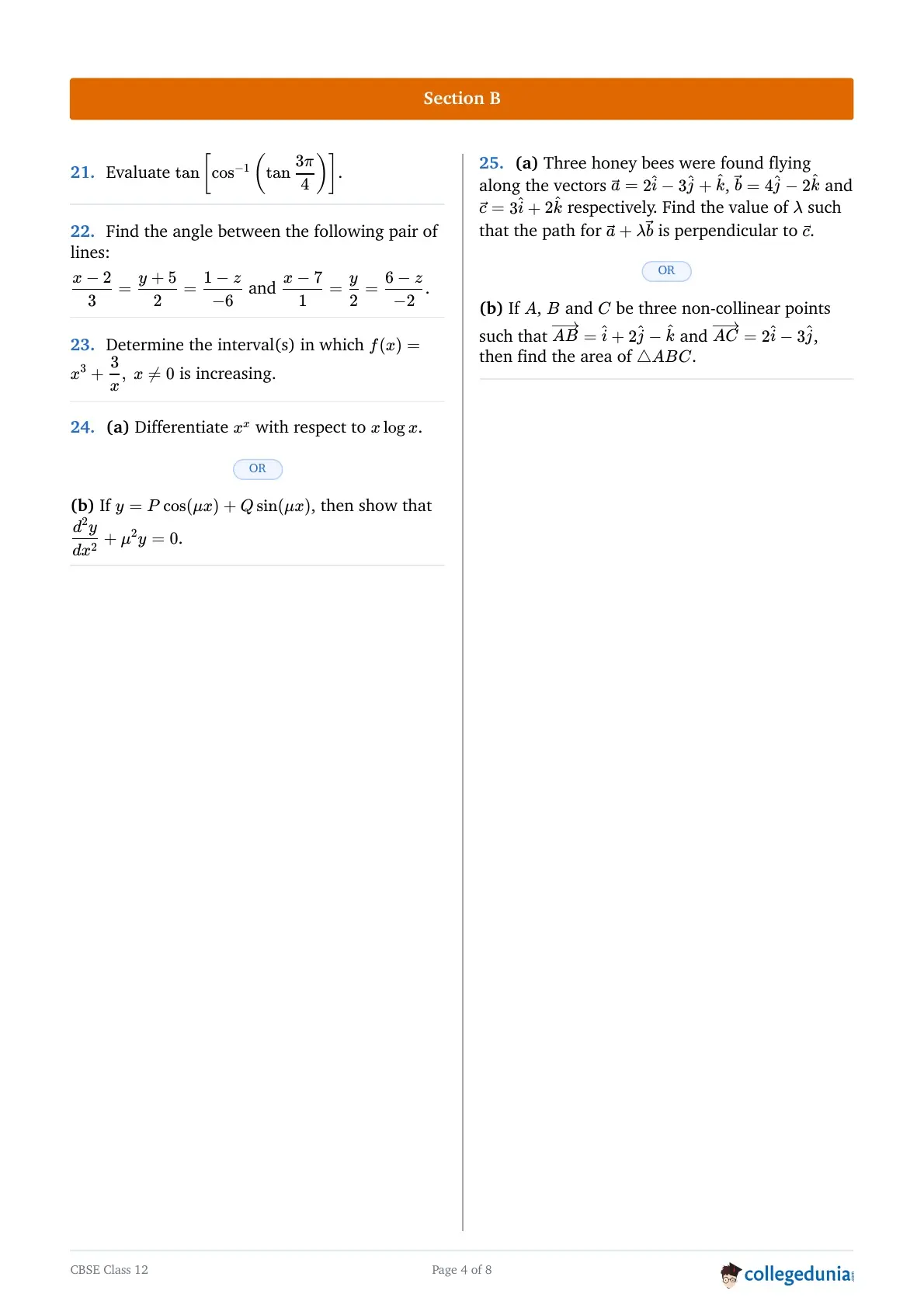
Question 21:

Evaluate \( \tan \left[ \cos^{-1} \left( \tan \frac{3\pi}{4} \right) \right] \).

Correct Answer:
View Solution


Concept:

Evaluate the trigonometric expression starting from the innermost function and moving outwards.
Use standard values for trigonometric functions of specific angles.
Principal value branch for \( \cos^{-1}x \) is \( [0, \pi] \).


Step 1: Evaluate the innermost tangent function

The innermost term is \( \tan \left( \frac{3\pi}{4} \right) \).


We can write \( \frac{3\pi}{4} \) as \( \pi - \frac{\pi}{4} \).

\[ \tan \left( \pi - \frac{\pi}{4} \right) = -\tan \left( \frac{\pi}{4} \right) = -1 \]


Step 2: Evaluate the inverse cosine function

Substitute the result from Step 1 into the inverse cosine function:
\[ \cos^{-1}(-1) \]


In the principal branch \( [0, \pi] \), the cosine function is \( -1 \) at \( \pi \).

\[ \cos^{-1}(-1) = \pi \]


Step 3: Evaluate the final tangent function

Substitute the result from Step 2 into the outer tangent function:
\[ \tan(\pi) \]


Since \( \sin(\pi) = 0 \) and \( \cos(\pi) = -1 \), we have:
\[ \tan(\pi) = \frac{0}{-1} = 0 \] Quick Tip: Always work from the inside out in nested trigonometric expressions. Ensure results of inverse functions lie within their defined principal value branches to avoid errors.


Question 22:

Find the angle between the following pair of lines : \( \frac{x-2}{3} = \frac{y+5}{2} = \frac{1-z}{-6} \) and \( \frac{x-7}{1} = \frac{y}{2} = \frac{6-z}{-2} \).

Correct Answer:
View Solution


Concept:

The angle between two lines is the angle between their direction vectors.
Standard form of a line: \( \frac{x-x_1}{a} = \frac{y-y_1}{b} = \frac{z-z_1}{c} \), where \( (a, b, c) \) are direction ratios.
Formula for cosine of angle \( \theta \): \( \cos \theta = \frac{|\vec{b_1} \cdot \vec{b_2}|}{|\vec{b_1}||\vec{b_2}|} \).


Step 1: Write the lines in standard form and identify direction vectors

Line 1: \( \frac{x-2}{3} = \frac{y+5}{2} = \frac{z-1}{6} \) (Notice the sign change in the \( z \) term to keep \( z \) positive).


Direction vector \( \vec{b_1} = 3\hat{i} + 2\hat{j} + 6\hat{k} \).


Line 2: \( \frac{x-7}{1} = \frac{y}{2} = \frac{z-6}{2} \) (Notice the sign change in the \( z \) term).


Direction vector \( \vec{b_2} = 1\hat{i} + 2\hat{j} + 2\hat{k} \).


Step 2: Calculate dot product and magnitudes

Dot product \( \vec{b_1} \cdot \vec{b_2} \):
\[ (3)(1) + (2)(2) + (6)(2) = 3 + 4 + 12 = 19 \]


Magnitude \( |\vec{b_1}| \):
\[ \sqrt{3^2 + 2^2 + 6^2} = \sqrt{9 + 4 + 36} = \sqrt{49} = 7 \]


Magnitude \( |\vec{b_2}| \):
\[ \sqrt{1^2 + 2^2 + 2^2} = \sqrt{1 + 4 + 4} = \sqrt{9} = 3 \]


Step 3: Solve for the angle \( \theta \)
\[ \cos \theta = \frac{19}{7 \times 3} = \frac{19}{21} \]

\[ \theta = \cos^{-1} \left( \frac{19}{21} \right) \] Quick Tip: Always ensure lines are in standard form (\( x, y, z \) coefficients are +1) before extracting direction ratios. A common trick is to hide a negative sign in the denominator like \( (1-z)/a = (z-1)/(-a) \).


Question 23:

Determine the interval(s) in which \( f(x) = \frac{x}{3} + \frac{3}{x}, x \neq 0 \) is increasing.

Correct Answer:
View Solution


Concept:

A function \( f(x) \) is increasing in an interval where its first derivative is greater than or equal to zero (\( f'(x) \geq 0 \)).


Step 1: Find the first derivative \( f'(x) \)

The function is \( f(x) = \frac{1}{3}x + 3x^{-1} \).


Differentiating with respect to \( x \):
\[ f'(x) = \frac{1}{3} - 3x^{-2} \]

\[ f'(x) = \frac{1}{3} - \frac{3}{x^2} \]


Step 2: Set the derivative for increasing condition

For \( f(x) \) to be increasing, \( f'(x) \geq 0 \):
\[ \frac{1}{3} - \frac{3}{x^2} \geq 0 \]

\[ \frac{x^2 - 9}{3x^2} \geq 0 \]


Step 3: Solve the inequality

Since \( 3x^2 > 0 \) for all \( x \neq 0 \), the sign depends only on the numerator:
\[ x^2 - 9 \geq 0 \implies (x - 3)(x + 3) \geq 0 \]


Using the wavy curve method, the solution is:
\[ x \in (-\infty, -3] \cup [3, \infty) \] Quick Tip: When solving inequalities with fractions, always keep track of the domain (\( x \neq 0 \) here). Squaring or multiplying by denominators is only safe if you know the denominator's sign.


Question 24:

Differentiate \( x^x \) with respect to \( x \log x \).

Correct Answer:
View Solution


Concept:

Differentiation of a function \( u \) with respect to another function \( v \) is given by \( \frac{du}{dv} = \frac{du/dx}{dv/dx} \).
Logarithmic differentiation is used for functions of the form \( f(x)^{g(x)} \).


Step 1: Differentiate \( u = x^x \) with respect to \( x \)

Let \( u = x^x \). Taking natural log on both sides:
\[ \log u = x \log x \]


Differentiating with respect to \( x \):
\[ \frac{1}{u} \frac{du}{dx} = 1 \cdot \log x + x \cdot \frac{1}{x} = \log x + 1 \]

\[ \frac{du}{dx} = x^x(1 + \log x) \]


Step 2: Differentiate \( v = x \log x \) with respect to \( x \)

Let \( v = x \log x \).


Using product rule:
\[ \frac{dv}{dx} = \frac{d}{dx}(x) \cdot \log x + x \cdot \frac{d}{dx}(\log x) \]

\[ \frac{dv}{dx} = 1 \cdot \log x + x \cdot \frac{1}{x} = \log x + 1 \]


Step 3: Find the derivative of \( u \) w.r.t. \( v \)
\[ \frac{du}{dv} = \frac{du/dx}{dv/dx} = \frac{x^x(1 + \log x)}{1 + \log x} \]

\[ \frac{du}{dv} = x^x \] Quick Tip: Notice that \( \log(x^x) = x \log x \). This means \( u = e^v \). Differentiating \( e^v \) with respect to \( v \) directly gives \( e^v \), which is \( x^x \).


Question 25:

If \( y = P \cos ux + Q \sin ux \), show that \( \frac{d^2y}{dx^2} + u^2y = 0 \).

Correct Answer:
View Solution


Concept:

Successive differentiation involves differentiating a function multiple times.
Chain rule: \( \frac{d}{dx}(\cos ax) = -a \sin ax \) and \( \frac{d}{dx}(\sin ax) = a \cos ax \).


Step 1: Find the first derivative \( \frac{dy}{dx} \)

Differentiate \( y \) with respect to \( x \):
\[ \frac{dy}{dx} = P(-u \sin ux) + Q(u \cos ux) \]

\[ \frac{dy}{dx} = -Pu \sin ux + Qu \cos ux \]


Step 2: Find the second derivative \( \frac{d^2y}{dx^2} \)

Differentiate \( \frac{dy}{dx} \) with respect to \( x \):
\[ \frac{d^2y}{dx^2} = -Pu(u \cos ux) + Qu(-u \sin ux) \]

\[ \frac{d^2y}{dx^2} = -Pu^2 \cos ux - Qu^2 \sin ux \]


Step 3: Simplify and relate to \( y \)

Factor out \( -u^2 \) from the terms on the right-hand side:
\[ \frac{d^2y}{dx^2} = -u^2(P \cos ux + Q \sin ux) \]


Since the term in parentheses is original function \( y \):
\[ \frac{d^2y}{dx^2} = -u^2y \implies \frac{d^2y}{dx^2} + u^2y = 0 \]

Hence proved. Quick Tip: When showing differential equations from trig functions, the second derivative usually results in the original function multiplied by a constant square of the frequency (\( -u^2 \)).


Question 26:

Three honey bees were found flying along the vectors \( \vec{a} = 2\hat{i} - 3\hat{j} + \hat{k} \), \( \vec{b} = 4\hat{j} - 2\hat{k} \) and \( \vec{c} = 3\hat{i} + 2\hat{k} \) respectively. Find the value of \( \lambda \) such that the path for \( \vec{a} + \lambda \vec{b} \) is perpendicular to \( \vec{c} \).

Correct Answer:
View Solution


Concept:

Two non-zero vectors \( \vec{u} \) and \( \vec{v} \) are perpendicular if their dot product is zero (\( \vec{u} \cdot \vec{v} = 0 \)).


Step 1: Determine the vector \( \vec{a} + \lambda \vec{b} \)

Substitute the components of \( \vec{a} \) and \( \vec{b} \):
\[ \vec{a} + \lambda \vec{b} = (2\hat{i} - 3\hat{j} + \hat{k}) + \lambda(0\hat{i} + 4\hat{j} - 2\hat{k}) \]


Combine corresponding components:
\[ \vec{a} + \lambda \vec{b} = 2\hat{i} + (4\lambda - 3)\hat{j} + (1 - 2\lambda)\hat{k} \]


Step 2: Apply the perpendicularity condition with \( \vec{c} \)

For \( (\vec{a} + \lambda \vec{b}) \perp \vec{c} \):
\[ (2\hat{i} + (4\lambda - 3)\hat{j} + (1 - 2\lambda)\hat{k}) \cdot (3\hat{i} + 0\hat{j} + 2\hat{k}) = 0 \]


Step 3: Calculate dot product and solve for \( \lambda \)

Multiply corresponding components and sum them:
\[ (2 \times 3) + (4\lambda - 3) \times 0 + (1 - 2\lambda) \times 2 = 0 \]

\[ 6 + 0 + 2 - 4\lambda = 0 \]

\[ 8 - 4\lambda = 0 \implies 4\lambda = 8 \implies \lambda = 2 \] Quick Tip: Always group components (\( \hat{i}, \hat{j}, \hat{k} \)) first before taking a dot product. Missing components (like \( \hat{j} \) in \( \vec{c} \)) have a coefficient of 0.


Question 27:

If \( A, B \) and \( C \) be three non-collinear points such that \( \vec{AB} = \hat{i} + 2\hat{j} - \hat{k} \) and \( \vec{AC} = 2\hat{i} - 3\hat{j} \), then find the area of \( \triangle ABC \).

Correct Answer:
View Solution


Concept:

The area of a triangle \( ABC \) with adjacent sides given as vectors \( \vec{AB} \) and \( \vec{AC} \) is \( \frac{1}{2} |\vec{AB} \times \vec{AC}| \).


Step 1: Calculate the cross product \( \vec{AB} \times \vec{AC} \)

Using the determinant method:
\[ \vec{AB} \times \vec{AC} = \det \begin{bmatrix} \hat{i} & \hat{j} & \hat{k} \\ 1 & 2 & -1 \\ 2 & -3 & 0 \end{bmatrix} \]


Expand along the first row:
\[ \hat{i}(0 - 3) - \hat{j}(0 - (-2)) + \hat{k}(-3 - 4) \]

\[ = -3\hat{i} - 2\hat{j} - 7\hat{k} \]


Step 2: Find the magnitude of the cross product
\[ |\vec{AB} \times \vec{AC}| = \sqrt{(-3)^2 + (-2)^2 + (-7)^2} \]

\[ = \sqrt{9 + 4 + 49} = \sqrt{62} \]


Step 3: Calculate the area of the triangle

Area of \( \triangle ABC = \frac{1}{2} \sqrt{62} \) square units.


Area \( \approx 3.93 \) square units. Quick Tip: Remember the factor of \( 1/2 \). For a parallelogram, the area is just \( |\vec{a} \times \vec{b}| \), but for a triangle, it must be halved.


Question 28:

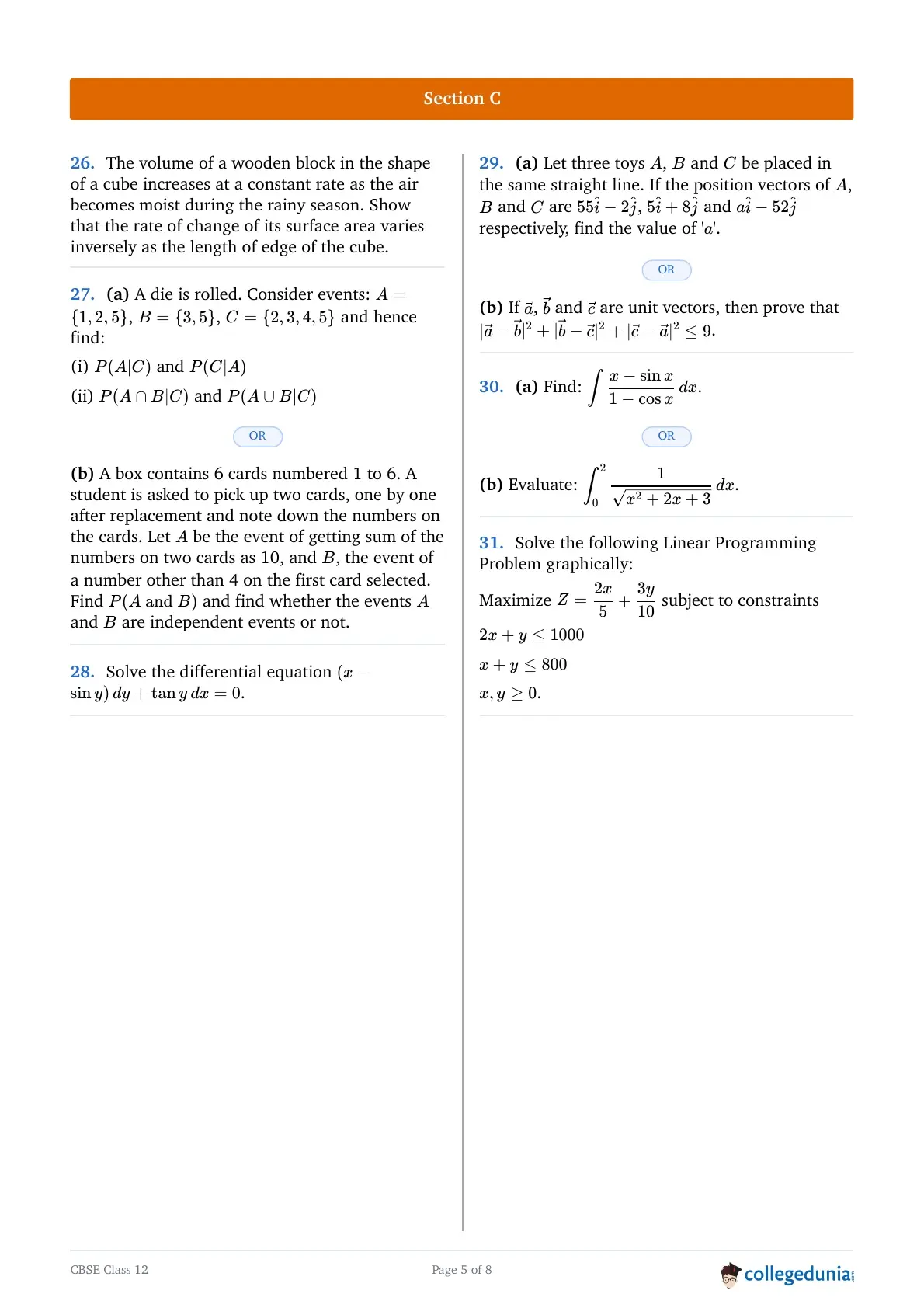
The volume of a wooden block in the shape of a cube increases at a constant rate as the air becomes moist during the rainy season. Show that the rate of change of its surface area varies inversely as the length of edge of the cube.

Correct Answer:
View Solution


Concept:

Let \( x \) be the length of the edge of the cube at any time \( t \).
Volume of the cube, \( V = x^3 \).
Surface area of the cube, \( S = 6x^2 \).
"Varies inversely" means \( y = \frac{k}{x} \) or \( y \propto \frac{1}{x} \).


Step 1: Use the given condition for the rate of change of volume

It is given that the volume increases at a constant rate.


Let \( \frac{dV}{dt} = k \), where \( k \) is a constant.


Since \( V = x^3 \), differentiate with respect to \( t \) using the chain rule:
\[ \frac{dV}{dt} = \frac{d}{dx}(x^3) \cdot \frac{dx}{dt} = 3x^2 \frac{dx}{dt} \]


Equating to the constant \( k \):
\[ 3x^2 \frac{dx}{dt} = k \implies \frac{dx}{dt} = \frac{k}{3x^2} \]


Step 2: Find the rate of change of surface area

The surface area is \( S = 6x^2 \).


Differentiate \( S \) with respect to \( t \):
\[ \frac{dS}{dt} = \frac{d}{dx}(6x^2) \cdot \frac{dx}{dt} = 12x \frac{dx}{dt} \]


Step 3: Substitute \( \frac{dx}{dt} \) to find the relation

Substitute the expression for \( \frac{dx}{dt} \) from Step 1 into the surface area derivative:
\[ \frac{dS}{dt} = 12x \left( \frac{k}{3x^2} \right) \]

\[ \frac{dS}{dt} = \frac{4k}{x} \]


Since \( 4k \) is a constant, we have:
\[ \frac{dS}{dt} \propto \frac{1}{x} \]


This shows that the rate of change of surface area varies inversely as the length of the edge of the cube. Quick Tip: In related rates problems, always express all derivatives in terms of one common rate (usually the one given as constant) to see the final proportionality clearly.


Question 29:

A die is rolled. Consider events : \( A = \{1, 2, 5\} \), \( B = \{3, 5\} \), \( C = \{2, 3, 4, 5\} \). Find \( P(A|C) \) and \( P(C|A) \).

Correct Answer:
View Solution


Concept:

Sample space for a die: \( S = \{1, 2, 3, 4, 5, 6\} \), \( n(S) = 6 \).
Conditional Probability: \( P(X|Y) = \frac{P(X \cap Y)}{P(Y)} = \frac{n(X \cap Y)}{n(Y)} \).


Step 1: Find the intersection and individual event counts

Events are: \( A = \{1, 2, 5\} \), \( C = \{2, 3, 4, 5\} \).


Intersection \( A \cap C = \{2, 5\} \).


Counts: \( n(A) = 3 \), \( n(C) = 4 \), \( n(A \cap C) = 2 \).


Step 2: Calculate \( P(A|C) \)

Using the definition of conditional probability:
\[ P(A|C) = \frac{n(A \cap C)}{n(C)} = \frac{2}{4} = \frac{1}{2} \]


Step 3: Calculate \( P(C|A) \)

Using the definition of conditional probability:
\[ P(C|A) = \frac{n(A \cap C)}{n(A)} = \frac{2}{3} \] Quick Tip: For discrete finite sample spaces, conditional probability \( P(X|Y) \) is simply the number of outcomes common to both sets divided by the total outcomes in the "given" set.


Question 30:

A die is rolled. Consider events : \( A = \{1, 2, 5\} \), \( B = \{3, 5\} \), \( C = \{2, 3, 4, 5\} \). Find \( P(A \cap B|C) \) and \( P(A \cup B|C) \).

Correct Answer:
View Solution


Concept:

\( P(X|C) = \frac{n(X \cap C)}{n(C)} \).
Set operations: Intersection \( \cap \) (common elements), Union \( \cup \) (all elements from both).


Step 1: Find \( P(A \cap B|C) \)

First, find \( A \cap B = \{5\} \).


Now find the intersection with \( C \): \( (A \cap B) \cap C = \{5\} \cap \{2, 3, 4, 5\} = \{5\} \).

\[ P(A \cap B|C) = \frac{n((A \cap B) \cap C)}{n(C)} = \frac{1}{4} \]


Step 2: Find \( P(A \cup B|C) \)

First, find \( A \cup B = \{1, 2, 3, 5\} \).


Now find the intersection with \( C \): \( (A \cup B) \cap C = \{1, 2, 3, 5\} \cap \{2, 3, 4, 5\} = \{2, 3, 5\} \).

\[ P(A \cup B|C) = \frac{n((A \cup B) \cap C)}{n(C)} = \frac{3}{4} \] Quick Tip: Always perform the set operations (\( \cap \) or \( \cup \)) first to define the specific event, then calculate its intersection with the condition set \( C \).


Question 31:

A box contains 6 cards numbered 1 to 6. A student is asked to pick up two cards, one by one after replacement and note down the numbers on the cards. Let A be the event of getting sum of the numbers on two cards as 10, and B, the event of a number other than 4 on the first card selected. Find \( P(A and B) \) and find whether the events A and B are independent events or not.

Correct Answer:
View Solution


Concept:

Sample Space \( S \): Total number of possible outcomes.
Event Intersection \( A \cap B \): Outcomes that satisfy both conditions simultaneously.
Condition for Independence: Two events \( A \) and \( B \) are independent if and only if \( P(A \cap B) = P(A) \cdot P(B) \).


Step 1: Determine the total number of outcomes in the sample space

There are 6 cards numbered \( \{1, 2, 3, 4, 5, 6\} \).


Two cards are picked "one by one after replacement".


Total outcomes \( n(S) = 6 \times 6 = 36 \).


Step 2: Define event A and calculate its probability

Event A is the event of getting a sum of 10.


Possible pairs \( (x, y) \) such that \( x + y = 10 \) where \( x, y \in \{1, 2, 3, 4, 5, 6\} \):
\[ A = \{(4, 6), (5, 5), (6, 4)\} \]


Number of outcomes in A, \( n(A) = 3 \).


Probability \( P(A) = \frac{n(A)}{n(S)} = \frac{3}{36} = \frac{1}{12} \).


Step 3: Define event B and calculate its probability

Event B is the event that a number other than 4 appears on the first card.


The first card can be any number from \( \{1, 2, 3, 5, 6\} \) (5 choices).


The second card can be any number from \( \{1, 2, 3, 4, 5, 6\} \) (6 choices).


Number of outcomes in B, \( n(B) = 5 \times 6 = 30 \).


Probability \( P(B) = \frac{n(B)}{n(S)} = \frac{30}{36} = \frac{5}{6} \).


Step 4: Find \( P(A \cap B) \)
\( A \cap B \) contains outcomes from A where the first card is not 4.


From set A: \( (4, 6) \) starts with 4 (excluded), \( (5, 5) \) and \( (6, 4) \) do not start with 4.

\[ A \cap B = \{(5, 5), (6, 4)\} \]


Number of outcomes in \( A \cap B \), \( n(A \cap B) = 2 \).


Probability \( P(A and B) = \frac{2}{36} = \frac{1}{18} \).


Step 5: Check for independence

Calculate the product \( P(A) \cdot P(B) \):
\[ P(A) \cdot P(B) = \frac{1}{12} \cdot \frac{5}{6} = \frac{5}{72} \]


Compare with \( P(A \cap B) \):
\[ P(A \cap B) = \frac{1}{18} = \frac{4}{72} \]


Since \( \frac{4}{72} \neq \frac{5}{72} \), we have \( P(A \cap B) \neq P(A) \cdot P(B) \).


Therefore, events A and B are not independent. Quick Tip: With replacement means the same outcome can repeat (like 5,5). Always list the intersection by looking at the smaller set (usually the one with more restrictions) and checking if those elements fit the other set's rule.


Question 32:

Solve the differential equation \( (x - \sin y) \, dy + \tan y \, dx = 0 \).

Correct Answer:
View Solution


Concept:

A first-order linear differential equation in \( x \) is of the form \( \frac{dx}{dy} + P(y)x = Q(y) \).
Solution is given by \( x \cdot (IF) = \int Q(y) \cdot (IF) \, dy + C \), where \( IF = e^{\int P(y) \, dy} \).


Step 1: Rearrange the equation into standard linear form

The given equation is: \( \tan y \, dx = (\sin y - x) \, dy \).


Divide by \( dy \cdot \tan y \):
\[ \frac{dx}{dy} = \frac{\sin y - x}{\tan y} \]

\[ \frac{dx}{dy} = \frac{\sin y}{\tan y} - \frac{x}{\tan y} \]

\[ \frac{dx}{dy} + (\cot y)x = \cos y \]


Step 2: Find the Integrating Factor (IF)

Here \( P(y) = \cot y \) and \( Q(y) = \cos y \).

\[ IF = e^{\int \cot y \, dy} = e^{\log |\sin y|} = \sin y \]


Step 3: Apply the general solution formula

The solution is \( x \cdot IF = \int Q(y) \cdot IF \, dy + C \):
\[ x \sin y = \int \cos y \sin y \, dy + C \]


Multiply and divide the integral by 2 to use \( 2\sin y \cos y = \sin 2y \):
\[ x \sin y = \frac{1}{2} \int \sin 2y \, dy + C \]

\[ x \sin y = \frac{1}{2} \left( -\frac{\cos 2y}{2} \right) + C \]

\[ x \sin y = -\frac{1}{4} \cos 2y + C \] Quick Tip: If an equation isn't linear in \( y \), check if it's linear in \( x \) by isolating \( dx/dy \). This is a common technique when \( y \) is inside trigonometric functions.


Question 33:

Let three toys A, B and C be placed in the same straight line. If the position vectors of A, B and C are \( 55\hat{i} - 2\hat{j} \), \( 5\hat{i} + 8\hat{j} \) and \( a\hat{i} - 52\hat{j} \) respectively, find the value of ‘a’.

Correct Answer:
View Solution


Concept:

If three points A, B, and C are collinear, then the vectors \( \vec{AB} \) and \( \vec{BC} \) are parallel.
Parallel vectors have proportional components: if \( \vec{u} = x_1\hat{i} + y_1\hat{j} \) and \( \vec{v} = x_2\hat{i} + y_2\hat{j} \) are parallel, then \( \frac{x_1}{x_2} = \frac{y_1}{y_2} \).


Step 1: Find the vectors \( \vec{AB} \) and \( \vec{BC} \)
\[ \vec{AB} = \vec{B} - \vec{A} = (5 - 55)\hat{i} + (8 - (-2))\hat{j} = -50\hat{i} + 10\hat{j} \]

\[ \vec{BC} = \vec{C} - \vec{B} = (a - 5)\hat{i} + (-52 - 8)\hat{j} = (a - 5)\hat{i} - 60\hat{j} \]


Step 2: Set up the proportionality equation for collinearity

Since the toys are in a straight line:
\[ \frac{-50}{a - 5} = \frac{10}{-60} \]


Simplify the right side:
\[ \frac{-50}{a - 5} = -\frac{1}{6} \]


Step 3: Solve for \( a \)

Cross-multiply the terms:
\[ -50 \times (-6) = 1 \times (a - 5) \]

\[ 300 = a - 5 \]

\[ a = 305 \] Quick Tip: Collinearity for 2D vectors can also be solved using slopes: \( m_{AB} = m_{BC} \). Here, \( \frac{8 - (-2)}{5 - 55} = \frac{-52 - 8}{a - 5} \).


Question 34:

If \( \vec{a} \), \( \vec{b} \) and \( \vec{c} \) are unit vectors, then prove that \( |\vec{a} - \vec{b}|^2 + |\vec{b} - \vec{c}|^2 + |\vec{c} - \vec{a}|^2 \leq 9 \).

Correct Answer:
View Solution


Concept:

A unit vector has a magnitude of 1, i.e., \( |\vec{a}| = |\vec{b}| = |\vec{c}| = 1 \).
The squared magnitude of a vector difference is \( |\vec{x} - \vec{y}|^2 = |\vec{x}|^2 + |\vec{y}|^2 - 2(\vec{x} \cdot \vec{y}) \).
For any vector \( \vec{v} \), the squared magnitude \( |\vec{v}|^2 \geq 0 \).


Step 1: Expand each squared term using vector properties

Given that \( \vec{a} \), \( \vec{b} \), and \( \vec{c} \) are unit vectors, we have \( |\vec{a}|^2 = 1 \), \( |\vec{b}|^2 = 1 \), and \( |\vec{c}|^2 = 1 \).


Expanding the terms individually:
\[ |\vec{a} - \vec{b}|^2 = |\vec{a}|^2 + |\vec{b}|^2 - 2(\vec{a} \cdot \vec{b}) = 1 + 1 - 2(\vec{a} \cdot \vec{b}) = 2 - 2(\vec{a} \cdot \vec{b}) \]

\[ |\vec{b} - \vec{c}|^2 = |\vec{b}|^2 + |\vec{c}|^2 - 2(\vec{b} \cdot \vec{c}) = 1 + 1 - 2(\vec{b} \cdot \vec{c}) = 2 - 2(\vec{b} \cdot \vec{c}) \]

\[ |\vec{c} - \vec{a}|^2 = |\vec{c}|^2 + |\vec{a}|^2 - 2(\vec{c} \cdot \vec{a}) = 1 + 1 - 2(\vec{c} \cdot \vec{a}) = 2 - 2(\vec{c} \cdot \vec{a}) \]


Step 2: Sum the expanded terms

Let \( S = |\vec{a} - \vec{b}|^2 + |\vec{b} - \vec{c}|^2 + |\vec{c} - \vec{a}|^2 \).


Substituting the expressions from Step 1:
\[ S = [2 - 2(\vec{a} \cdot \vec{b})] + [2 - 2(\vec{b} \cdot \vec{c})] + [2 - 2(\vec{c} \cdot \vec{a})] \]

\[ S = 6 - 2(\vec{a} \cdot \vec{b} + \vec{b} \cdot \vec{c} + \vec{c} \cdot \vec{a}) \]


Step 3: Use the property of the sum of vectors to establish the inequality

Consider the vector \( \vec{a} + \vec{b} + \vec{c} \). Its squared magnitude must be non-negative:
\[ |\vec{a} + \vec{b} + \vec{c}|^2 \geq 0 \]


Expanding the expression:
\[ |\vec{a}|^2 + |\vec{b}|^2 + |\vec{c}|^2 + 2(\vec{a} \cdot \vec{b} + \vec{b} \cdot \vec{c} + \vec{c} \cdot \vec{a}) \geq 0 \]


Substitute the unit vector values (1+1+1=3):
\[ 3 + 2(\vec{a} \cdot \vec{b} + \vec{b} \cdot \vec{c} + \vec{c} \cdot \vec{a}) \geq 0 \]


Rearranging the terms:
\[ 2(\vec{a} \cdot \vec{b} + \vec{b} \cdot \vec{c} + \vec{c} \cdot \vec{a}) \geq -3 \]


Step 4: Apply the inequality to the sum \( S \)

Multiply the inequality from Step 3 by \( -1 \), noting that the inequality sign reverses:
\[ -2(\vec{a} \cdot \vec{b} + \vec{b} \cdot \vec{c} + \vec{c} \cdot \vec{a}) \leq 3 \]


Add 6 to both sides of the inequality:
\[ 6 - 2(\vec{a} \cdot \vec{b} + \vec{b} \cdot \vec{c} + \vec{c} \cdot \vec{a}) \leq 6 + 3 \]

\[ S \leq 9 \]

Hence, \( |\vec{a} - \vec{b}|^2 + |\vec{b} - \vec{c}|^2 + |\vec{c} - \vec{a}|^2 \leq 9 \). Quick Tip: The expression \( 2(\vec{a} \cdot \vec{b} + \vec{b} \cdot \vec{c} + \vec{c} \cdot \vec{a}) \) frequently appears in unit vector problems. Relate it back to the expansion of \( |\vec{a} + \vec{b} + \vec{c}|^2 \geq 0 \) to find the bounds for the sum.


Question 35:

Find : \( \int \frac{x - \sin x}{1 - \cos x} \, dx \).

Correct Answer:
View Solution


Concept:

Half-angle identities: \( 1 - \cos x = 2\sin^2(x/2) \) and \( \sin x = 2\sin(x/2)\cos(x/2) \).
Integration by parts: \( \int u \, dv = uv - \int v \, du \).


Step 1: Simplify the integrand using identities

Split the integral into two parts:
\[ I = \int \frac{x}{1 - \cos x} \, dx - \int \frac{\sin x}{1 - \cos x} \, dx \]


Substitute half-angle formulas:
\[ I = \int \frac{x}{2\sin^2(x/2)} \, dx - \int \frac{2\sin(x/2)\cos(x/2)}{2\sin^2(x/2)} \, dx \]

\[ I = \frac{1}{2} \int x \csc^2(x/2) \, dx - \int \cot(x/2) \, dx \]


Step 2: Solve the first integral using Integration by Parts

For \( \int x \csc^2(x/2) \, dx \), let \( u = x \) and \( dv = \csc^2(x/2) \, dx \).


Then \( du = dx \) and \( v = -2 \cot(x/2) \).

\[ \int x \csc^2(x/2) \, dx = -2x \cot(x/2) - \int -2 \cot(x/2) \, dx \]

\[ = -2x \cot(x/2) + 2 \int \cot(x/2) \, dx \]


Step 3: Combine the results

Substitute this back into the main expression for \( I \):
\[ I = \frac{1}{2} \left[ -2x \cot(x/2) + 2 \int \cot(x/2) \, dx \right] - \int \cot(x/2) \, dx \]

\[ I = -x \cot(x/2) + \int \cot(x/2) \, dx - \int \cot(x/2) \, dx \]


The integral terms cancel out:
\[ I = -x \cot(x/2) + C \] Quick Tip: Whenever an integral contains both a polynomial and a trigonometric term after simplification, check if Integration by Parts on the polynomial term will produce a secondary integral that cancels out other existing terms.


Question 36:

Evaluate : \( \int_0^2 \frac{1}{\sqrt{x^2 + 2x + 3}} \, dx \).

Correct Answer:
View Solution


Concept:

Integration of irrational algebraic functions involving a quadratic denominator \( \sqrt{ax^2 + bx + c} \) often requires completing the square.
Standard Integral Formula: \( \int \frac{dx}{\sqrt{x^2 + a^2}} = \log |x + \sqrt{x^2 + a^2}| + C \).
Fundamental Theorem of Calculus: \( \int_a^b f(x) \, dx = F(b) - F(a) \).


Step 1: Complete the square for the quadratic expression in the denominator

The quadratic expression is \( x^2 + 2x + 3 \).


To complete the square, we take half of the coefficient of \( x \), which is \( 1 \), and square it:
\[ x^2 + 2x + 3 = (x^2 + 2x + 1) + 2 \]


Writing it in terms of squares:
\[ = (x + 1)^2 + (\sqrt{2})^2 \]


Step 2: Substitute back into the integral and apply the formula

Let the integral be \( I \):
\[ I = \int_0^2 \frac{1}{\sqrt{(x + 1)^2 + (\sqrt{2})^2}} \, dx \]


Using the formula \( \int \frac{dx}{\sqrt{X^2 + A^2}} = \log |X + \sqrt{X^2 + A^2}| \), where \( X = x+1 \) and \( A = \sqrt{2} \):
\[ I = \left[ \log \left| (x + 1) + \sqrt{(x + 1)^2 + (\sqrt{2})^2} \right| \right]_0^2 \]


Simplify the expression inside the log back to its original quadratic form:
\[ I = \left[ \log \left| (x + 1) + \sqrt{x^2 + 2x + 3} \right| \right]_0^2 \]


Step 3: Evaluate the definite integral using the limits

Substitute the upper limit \( x = 2 \):
\[ Value at upper limit = \log |(2 + 1) + \sqrt{2^2 + 2(2) + 3}| \]
\[ = \log |3 + \sqrt{4 + 4 + 3}| = \log(3 + \sqrt{11}) \]


Substitute the lower limit \( x = 0 \):
\[ Value at lower limit = \log |(0 + 1) + \sqrt{0^2 + 2(0) + 3}| \]
\[ = \log |1 + \sqrt{3}| = \log(1 + \sqrt{3}) \]


Subtract the lower limit value from the upper limit value:
\[ I = \log(3 + \sqrt{11}) - \log(1 + \sqrt{3}) \]


Using the property \( \log A - \log B = \log(A/B) \):
\[ I = \log \left( \frac{3 + \sqrt{11}}{1 + \sqrt{3}} \right) \] Quick Tip: Always simplify the quadratic denominator by completing the square first. This transforms the integral into one of the nine standard forms.
Check that the coefficient of \( x^2 \) is \( +1 \) before completing the square to avoid sign errors inside the square root.


Question 37:

Solve the following Linear Programming Problem graphically :

Maximize \( Z = \frac{2x}{5} + \frac{3y}{10} \)

subject to constraints
\( 2x + y \leq 1000 \)
\( x + y \leq 800 \)
\( x, y \geq 0 \).

Correct Answer:
View Solution


Concept:

Identify the feasible region by plotting the linear inequalities on a coordinate plane.
Find the coordinates of the corner points (vertices) of the feasible region.
Evaluate the objective function at each corner point.
The point that yields the highest value for \( Z \) is the optimal solution.


Step 1: Plot the boundary lines and find the feasible region

Convert inequalities to equations to find boundary lines:


1. \( L_1: 2x + y = 1000 \). At \( x = 0, y = 1000 \); at \( y = 0, x = 500 \). Points are \( (0, 1000) \) and \( (500, 0) \).


2. \( L_2: x + y = 800 \). At \( x = 0, y = 800 \); at \( y = 0, x = 800 \). Points are \( (0, 800) \) and \( (800, 0) \).


3. \( x, y \geq 0 \) represents the first quadrant.


The feasible region is the area bounded by these lines and the axes toward the origin.


Step 2: Find the point of intersection of the boundary lines

Solve the system:
\( 2x + y = 1000 \) ...(i)
\( x + y = 800 \) ...(ii)


Subtract (ii) from (i):
\( (2x - x) + (y - y) = 1000 - 800 \implies x = 200 \).


Substitute \( x = 200 \) in (ii):
\( 200 + y = 800 \implies y = 600 \).


The intersection point is \( (200, 600) \).


Step 3: Evaluate the objective function at corner points


The corner points of the feasible region are \( O(0,0), A(500,0), B(200,600), \) and \( C(0,800) \).


Objective Function: \( Z = 0.4x + 0.3y \)


1. At \( O(0,0): Z = 0.4(0) + 0.3(0) = 0 \)


2. At \( A(500,0): Z = 0.4(500) + 0.3(0) = 200 \)


3. At \( B(200,600): Z = 0.4(200) + 0.3(600) = 80 + 180 = 260 \)


4. At \( C(0,800): Z = 0.4(0) + 0.3(800) = 240 \)


The maximum value of \( Z \) is 260 at the point \( (200, 600) \). Quick Tip: To plot lines quickly, find the x-intercept and y-intercept by setting \( y=0 \) and \( x=0 \) respectively.
In "less than or equal to" (\( \leq \)) constraints with positive coefficients, the feasible region is usually toward the origin.


Question 38:

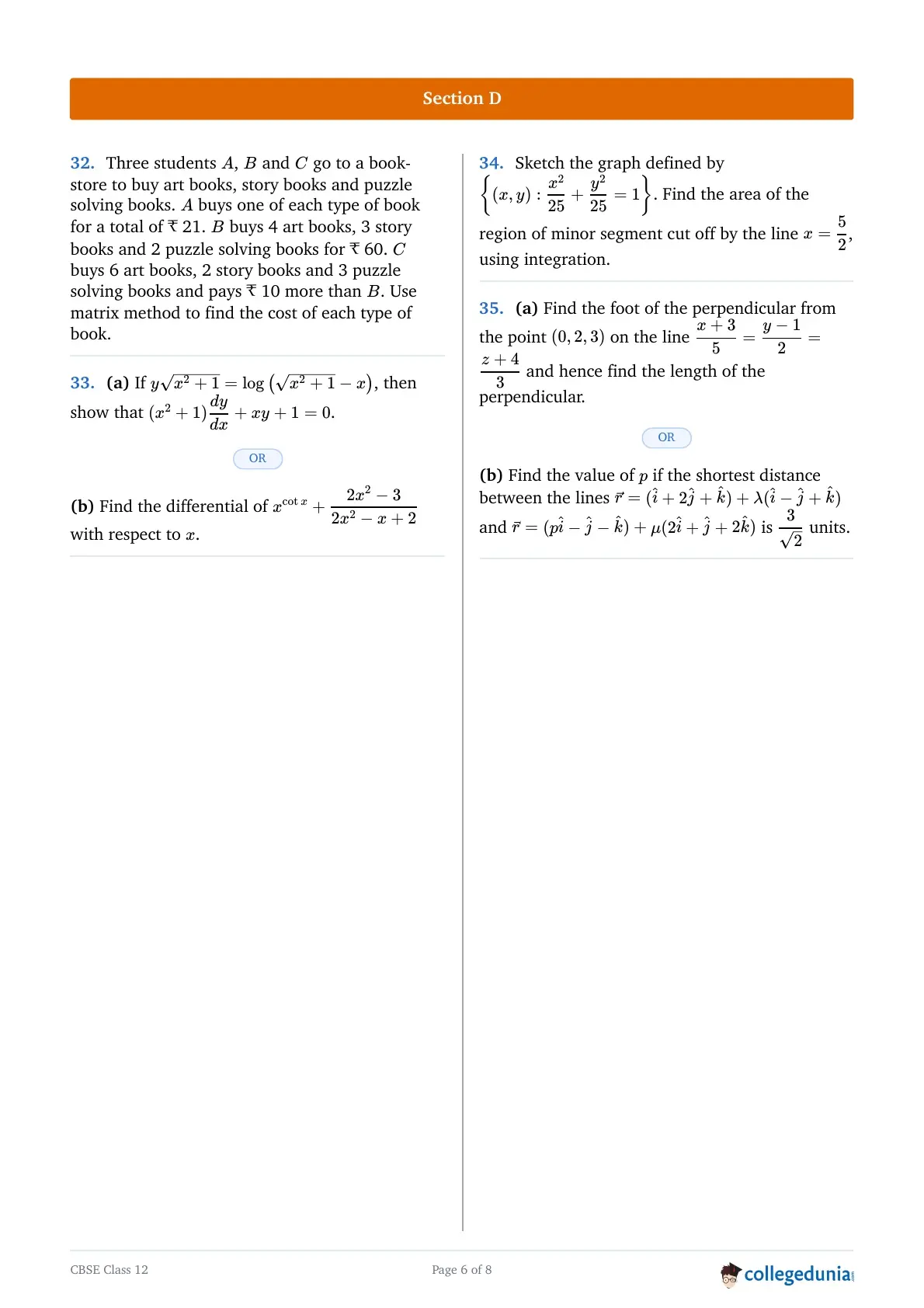
Three students A, B and C go to a book-store to buy art books, story books and puzzle solving books. A buys one of each type of book for a total of RS 21. B buys 4 art books, 3 story books and 2 puzzle solving books for RS 60. C buys 6 art books, 2 story books and 3 puzzle solving books and pays RS 10 more than B. Use matrix method to find the cost of each type of book.

Correct Answer:
View Solution


Concept:

Formulate a system of linear equations from the given word problem.
Represent the system in matrix form \( AX = B \).
Solve for \( X \) using the formula \( X = A^{-1}B \), where \( A^{-1} = \frac{1}{|A|} adj(A) \).


Step 1: Set up the linear equations

Let the cost of one art book be RS \( x \), one story book be RS \( y \), and one puzzle book be RS \( z \).


From student A: \( x + y + z = 21 \) ...(i)

From student B: \( 4x + 3y + 2z = 60 \) ...(ii)

From student C: \( 6x + 2y + 3z = 60 + 10 = 70 \) ...(iii)


Step 2: Represent in matrix form and find the determinant

The system is \( AX = B \):
\[ \begin{bmatrix} 1 & 1 & 1 \\ 4 & 3 & 2 \\ 6 & 2 & 3 \end{bmatrix} \begin{bmatrix} x \\ y \\ z \end{bmatrix} = \begin{bmatrix} 21 \\ 60 70 \end{bmatrix} \]

\( |A| = 1(9 - 4) - 1(12 - 12) + 1(8 - 18) = 1(5) - 1(0) + 1(-10) = -5 \).


Since \( |A| \neq 0 \), \( A^{-1} \) exists.


Step 3: Find the adjoint of matrix \( A \)

Calculate cofactors \( C_{ij} \):
\( C_{11} = 5, C_{12} = 0, C_{13} = -10 \)
\( C_{21} = -1, C_{22} = -3, C_{23} = 4 \)
\( C_{31} = -1, C_{32} = 2, C_{33} = -1 \)

\[ adj(A) = \begin{bmatrix} 5 & -1 & -1 \\ 0 & -3 & 2 \\ -10 & 4 & -1 \end{bmatrix} \]


Step 4: Solve for \( X \)
\[ X = A^{-1}B = \frac{1}{-5} \begin{bmatrix} 5 & -1 & -1 \\ 0 & -3 & 2 \\ -10 & 4 & -1 \end{bmatrix} \begin{bmatrix} 21 \\ 60 \\ 70 \end{bmatrix} \]


Multiply matrix with vector:
\[ \begin{bmatrix} x \\ y \\ z \end{bmatrix} = -\frac{1}{5} \begin{bmatrix} 5(21) - 60 - 70 \\ 0(21) - 3(60) + 2(70) \\ -10(21) + 4(60) - 70 \end{bmatrix} = -\frac{1}{5} \begin{bmatrix} -25 \\ -40 \\ -40 \end{bmatrix} = \begin{bmatrix} 5 \\ 8 \\ 8 \end{bmatrix} \]


The cost of an art book is RS 5, a story book is RS 8, and a puzzle book is RS 8. Quick Tip: Always check your final answers by substituting them back into the original equations. For example: \( 5 + 8 + 8 = 21 \), which matches the first equation.


Question 39:

If \( y\sqrt{x^2+1} = \log (\sqrt{x^2+1}-x) \), show that \( (x^2+1) \frac{dy}{dx} + xy + 1 = 0 \).

Correct Answer:
View Solution


Concept:

Differentiate the function implicitly using the product rule.
Use the chain rule for differentiating logarithmic and square root functions.
Simplify the resulting expression to match the target equation.


Step 1: Differentiate both sides with respect to \( x \)

The equation is \( y\sqrt{x^2+1} = \log (\sqrt{x^2+1}-x) \).


Differentiating the left side using the product rule:
\[ \frac{d}{dx} (y\sqrt{x^2+1}) = \frac{dy}{dx}\sqrt{x^2+1} + y \cdot \frac{1}{2\sqrt{x^2+1}} \cdot 2x = \frac{dy}{dx}\sqrt{x^2+1} + \frac{xy}{\sqrt{x^2+1}} \]


Differentiating the right side using the chain rule:
\[ \frac{d}{dx} (\log (\sqrt{x^2+1}-x)) = \frac{1}{\sqrt{x^2+1}-x} \cdot \left( \frac{2x}{2\sqrt{x^2+1}} - 1 \right) = \frac{1}{\sqrt{x^2+1}-x} \cdot \frac{x - \sqrt{x^2+1}}{\sqrt{x^2+1}} \]


Step 2: Simplify the derivative on the right side

Factor out \( -1 \) in the numerator:
\[ \frac{d}{dx} (\log (\sqrt{x^2+1}-x)) = \frac{1}{\sqrt{x^2+1}-x} \cdot \frac{-(\sqrt{x^2+1} - x)}{\sqrt{x^2+1}} = -\frac{1}{\sqrt{x^2+1}} \]


Step 3: Equate the results and rearrange

Equating the expressions from Step 1 and Step 2:
\[ \frac{dy}{dx}\sqrt{x^2+1} + \frac{xy}{\sqrt{x^2+1}} = -\frac{1}{\sqrt{x^2+1}} \]


Multiply the entire equation by \( \sqrt{x^2+1} \):
\[ \frac{dy}{dx}(x^2+1) + xy = -1 \]


Rearranging terms:
\[ (x^2+1) \frac{dy}{dx} + xy + 1 = 0 \]. Hence proved. Quick Tip: When simplifying the derivative of \( \log(\sqrt{x^2+1} - x) \), look for common terms in the numerator and denominator that can cancel each other out after a sign change.


Question 40:

Find the differential of \( x^{\cot x} + \frac{2x^2-3}{2x^2-x+2} \) with respect to \( x \).

Correct Answer:
View Solution


Concept:

Differentiate the two terms separately and then sum their derivatives.
Use logarithmic differentiation for the function-to-power-function term \( x^{\cot x} \).
Use the quotient rule for the rational algebraic function.


Step 1: Differentiate \( u = x^{\cot x} \)

Let \( u = x^{\cot x} \). Taking natural log on both sides:
\[ \log u = \cot x \log x \]


Differentiating both sides with respect to \( x \):
\[ \frac{1}{u} \frac{du}{dx} = (-\csc^2 x) \log x + \cot x \left( \frac{1}{x} \right) \]

\[ \frac{du}{dx} = x^{\cot x} \left( \frac{\cot x}{x} - \csc^2 x \log x \right) \]


Step 2: Differentiate \( v = \frac{2x^2-3}{2x^2-x+2} \)

Using the quotient rule \( \frac{d}{dx}(\frac{N}{D}) = \frac{N'D - ND'}{D^2} \):
\[ \frac{dv}{dx} = \frac{(4x)(2x^2-x+2) - (2x^2-3)(4x-1)}{(2x^2-x+2)^2} \]


Expanding the numerator:
\[ = \frac{(8x^3 - 4x^2 + 8x) - (8x^3 - 2x^2 - 12x + 3)}{(2x^2-x+2)^2} \]

\[ = \frac{-2x^2 + 20x - 3}{(2x^2-x+2)^2} \]


Step 3: Combine the results

Let \( y = u + v \). Then \( \frac{dy}{dx} = \frac{du}{dx} + \frac{dv}{dx} \).

\[ \frac{dy}{dx} = x^{\cot x} \left( \frac{\cot x}{x} - \csc^2 x \log x \right) + \frac{-2x^2 + 20x - 3}{(2x^2-x+2)^2} \] Quick Tip: For \( x^{f(x)} \), the derivative always takes the form \( x^{f(x)} [ \frac{f(x)}{x} + f'(x)\log x ] \). Applying this directly can save time.


Question 41:

Sketch the graph defined by \( \left\{ (x, y) : \frac{x^2}{25} + \frac{y^2}{25} = 1 \right\} \). Find the area of the region of minor segment cut off by the line \( x = \frac{5}{2} \), using integration.

Correct Answer:
View Solution


Concept:

The equation \( \frac{x^2}{25} + \frac{y^2}{25} = 1 \) simplifies to \( x^2 + y^2 = 25 \), which is a circle with center \( (0,0) \) and radius \( 5 \).
The area of a segment is found by integrating the function \( y = f(x) \) between specified limits.
Use the standard integral formula: \( \int \sqrt{a^2 - x^2} \, dx = \frac{x}{2}\sqrt{a^2-x^2} + \frac{a^2}{2}\sin^{-1}(\frac{x}{a}) + C \).


Step 1: Sketch and identify the region

The graph is a circle with radius 5. The line \( x = 5/2 \) is a vertical line.


The region is the area between the line \( x = 5/2 \) and the right-hand part of the circle (where \( x = 5 \)).


Due to symmetry about the x-axis, the total area is twice the area in the first quadrant.


Step 2: Set up the integral

Area \( A = 2 \int_{5/2}^{5} y \, dx = 2 \int_{5/2}^{5} \sqrt{25 - x^2} \, dx \).


Apply the integration formula:
\[ A = 2 \left[ \frac{x}{2}\sqrt{25 - x^2} + \frac{25}{2}\sin^{-1}\left(\frac{x}{5}\right) \right]_{5/2}^{5} \]

\[ A = \left[ x\sqrt{25 - x^2} + 25\sin^{-1}\left(\frac{x}{5}\right) \right]_{5/2}^{5} \]


Step 3: Evaluate the definite integral

Upper limit (\( x = 5 \)): \( 5\sqrt{0} + 25\sin^{-1}(1) = 25(\frac{\pi}{2}) = \frac{25\pi}{2} \).


Lower limit (\( x = 5/2 \)): \( \frac{5}{2}\sqrt{25 - \frac{25}{4}} + 25\sin^{-1}(\frac{1}{2}) = \frac{5}{2}\left(\frac{5\sqrt{3}}{2}\right) + 25(\frac{\pi}{6}) = \frac{25\sqrt{3}}{4} + \frac{25\pi}{6} \).


Total Area = \( \frac{25\pi}{2} - \left( \frac{25\sqrt{3}}{4} + \frac{25\pi}{6} \right) = \frac{75\pi - 25\pi}{6} - \frac{25\sqrt{3}}{4} \)


Area = \( \frac{25\pi}{3} - \frac{25\sqrt{3}}{4} \) sq. units. Quick Tip: Always simplify the equation first. While the initial form looked like an ellipse, the equal denominators indicate a circle, which is much simpler to calculate.


Question 42:

Find the foot of the perpendicular from the point \( (0, 2, 3) \) on the line \( \frac{-x-3}{-5} = \frac{1-y}{-2} = \frac{3z+12}{9} \) and hence find the length of the perpendicular.

Correct Answer:
View Solution


Concept:

Convert the line to standard form and write general coordinates for any point on the line in terms of a parameter \( \lambda \).
The vector from the given point to the foot of the perpendicular must be orthogonal (perpendicular) to the line's direction vector.
Solve for \( \lambda \) and calculate the distance between the points.


Step 1: Standardize the line equation and find a general point

Rewrite the line: \( \frac{x+3}{5} = \frac{y-1}{2} = \frac{z+4}{3} = \lambda \).


A general point \( P \) on the line is \( (5\lambda - 3, 2\lambda + 1, 3\lambda - 4) \).


The given point is \( Q(0, 2, 3) \).


Step 2: Set up the perpendicularity condition

Direction vector of the line: \( \vec{b} = 5\hat{i} + 2\hat{j} + 3\hat{k} \).


Vector \( \vec{QP} = (5\lambda - 3)\hat{i} + (2\lambda - 1)\hat{j} + (3\lambda - 7)\hat{k} \).


Since \( \vec{QP} \perp \vec{b} \), their dot product is zero:
\[ 5(5\lambda - 3) + 2(2\lambda - 1) + 3(3\lambda - 7) = 0 \]

\[ 25\lambda - 15 + 4\lambda - 2 + 9\lambda - 21 = 0 \implies 38\lambda = 38 \implies \lambda = 1 \]


Step 3: Find the foot and the length

Substituting \( \lambda = 1 \) into \( P \):

Foot of perpendicular = \( (5(1)-3, 2(1)+1, 3(1)-4) = (2, 3, -1) \).


Length of perpendicular = \( \sqrt{(2-0)^2 + (3-2)^2 + (-1-3)^2} \)
\[ = \sqrt{4 + 1 + 16} = \sqrt{21} units. \] Quick Tip: Double-check your standard form conversion. The coefficients of \( x, y, z \) must always be \( +1 \). Here, signs and constants needed adjustment before extracting direction ratios.


Question 43:

Find the value of \( p \) if the shortest distance between the lines \( \vec{r} = (\hat{i} + 2\hat{j} + \hat{k}) + \lambda(\hat{i} - \hat{j} + \hat{k}) \) and \( \vec{r} = (p\hat{i} - \hat{j} - \hat{k}) + \mu(2\hat{i} + \hat{j} + 2\hat{k}) \) is \( \frac{3}{\sqrt{2}} \) units.

Correct Answer:
View Solution


Concept:

Shortest distance (SD) formula between skew lines \( \vec{r} = \vec{a_1} + \lambda \vec{b_1} \) and \( \vec{r} = \vec{a_2} + \mu \vec{b_2} \) is:

\[ SD = \frac{|(\vec{a_2} - \vec{a_1}) \cdot (\vec{b_1} \times \vec{b_2})|}{|\vec{b_1} \times \vec{b_2}|} \]


Step 1: Identify vectors and calculate the cross product
\( \vec{a_1} = (1, 2, 1), \vec{b_1} = (1, -1, 1) \)
\( \vec{a_2} = (p, -1, -1), \vec{b_2} = (2, 1, 2) \)

\[ \vec{b_1} \times \vec{b_2} = \det \begin{bmatrix} \hat{i} & \hat{j} & \hat{k} \\ 1 & -1 & 1 \\ 2 & 1 & 2 \end{bmatrix} = \hat{i}(-2-1) - \hat{j}(2-2) + \hat{k}(1+2) = -3\hat{i} + 3\hat{k} \]


Magnitude \( |\vec{b_1} \times \vec{b_2}| = \sqrt{(-3)^2 + 3^2} = 3\sqrt{2} \).


Step 2: Calculate the numerator of the SD formula
\[ \vec{a_2} - \vec{a_1} = (p-1)\hat{i} - 3\hat{j} - 2\hat{k} \]


Numerator = \( |((p-1)\hat{i} - 3\hat{j} - 2\hat{k}) \cdot (-3\hat{i} + 3\hat{k})| \)
\[ = |-3(p-1) - 6| = |-3p + 3 - 6| = |-3p - 3| = 3|p + 1| \]


Step 3: Solve for \( p \)

Substitute into the SD formula:
\[ \frac{3|p+1|}{3\sqrt{2}} = \frac{3}{\sqrt{2}} \implies \frac{|p+1|}{\sqrt{2}} = \frac{3}{\sqrt{2}} \]

\[ |p+1| = 3 \]


This gives two cases: \( p + 1 = 3 \implies p = 2 \) and \( p + 1 = -3 \implies p = -4 \).

The possible values of \( p \) are \( 2 \) or \( -4 \). Quick Tip: The shortest distance is zero for intersecting lines. Skew lines have a finite non-zero SD. Always use the absolute value in the numerator when solving for parameters.


Question 44:

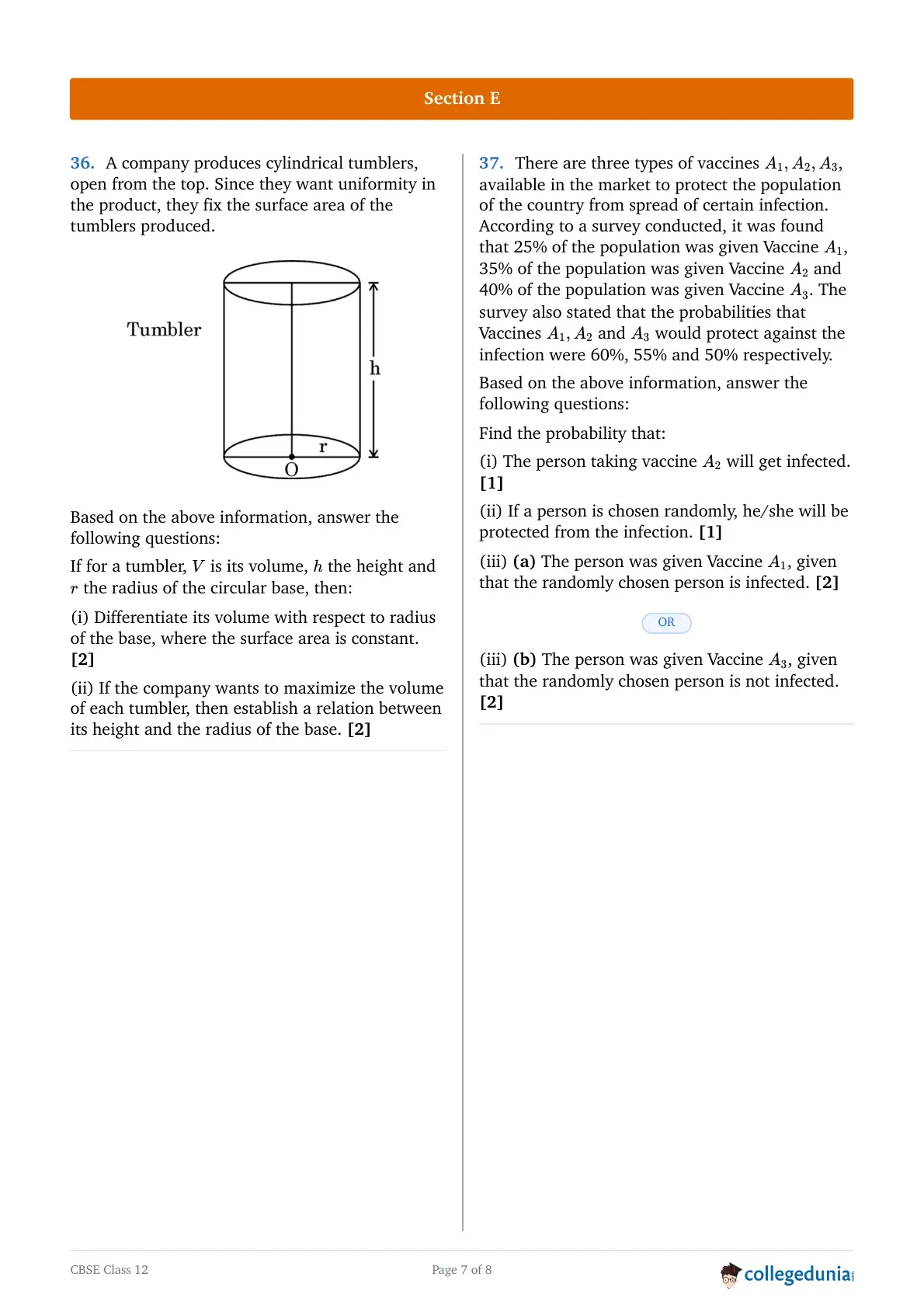
A company produces cylindrical tumblers, open from the top. Since they want uniformity in the product, they fix the surface area of the tumblers produced. If for a tumbler, \( V \) is its volume, \( h \) the height and \( r \) the radius of the circular base, then:


Differentiate its volume with respect to radius of the base, where
the surface area is constant.

Correct Answer:
View Solution


Concept:

Volume of cylinder: \( V = \pi r^2 h \).
Surface area of an open cylinder: \( S = \pi r^2 + 2\pi r h \).
To differentiate \( V \) wrt \( r \), express \( V \) as a function of \( r \) alone by eliminating \( h \).


Step 1: Express \( h \) in terms of \( S \) and \( r \)

From the surface area formula (where \( S \) is constant): \[ 2\pi r h = S - \pi r^2 \] \[ h = \frac{S - \pi r^2}{2\pi r} \]


Step 2: Substitute \( h \) into the volume formula
\[ V = \pi r^2 \left( \frac{S - \pi r^2}{2\pi r} \right) \] \[ V = \frac{r(S - \pi r^2)}{2} \] \[ V = \frac{Sr}{2} - \frac{\pi r^3}{2} \]


Step 3: Differentiate \( V \) with respect to \( r \)

Treating \( S \) and \( \pi \) as constants: \[ \frac{dV}{dr} = \frac{d}{dr} \left( \frac{Sr}{2} - \frac{\pi r^3}{2} \right) \] \[ \frac{dV}{dr} = \frac{S}{2} - \frac{3\pi r^2}{2} \] Quick Tip: For an open cylinder, only one base (\( \pi r^2 \)) is included in the surface area.
Ensure you simplify the volume expression before differentiating to avoid the product rule.


Question 45:

If the company wants to maximize the volume of each tumbler,
then establish a relation between its height and the radius of the
base.

Correct Answer:
View Solution


Concept:

For maximum volume, the derivative \( dV/dr \) must be zero.
Use the result from the previous part to find the optimal dimensions.


Step 1: Set the derivative to zero

From part (i): \( \frac{dV}{dr} = \frac{S}{2} - \frac{3\pi r^2}{2} \).
For maximum volume: \[ \frac{S}{2} - \frac{3\pi r^2}{2} = 0 \] \[ S = 3\pi r^2 \]


Step 2: Substitute the original formula for \( S \)

We know \( S = \pi r^2 + 2\pi r h \).
Substituting this into our optimality condition: \[ \pi r^2 + 2\pi r h = 3\pi r^2 \]


Step 3: Simplify the relation
\[ 2\pi r h = 3\pi r^2 - \pi r^2 \] \[ 2\pi r h = 2\pi r^2 \]
Dividing by \( 2\pi r \) (since \( r \neq 0 \)): \[ h = r \]


Step 4: Conclusion

To maximize the volume of an open cylindrical tumbler for a fixed surface area, the height must be equal to the radius of the base. Quick Tip: In many optimization problems involving shapes, the dimensions often turn out to be equal or proportional to each other.
Always verify with the second derivative test if required; here \( d^2V/dr^2 = -3\pi r < 0 \), confirming a maximum.


Question 46:

There are three types of vaccines \( A_1, A_2, A_3 \), available in the market to protect the population of the country from spread of certain infection. According to a survey conducted, it was found that 25% of the population was given Vaccine \( A_1 \), 35% of the population was given Vaccine \( A_2 \) and 40% of the population was given Vaccine \( A_3 \). The survey also stated that the probabilities that Vaccines \( A_1, A_2 \) and \( A_3 \) would protect against the infection were 60%, 55% and 50% respectively. Based on the above information, find the probability that:


The person taking vaccine \( A_2 \) will get infected.

Correct Answer:
View Solution


Concept:

Probability of an event and its complement: \( P(E') = 1 - P(E) \).
Given a conditional probability of success (protection), the probability of failure (infection) is its complement.


Step 1: Identify the given probabilities for Vaccine \( A_2 \)

From the case study, for a person taking Vaccine \( A_2 \):
Probability of being protected, \( P(Protected | A_2) = 55% = 0.55 \).


Step 2: Calculate the probability of being infected

Getting infected is the complementary event of being protected. \[ P(Infected | A_2) = 1 - P(Protected | A_2) \] \[ P(Infected | A_2) = 1 - 0.55 \] \[ P(Infected | A_2) = 0.45 \]


Step 3: Final Result

The probability that a person taking Vaccine \( A_2 \) will get infected is \( 0.45 \) or \( 45% \). Quick Tip: Conditional probability for a single branch is simply the complement.
Always convert percentages to decimals for easier calculation in probability problems.


Question 47:

If a person is chosen randomly, he/she will be protected from the
infection.

Correct Answer:
View Solution


Concept:

Theorem of Total Probability: For mutually exclusive events \( E_1, E_2, E_3 \), the total probability of an event \( A \) is \( P(A) = \sum P(E_i)P(A|E_i) \).


Step 1: Define the events and their probabilities


Let \( E_1, E_2, E_3 \) be the events that a person takes Vaccine \( A_1, A_2, A_3 \) respectively.

\[ P(E_1) = 25% = 0.25 \] \[ P(E_2) = 35% = 0.35 \] \[ P(E_3) = 40% = 0.40 \]
Let \( A \) be the event that the person is protected. \[ P(A|E_1) = 0.60 \] \[ P(A|E_2) = 0.55 \] \[ P(A|E_3) = 0.50 \]


Step 2: Apply the Total Probability Formula

\[ P(A) = P(E_1)P(A|E_1) + P(E_2)P(A|E_2) + P(E_3)P(A|E_3) \] \[ P(A) = (0.25 \times 0.60) + (0.35 \times 0.55) + (0.40 \times 0.50) \]


Step 3: Calculate the final numerical value

\[ P(A) = 0.1500 + 0.1925 + 0.2000 \] \[ P(A) = 0.5425 \]


The probability that a randomly chosen person is protected is \( 0.5425 \). Quick Tip: Total probability sums the 'weighted' probabilities of each vaccine branch.
Multiply carefully and keep as many decimal places as needed until the final step.


Question 48:

The person was given Vaccine \(A_1\), given that the randomly chosen person is infected.

Correct Answer:
View Solution


Concept:

Bayes' Theorem: \( P(E_k|I) = \frac{P(E_k)P(I|E_k)}{P(I)} \).
\( P(I) = 1 - P(Protected) \).


Step 1: Calculate the total probability of being infected

From question 37(ii), total probability of protection \( P(A) = 0.5425 \).
Total probability of infection \( P(I) = 1 - 0.5425 = 0.4575 \).


Step 2: Calculate the numerator for Bayes' Theorem

We need the probability of being infected given Vaccine \( A_1 \). \[ P(I|E_1) = 1 - 0.60 = 0.40 \]
Numerator: \( P(E_1)P(I|E_1) = 0.25 \times 0.40 = 0.10 \).


Step 3: Apply Bayes' Theorem
\[ P(E_1|I) = \frac{P(E_1)P(I|E_1)}{P(I)} \] \[ P(E_1|I) = \frac{0.10}{0.4575} \]
Converting to fraction: \[ P(E_1|I) = \frac{1000}{4575} = \frac{40}{183} \] Quick Tip: Always simplify your final fraction if possible.
Bayes' Theorem answers "given the result, what was the cause?".


Question 49:

The person was given Vaccine \(A_3\), given that the randomly chosen person is not infected.

Correct Answer:
View Solution


Concept:


Bayes' Theorem for protected individuals (not infected): \( P(E_3|A) = \frac{P(E_3)P(A|E_3)}{P(A)} \).


Step 1: Identify the required values from previous steps

\( P(A) = 0.5425 \) (Total Probability of protection).
\( P(E_3) = 0.40 \). \( P(A|E_3) = 0.50 \).


Step 2: Calculate the numerator

\[ P(E_3)P(A|E_3) = 0.40 \times 0.50 = 0.20 \]


Step 3: Apply Bayes' Theorem

\[ P(E_3|A) = \frac{0.20}{0.5425} \]
Converting to fraction: \[ P(E_3|A) = \frac{2000}{5425} = \frac{80}{217} \] Quick Tip: "Not infected" is the same as "Protected" in this context.
Double check your division when converting decimals to fractions.


Question 50:

A school wants the students of class XII to do a project on ‘Sustainability’ keeping the world environment in mind. They select the student participants on the basis of an essay writing competition.

7 students out of 80 are selected for the project and are categorized into
two sets such that :

Girl students belong to Set A = \( A = \{G_1, G_2, G_3, G_4\} \) and

Boy students belong to Set B = \( B = \{B_1, B_2, B_3\} \) .


How many relations are possible from Set \( A \to \) Set \( B \)?

Correct Answer:
View Solution


Concept:

A relation from set \( A \) to set \( B \) is any subset of the Cartesian product \( A \times B \).
If \( n(A) = p \) and \( n(B) = q \), then the number of elements in \( A \times B \) is \( p \times q \).
The total number of subsets of a set with \( m \) elements is \( 2^m \).


Step 1: Find the number of elements in each set

Set \( A \) contains 4 elements: \( n(A) = 4 \).

Set \( B \) contains 3 elements: \( n(B) = 3 \).


Step 2: Calculate the number of elements in the Cartesian product \( A \times B \)
\[ n(A \times B) = n(A) \times n(B) \] \[ n(A \times B) = 4 \times 3 = 12 \]


Step 3: Determine the total number of relations

The total number of possible relations is the total number of subsets of \( A \times B \). \[ Total Relations = 2^{n(A \times B)} \] \[ Total Relations = 2^{12} \] \[ Total Relations = 4096 \] Quick Tip: A relation is simply a set of ordered pairs; it doesn't have the "one output per input" restriction of a function.
Remember: The number of relations from \( A \to B \) is the same as from \( B \to A \).


Question 51:

Let \( R \) be a relation from \( A \to B \) such that \( R = \{(G_1, B_1), (G_2, B_2), (G_3, B_2), (G_4, B_3), (G_1, B_2)\} \). Is \( R \) an injective function? Justify your answer.

Correct Answer:
View Solution


Concept:


A relation is a function if every element in the domain has exactly one image in the codomain.
A function is injective (one-to-one) if distinct elements in the domain have distinct images in the codomain.


Step 1: Check if the relation \( R \) qualifies as a function


In the given relation \( R \):


The element \( G_1 \in A \) is associated with two different elements in \( B \), namely \( B_1 \) and \( B_2 \).

\[ (G_1, B_1) \in R \quad and \quad (G_1, B_2) \in R \]


By the definition of a function, an element in the domain cannot have more than one image.


Therefore, \( R \) is not a function.


Step 2: Check the condition for injectivity

Even if we ignore the first step, let's examine the mapping of other elements:
We see that \( (G_2, B_2) \in R \) and \( (G_3, B_2) \in R \).
Two distinct elements \( G_2 \) and \( G_3 \) have the same image \( B_2 \).
This violates the condition for a function to be injective.


Step 3: Conclusion and Justification

\( R \) is not an injective function because:


It is not a function (since \( G_1 \) has multiple images).
It is not one-to-one (since \( G_2 \) and \( G_3 \) share the same image \( B_2 \)). Quick Tip: To be a function, check if any first element in the pairs is repeated with a different second element.
Injectivity is about the 'uniqueness' of the second elements in the pairs.


Question 52:

Let the relation \(R\) from \(A \to A\) be such that \[ R = \{(x,y) : x,y \in A,\ x and y are students from the same colony in the city\}. \]
Verify if \(R\) is an equivalence relation.

Correct Answer:
View Solution


Concept:

Reflexive: \((x, x) \in R\) for all \(x \in A\).
Symmetric: If \((x, y) \in R\), then \((y, x) \in R\).
Transitive: If \((x, y) \in R\) and \((y, z) \in R\), then \((x, z) \in R\).
A relation is an equivalence relation if it is reflexive, symmetric, and transitive.


Step 1: Verify Reflexivity

For any student \( x \in A \), \( x \) and \( x \) are obviously from the same colony.
So, \( (x, x) \in R \) for all \( x \in A \).
Therefore, \( R \) is reflexive.


Step 2: Verify Symmetry

Let \( (x, y) \in R \). This means student \( x \) and student \( y \) are from the same colony.
If \( x \) and \( y \) are in the same colony, then \( y \) and \( x \) are also in the same colony.
So, \( (y, x) \in R \).
Therefore, \( R \) is symmetric.


Step 3: Verify Transitivity

Let \( (x, y) \in R \) and \( (y, z) \in R \).
This means \( x \) and \( y \) are in the same colony, and \( y \) and \( z \) are in the same colony.
This logically implies that \( x \) and \( z \) must also be in the same colony.
So, \( (x, z) \in R \).
Therefore, \( R \) is transitive.


Step 4: Conclusion

Since the relation \( R \) is reflexive, symmetric, and transitive, it is verified that \( R \) is an equivalence relation. Quick Tip: Any relation defined by the property of "belonging to the same category" (colony, school, age, etc.) is always an equivalence relation.
Use clear logical statements for symmetry and transitivity to earn full marks.


Question 53:

Verify if any function \( f : B \to A \) is bijective. Give reason to support your answer.

Correct Answer:
View Solution


Concept:


A function is bijective if it is both injective (one-to-one) and surjective (onto).
For a function \( f : X \to Y \) to be bijective, the number of elements in the domain and codomain must be equal: \( n(X) = n(Y) \).


Step 1: Compare the number of elements in both sets


Set \( B \) (Domain) contains 3 elements: \( n(B) = 3 \).


Set \( A \) (Codomain) contains 4 elements: \( n(A) = 4 \).


Step 2: Analyze the condition for Surjectivity (Onto)


For a function to be surjective, every element in the codomain \( A \) must have at least one pre-image in the domain \( B \).


Since there are only 3 elements in the domain \( B \), they can map to at most 3 distinct elements in the codomain \( A \).


Because the codomain \( A \) has 4 elements, at least one element in \( A \) will always be left without a pre-image.


Thus, no function from \( B \) to \( A \) can be surjective.


Step 3: Conclusion


A function must be both injective and surjective to be bijective.
Since no function from \( B \) to \( A \) can be surjective (due to \( n(B) < n(A) \)), it follows that no such function can be bijective. Quick Tip: If \( n(Domain) \neq n(Codomain) \), a bijection is impossible.
If \( n(D) < n(C) \), it cannot be onto. If \( n(D) > n(C) \), it cannot be one-to-one.

CBSE Class 12 Mathematics Chapter-Wise Weightage

S.No Units Marks
I Relations and Functions 08
II Algebra 10
III Calculus 35
IV Vectors and Three-Dimensional Geometry 14
V Linear Programming 05
VI Probability 08
Total (Theory) 80
Internal Assessment 20

CBSE Class 12 Mathematics Paper Analysis 2026