




CBSE Class 12th Board Mathematics exam was conducted on 8th March 2025 from 10:30 AM to 1:30 PM.The Mathematics theory paper is worth 80 marks, and the internal assessment is worth 20 marks. The CBSE Mathematics question paper includes MCQ (1 mark each), short-answer type questions (2 and 3 marks each), and long-answer type questions (4 and 6 marks each), totaling 80 marks.
Also Check: CBSE Class 12 Question Paper 2025 (All Subjects)
The Mathematics question paper includes the following types of questions:
- The question paper has 38 questions, all compulsory, for 80 marks in 3 hours, with 15 minutes of extra reading time
- Section A (Q1 to Q18) has 18 multiple choice questions and Q19 and Q20 are 2 assertion-reason questions, all of 1 mark each, and Section B (Q21 to Q25) has 5 very short answer questions of 2 marks each
- Section C (Q26 to Q31) has 6 short answer questions of 3 marks each, and Section D (Q32 to Q35) has 4 long answer questions of 5 marks each
- Section E (Q36 to Q38) has 3 case study based questions of 4 marks each
- There is no overall choice, but internal choice (OR) is given in 2 questions of Section B, 3 of Section C, 2 of Section D and 2 of Section E, and calculators are not allowed
CBSE Class 12 2025 Mathematics 65-5-2 Question Paper with Solution PDF
| CBSE Official PDF | CD PDF | CD PDF with Solutions |
|---|---|---|
| Download official PDF 3.44 MB | Download Collegedunia PDF 1.40 MB | – |
CBSE Class 12 Mathematics 2025 Set 2 (65/5/2) Questions with Solutions
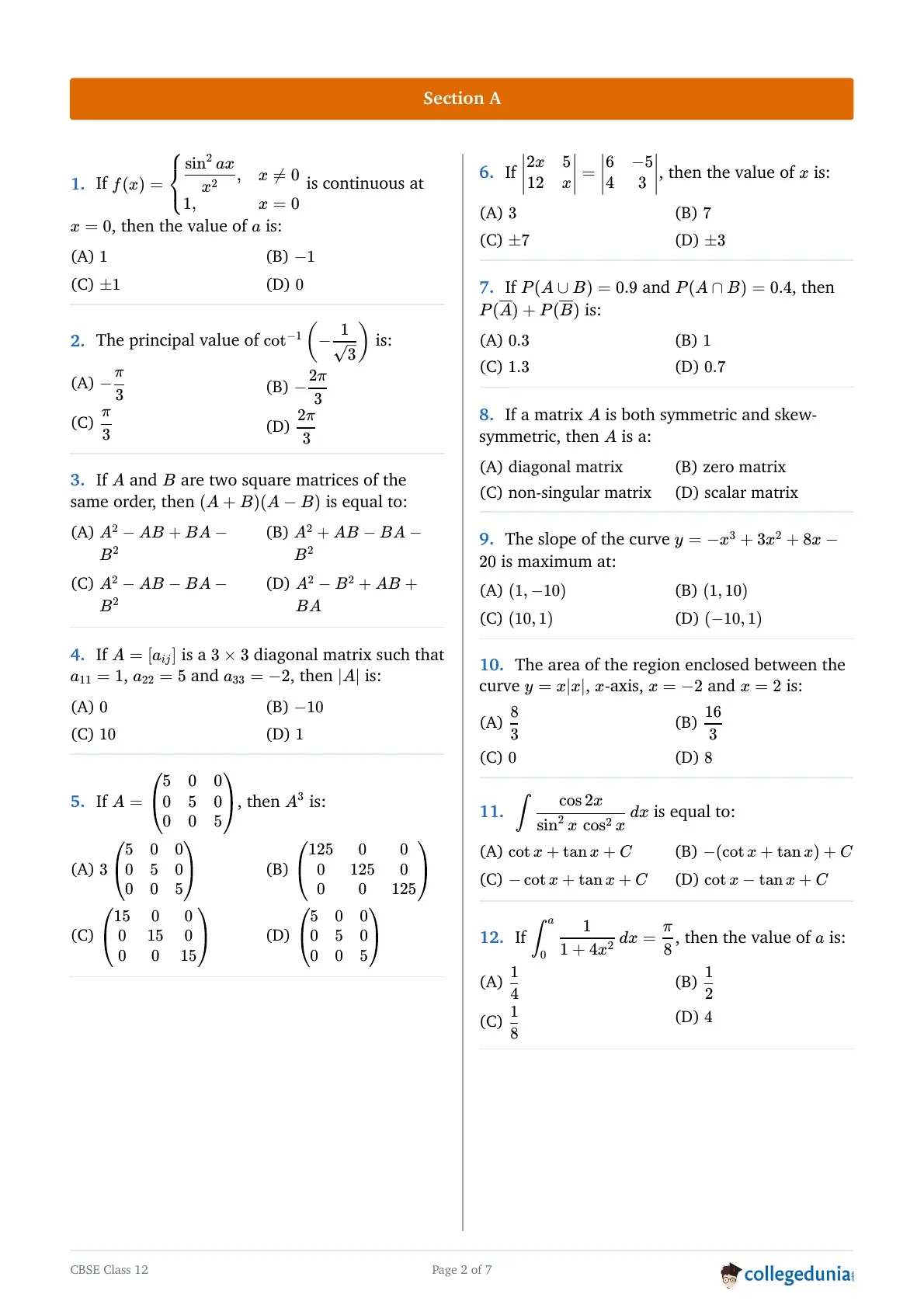
If \[ f(x) = \begin{cases} \frac{\sin^2(ax)}{x^2}, & x \neq 0 \\ 1, & x = 0 \end{cases} \] is continuous at \( x = 0 \), then the value of \( a \) is:
The principal value of \( \cot^{-1} \left( -\frac{1}{\sqrt{3}} \right) \) is:
If A and B are two square matrices of the same order, then (A + B)(A - B) is equal to:
If \(A=[a_{ij}]\) is a \(3\times 3\) diagonal matrix such that \(a_{11}=1\), \(a_{22}=5\) and \(a_{33}=-2\), then \(|A|\) is :
If \(A=\begin{bmatrix}5 & 0 & 0\\ 0 & 5 & 0\\ 0 & 0 & 5\end{bmatrix}\), then \(A^{3}\) is :
If \( \left| \begin{matrix} 2x & 5 \\ 12 & x \end{matrix} \right| = \left| \begin{matrix} 6 & -5 \\ 4 & 3 \end{matrix} \right| \), then the value of x is:
If \(P(A \cup B) = 0.9\) and \(P(A \cap B) = 0.4\), then \(P(\overline{A}) + P(\overline{B})\) is :
If a matrix A is both symmetric and skew-symmetric, then A is:
The slope of the curve \( y = -x^3 + 3x^2 + 8x - 20 \) is maximum at:
The area of the region enclosed between the curve \( y = |x| \), x-axis, \( x = -2 \) and \( x = 2 \) is:
\( \int \frac{\cos 2x}{\sin^2 x \cos^2 x} \, dx \) is equal to:
If \( \int_0^a \frac{1}{1 + 4x^2} \, dx = \frac{\pi}{8} \), then the value of \(a\) is:
If \( f(x) = \lfloor x \rfloor \) is the greatest integer function, then the correct statement is:
The integrating factor of the differential equation \( \frac{dx}{dy} = \frac{x \log x}{2 \log x - y} \) is:
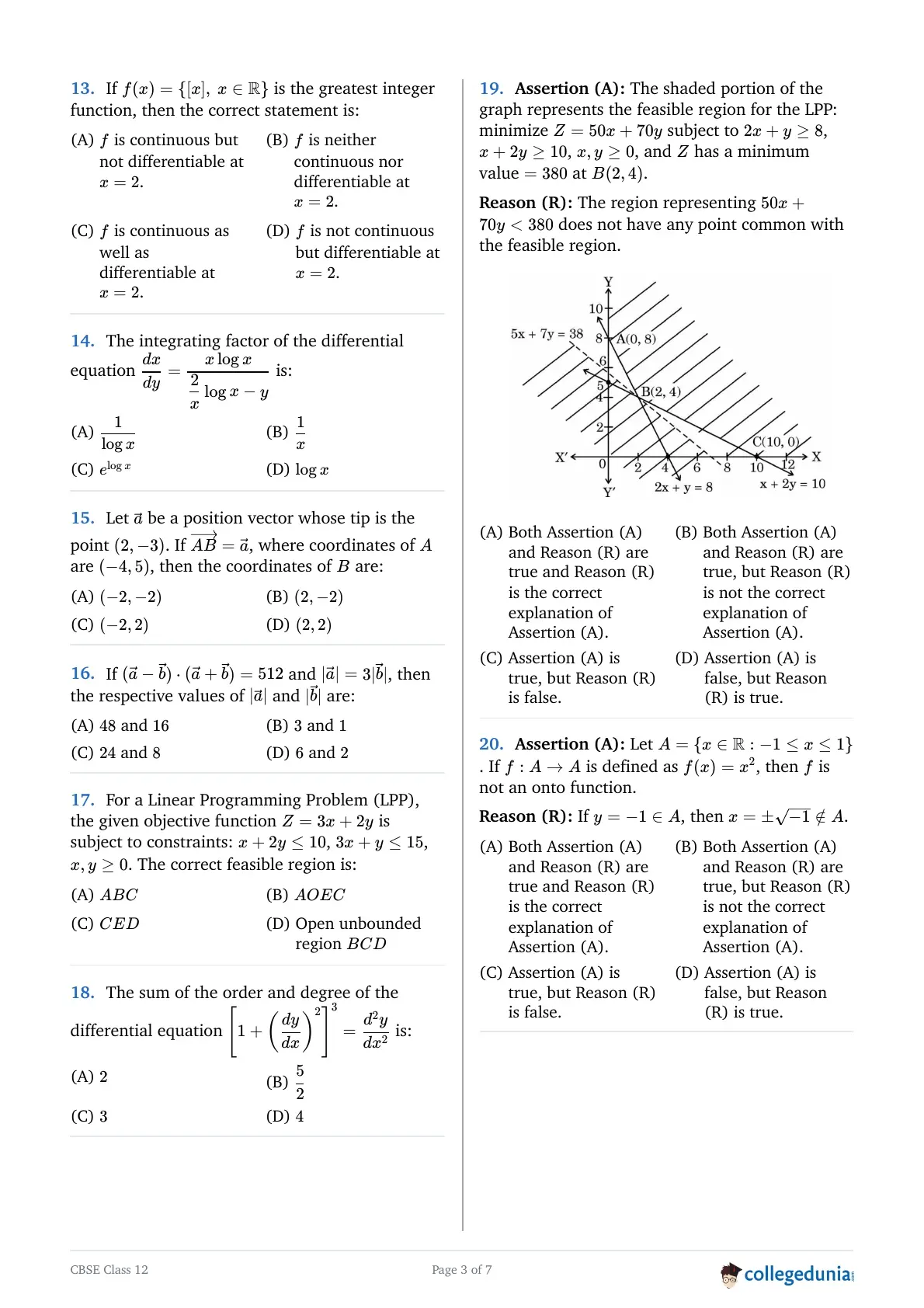
Let \( \vec{a} \) be a position vector whose tip is the point (2, -3). If \( \overrightarrow{AB} = \vec{a} \), where coordinates of A are (–4, 5), then the coordinates of B are:
The respective values of \( |\vec{a}| \) and} \( |\vec{b}| \), if given \[ (\vec{a} - \vec{b}) \cdot (\vec{a} + \vec{b}) = 512 \quad \text{and} \quad |\vec{a}| = 3 |\vec{b}|, \] are:
For a Linear Programming Problem (LPP), the given objective function \( Z = 3x + 2y \) is subject to constraints: \[ x + 2y \leq 10, \] \[ 3x + y \leq 15, \] \[ x, y \geq 0. \] 
The correct feasible region is:
The sum of the order and degree of the differential equation
\[\left[1+\left(\frac{dy}{dx}\right)^{2}\right]^{3}=\frac{d^{2}y}{dx^{2}}\]
is :
Assertion (A): The shaded portion of the graph represents the feasible region for the given Linear Programming Problem (LPP).
Reason (R): The region representing \( Z = 50x + 70y \) such that \( Z < 380 \) does not have any point common with the feasible region.
Assertion (A): Let \( A = \{ x \in \mathbb{R} : -1 \leq x \leq 1 \} \). If \( f : A \to A \) be defined as \( f(x) = x^2 \), then \( f \) is not an onto function.
Reason (R): If \( y = -1 \in A \), then \( x = \pm \sqrt{-1} \notin A \).
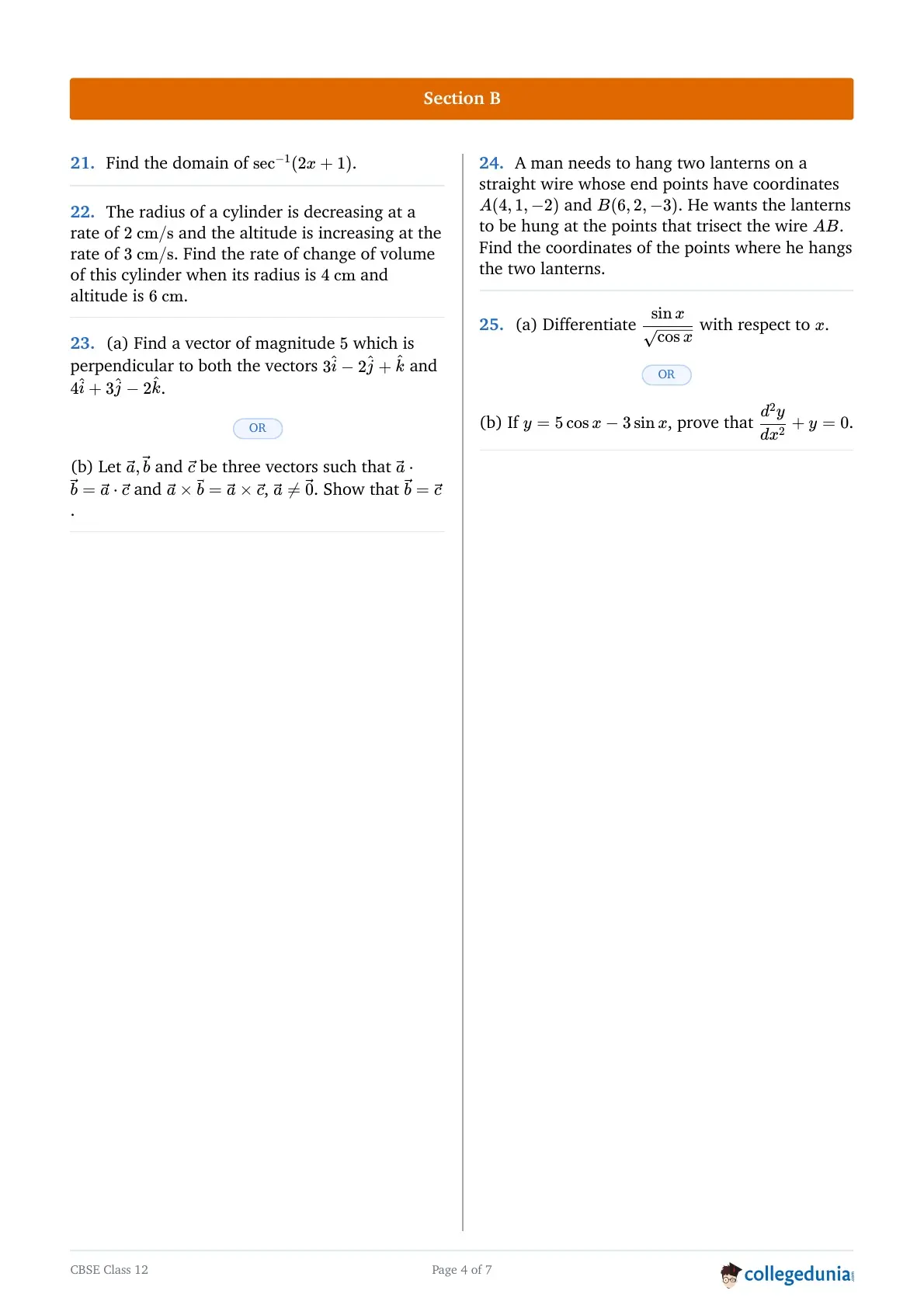
Find the domain of \( \sec^{-1}(2x + 1) \).
The radius of a cylinder is decreasing at a rate of 2 cm/s and the altitude is increasing at a rate of 3 cm/s. Find the rate of change of volume of this cylinder when its radius is 4 cm and altitude is 6 cm.
Find a vector of magnitude 5 which is perpendicular to both the vectors \( 3\hat{i} - 2\hat{j} + \hat{k} \text{ and } 4\hat{i} + 3\hat{j} - 2\hat{k} \).
If three non-zero vectors are \( \vec{a}, \vec{b} \) and \( \vec{c} \) such that
\( \vec{a} \cdot \vec{b} = \vec{a} \cdot \vec{c} \) and \( \vec{a} \times \vec{b} = \vec{a} \times \vec{c} \),
then show that \( \vec{b} = \vec{c} \).
A man needs to hang two lanterns on a straight wire whose end points have coordinates A (4, 1, -2) and B (6, 2, -3). Find the coordinates of the points where he hangs the lanterns such that these points trisect the wire AB.
Differentiate \(\frac{\sin x}{\sqrt{\cos x}}\) with respect to x.
If \(y = 5 \cos x - 3 \sin x\), prove that \(\frac{d^2y}{dx^2} + y = 0\).
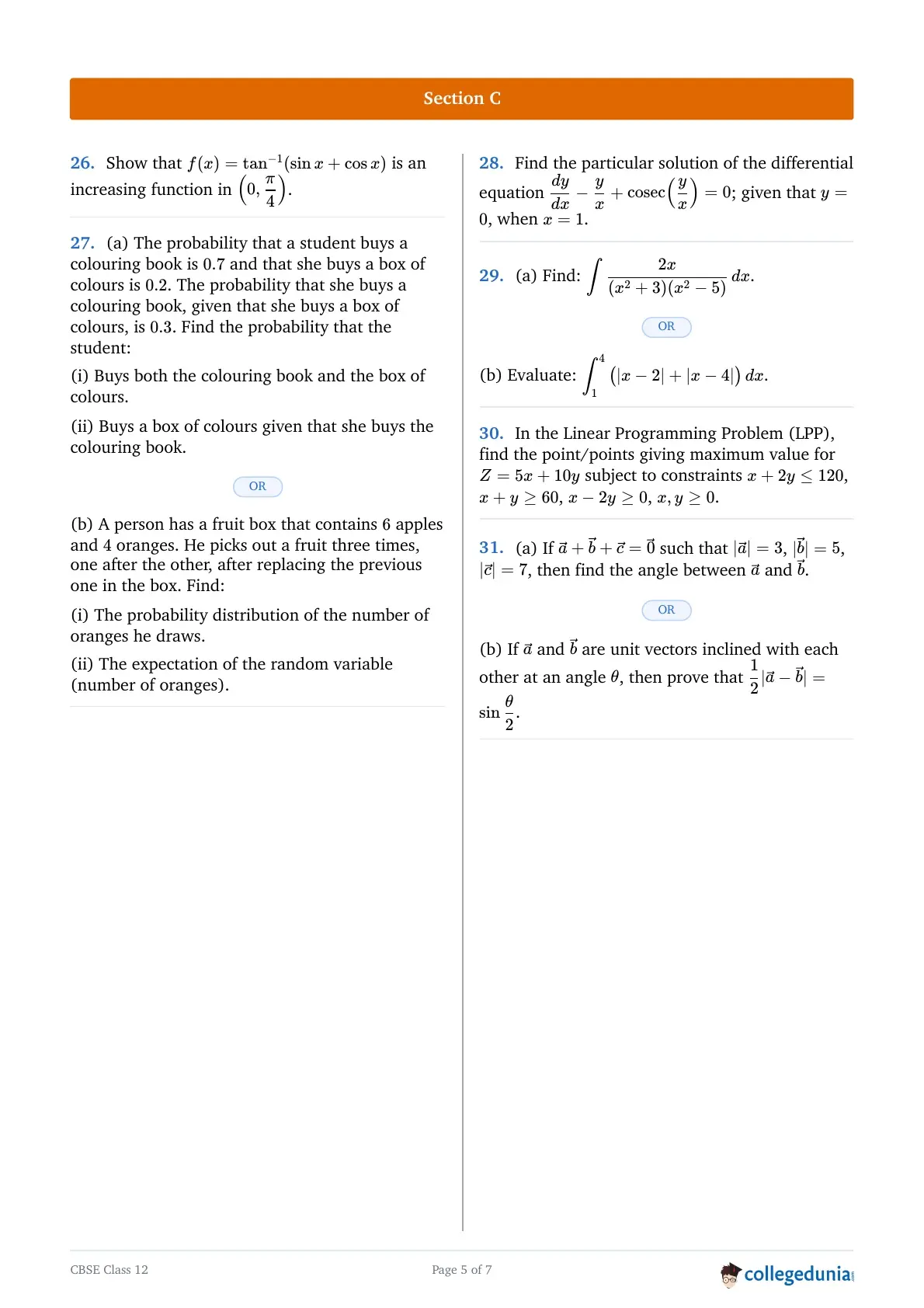
Show that \( f(x) = \tan^{-1}(\sin x + \cos x) \) is an increasing function in \( \left[ 0, \frac{\pi}{4} \right] \).
The probability that a student buys a colouring book is 0.7, and a box of colours is 0.2. The probability that she buys a colouring book, given that she buys a box of colours, is 0.3. Find:
(i) The probability that she buys both the colouring book and the box of colours.
(ii) The probability that she buys a box of colours given she buys the colouring book.
A fruit box contains 6 apples and 4 oranges. A person picks out a fruit three times with replacement. Find:
(i) The probability distribution of the number of oranges he draws.
(ii) The expectation of the number of oranges.
Find the particular solution of the differential equation \( \frac{dy}{dx} - \frac{y}{x} + \csc\left(\frac{y}{x}\right) = 0 \); given that \( y = 0 \), when \( x = 1 \).
Find: \[ \int \frac{2x}{(x^2 + 3)(x^2 - 5)} \, dx \]
Evaluate: \[ \int_1^5 \left( |x-2| + |x-4| \right) \, dx \]
In the Linear Programming Problem (LPP), find the point/points giving the maximum value for \( Z = 5x + 10y\) subject to the constraints:
\[x + 2y \leq 120 \\ x + y \geq 60 \\ x - 2y \geq 0 \\ x \geq 0, y \geq 0\]
If \(\vec{a} + \vec{b} + \vec{c} = \vec{0}\) such that \(|\vec{a}| = 3\), \(|\vec{b}| = 5\), \(|\vec{c}| = 7\), then find the angle between \(\vec{a}\) and \(\vec{b}\).
If \(\vec{a}\) and \(\vec{b}\) are unit vectors inclined with each other at an angle \(\theta\), then prove that \(\dfrac{1}{2}\left|\vec{a}-\vec{b}\right|=\sin\dfrac{\theta}{2}\).
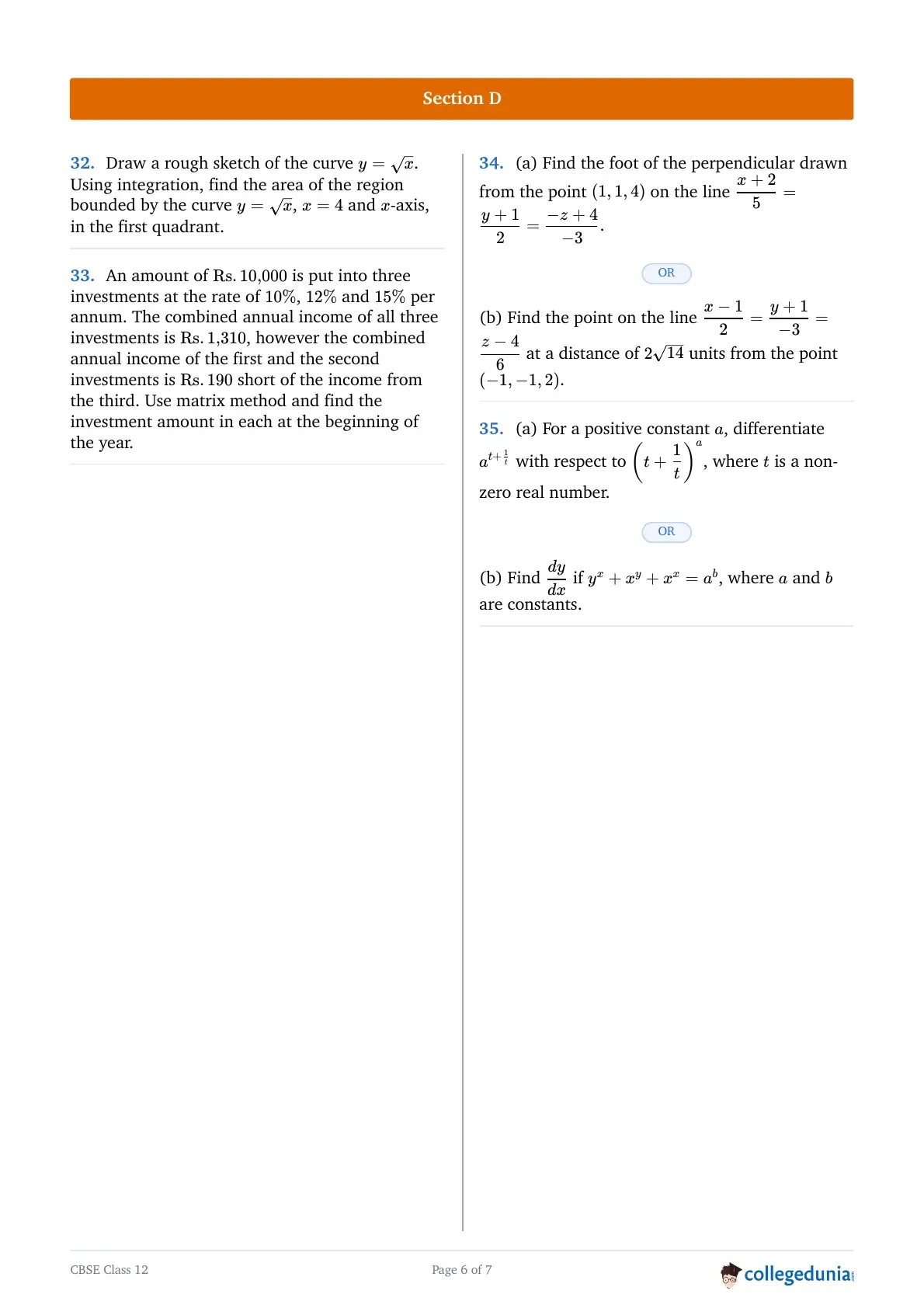
Draw a rough sketch of the curve \( y = \sqrt{x} \). Using integration, find the area of the region bounded by the curve \( y = \sqrt{x} \), \( x = 4 \), and the x-axis, in the first quadrant.
An amount of ₹ 10,000 is put into three investments at the rate of 10%, 12% and 15% per annum. The combined annual income of all three investments is ₹ 1,310, however, the combined annual income of the first and second investments is ₹ 190 short of the income from the third. Use matrix method and find the investment amount in each at the beginning of the year.
Find the foot of the perpendicular drawn from the point \( (1, 1, 4) \) on the line \( \frac{x+2}{5} = \frac{y+1}{2} = \frac{z-4}{-3} \).
Find the point on the line \( \frac{x-1}{3} = \frac{y+1}{2} = \frac{z-4}{3} \) at a distance of \( \sqrt{2} \) units from the point \( (-1, -1, 2) \).
For a positive constant \(a\), differentiate \(a^{t+\frac{1}{t}}\) with respect to \(\left(t+\dfrac{1}{t}\right)^{a}\), where \(t\) is a non-zero real number.
Find \( \frac{dy}{dx} \) if \( x^3 + y^3 + x^2 = a^b \), where \( a \) and \( b \) are constants.
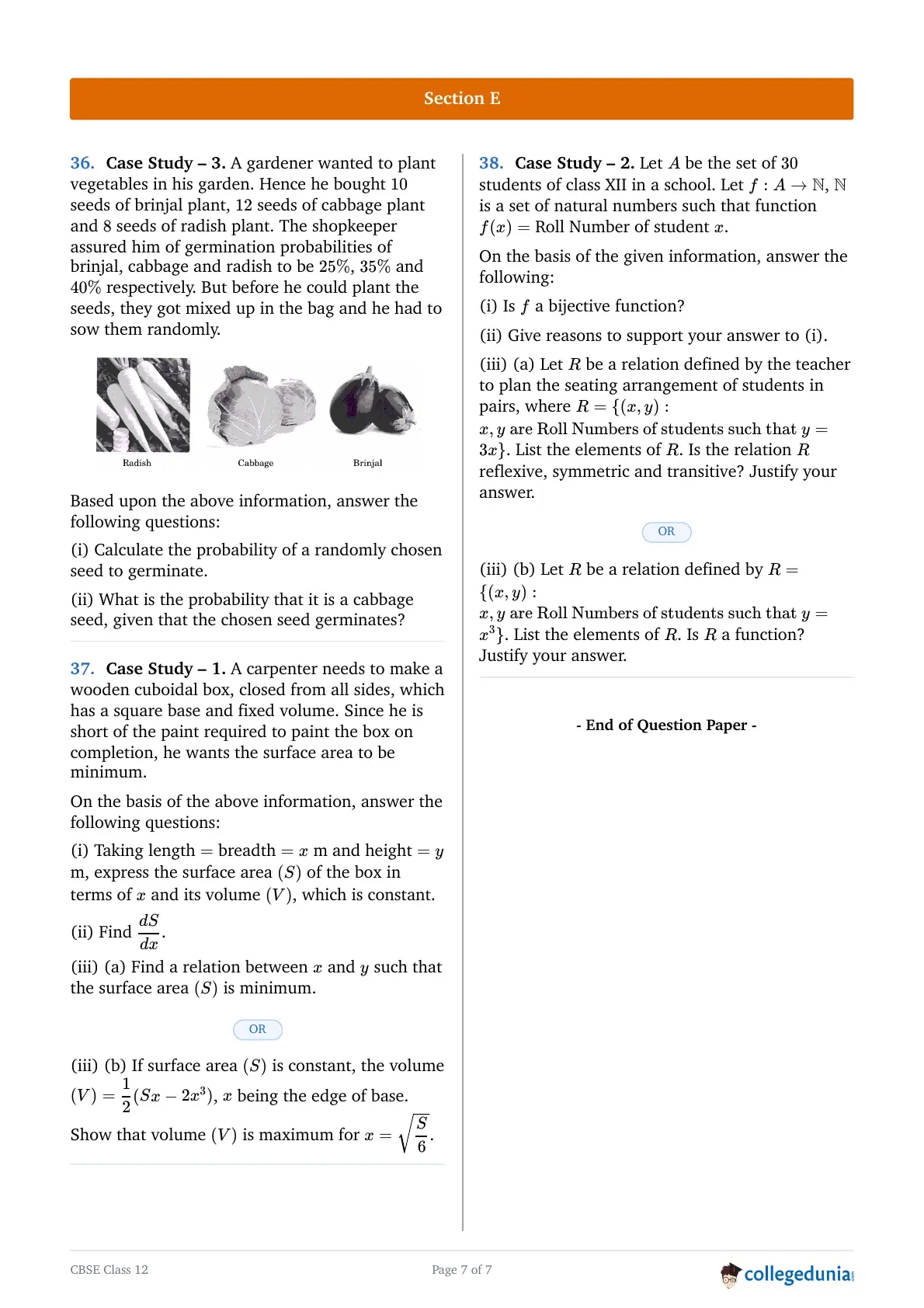
Case Study – 3. A gardener wanted to plant vegetables in his garden. Hence he bought \(10\) seeds of brinjal plant, \(12\) seeds of cabbage plant and \(8\) seeds of radish plant. The shopkeeper assured him of germination probabilities of brinjal, cabbage and radish to be \(25\%\), \(35\%\) and \(40\%\) respectively. But before he could plant the seeds, they got mixed up in the bag and he had to sow them randomly.
Based upon the above information, answer the following questions:
Calculate the probability of a randomly chosen seed to germinate.
What is the probability that it is a cabbage seed, given that the chosen seed germinates?
Case Study – 1. A carpenter needs to make a wooden cuboidal box, closed from all sides, which has a square base and fixed volume. Since he is short of the paint required to paint the box on completion, he wants the surface area to be minimum.
On the basis of the above information, answer the following questions:
Taking length \(=\) breadth \(=x\) m and height \(=y\) m, express the surface area \((S)\) of the box in terms of \(x\) and its volume \((V)\), which is constant.
Find \(\dfrac{dS}{dx}\).
Find a relation between \(x\) and \(y\) such that the surface area \((S)\) is minimum.
If surface area \((S)\) is constant, the volume \((V)=\dfrac{1}{2}(Sx-2x^{3})\), \(x\) being the edge of base. Show that volume \((V)\) is maximum for \(x=\sqrt{\dfrac{S}{6}}\).
Case Study – 2. Let \(A\) be the set of \(30\) students of class XII in a school. Let \(f:A\to\mathbb{N}\), \(\mathbb{N}\) is a set of natural numbers such that function \(f(x)=\) Roll Number of student \(x\).
On the basis of the given information, answer the following:
Is \(f\) a bijective function?
Give reasons to support your answer to (i).
Let \(R\) be a relation defined by the teacher to plan the seating arrangement of students in pairs, where \(R=\{(x,y):x,y\text{ are Roll Numbers of students such that }y=3x\}\). List the elements of \(R\). Is the relation \(R\) reflexive, symmetric and transitive? Justify your answer.
Let \(R\) be a relation defined by \(R=\{(x,y):x,y\text{ are Roll Numbers of students such that }y=x^{3}\}\). List the elements of \(R\). Is \(R\) a function? Justify your answer.
CBSE Class 12 Mathematics 2025 Question Paper Details
| Exam | CBSE Class 12 Board Examination 2025 |
| Subject | Mathematics |
| Paper code | 65/5/2 |
| Exam date | March 8, 2025 |
| Time allowed | 3 hours (plus 15 minutes of reading time, 10:15 AM to 10:30 AM) |
| Maximum marks | 80 |
| Total questions | 38 (attempt 38) |
CBSE Class 12 Mathematics Question Paper Pattern and Marking Scheme
The CBSE Class 12 Mathematics 2025 question paper is of 80 marks and has 38 questions, of which 38 are to be attempted. The tables below give the section-wise paper pattern and the split of marks, as printed in the official question paper.
CBSE Class 12 Mathematics Question Paper Pattern 2025
| Section | Questions | Question Type | Choice | Marks per Question | Marks |
|---|---|---|---|---|---|
| Section A | Q1-Q18 | Multiple choice questions (MCQs) | All 18 | 1 | 18 |
| Q19-Q20 | Assertion-Reason based questions | All 2 | 1 | 2 | |
| Section B | Q21-Q25 | Very short answer (VSA) questions | All 5 | 2 | 10 |
| Section C | Q26-Q31 | Short answer (SA) questions | All 6 | 3 | 18 |
| Section D | Q32-Q35 | Long answer (LA) questions | All 4 | 5 | 20 |
| Section E | Q36-Q38 | Case study based questions | All 3 | 4 | 12 |
| Total | 38 questions | Attempt 38 | 80 |
CBSE Class 12 Mathematics Marks Distribution 2025
| Question Type | Questions to Attempt | Marks per Question | Total Marks |
|---|---|---|---|
| Multiple choice questions (MCQs) (Section A) | 18 | 1 | 18 |
| Assertion-Reason based questions (Section A) | 2 | 1 | 2 |
| Very short answer (VSA) questions (Section B) | 5 | 2 | 10 |
| Short answer (SA) questions (Section C) | 6 | 3 | 18 |
| Long answer (LA) questions (Section D) | 4 | 5 | 20 |
| Case study based questions (Section E) | 3 | 4 | 12 |
| Total | 38 | 80 |



Comments