




CBSE Class 12 Accountancy Question Paper 2026 Set - 3 (67/4/3) is now available for download. CBSE conducted the Class 12 Accountancy examination on Feb 24, 2026, from 10:30 AM to 1:30 PM.
Also Check: CBSE Class 12 Question Paper 2026 (All Subjects)
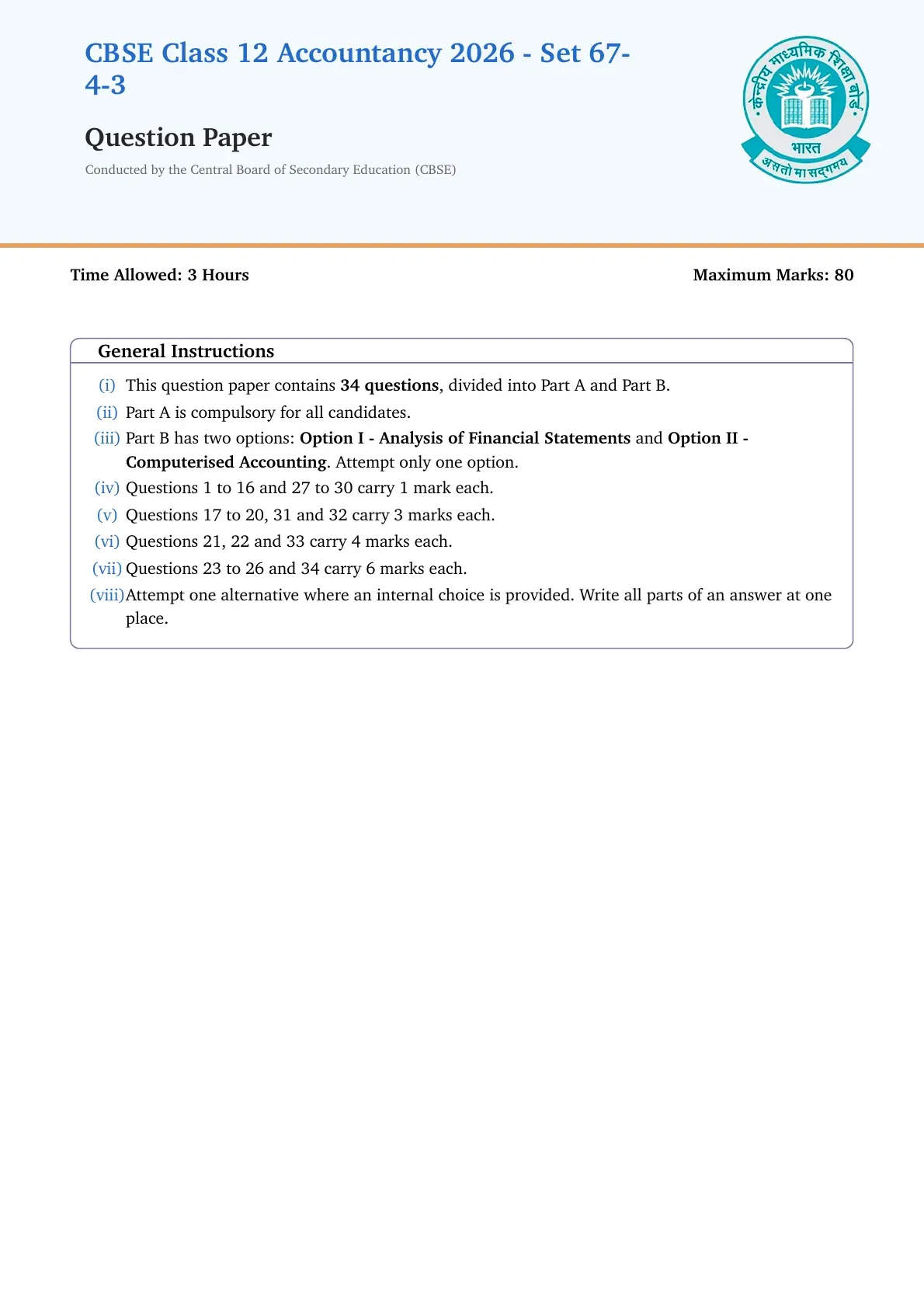
The question paper consists of 34 questions carrying a total of 80 marks:
- Part A is compulsory for all candidates
- Part B has two options, and candidates have to attempt only one of the given options
- Option I : Analysis of Financial Statements
- Option II : Computerised Accounting
The Accountancy question paper 2026 was rated moderately difficult by the students.
CBSE Class 12 Accountancy Set - 3(67/4/3) Question Paper 2026 with Solution Pdf
| CBSE Official PDF | CD PDF | CD PDF with Solutions |
|---|---|---|
| Download official PDF 2.37 MB | Download Collegedunia PDF 0.33 MB | – |
CBSE Class 12 Accountancy 2026 Set 3 (67/4/3) Questions with Solutions
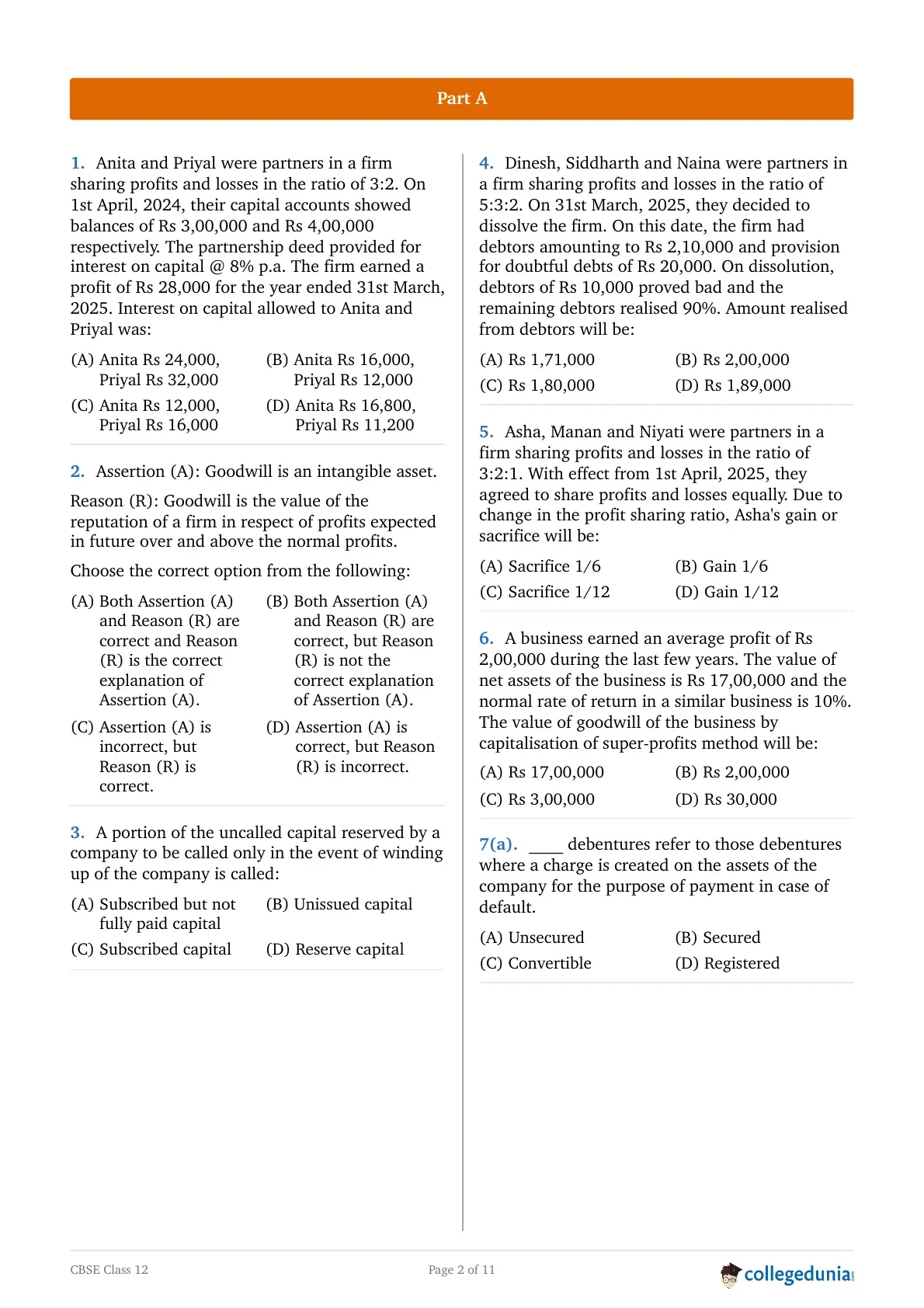
Anita and Priyal were partners in a firm sharing profits and losses in the ratio of 3:2. On 1st April, 2024, their capital accounts showed balances of Rs 3,00,000 and Rs 4,00,000 respectively. The partnership deed provided for interest on capital @ 8% p.a. The firm earned a profit of Rs 28,000 for the year ended 31st March, 2025. Interest on capital allowed to Anita and Priyal was:
Assertion (A): Goodwill is an intangible asset.
Reason (R): Goodwill is the value of the reputation of a firm in respect of profits expected in future over and above the normal profits.
Choose the correct option from the following:
A portion of the uncalled capital reserved by a company to be called only in the event of winding up of the company is called:
Dinesh, Siddharth and Naina were partners in a firm sharing profits and losses in the ratio of 5:3:2. On 31st March, 2025, they decided to dissolve the firm. On this date, the firm had debtors amounting to Rs 2,10,000 and provision for doubtful debts of Rs 20,000. On dissolution, debtors of Rs 10,000 proved bad and the remaining debtors realised 90%. Amount realised from debtors will be:
Asha, Manan and Niyati were partners in a firm sharing profits and losses in the ratio of 3:2:1. With effect from 1st April, 2025, they agreed to share profits and losses equally. Due to change in the profit sharing ratio, Asha's gain or sacrifice will be:
A business earned an average profit of Rs 2,00,000 during the last few years. The value of net assets of the business is Rs 17,00,000 and the normal rate of return in a similar business is 10%. The value of goodwill of the business by capitalisation of super-profits method will be:
____ debentures refer to those debentures where a charge is created on the assets of the company for the purpose of payment in case of default.
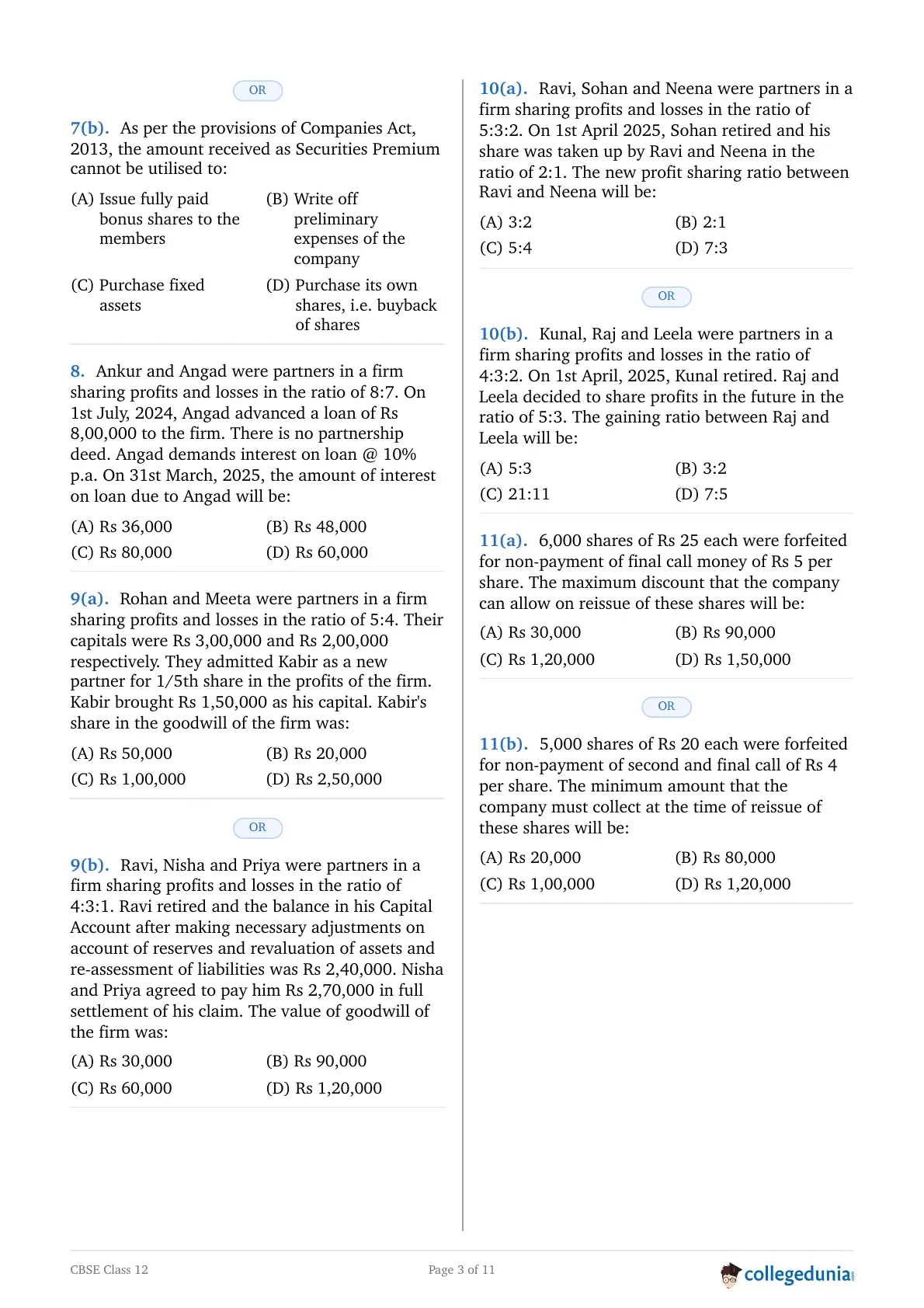
As per the provisions of Companies Act, 2013, the amount received as Securities Premium cannot be utilised to:
Ankur and Angad were partners in a firm sharing profits and losses in the ratio of 8:7. On 1st July, 2024, Angad advanced a loan of Rs 8,00,000 to the firm. There is no partnership deed. Angad demands interest on loan @ 10% p.a. On 31st March, 2025, the amount of interest on loan due to Angad will be:
Rohan and Meeta were partners in a firm sharing profits and losses in the ratio of 5:4. Their capitals were Rs 3,00,000 and Rs 2,00,000 respectively. They admitted Kabir as a new partner for 1/5th share in the profits of the firm. Kabir brought Rs 1,50,000 as his capital. Kabir's share in the goodwill of the firm was:
Ravi, Nisha and Priya were partners in a firm sharing profits and losses in the ratio of 4:3:1. Ravi retired and the balance in his Capital Account after making necessary adjustments on account of reserves and revaluation of assets and re-assessment of liabilities was Rs 2,40,000. Nisha and Priya agreed to pay him Rs 2,70,000 in full settlement of his claim. The value of goodwill of the firm was:
Ravi, Sohan and Neena were partners in a firm sharing profits and losses in the ratio of 5:3:2. On 1st April 2025, Sohan retired and his share was taken up by Ravi and Neena in the ratio of 2:1. The new profit sharing ratio between Ravi and Neena will be:
Kunal, Raj and Leela were partners in a firm sharing profits and losses in the ratio of 4:3:2. On 1st April, 2025, Kunal retired. Raj and Leela decided to share profits in the future in the ratio of 5:3. The gaining ratio between Raj and Leela will be:
6,000 shares of Rs 25 each were forfeited for non-payment of final call money of Rs 5 per share. The maximum discount that the company can allow on reissue of these shares will be:
5,000 shares of Rs 20 each were forfeited for non-payment of second and final call of Rs 4 per share. The minimum amount that the company must collect at the time of reissue of these shares will be:
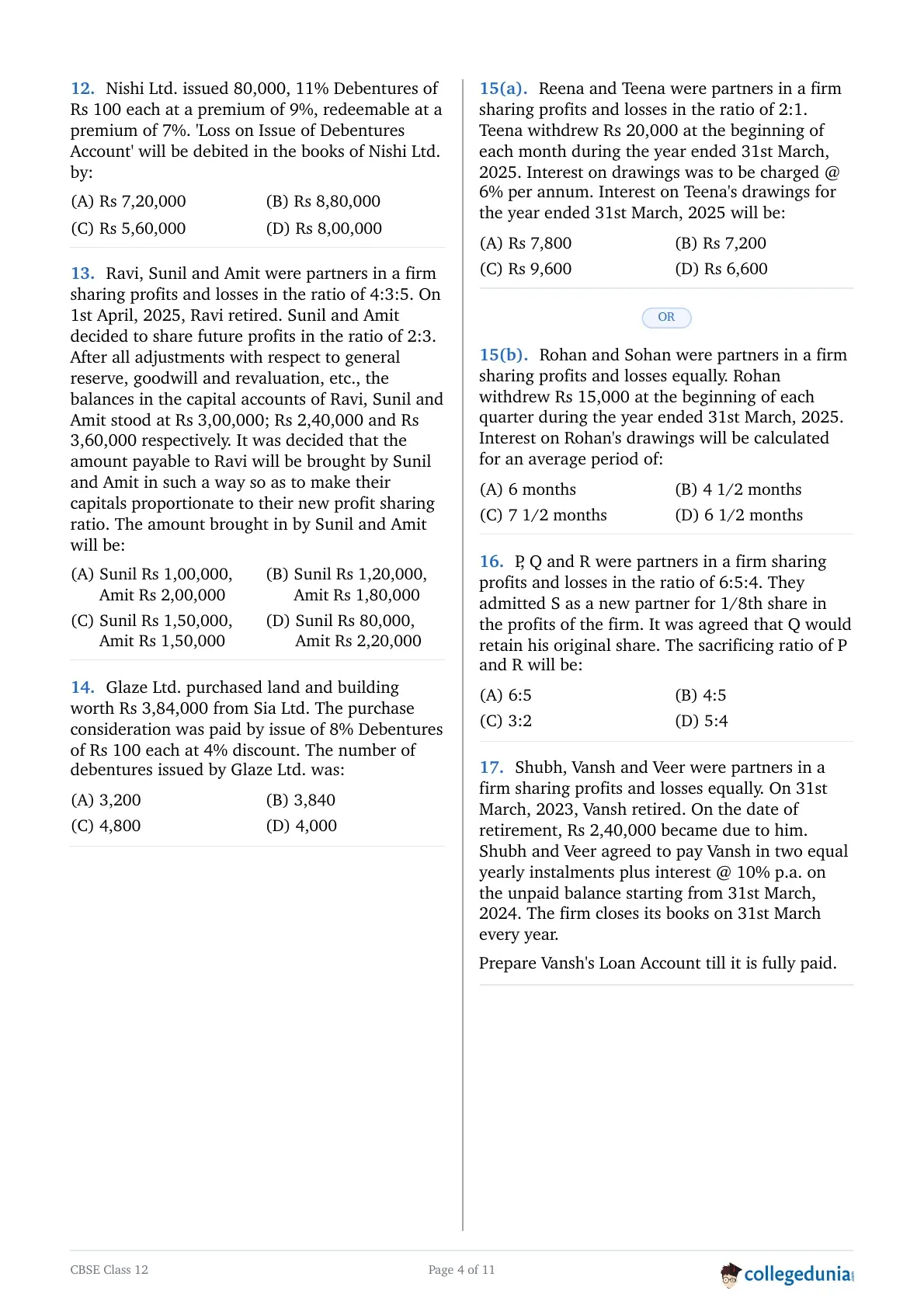
Nishi Ltd. issued 80,000, 11% Debentures of Rs 100 each at a premium of 9%, redeemable at a premium of 7%. 'Loss on Issue of Debentures Account' will be debited in the books of Nishi Ltd. by:
Ravi, Sunil and Amit were partners in a firm sharing profits and losses in the ratio of 4:3:5. On 1st April, 2025, Ravi retired. Sunil and Amit decided to share future profits in the ratio of 2:3. After all adjustments with respect to general reserve, goodwill and revaluation, etc., the balances in the capital accounts of Ravi, Sunil and Amit stood at Rs 3,00,000; Rs 2,40,000 and Rs 3,60,000 respectively. It was decided that the amount payable to Ravi will be brought by Sunil and Amit in such a way so as to make their capitals proportionate to their new profit sharing ratio. The amount brought in by Sunil and Amit will be:
Glaze Ltd. purchased land and building worth Rs 3,84,000 from Sia Ltd. The purchase consideration was paid by issue of 8% Debentures of Rs 100 each at 4% discount. The number of debentures issued by Glaze Ltd. was:
Reena and Teena were partners in a firm sharing profits and losses in the ratio of 2:1. Teena withdrew Rs 20,000 at the beginning of each month during the year ended 31st March, 2025. Interest on drawings was to be charged @ 6% per annum. Interest on Teena's drawings for the year ended 31st March, 2025 will be:
Rohan and Sohan were partners in a firm sharing profits and losses equally. Rohan withdrew Rs 15,000 at the beginning of each quarter during the year ended 31st March, 2025. Interest on Rohan's drawings will be calculated for an average period of:
P, Q and R were partners in a firm sharing profits and losses in the ratio of 6:5:4. They admitted S as a new partner for 1/8th share in the profits of the firm. It was agreed that Q would retain his original share. The sacrificing ratio of P and R will be:
Shubh, Vansh and Veer were partners in a firm sharing profits and losses equally. On 31st March, 2023, Vansh retired. On the date of retirement, Rs 2,40,000 became due to him. Shubh and Veer agreed to pay Vansh in two equal yearly instalments plus interest @ 10% p.a. on the unpaid balance starting from 31st March, 2024. The firm closes its books on 31st March every year.
Prepare Vansh's Loan Account till it is fully paid.
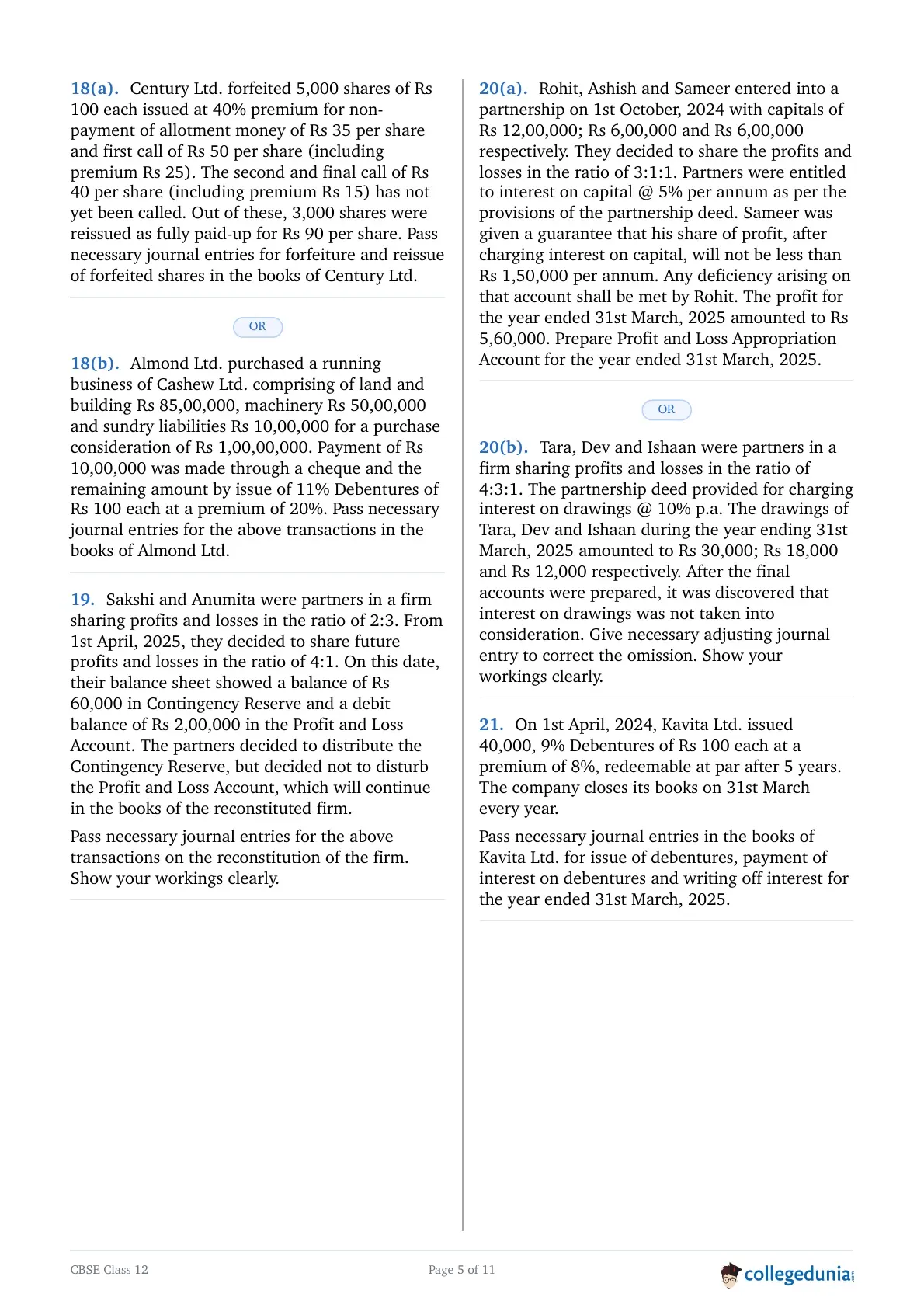
Century Ltd. forfeited 5,000 shares of Rs 100 each issued at 40% premium for non-payment of allotment money of Rs 35 per share and first call of Rs 50 per share (including premium Rs 25). The second and final call of Rs 40 per share (including premium Rs 15) has not yet been called. Out of these, 3,000 shares were reissued as fully paid-up for Rs 90 per share. Pass necessary journal entries for forfeiture and reissue of forfeited shares in the books of Century Ltd.
Almond Ltd. purchased a running business of Cashew Ltd. comprising of land and building Rs 85,00,000, machinery Rs 50,00,000 and sundry liabilities Rs 10,00,000 for a purchase consideration of Rs 1,00,00,000. Payment of Rs 10,00,000 was made through a cheque and the remaining amount by issue of 11% Debentures of Rs 100 each at a premium of 20%. Pass necessary journal entries for the above transactions in the books of Almond Ltd.
Sakshi and Anumita were partners in a firm sharing profits and losses in the ratio of 2:3. From 1st April, 2025, they decided to share future profits and losses in the ratio of 4:1. On this date, their balance sheet showed a balance of Rs 60,000 in Contingency Reserve and a debit balance of Rs 2,00,000 in the Profit and Loss Account. The partners decided to distribute the Contingency Reserve, but decided not to disturb the Profit and Loss Account, which will continue in the books of the reconstituted firm.
Pass necessary journal entries for the above transactions on the reconstitution of the firm. Show your workings clearly.
Rohit, Ashish and Sameer entered into a partnership on 1st October, 2024 with capitals of Rs 12,00,000; Rs 6,00,000 and Rs 6,00,000 respectively. They decided to share the profits and losses in the ratio of 3:1:1. Partners were entitled to interest on capital @ 5% per annum as per the provisions of the partnership deed. Sameer was given a guarantee that his share of profit, after charging interest on capital, will not be less than Rs 1,50,000 per annum. Any deficiency arising on that account shall be met by Rohit. The profit for the year ended 31st March, 2025 amounted to Rs 5,60,000. Prepare Profit and Loss Appropriation Account for the year ended 31st March, 2025.
Tara, Dev and Ishaan were partners in a firm sharing profits and losses in the ratio of 4:3:1. The partnership deed provided for charging interest on drawings @ 10% p.a. The drawings of Tara, Dev and Ishaan during the year ending 31st March, 2025 amounted to Rs 30,000; Rs 18,000 and Rs 12,000 respectively. After the final accounts were prepared, it was discovered that interest on drawings was not taken into consideration. Give necessary adjusting journal entry to correct the omission. Show your workings clearly.
On 1st April, 2024, Kavita Ltd. issued 40,000, 9% Debentures of Rs 100 each at a premium of 8%, redeemable at par after 5 years. The company closes its books on 31st March every year.
Pass necessary journal entries in the books of Kavita Ltd. for issue of debentures, payment of interest on debentures and writing off interest for the year ended 31st March, 2025.
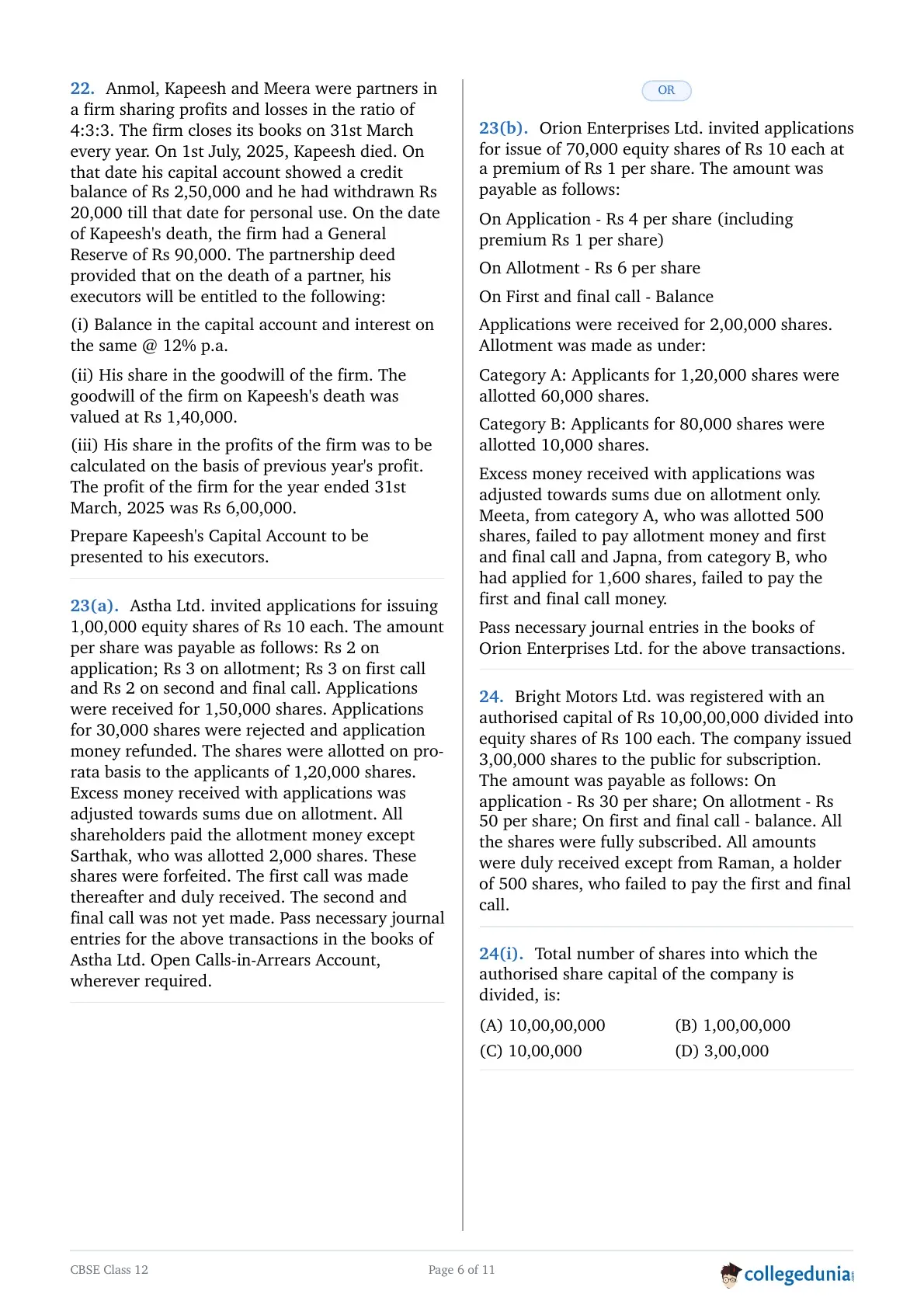
Anmol, Kapeesh and Meera were partners in a firm sharing profits and losses in the ratio of 4:3:3. The firm closes its books on 31st March every year. On 1st July, 2025, Kapeesh died. On that date his capital account showed a credit balance of Rs 2,50,000 and he had withdrawn Rs 20,000 till that date for personal use. On the date of Kapeesh's death, the firm had a General Reserve of Rs 90,000. The partnership deed provided that on the death of a partner, his executors will be entitled to the following:
(i) Balance in the capital account and interest on the same @ 12% p.a.
(ii) His share in the goodwill of the firm. The goodwill of the firm on Kapeesh's death was valued at Rs 1,40,000.
(iii) His share in the profits of the firm was to be calculated on the basis of previous year's profit. The profit of the firm for the year ended 31st March, 2025 was Rs 6,00,000.
Prepare Kapeesh's Capital Account to be presented to his executors.
Astha Ltd. invited applications for issuing 1,00,000 equity shares of Rs 10 each. The amount per share was payable as follows: Rs 2 on application; Rs 3 on allotment; Rs 3 on first call and Rs 2 on second and final call. Applications were received for 1,50,000 shares. Applications for 30,000 shares were rejected and application money refunded. The shares were allotted on pro-rata basis to the applicants of 1,20,000 shares. Excess money received with applications was adjusted towards sums due on allotment. All shareholders paid the allotment money except Sarthak, who was allotted 2,000 shares. These shares were forfeited. The first call was made thereafter and duly received. The second and final call was not yet made. Pass necessary journal entries for the above transactions in the books of Astha Ltd. Open Calls-in-Arrears Account, wherever required.
Orion Enterprises Ltd. invited applications for issue of 70,000 equity shares of Rs 10 each at a premium of Rs 1 per share. The amount was payable as follows:
On Application - Rs 4 per share (including premium Rs 1 per share)
On Allotment - Rs 6 per share
On First and final call - Balance
Applications were received for 2,00,000 shares. Allotment was made as under:
Category A: Applicants for 1,20,000 shares were allotted 60,000 shares.
Category B: Applicants for 80,000 shares were allotted 10,000 shares.
Excess money received with applications was adjusted towards sums due on allotment only. Meeta, from category A, who was allotted 500 shares, failed to pay allotment money and first and final call and Japna, from category B, who had applied for 1,600 shares, failed to pay the first and final call money.
Pass necessary journal entries in the books of Orion Enterprises Ltd. for the above transactions.
Comprehension:
Bright Motors Ltd. was registered with an authorised capital of Rs 10,00,00,000 divided into equity shares of Rs 100 each. The company issued 3,00,000 shares to the public for subscription. The amount was payable as follows: On application -
Read More
Rs 30 per share; On allotment - Rs 50 per share; On first and final call - balance. All the shares were fully subscribed. All amounts were duly received except from Raman, a holder of 500 shares, who failed to pay the first and final call.Total number of shares into which the authorised share capital of the company is divided, is:
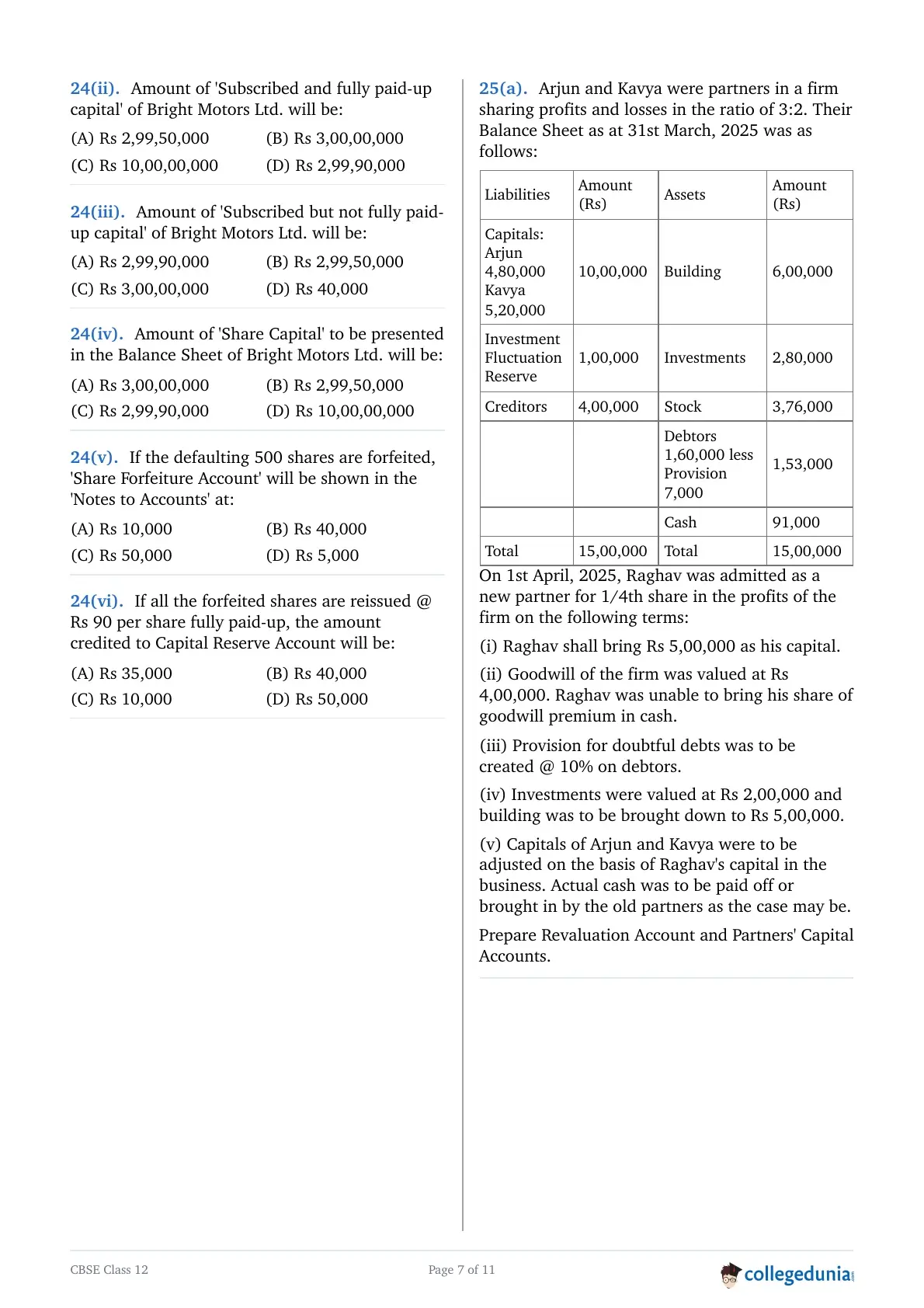
Amount of 'Subscribed and fully paid-up capital' of Bright Motors Ltd. will be:
Amount of 'Subscribed but not fully paid-up capital' of Bright Motors Ltd. will be:
Amount of 'Share Capital' to be presented in the Balance Sheet of Bright Motors Ltd. will be:
If the defaulting 500 shares are forfeited, 'Share Forfeiture Account' will be shown in the 'Notes to Accounts' at:
If all the forfeited shares are reissued @ Rs 90 per share fully paid-up, the amount credited to Capital Reserve Account will be:
Arjun and Kavya were partners in a firm sharing profits and losses in the ratio of 3:2. Their Balance Sheet as at 31st March, 2025 was as follows:
| Liabilities | Amount (Rs) | Assets | Amount (Rs) |
| Capitals: Arjun 4,80,000 Kavya 5,20,000 | 10,00,000 | Building | 6,00,000 |
| Investment Fluctuation Reserve | 1,00,000 | Investments | 2,80,000 |
| Creditors | 4,00,000 | Stock | 3,76,000 |
| Debtors 1,60,000 less Provision 7,000 | 1,53,000 | ||
| Cash | 91,000 | ||
| Total | 15,00,000 | Total | 15,00,000 |
On 1st April, 2025, Raghav was admitted as a new partner for 1/4th share in the profits of the firm on the following terms:
(i) Raghav shall bring Rs 5,00,000 as his capital.
(ii) Goodwill of the firm was valued at Rs 4,00,000. Raghav was unable to bring his share of goodwill premium in cash.
(iii) Provision for doubtful debts was to be created @ 10% on debtors.
(iv) Investments were valued at Rs 2,00,000 and building was to be brought down to Rs 5,00,000.
(v) Capitals of Arjun and Kavya were to be adjusted on the basis of Raghav's capital in the business. Actual cash was to be paid off or brought in by the old partners as the case may be.
Prepare Revaluation Account and Partners' Capital Accounts.
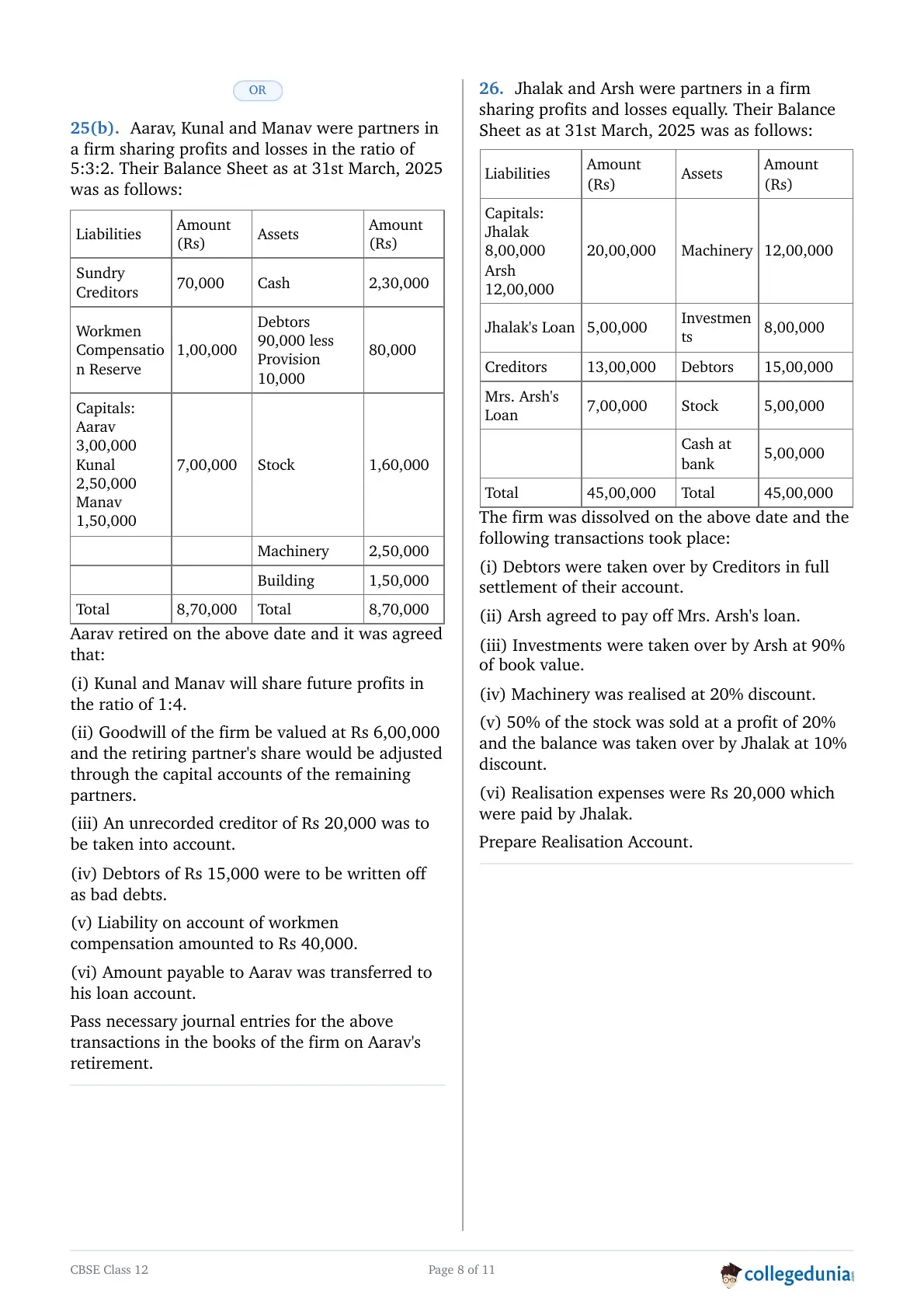
Aarav, Kunal and Manav were partners in a firm sharing profits and losses in the ratio of 5:3:2. Their Balance Sheet as at 31st March, 2025 was as follows:
| Liabilities | Amount (Rs) | Assets | Amount (Rs) |
| Sundry Creditors | 70,000 | Cash | 2,30,000 |
| Workmen Compensation Reserve | 1,00,000 | Debtors 90,000 less Provision 10,000 | 80,000 |
| Capitals: Aarav 3,00,000 Kunal 2,50,000 Manav 1,50,000 | 7,00,000 | Stock | 1,60,000 |
| Machinery | 2,50,000 | ||
| Building | 1,50,000 | ||
| Total | 8,70,000 | Total | 8,70,000 |
Aarav retired on the above date and it was agreed that:
(i) Kunal and Manav will share future profits in the ratio of 1:4.
(ii) Goodwill of the firm be valued at Rs 6,00,000 and the retiring partner's share would be adjusted through the capital accounts of the remaining partners.
(iii) An unrecorded creditor of Rs 20,000 was to be taken into account.
(iv) Debtors of Rs 15,000 were to be written off as bad debts.
(v) Liability on account of workmen compensation amounted to Rs 40,000.
(vi) Amount payable to Aarav was transferred to his loan account.
Pass necessary journal entries for the above transactions in the books of the firm on Aarav's retirement.
Jhalak and Arsh were partners in a firm sharing profits and losses equally. Their Balance Sheet as at 31st March, 2025 was as follows:
| Liabilities | Amount (Rs) | Assets | Amount (Rs) |
| Capitals: Jhalak 8,00,000 Arsh 12,00,000 | 20,00,000 | Machinery | 12,00,000 |
| Jhalak's Loan | 5,00,000 | Investments | 8,00,000 |
| Creditors | 13,00,000 | Debtors | 15,00,000 |
| Mrs. Arsh's Loan | 7,00,000 | Stock | 5,00,000 |
| Cash at bank | 5,00,000 | ||
| Total | 45,00,000 | Total | 45,00,000 |
The firm was dissolved on the above date and the following transactions took place:
(i) Debtors were taken over by Creditors in full settlement of their account.
(ii) Arsh agreed to pay off Mrs. Arsh's loan.
(iii) Investments were taken over by Arsh at 90% of book value.
(iv) Machinery was realised at 20% discount.
(v) 50% of the stock was sold at a profit of 20% and the balance was taken over by Jhalak at 10% discount.
(vi) Realisation expenses were Rs 20,000 which were paid by Jhalak.
Prepare Realisation Account.
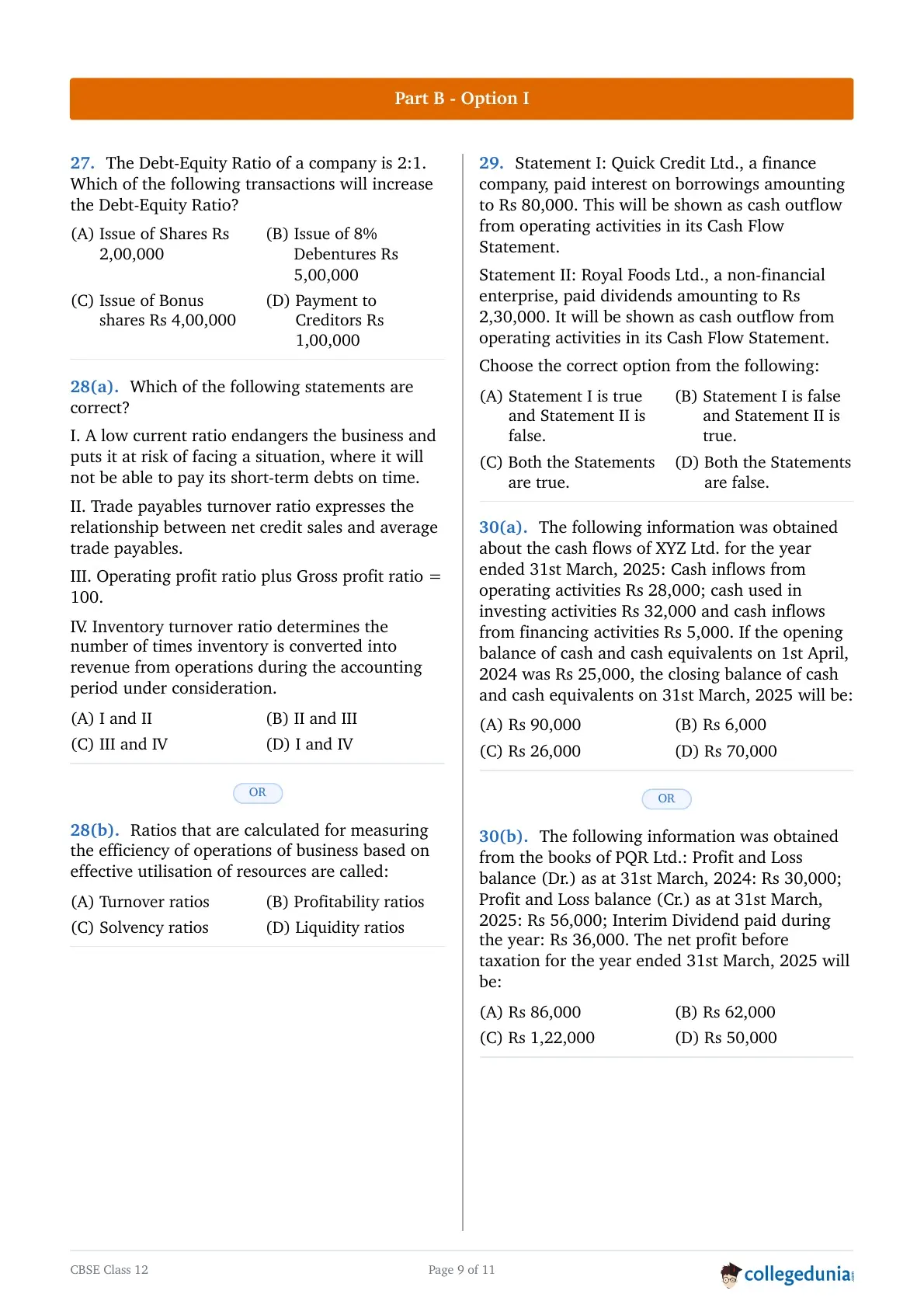
The Debt-Equity Ratio of a company is 2:1. Which of the following transactions will increase the Debt-Equity Ratio?
Which of the following statements are correct?
I. A low current ratio endangers the business and puts it at risk of facing a situation, where it will not be able to pay its short-term debts on time.
II. Trade payables turnover ratio expresses the relationship between net credit sales and average trade payables.
III. Operating profit ratio plus Gross profit ratio = 100.
IV. Inventory turnover ratio determines the number of times inventory is converted into revenue from operations during the accounting period under consideration.
Ratios that are calculated for measuring the efficiency of operations of business based on effective utilisation of resources are called:
Statement I: Quick Credit Ltd., a finance company, paid interest on borrowings amounting to Rs 80,000. This will be shown as cash outflow from operating activities in its Cash Flow Statement.
Statement II: Royal Foods Ltd., a non-financial enterprise, paid dividends amounting to Rs 2,30,000. It will be shown as cash outflow from operating activities in its Cash Flow Statement.
Choose the correct option from the following:
The following information was obtained about the cash flows of XYZ Ltd. for the year ended 31st March, 2025: Cash inflows from operating activities Rs 28,000; cash used in investing activities Rs 32,000 and cash inflows from financing activities Rs 5,000. If the opening balance of cash and cash equivalents on 1st April, 2024 was Rs 25,000, the closing balance of cash and cash equivalents on 31st March, 2025 will be:
The following information was obtained from the books of PQR Ltd.: Profit and Loss balance (Dr.) as at 31st March, 2024: Rs 30,000; Profit and Loss balance (Cr.) as at 31st March, 2025: Rs 56,000; Interim Dividend paid during the year: Rs 36,000. The net profit before taxation for the year ended 31st March, 2025 will be:
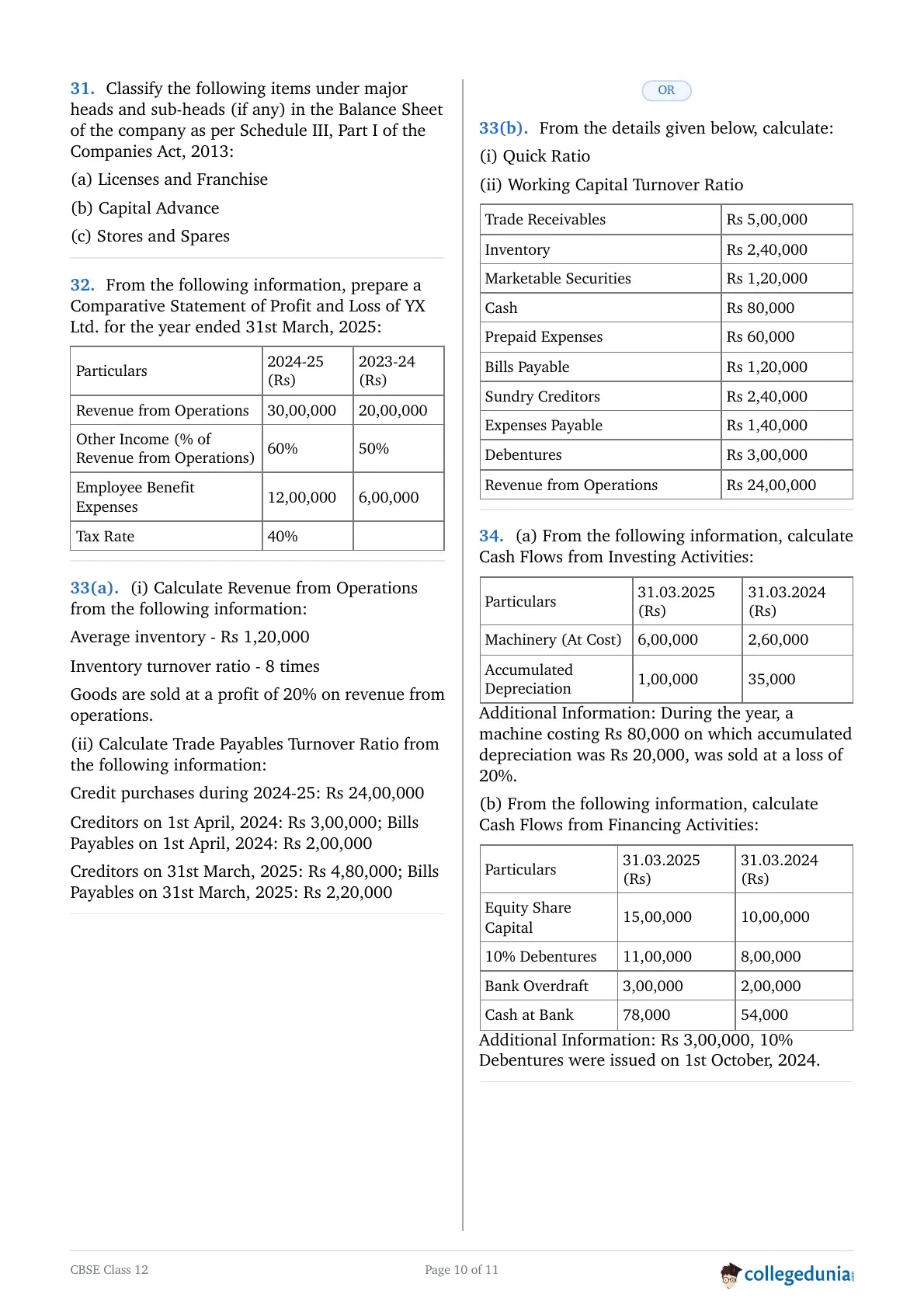
Classify the following items under major heads and sub-heads (if any) in the Balance Sheet of the company as per Schedule III, Part I of the Companies Act, 2013:
(a) Licenses and Franchise
(b) Capital Advance
(c) Stores and Spares
From the following information, prepare a Comparative Statement of Profit and Loss of YX Ltd. for the year ended 31st March, 2025:
| Particulars | 2024-25 (Rs) | 2023-24 (Rs) |
| Revenue from Operations | 30,00,000 | 20,00,000 |
| Other Income (% of Revenue from Operations) | 60% | 50% |
| Employee Benefit Expenses | 12,00,000 | 6,00,000 |
| Tax Rate | 40% |
(i) Calculate Revenue from Operations from the following information:
Average inventory - Rs 1,20,000
Inventory turnover ratio - 8 times
Goods are sold at a profit of 20% on revenue from operations.
(ii) Calculate Trade Payables Turnover Ratio from the following information:
Credit purchases during 2024-25: Rs 24,00,000
Creditors on 1st April, 2024: Rs 3,00,000; Bills Payables on 1st April, 2024: Rs 2,00,000
Creditors on 31st March, 2025: Rs 4,80,000; Bills Payables on 31st March, 2025: Rs 2,20,000
From the details given below, calculate:
(i) Quick Ratio
(ii) Working Capital Turnover Ratio
| Trade Receivables | Rs 5,00,000 |
| Inventory | Rs 2,40,000 |
| Marketable Securities | Rs 1,20,000 |
| Cash | Rs 80,000 |
| Prepaid Expenses | Rs 60,000 |
| Bills Payable | Rs 1,20,000 |
| Sundry Creditors | Rs 2,40,000 |
| Expenses Payable | Rs 1,40,000 |
| Debentures | Rs 3,00,000 |
| Revenue from Operations | Rs 24,00,000 |
(a) From the following information, calculate Cash Flows from Investing Activities:
| Particulars | 31.03.2025 (Rs) | 31.03.2024 (Rs) |
| Machinery (At Cost) | 6,00,000 | 2,60,000 |
| Accumulated Depreciation | 1,00,000 | 35,000 |
Additional Information: During the year, a machine costing Rs 80,000 on which accumulated depreciation was Rs 20,000, was sold at a loss of 20%.
(b) From the following information, calculate Cash Flows from Financing Activities:
| Particulars | 31.03.2025 (Rs) | 31.03.2024 (Rs) |
| Equity Share Capital | 15,00,000 | 10,00,000 |
| 10% Debentures | 11,00,000 | 8,00,000 |
| Bank Overdraft | 3,00,000 | 2,00,000 |
| Cash at Bank | 78,000 | 54,000 |
Additional Information: Rs 3,00,000, 10% Debentures were issued on 1st October, 2024.
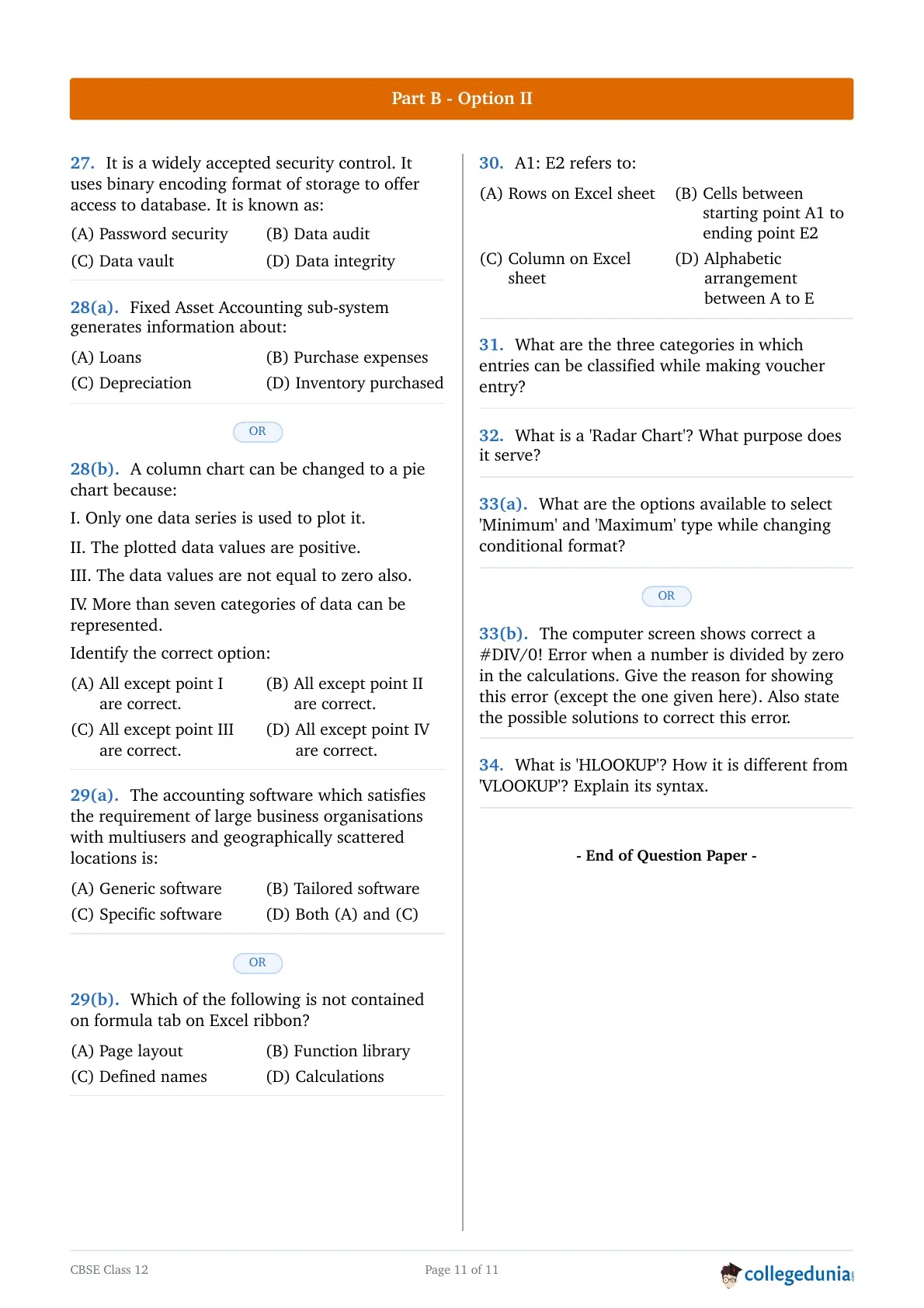
It is a widely accepted security control. It uses binary encoding format of storage to offer access to database. It is known as:
Fixed Asset Accounting sub-system generates information about:
A column chart can be changed to a pie chart because:
I. Only one data series is used to plot it.
II. The plotted data values are positive.
III. The data values are not equal to zero also.
IV. More than seven categories of data can be represented.
Identify the correct option:
The accounting software which satisfies the requirement of large business organisations with multiusers and geographically scattered locations is:
Which of the following is not contained on formula tab on Excel ribbon?
What are the three categories in which entries can be classified while making voucher entry?
What are the options available to select 'Minimum' and 'Maximum' type while changing conditional format?
The computer screen shows correct a #DIV/0! Error when a number is divided by zero in the calculations. Give the reason for showing this error (except the one given here). Also state the possible solutions to correct this error.
What is 'HLOOKUP'? How it is different from 'VLOOKUP'? Explain its syntax.
CBSE Class 12 Accountancy Question Paper Pattern and Marking Scheme
The CBSE Class 12 Accountancy 2026 theory paper is of 80 marks and has 34 questions, all compulsory: Part A (60 marks) is common and Part B (20 marks) has two options, Option I (Analysis of Financial Statements) and Option II (Computerised Accounting), of which a candidate attempts only one. Internal choice (OR) is given in several questions. The tables below give the paper pattern and the marking rules from the official CBSE question paper and marking scheme.
CBSE Class 12 Accountancy Question Paper Pattern 2026
| Part | Questions | Question Type | Marks per Question | Marks |
|---|---|---|---|---|
| Part A | Q1 - Q16 | Multiple choice questions (MCQs) | 1 | 16 |
| Part A | Q17 - Q20 | Short answer questions | 3 | 12 |
| Part A | Q21 - Q22 | Short answer questions | 4 | 8 |
| Part A | Q23 | Long answer questions | 6 | 6 |
| Part A | Q24 | Case-based questions (6 MCQs of 1 mark each) | 1 | 6 |
| Part A | Q25 - Q26 | Long answer questions | 6 | 12 |
| Part B | Q27 - Q30 | Multiple choice questions (MCQs) | 1 | 4 |
| Part B | Q31 - Q32 | Short answer questions | 3 | 6 |
| Part B | Q33 | Short answer questions | 4 | 4 |
| Part B | Q34 | Long answer questions | 6 | 6 |
| Total | 34 questions | 80 |
CBSE Class 12 Accountancy Marking Scheme 2026
| Marking point | How it is applied |
|---|---|
| Value-point marking | Marks are awarded against the value points (steps) given in the official marking scheme; the marks of an answer are split across its parts and value points. |
| Own expression | The marking scheme carries suggested value points only. A correct answer in the student's own words is awarded due marks. |
| Competency-based questions | If a competency-based answer is not from the marking scheme but shows the correct competency, due marks are awarded. |
| Errors | An error is penalised only once; no marks are deducted for its cumulative effect. |
| Incorrect answer | A totally incorrect answer is awarded zero (0) marks. |
| Choice (OR) questions | If both options of a question with internal choice are attempted, marks are awarded for both and the higher score is taken; if only one option is attempted, the other is marked NA (not attempted). |
| Part B options | If a candidate attempts both Option I and Option II of Part B, the higher of the two scores is taken and the other response is disregarded. |
| Scale of marks | The full scale of 0 to 80 marks is used and full marks are awarded whenever the answer deserves them. |
CBSE Class 12 Accountancy Unit-Wise Weightage
| Part | Units / Chapters | Marks |
|---|---|---|
| Part A – Accounting for Partnership Firms and Companies (60 Marks) | Fundamentals of Partnership Firms | 6 |
| Reconstitution of Partnership (Admission, Retirement, Death, Change in Ratio) | 18 | |
| Dissolution of Partnership Firm | 6 | |
| Accounting for Share Capital | 8 | |
| Accounting for Debentures | 12 | |
| Total Part A | — | 60 |
| Part B – Financial Statement Analysis OR Computerised Accounting (20 Marks) | Analysis of Financial Statements (including Cash Flow Statement, Ratio Analysis) OR Computerised Accounting | 20 |
| Total Part B | — | 20 |
| Part C – Project Work | Project File (12) + Viva Voce (8) | 20 |
| Grand Total | — | 100 |



Comments