




CBSE Class 12 Biology Set 1 - (57/5/1) Question Paper 2026 is available for download here. CBSE conducted Class 12 Biology exam on March 27, 2026 from 10:30 AM to 1:30 PM. The Biology theory paper is of 70 marks, and the internal assessment is of 30 marks.
Also Check: CBSE Class 12 Question Paper 2026 (All Subjects)
The Biology question paper includes the following types of questions, which make up the total of 70 marks:
- MCQs: 1 mark each
- Short-answer type questions: 2 & 3 marks each
- Case-study based questions: 4 marks each
- Long-answer type questions: 5 marks each
CBSE Class 12 Biology Question Paper 2026 (Set 1 - 57/5/1) with Solution PDF
| CBSE Official PDF | CD PDF | CD PDF with Solutions |
|---|---|---|
| Download official PDF 0.77 MB | Download Collegedunia PDF 0.64 MB | Download solutions PDF 0.86 MB |
CBSE Class 12 Biology 2026 Set 1 (57/5/1) Questions with Solutions
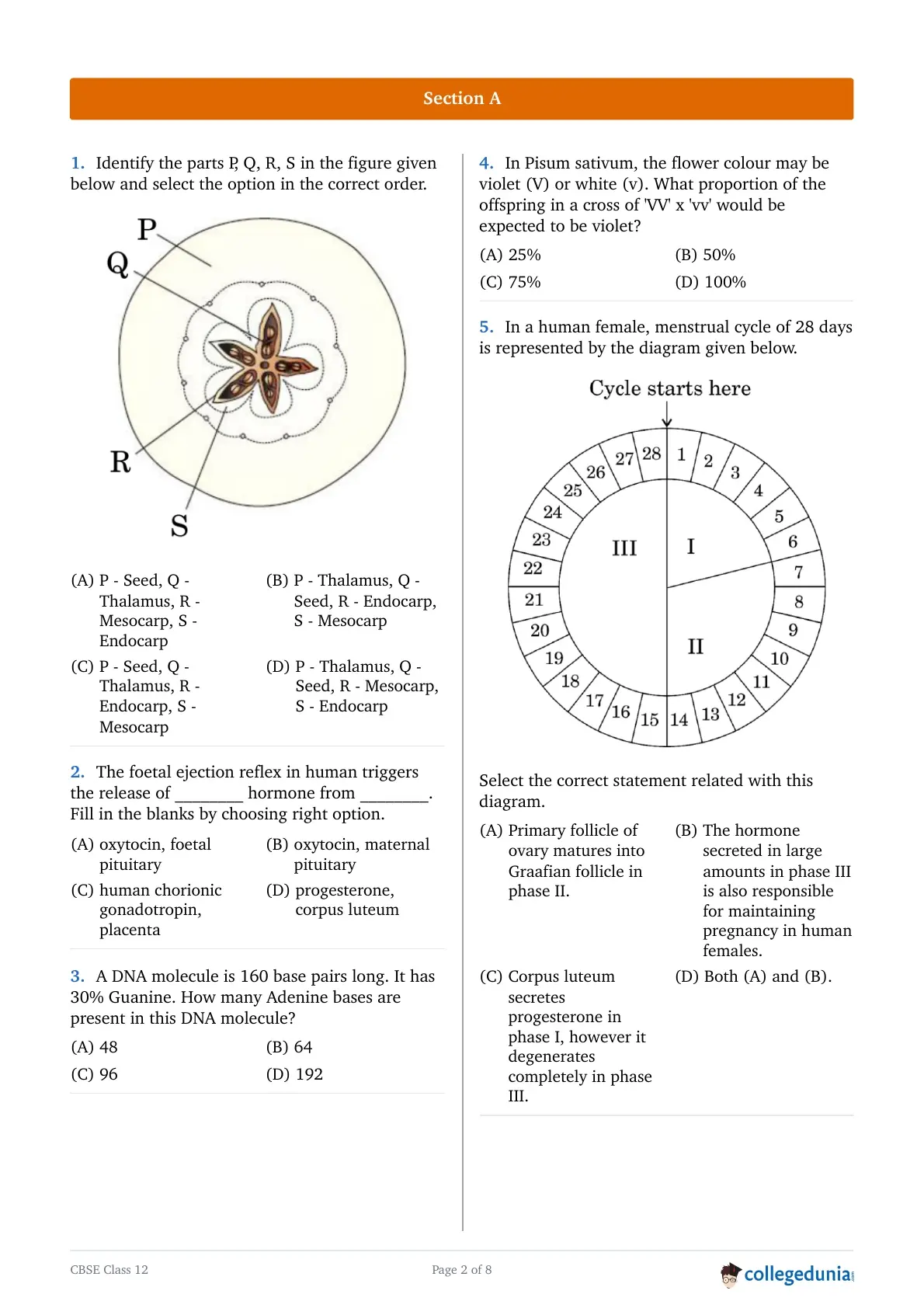
Identify the parts P, Q, R, S in the figure given below and select the option in the correct order.

The foetal ejection reflex in human triggers the release of _______ hormone from _______
A DNA molecule is 160 base pairs long. It has 30% Guanine. How many Adenine bases are present in this DNA molecule?
In Pisum sativum, the flower colour may be violet (V) or white (v). What proportion of the offspring in a cross of "VV × vv" would be expected to be violet?
In a human female, menstrual cycle of 28 days is represented by the diagram given below. Select the correct statement related with this diagram.

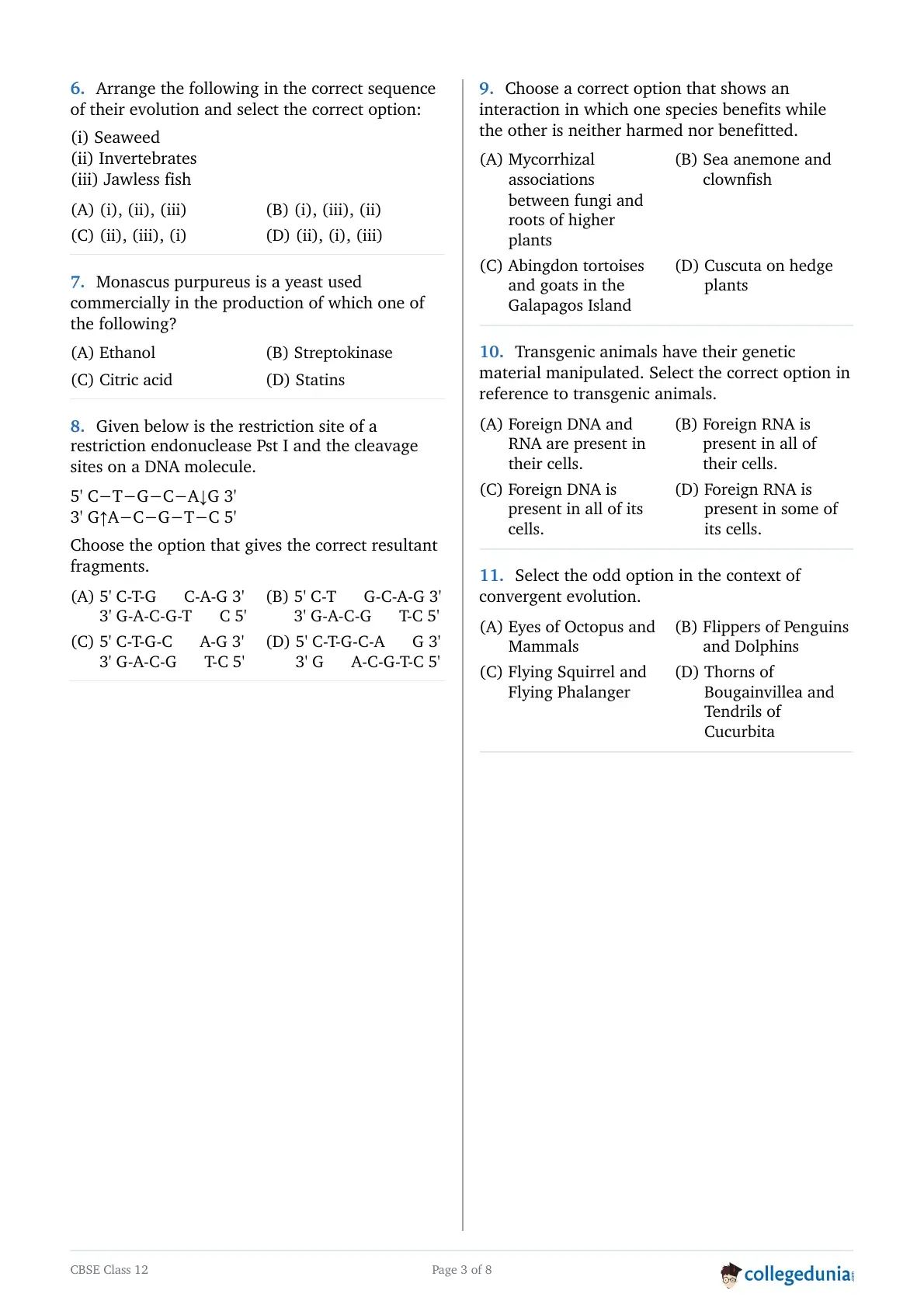
Arrange the following in the correct sequence of their evolution and select the correct option:
(i) Seaweed
(ii) Invertebrates
(iii) Jawless fish
Monascus purpureus is a yeast used commercially in the production of which one of the following?
Given below is the restriction site of a restriction endonuclease Pst I and the cleavage sites on a DNA molecule.

Choose a correct option that shows an interaction in which one species benefits while the other is neither harmed nor benefitted.
Transgenic animals have their genetic material manipulated. Select the correct option in reference to transgenic animals.
Select the odd option in the context of convergent evolution.
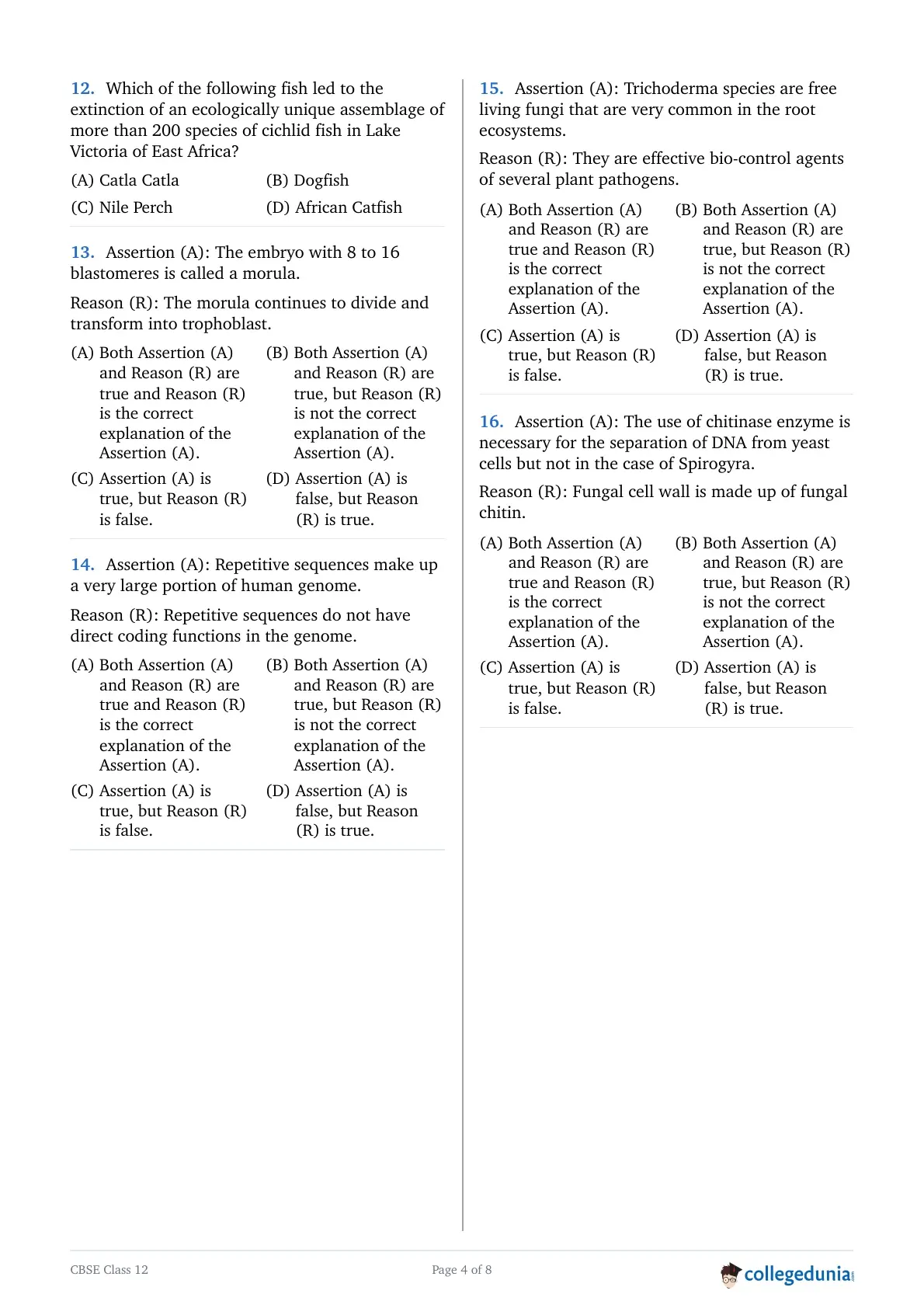
Which of the following fish led to the extinction of an ecologically unique assemblage of more than 200 species of cichlid fish in Lake Victoria of East Africa?
Assertion (A): The embryo with 8 to 16 blastomeres is called a morula.
Reason (R): The morula continues to divide and transform into trophoblast.
Assertion (A): Repetitive sequences make up a very large portion of human genome.
Reason (R): Repetitive sequences do not have direct coding functions in the genome.
Assertion (A): Trichoderma species are free living fungi that are very common in the root ecosystems.
Reason (R): They are effective bio-control agents of several plant pathogens.
Assertion (A): The use of chitinase enzyme is necessary for the separation of DNA from yeast cells but not in the case of Spirogyra.
Reason (R): Fungal cell wall is made up of fungal chitin.
Mention the functions of each of the following:
(i) Tassels of Corn Cob:
(ii) Scutellum:
Farmers prefer apomictic seeds over hybrid seeds. Give any two reasons.
Define the term 'amniocentesis'. Why has the government imposed a statutory ban in spite of its importance in the medical field?
Name the lymphoid organ that acts as a large reservoir of erythrocytes. Explain its role as a lymphoid organ.
Suggest how a virus-free healthy plant can be obtained from a diseased sugarcane plant.
In order to force bacteria to take up the recombinant DNA, they must be made competent. Explain how it can be achieved.
Differentiate between grazing food chain and detritus food chain.
Ecological pyramids are widely accepted but they still have some limitations. Write any two limitations.
List any three outbreeding devices that flowering plants have developed for cross-pollination and explain how they help to encourage cross-pollination.
Draw a labelled diagram of a 'replicating fork' showing the polarity. Why does DNA replication occur within such 'fork'?
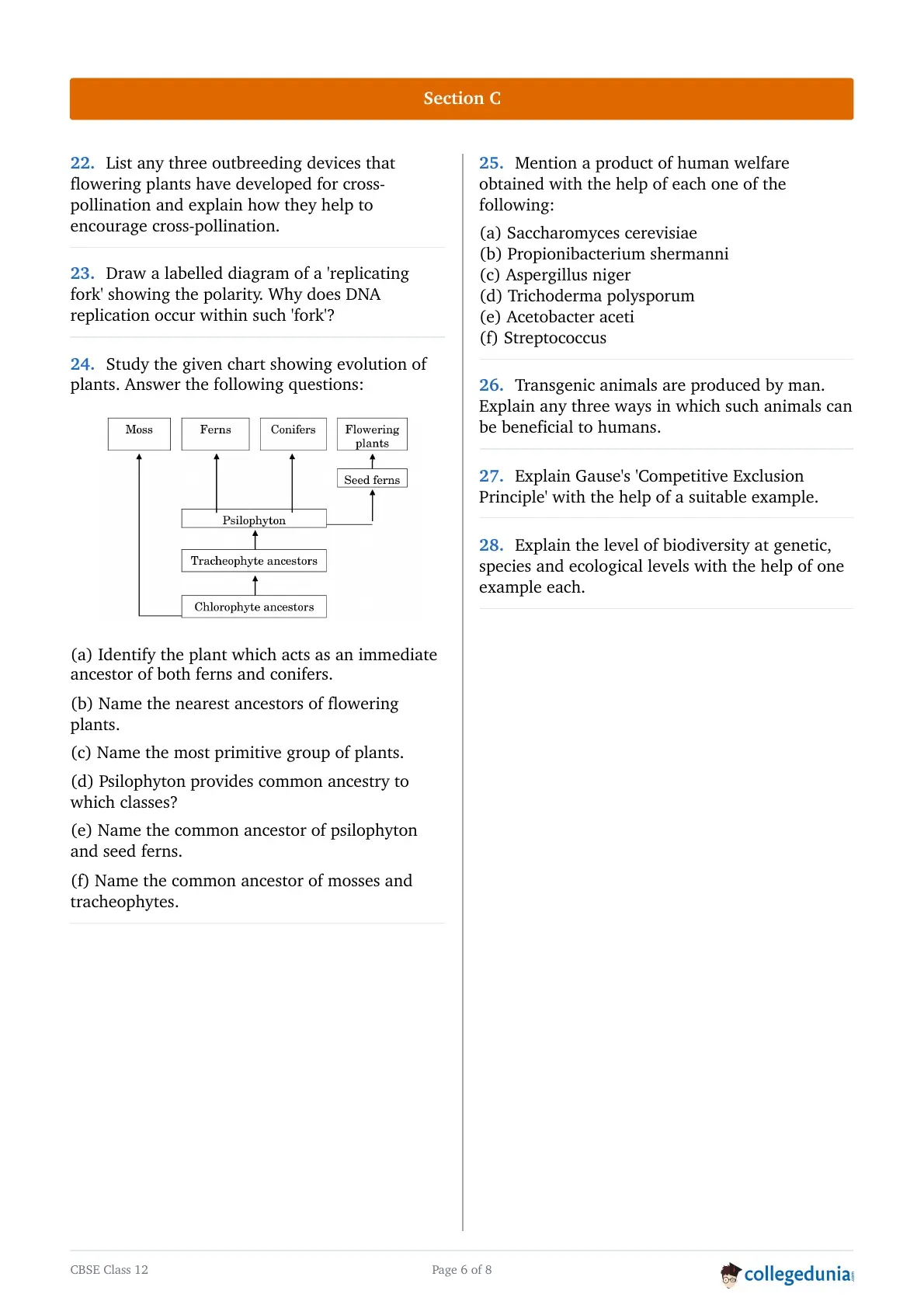
Study the given chart showing the evolution of plants. Answer the following questions:

(b) Name the nearest ancestors of flowering plants.
(c) Name the most primitive group of plants.
(d) Psilophyton provides common ancestry to which classes?
(e) Name the common ancestor of Psilophyton and seed ferns.
(f) Name the common ancestor of mosses and tracheophytes.
Mention a product of human welfare obtained with the help of each of the following:
(a) Saccharomyces cerevisiae
(b) Propionibacterium shermanni
(c) Aspergillus niger
(d) Trichoderma polysporum
(e) Acetobacter aceti
(f) Streptococcus
Transgenic animals are produced by man. Explain any three ways in which such animals can be beneficial to humans.
Explain Gause's 'Competitive Exclusion Principle' with the help of a suitable example.
Explain the level of biodiversity at genetic, species, and ecological levels with the help of one example each.
Read the following passage and answer the questions that follow:
The process of copying genetic information from template strand of DNA into RNA is called transcription. It is mediated by RNA polymerase. Transcription takes place in the nucleus of eukaryotic cells. In transcription, only a segment of DNA and only one of the strands is copied into RNA.
Read the following passage and answer the questions that follow :
The process of copying genetic information from template strand of DNA into RNA is called transcription. It is mediated by RNA polymerase. Transcription takes place in the nucleus of eukaryotic cells. In transcription, only a segment of DNA and only one of the strands is copied into RNA.
(a) Why is the strand of DNA with \( 3^{\prime} \rightarrow 5^{\prime} \) polarity transcribed and not the other strand of \( 5^{\prime} \rightarrow 3^{\prime} \) polarity ?
Read the following passage and answer the questions that follow :
The process of copying genetic information from template strand of DNA into RNA is called transcription. It is mediated by RNA polymerase. Transcription takes place in the nucleus of eukaryotic cells. In transcription, only a segment of DNA and only one of the strands is copied into RNA.
(b) (i) Why is hnRNA required to undergo splicing ?
Read the following passage and answer the questions that follow :
The process of copying genetic information from template strand of DNA into RNA is called transcription. It is mediated by RNA polymerase. Transcription takes place in the nucleus of eukaryotic cells. In transcription, only a segment of DNA and only one of the strands is copied into RNA.
(b) (ii) Mention the two additional processes which hnRNA needs to undergo after splicing to become functional.
Read the following passage and answer the questions that follow :
The process of copying genetic information from template strand of DNA into RNA is called transcription. It is mediated by RNA polymerase. Transcription takes place in the nucleus of eukaryotic cells. In transcription, only a segment of DNA and only one of the strands is copied into RNA.
(c) Why is only one strand of the DNA transcribed ? Give two reasons.
Read the following passage and answer the questions that follow:
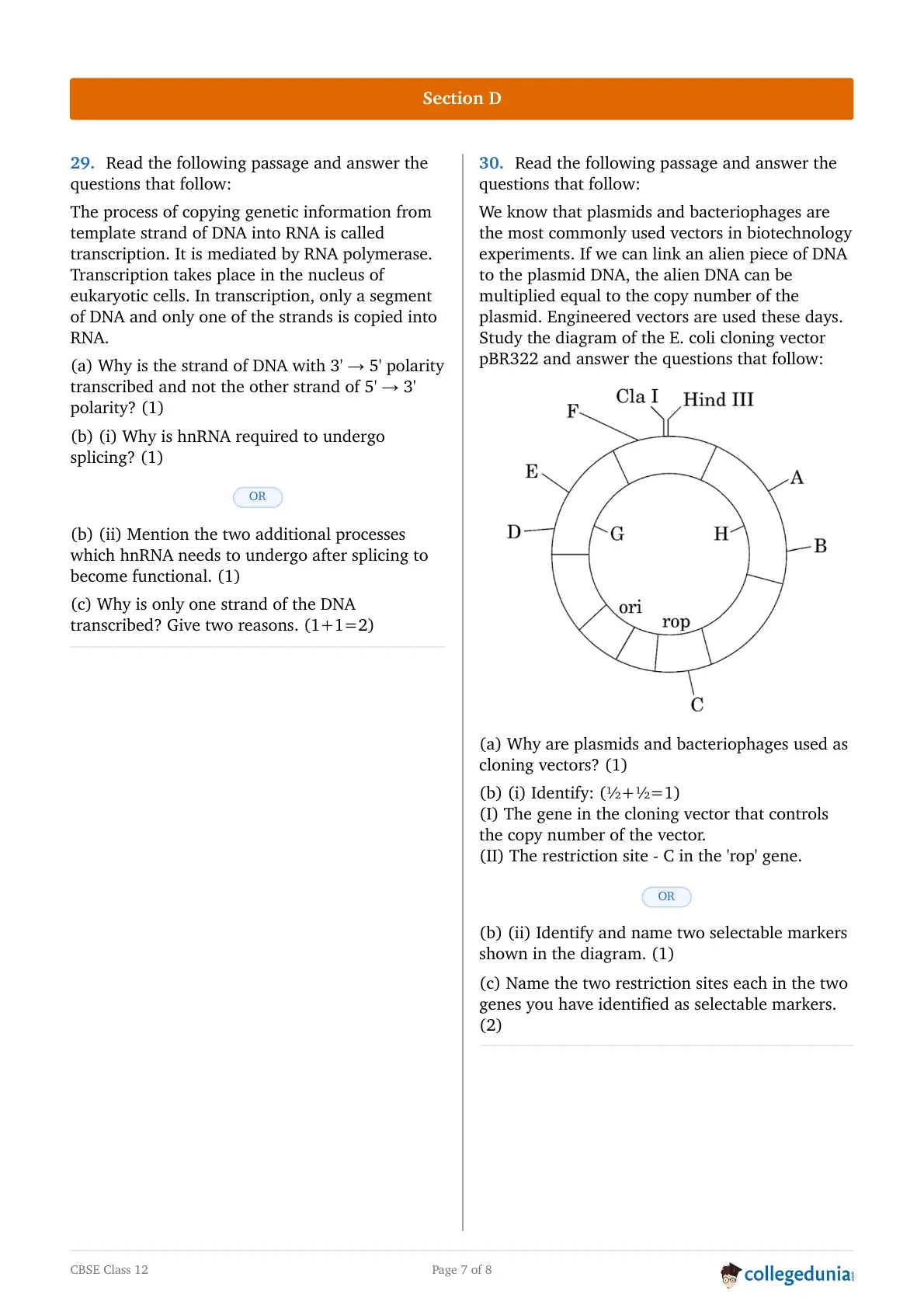
We know that plasmids and bacteriophages are the most commonly used vectors in biotechnology experiments. If we can link an alien piece of DNA to the plasmid DNA, the alien DNA can be multiplied equal to the copy number of the plasmid. Engineered vectors are used these days. Study the diagram of the E. coli cloning vector pBR322 and answer the questions that follow:

Read the following passage and answer the questions that follow :
We know that plasmids and bacteriophages are the most commonly used vectors in biotechnology experiments. If we can link an alien piece of DNA to the plasmid DNA, the alien DNA can be multiplied equal to the copy number of the plasmid. Engineered vectors are used these days. Study the diagram of the E. coli cloning vector pBR322 and answer the questions that follow :
(a) Why are plasmids and bacteriophages used as cloning vectors ?

Read the following passage and answer the questions that follow :
We know that plasmids and bacteriophages are the most commonly used vectors in biotechnology experiments. If we can link an alien piece of DNA to the plasmid DNA, the alien DNA can be multiplied equal to the copy number of the plasmid. Engineered vectors are used these days. Study the diagram of the E. coli cloning vector pBR322 and answer the questions that follow :
(b) (i) Identify :
(I) The gene in the cloning vector that controls the copy number of the vector.
(II) The restriction site - C in the "rop" gene.
Read the following passage and answer the questions that follow :
We know that plasmids and bacteriophages are the most commonly used vectors in biotechnology experiments. If we can link an alien piece of DNA to the plasmid DNA, the alien DNA can be multiplied equal to the copy number of the plasmid. Engineered vectors are used these days. Study the diagram of the E. coli cloning vector pBR322 and answer the questions that follow :
(b) (ii) Identify and name two selectable markers shown in the diagram.
Read the following passage and answer the questions that follow :
We know that plasmids and bacteriophages are the most commonly used vectors in biotechnology experiments. If we can link an alien piece of DNA to the plasmid DNA, the alien DNA can be multiplied equal to the copy number of the plasmid. Engineered vectors are used these days. Study the diagram of the E. coli cloning vector pBR322 and answer the questions that follow :
(c) Name the two restriction sites each in the two genes you have identified as selectable markers.
Briefly explain the events of fertilisation and implantation in an adult human female.
Arrange the following hormones in sequence of their secretion in a pregnant woman: hCG; LH; FSH; Relaxin.
Mention the source and the functions of the above mentioned hormones.
Work out separate monohybrid crosses up to F2 generation between two pea plants and two Antirrhinum plants, both having contrasting traits with respect to the colour of the flower. Comment on the patterns of inheritance in the crosses carried out in such two cases.
Name the phenomenon that leads to situations like ‘XO’ abnormality in humans. Also name this genetic disorder. How are individuals with an XO chromosomal abnormality affected? Write its symptoms as well as karyotype.
How does a chromosomal disorder differ from a Mendelian disorder ? Write one example for each.
Mention the source and the role of the following in providing defence against infection in the human body: (I) Histamine (II) Interferons
(I) Write the scientific names of the two species of filarial worms causing filariasis.
(II) How do they affect the body of infected persons ?
(III) How does the disease spread ?
(a) (i) Draw the structure of an antibody molecule and label any four of its parts.
(ii) Differentiate between active and passive immunity. Write any three differences.
CBSE Class 12 Biology Question Paper Pattern and Marking Scheme
The CBSE Class 12 Biology 2026 question paper is of 70 marks and has 33 questions in five sections, A to E, all compulsory. The tables below give the section-wise paper pattern and the marking rules from the official CBSE marking scheme.
CBSE Class 12 Biology Question Paper Pattern 2026
| Section | Questions | Question Type | Marks per Question | Marks |
|---|---|---|---|---|
| A | Q1 - Q16 | Multiple choice questions | 1 | 16 |
| B | Q17 - Q21 | Very short answer type | 2 | 10 |
| C | Q22 - Q28 | Short answer type | 3 | 21 |
| D | Q29 - Q30 | Case-based questions | 4 | 8 |
| E | Q31 - Q33 | Long answer type | 5 | 15 |
| Total | 33 questions | 70 |
CBSE Class 12 Biology Marking Scheme 2026
| Marking point | How it is applied |
|---|---|
| Value-point marking | Marks are awarded against the value points (steps) given in the official marking scheme; the marks of an answer are split across its steps. |
| Own expression | The marking scheme carries suggested value points only. A correct answer in the student's own words is awarded due marks. |
| Competency-based questions | If a competency-based answer is not from the marking scheme but shows the correct competency, due marks are awarded. |
| Errors | An error is penalised only once; no marks are deducted for its cumulative effect. |
| Incorrect answer | A totally incorrect answer is awarded zero (0) marks. |
| Choice (OR) questions | If both options of a question with internal choice are attempted, marks are awarded for both and the higher score is taken; if only one option is attempted, the other is marked NA (not attempted). |
| Scale of marks | The full scale of 0 to 70 marks is used and full marks are awarded whenever the answer deserves them. |
CBSE Class 12 Biology Unit-Wise Weightage
| Unit No. | Unit Name | Marks |
|---|---|---|
| VI | Reproduction | 16 |
| VII | Genetics and Evolution | 20 |
| VIII | Biology and Human Welfare | 12 |
| IX | Biotechnology and Its Applications | 12 |
| X | Ecology and Environment | 10 |
| Total | — | 70 |



Comments